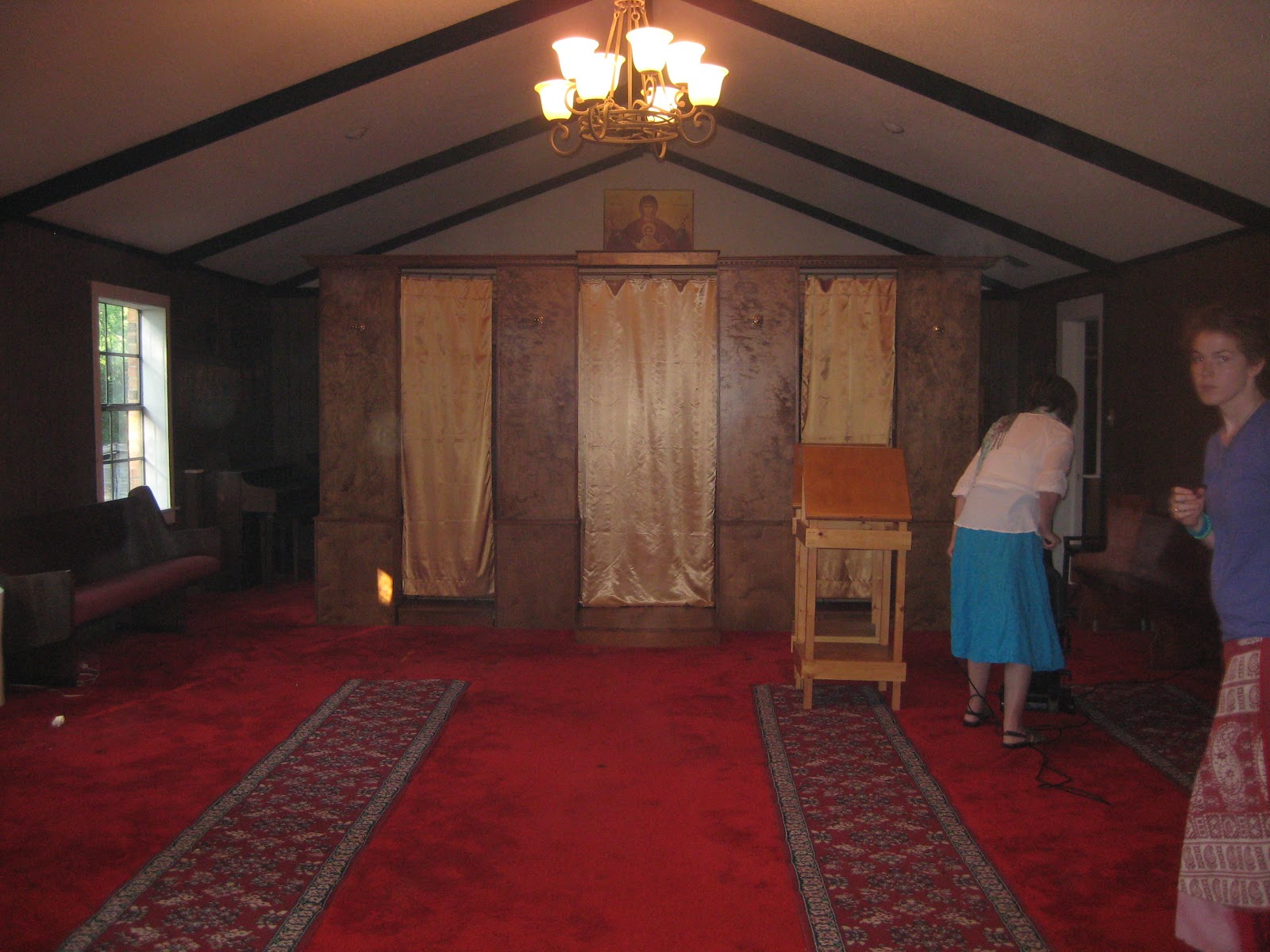
Sunday, May 27, 2012

Presto Change-o


Since September 2006, our local Orthodox mission has met in an old 1926 schoolhouse.  We own land where we plan to build our own temple.  But right now, we seem to be stuck in design--trapped between an Orthodox aesthetic and what a bank will actually loan us to build it.  So for the foreseeable future, it looks as though we will stay in the old schoolhouse a while longer.


The first schoolhouse was built in 1878, and the adjacent cemetery began a few years later.  In 1939, the school closed--consolidated with a larger district--and the property deeded to the cemetery association.  From the very beginning, the schoolhouse was often used for church services, usually of the Baptist variety, but also of a Church of Christ in the1940s.  In the mid 1970s, an itinerant carpenter/Baptist preacher wanted his own church.  He convinced the cemetery association to allow him to make alterations to the structure.  We never actually went to church there, but attended the annual Memorial Day Services and dinner-on-the-ground, as my mother's people bury in the cemetery next door.  I remember coming home from college one year and seeing the alterations for the first time.  I went inside and remember just wanting to cry.  Gone were the high ceilings and tall narrow windows, as was the pot-bellied stove in the center of the room, and the school desks, and the old picture of George Washington.  What replaced it was a thorough-going bastardization--lowered ceilings, short metal windows, dark paneling and thick, red-shag carpeting throughout.  The carpenter/preacher made his own pulpit--the frame of an old pump-organ covered with left-over dark paneling an topped with more of the red shag carpeting (really.)  The church group installed clunky, heavy wooden pews, with red padded seats.  The crowning glory, however, was a velvet-screened picture of the Last Supper, as well as one of The Sacred Heart of Jesus (though I doubt any of the congregants knew they had hung a Catholic icon.)  He nailed a wooden cross to the wall above the pulpit, and a homemade cross with a clock in the center on the back wall.  And of course, the American flag was prominently displayed up front.  I did not know how to articulate my feelings at the time, other than the fact that I knew I loathed it.

The church rocked along for a while, but fell victim to the inevitable splits and power plays, becoming increasing a make-it-up-as-you-go affair.  A cousin of mine rode herd over the downward spiral, just as her dad had done to a church group a generation earlier.  I was very close to this kinswoman, but realize that had she lived, she would never have allowed us to use the building--for an Orthodox Church, of all things!  But she died--suddenly--in the very room in which she had been born--which had been the same room in which her own father had been born and died.  Anyway, we took over the building much as the church left it, albeit a bit mustier.

We have a good arrangement with the cemetery association.  We do not pay rent, but cover the utilities and insurance and make any necessary repairs.  But once a year, in late May, we have to give up the building to them for their annual meeting.  For many years, the routine was to have a business meeting, then some singing and a quasi-religious service, followed by dinner on the ground.  For many years, my great-great aunt would play the old out-of-tune piano and lead singing [I can still hear her warbling "Tell me the sto-ry of Jee-sus, mark on my heart every word, tell me the sto-ry most precious, Sweetest that ever was heard..."]  The singing and sermon have fallen by the wayside, as most of the old-timers who insisted on this are now gone.  Now, the program usually consists of some talk about the history of the community or its families.  But the 1970s alterations became the new tradition.  Even though the cemetery group no longer puts-on a sermonette with its business meeting, they still have to have their meeting on Sunday, with pews in place and an aisle down the middle.


And so, once a year we have what we call "taking down the temple."  The altar and iconostasis come down.  The candlestands and incense go into hiding.  The saints that surround us go away for a while.  And in comes the paneled and red-tufted pulpit, the American flag, those godawful pews, and of course, the velvet Jesus.  I am anti-pew, not because I am in the OCA, but because every year I have to help inch them down two narrow hallways from the back room where we have them stacked on-end.  And then a few days later, we get to reverse the process.  Mind you, I am not complaining (much), for I realize some mission situations have to do this every time they meet.


After six years of this, we've gotten pretty good at it.  With enough help, we can do it in slightly under an hour.  We usually have plenty of help, due in part to the iced-down beer I bring for afterwards.  I guess you can say that is our tradition.  I attend the cemetery meeting, first because I am their secretary-treasurer, but mainly to protect the mission's interests if something were to come up.  It is the strangest thing in the world to sit in the room that only the night before had been our nave.  Thankfully, I am not subjected to any preaching at these meetings.  There could be no greater contrasts between worship environments.   The starkness and paucity of this reconstituted Baptist chapel is really quite sad.

Thursday, May 17, 2012

Douthat Again

More Douthat from the "Heretic" book promotion:

Finally, when strong religious impulses coexist with weak religious institutions, people become more likely to channel religious energy into partisan politics instead, and to freight partisan causes with more metaphysical significance than they can bear. The result, visible both in the “hope and change” fantasies of Obama’s 2008 campaign and the right-wing backlash it summoned up, is a politics that gives free rein to both utopian and apocalyptic delusions, and that encourages polarization without end.

Read it here.

Wednesday, April 25, 2012

"I Weep for the Future"

         In 1997, I started teaching a night class each semester at the University of Texas at Tyler.  Last year, I picked up a class at Lon Morris College in nearby Jacksonville.  Starting this fall, my UT classes will go online (unfortunately), but I will be teaching 2 night classes, and possible a 3rd, at Lon Morris.  Since I still have my "real" job during the day, this should keep me occupied.  The pay is pretty meager, but I thoroughly enjoy teaching, especially college students.
     Without being condescending, I will have to say that it continues to amaze me how little these young people know--and I'm not even talking about history, for that is a given.  I am referring to the very popular culture that defines them in every way.  They seemingly have little to no knowledge of any cultural currents that precede their present and immediate past.  Last Monday night, I was introducing my class to the 1980s--Reaganism and Republican economic theorizing and all that.  To try and explain "Supply-Side Economics" which then-candidate George H. W. Bush correctly labeled "voodoo economics," I referenced the opening scene from Ferris Beuller's Day Off.   (Every informed reader here will undoubtedly remember Ben Stein portraying a boring high school economics teacher---"something d-o-o economics, voodoo economics.")  My class of 23 had absolutely no idea of what I was talking about.  Not a single one of them had ever seen the film.  Now, if I wanted to get on an intellectual high horse, I could dismiss this movie as a bit of inconsequential, superficial fluff about the improbable adventures of 3 snotty, pampered--and not particularly sympathetic--rich kids skipping school on a lark.  I would suggest that someone taking this view needs to lighten-up a bit.  The film is a guilty pleasure of mine, and I still find it a helluva lot of fun--with any number of classic lines.  Young people could do far worse than take the last, or near last line of the movie as a charge for life.  When I first started teaching, I could affect a monotone and ask "anyone, anyone" and usually get a glimmer of recognition from a few students.  No longer.  They would be equally oblivious were I to toss out a line from Animal House or Blazing Saddles--not to mention more serious fare, such as the The Graduate. 
     Granted, none of these films speak well for the health of our American nation, other than perhaps an ability to laugh at ourselves.  But that does not mean they are without importance.  I once had a friend who refused to read fiction, it being a a position of pride with him.  I used to argue with him about this.  How could one possibly know anything about the Victorian era, for example, without at least some exposure to Dickens?  Our son grew up reading everything--and watching these classic movies with us, as well.    A conversation between the 3 of us could contain a line from Cat on a Hot Tin Roof, or All About Eve, or Young Frankenstein, and we all get it.  For better or for worse, these films were touchstones of particular eras of our history, and help provide context for a confusing present.  My students have no such moorings, and are seemingly adrift--historically, culturally, and in far more serious aspects of life.

Wednesday, April 11, 2012

"A Nation of Heretics"

I had an interesting and oddly humorous conversation yesterday. An old business acquaintance (about 25 years my senior) stopped by my office. We have not visited on a regular basis in a number of years. The man--whom I will call Harvey--is a retired banker who has made a ton of money speculating in real estate and stocks. He is generally good-natured, but with a reputation of being tight with a dollar, a fact brought home to me a few years ago. I purchased a small office condo from him about 13 years ago, and he carried the note. In those days, Harvey was in an out of our office on a daily basis--it was convenient, and we always had the coffee pot on. Anyway, my payments to him were due the first of the month. There were times when "first of the month" was too loosely-interpreted on my part, I suppose. But it was not a big deal--he knew where to find me, and it was not as if he actually lived off these payments. Anyway, after a number of years, I refinanced, bundling this property with the building where I officed into one note. When it came time to determine his pay-off, he stopped by my office with his copy of the amortization schedule--where he had very meticulously figured the extra interest amount due on each and every month when I was late. I took offence at the time, but now I laugh about it. And I thought of Uriah Pert, the old skinflint (and only interesting character) in the Gasoline Alley comic strip.

Harvey, however, wanted to talk about politics and religion, rather than money. The conversation took an odd turn when he asked me the following question:

"Where do you think our President went to church on Sunday?" (Meaning, of course, that he probably didn't)

"I hadn't given it a thought," was my response.

Harvey then went on to bemoan the fact that for the first time in our history, we didn't have a President who was a Christian. For a time, I just looked at him, and then decided that I would take the bait. I now know that he is not a particularly perceptive man when it comes to anything outside of his worldview. Harvey would find it inconceivable that someone of my age, in business, working in the smug and snooty city that I do, would have a differing take on things. If he had taken time to look around at a few items on my shelves and on the wall, he might just realize that he had wandered far from the local Republican party headquarters. Anyway, I did not let this pass.

"Are you saying that the President is not a Christian?" (nervous laughter on his part.)

I said, "He's Christian like most of this country is Christian. You've heard the old line about American Christianity being 3,000 miles wide and 3 inches deep, haven't you? The President is no different than most Americans today--they say they are 'spiritual' but not religious." (more nervous laughter.)

"Now, are you saying that the Mormon Romney is more 'Christian' than the President?"

He did answer no to that, at least.

I then delivered the deepest cut of all:

"You know, Ronald Reagan didn't go to church, either."

By this time, Harvey was ready to leave--but I was not through. It just so happens that I had cut out Ross Douthat's column from the Sunday NYTimes and had it handy. I found the clipping and read aloud the following selection:

Barack Obama, Mitt Romney and Rick Santorum all identify as Christians, but their theological traditions and personal experiences of faith diverge more starkly than any group of presidential contenders in recent memory. These divergences reflect America as it actually is: We’re neither traditionally Christian nor straightforwardly secular. Instead, we’re a nation of heretics in which most people still associate themselves with Christianity but revise its doctrines as they see fit, and nobody can agree on even the most basic definitions of what Christian faith should mean.


The old Christian establishment — which by the 1950s encompassed Kennedy’s Roman Catholic Church as well as the major Protestant denominations — could be exclusivist, snobbish and intolerant. But the existence of a Christian center also helped bind a vast and teeming nation together. It was the hierarchy, discipline and institutional continuity of mainline Protestantism and later Catholicism that built hospitals and schools, orphanages and universities, and assimilated generations of immigrants...[and] provided a kind of invisible mortar for our culture and a framework for our great debates. Today, that religious common ground has all but disappeared. And the inescapability of religious polarization — whether it pits evangelicals against Mormons, the White House against the Catholic Church, or Rick Santorum against the secular press — during an election year that was expected to be all about the economy is a sign of what happens to a deeply religious country when its theological center cannot hold.

Douthat's article is a good one. Check it out.

(I had a great-aunt who loved to relate her "telling-off" of someone. She would always end with a cock of her head and saying, "and I told him!" I hope this anecdote does not come across that way.)

Saturday, March 24, 2012

And they are unconsciously so blinded by Americanism that they unthinkingly dismiss anything in the words of Jesus Christ or Church teaching that challenges their faith in America, in its exceptionalism and goodness.

I stumbled across this quote on a Catholic site, referencing a certain type of Catholic, in the context of their support for a particular Presidential candidate. The warning here, of course, is not just for Catholics. Such thinking--perhaps our nation's besetting sin--is commonplace across the American religious landscape, Orthodoxy included.

The article can be found here.

Thursday, March 15, 2012

My Irish Offering for St. Patrick's Day


In the old days I never paid much attention to St. Patrick’s Day, or at least the phoney-baloney fake-Irish popular American version. I thought it all just so much silliness, such as the commercial I just endured--Burger King promoting french fries with green ketchup, all in fake Irish brogue, of course. Now of course, saint’s days have actual meaning to me, and I have since taken it upon myself to learn a little of the real story behind St. Patrick. (I wonder what percentage of the revelers on Saturday know that he was not even Irish? I would guess it would be in single digits toward the lower end.)

Of course, any real comprehension of the saint behind it all is lost in our frenzy to evoke all things green and "Irish." In my extended family, my paternal cousins (with whom I am very close) consider me the keeper of the family lore. One of my favorites was a career flight attendant for Delta, making the Atlanta-Dublin run every week for many years. My cousin fell in love with Ireland, considered it a second home, and maintains friendships there still. She almost pleaded with me once-- “don’t we have any Irish blood in us?” My answer was "well, yes, but..."


The story, of course, is in the “but.” We actually do have Gaelic blood, through a wonderfully wild and eccentric and slightly rough-around-the-edges Irish clan--the Gollihars (which is just the phonetic back-country spelling of Gallagher.) My dad and his brothers were pretty wild themselves when they were young. In exasperation, my long-suffering grandparents would sometimes scold them in a usually futile attempt to shame them into better behavior. The miscreants would be told that they were "acting just like little Gollihars.” It was not a compliment. My grandad's two sisters were the sweetest women one could hope for--and they were, in fact, the absolute salvation of my family after my grandmother’s death. They were proper Presbyterian ladies of the Edwardian era--prim, polite, and truth be told, a bit proud. My grandad would tease them, and one of the subjects he knew would get under their skin was to start talking about their grandmother's family, the notorious Gollihars. My aunt remembers her aunts getting embarrassed and saying, "Brother! hush!" Aunt Willabelle's daughter thought she would also try that line of teasing with her mother. She told me once that that was the only time her mother ever slapped her. In my great aunts' world view, you just did not talk about the Gollihars in polite society.


The first of my line of whom we have any real record was a Patrick Gollihar (sometimes Gallagher), appearing at Harrodsburg, on the Kentucky frontier in the mid 1780s. His wife's name is unknown, but we do know that she was Choctaw. There is no proof, of course, other than my grandfather’s word. But in every generation since, there have been descendants who look like they were part native American, even down to my dad's generation. The Indian blood was never the problem, however. The Irish Gollihar strain
was another matter, apparently.


Patrick’s son, Charles Gollihar, established himself in the Arkansas territory by the early 1820s. He fathered a few children by his first wife, and upon her death, married Margaret, the daughter of an old German Dunkard neighbor. Charles and Margaret had 8 or 9 children of their own. Gollihar made his living by operating a tavern out in the countryside, in a community with the misnomer of "Harmony." It seems the establishment did not have a good reputation (though in fairness, I do not imagine this was unusual for taverns of that day and place.) Some cynics noted that well-healed travelers who stopped at the inn had a way of turning up dead. In fact, at the time of his daughter Jane’s marriage to my great-great granddad John Cowan, Charles Gollihar was in jail in Arkadelphia awaiting trial for murder. I do not know how the trial was resolved, other than that Charles Gollihar was eventually released. It seems, however, that the authorities in Clark County thought it advantageous that he remove himself elsewhere. Charles and Margaret and most of their children moved to Texas in the mid 1850s. John and Jane, along with his sister Martha who had married Jane’s brother Drew Gollihar, followed the Cowan family to the Fort Smith area instead.


The Gollihars were hard to pin down once they arrived in Texas. Mention of them is found here and there throughout the Hill Country of central Texas, while others appear on the Texas Gulf Coast, in the general area of Corpus Christi. The Civil War (I am one Southerner who refuses to play the silly word game of saying “War Between the States”) disrupted the life of this family, as it did for most. Three brothers in Texas—Crittenden, Grandison and Charles, Jr.—were drafted into the Confederate Army, while Drew and brother-in-law John Cowan were drafted into the Confederate Army in Arkansas. Significantly, none of them enlisted. Only Gran seems to have taken it all seriously. He became ill and died in camp in 1864. All the others deserted early on. The Cowans were straight-out Unionists, and were persecuted for their stance during the war years. John’s younger brother and brother-in-law fought for the Union, while he went home on Christmas leave in 1862, loaded up the family and slipped across the line into the Indian Territory, and then on to Texas, where they laid low for the remainder of the conflict. The Gollihars gave no evidence of being so principled, but seemed to take a dim view of the Confederacy, nonetheless. Drew deserted and hid out in the Indian Territory. Crit and Charlie deserted and hid out with others in the brush country in Victoria County along the Texas Gulf Coast. Uncle Crit was a giant of a man, and was the leader of the gang of deserters. Their main concern was avoiding the vigilante Rebs (or “Heel Flys”) who took control in many Texas counties. Other than that, it does not seem that they were up to much good. In the revealing and little-known memoir, “Heel Fly Time in Texas,” one of the more humorous incidents was when these county men raided Uncle Crit’s farm, stealing all of Aunt Frances’ chickens.

The post-war years did not signal better times for the Texas Gollihars. Uncle Crit was killed in a gunfight in 1866. In 1867, his older half-brother, Uncle William, was hanged for horse theft. Also during this time, 70-year old Charles Gollihar who had evaded the hangman's noose back in Arkansas, was not able to avoid a Comanche's arrow on Wolf Creek in Burnet County in the Texas Hill Country. He managed to escape, but died shortly after making it home.

John and Jane Gollihar Cowan lived on 200 acres on Cowan Mountain in southern Bell County. He worked as a teamster and she was the community midwife. The remaining siblings were scattered. Aunt Laura Snider lived in San Antonio. Aunt Mauguerite Nichols lived in Copperas Cove, and if her tombstone is any indication, did well in this life. Uncle Charlie lived out his life down in Corpus Christi.


The Gollihars were no doubt Catholic upon their arrival in America. Catholicism would have been hard to maintain on the Kentucky, Arkansas and Texas frontiers, however, and it seemingly slipped away in most of the family. My family emigrated before Catholicism became so heavily tied to Irish nationalism. But nevertheless, once Uncle Charlie and Uncle Gran moved to Corpus Christi, you might say that they reverted to type. There must have been some nascient Catholicism within the family during those frontier years. Uncle Gran never married and his grave is one of the oldest in Holy Cross Cemetery, the historic Catholic burial ground. Uncle Charlie is there too, along with his large family. He lived on until 1939, dying at age 96. His buckboard was a common sight on Corpus Christi streets long after automobiles had become the norm. His family were tradesmen and shopowners in the city, well known but never exactly prominent. Today they are considered the oldest Anglo-Catholic family in Corpus Christi. One of the major streets is named after them, as is a park.

In my dad’s youth, he remembered the occasional visit of a Tobe Gollihar, a kinsman who was described as “simple-minded,” in the old terminology. The old man would just show up and hang around the various family farmsteads, with no apparent inclination to ever return home. My dad recalls that once his great-uncle George gave Tobe a new pocket knife if he would return home. And so, Uncle George put Tobe on the train home. My dad conflated this story with the story of the uncle in Corpus Christi and thought they were the same man. It took me a while to untangle this, but Tobe, it turns out, was the son of Uncle Will the horse thief.

About 4 years ago, I paid a hurried visit to Corpus Christi, and met with a few of my distant kin there. My contact in the family was Sister Patrice, principal of Incarnate Word Academy. She wanted me to meet her two surviving aunts (both since deceased), as well as their cousin, Miss Margaret. Uncle Charlie’s oldest son was also named Charles. He never married, but late in life had something of a common-law arrangement with a much younger Mexican lady. Two years prior to his death, she gave birth to their child, Margaret. The daughter never married, and at that I met her she was 80 years old. She was a quiet and dignified Mexican matron. She brought a grocery sack with her, and before our visit was over, pulled out two carefully-wrapped large fragile portraits—one of her grandfather (my uncle Charles,) and another of her grandmother (my Aunt Martha.) They were her treasures.

So that is the story of my Irish family on this St. Patrick's Day. And my great-aunts were wrong. I am glad to claim them, rough edges and all.

Sunday, March 11, 2012

New Church Website

Due to the generosity of a parishioner, our church has a new and improved website. There's a few items left to be loaded, but the site is basically up and running. I think it is all very well done, for this sort of thing. Our East Texas mission has been in existence for 5 1/2 years, in an area that is overwhelmingly evangelical Protestant. The site is designed with that demographic in mind. Check it out here.

Thursday, March 08, 2012

HHS, Pat Buchanan, Hitchens on Thatcher, Charles III In Waiting, John Maynard Keynes, D. G. Hart, and Right-Mindedness

On the masthead of The American Conservative are the words "ideas over ideology" and "principles over party." I am an enthusiastic booster of this publication. Ideologues of all stripes will find something to offend on almost every page. A few selections, and some comments, from the March 2012 issue, following:


1. The lead editorial--"Liberal Misconceptions"--tackles the recent flap over the HHS ruling regarding contraception. Personally, this issue is not the hill upon which I wish to fight a battle to the death. But the TAC writer zeroes in on the question that has bothered me--namely, why the insistence that contraception absolutely must be covered in health plans, with its denial being characterized as a denial of rights? I have health insurance, but with no dental coverage. When I go to the dentist, I pull out my wallet, and I do not feel as though I am somehow being denied my rights as a patient.


...the HHS ruling did combine two fundamental precepts of modern liberalism--that true freedom requires other people to foot the bill for one's choices and that women in particular are not free until they have been pharmaceutically liberated.


...the notion that lack of a subsidy is infringement of freedom has to be understood in light of the larger principle....At stake is the core liberal principle of autonomy: while anyone can choose when to have sex, without the aid of technology women cannot control when they conceive. Pregnancy circumscribes many freedoms, including the freedom to work; thus individual liberty requires "free" provision of contraception.


This liberal view is itself a religion of sorts--certainly it is as intimate and foundational as most faiths. And as sectarian, too. Just as it would not be right to tax one church to support another, liberals are in no position to demand that people who hold other understandings of human life and liberty conform to the rituals and liturgies of their worldview. Few liberals, blind to their own biases, see this however.


Such matters aren't settled by political brawls; a much larger project of suasion is required. Churches understand this better than their critics, and in fighting to preserve the domain of conscience--the right to refuse to participate in someone else's encompassing worldview--the opponents of mandates like this are in fact championing the most basic freedom of all.


2. Pat Buchanan defends his recent termination from MSNBC in "Blacklisted But Not Beaten." The publication of his most recent work, Suicide of a Superpower: Will America Survive to 2025, and in particular the 4th chapter entitled "The End of White America," has stirred up a hailstorm of criticism from the professional Left. A group called Color of Change, Media Matters, the Human Rights Campaign, and of course Abe Foxman's Anti-Defamation League beat the drums for Buchanan's termination from MSNBC. The president of the network bowed to the pressure, first putting him on leave, and in recent weeks firing him. Buchanan notes that he said nothing more than did the Atlantic and Newsweek in 2009 when they ran cover stories entitled "The End of White America," and "The Decline and Fall of Christian America" respectively. Frankly, I take Buchanan much the same way I do Ron Paul--appreciative of their warnings against our over-reaching foreign policy, but a bit spooked when they turned their attention to domestic issues. And being a Texan, I do not share Buchanan's alarm over our changing demographics. I still watch MSNBC, and it remains the best US news channel, but there is a big hole where Buchanan's commentary used to be. I miss him already, and the discussion is diminished by his absence.


3. Peter Hitchens writes of "The Myth of Margaret Thatcher." He rightly bemoans the cruelty of the recent movie of her career, but notes that "Conservatives must come to grips with the noble failure of the Iron Lady." Living for many years overseas, Hitchens came to see Britain as foreigners did, which he said made him melancholy. "They thought we were still polite. They thought our schools were still good. They thought we were law-abiding and hard-working and patriotic....And with this went an absurd, uncritical worship of Margaret Thatcher..."


He faults her on a number of accounts: her Falklands War was to "save her own bacon," with a Royal Navy she had been trying to "cut to ribbons" only weeks before; her coal mine, steelworks and shipyard closings "look thin in an age where it is generally recognized that manufacturing industry is still important after all;" the gigantic welfare state continues unabated; British state education "annually turns out tens of thousands of some of the most ignorant and unemployable teenagers in the industrialized world;" political correctness run amok under the Equalities Act, etc.


Perhaps above all, the hideous cultural and moral revolution of the 1960s goes completely unchallenged. Civility, beauty, tradition, the small and the particular are all still despised and trampled on....Marriage, the family, and private life continue to fade away, blasted by the chilly interference of the state and the roar of commerce....in all her years she did little or nothing to reverse the demoralization brought about in the 1960s, when she had the power to try.


4. Rod Dreher's "Philosopher Prince" attempts the unenviable task of casting Prince Charles as champion of "traditionalist ideals and causes." I am generally sympathetic to monarchies and monarchism. Just not the British. My preference runs to the Ruritanian or in-exile variety. Outside of the Japanese, the Plantagenet-Tudor-Stewart-Hanover-Saxe-Coburg-Gotha-Windsors are no doubt the longest show running, and I have no desire to see a 946-year act come to a close anytime soon. I just have a hard time warming-up to any of them, particularly Prince Charles. I get the idea that while the Windsors have been enormously successful in protecting and nurturing their particular family franchise, that they have no larger loyalty to the institution as a whole, or in fact, anywhere outside their borders.


Dreher writes that "Charles believes Western civilization took a wrong turn at the Enlightenment, is headed toward destruction (especially environmental) and cannot save itself without an abrupt change of intellectual and spiritual course."


I agree with every word of that. It is just that I have a hard time taking that as my marching orders when they come from Prince Charles. To be sure, he has put a bit of his money where his mouth is: supporting historical preservation, funding the teaching of traditional arts and skills, supporting localism, decrying modernist architecture, creating new urbanist communities, and turning his 1,000 acre farm into a successful organic gardening enterprise. This is all well and good, and certainly doable if you are one of the richest men around.


In the past, some American Orthodox Christians have made much of his visits to Mount Athos, or clandestine meetings with Orthodox priests in England, creating speculation that Prince Charles is a secret wannabe Orthodox. To his credit, Dreher does not even hint at that, noting in fact that the Prince is just as enamored with Tibetan Buddhism, and Islam and "its insistence on the essential unity of all things," as well as being a thorough-going Perennialist devoted to the teachings of Rene Guenon, all the while being a "prayerful and devoted Anglican communicant." In today's parlance, he would be dubbed "spiritual."


Most of his critics are on the Right, who find him incredibly naive about Islam and its leaders in Great Britain, as well as being dangerous in his ignorance of economics. Localism, traditionalism, organic farming, historic preservation and such like are all issues I support. Indeed, Charles seems to be someone who is given to thinking about things, which is something of a novelty in his line. I will give him that. I just think that if I am being lectured about "godless, hedonistic materialism in the modern age," that it needs to be from someone with less godless, hedonistic, materialistic baggage. God Save the Queen!


5. I do not understand economics, but I did appreciate the following paragraph in "Why Stimulus Fails," by William W. Chip.


Conservative critics of today's Keynesian stimulus spending may be right, but not necessarily because Keynes was wrong. Unlike philosophy or physics, economics is a social science that seeks to explain the events of its time, not to reveal eternal verities. It may be that Keynes got the formula exactly right for the 20th century but that we have entered a new era in which his theory has become as obsolete as classical 19th-century theories that Keynes himself debunked. As Keynes famously said: "Practical men, who believe themselves to be quite exempt from any intellectual influences, are usually the slaves of some defunct economist."


6. D. G. Hart weighs in on contemporary American Christianity in "Church Not State: Christians must choose between faith or worldly relevance." Well, yes. Hart divides adherents into 2 broad camps--the "republican Christians" and the "Augustinian Christians." (To me, the larger story seems to be the extent to which Americans have fallen off the grid of either one.) He places his particular Presbyterian sect into the "Augustinian" category, along with right-thinking Lutherans and Roman Catholics. This did not seem nearly as natural to me as it apparently did to Hart. I suppose for some people, church history really does begin in 1517. But no matter. I also found it interesting that he had nothing to say at all about Episcopalianism in this country--in either category.


These quibbles aside, I agreed with most of the points he raised. Extended quotes, following:


Over the last 30 years, born-again Protestants have overwhelmingly backed Republican candidates in the belief that for religion to matter, it must influence not only what people do when they gather for worship but also what they do every other day of the week....arguments for taking religion seriously in politics have coincided with the resurgence of the Republican Party since Ronald Reagan.


Consequently, to propose that a truly conservative position is to contend for faith's own inherent merits, quite apart from any benediction from the civil government, is to risk sounding liberal--or even worse, secular.


The idea that faith is important to the degree that it shapes public life--especially the workings of government--although asserted with the most laudable of motives, is in fact the greatest impediment to taking religion seriously. (emphasis mine.)


The ideas and standards that inform most faith-based politics do not arise from religion's own ideals but from the shifting demands of policy, legislation, and re-election.


Hart believes that if we are to take religion and its theological and liturgical convictions seriously, then we need to be prepared for the kind of disagreement and balkanization that come with the most devout of faiths. Americans have not been well prepared for this kind of religious antagonism. the largest and most influential religious bodies have not only failed to explain such disagreements, they have actually established the dynamics that undermine faith's importance.


Hart concludes that the "republican Christians" that have been most eager to assert the relevance of faith, have also been the most responsible for its secularization. Meanwhile, the "Augustinian Christians" who objected least to secularization, who were least likely to talk openly of their faith, were often the ones who took faith "in all its details more seriously."


Hart notes that the Second Great Awakening (1820-1860) established "conversion" as the standard of genuine faith, leading to the combination of revival and reform as being normative for republican Christianity.


The republican Protestants demonstrate how a desire for a relevant faith redirects Christianity from convictions about the supremacy of eternal realities to the demands of the present. In the hands of republican Christianity, faith ceases to be otherworldly. Instead, it uses cultural health or social order as leading indicators of the world to come. In effect, republican Christianity immanentizes the eschaton.


For Augustinian believers, a modest republic free from continental, let alone global, ambitions was a worthwile endeavor becuase the church, not the nation, was the only vehicle for real and lasting greatness. The logic behind this Augustinian concession was that the truths and practices of a church did in fact mattter irrespective of liberty, democracy, and free markets, while republican Christians too often gave the impression tht their faith only mattered if it could be shown to advance the cause of political independence, republican government, and the creation of wealth.


I found it interesting that Hart did not buy into the Manhattan Declaration, and questioned the usefulness and wisdom of the project. He closes with H. L. Mencken's obituary for J. Gresham Machem (1936), a piece that is familiar to me, as my late, great friend Milton Burton was fond of quoting from it. Lines like this--"Religion, if it is to retain any genuine significance, can never be reduced to a series of sweet attitudes, possible to anyone not actually in jail for felony"--were made for Milton.


Hart closes strong--"the biggest obstacle to taking religion seriously are those well-meaning republican Christians who do not understand...that the more deep-down-diving and mud upbringing faith is, the less it will need to prove that it matters in national life."


7. And finally, Samuel Goldman writes of "Right Minds."


Classical conservatism is a coherent theory of opposition to the French Revolution and its consequences. And it does insist on hierarchy in human affairs, both public and private.

But what the great sociologist Robert Nisbet called the “dogmatics” of conservatism cannot be understood by reflecting on Irving Kristol, William F. Buckley, or other 20th-century publicists….The counterrevolutionary ideology has to be articulated on its own terms before it is connected to the dilemmas of contemporary politics.


The French Revolution was not the first revolution in human or even European history. Mobs had ruled the streets before; princes had often enough been deposed. Yet Burke insisted that that the Revolution was “the most astonishing thing that has hitherto happened in the world.” What was so astonishing about it? Burke’s answer was that the French Revolution was the consequence of an extraordinary new theory of society.


According to this theory, which Burke attributed to the philosophers of the Enlightenment, human beings are naturally free and self-sufficient. Because each man is potentially a Crusoe, any relations between individuals are essentially voluntary.


The question, then, is whether the “chains” that bind one person to another reflect the will of every individual involved. If so, they are legitimate—a term that Jean-Jacques Rousseau was the first to transform from a principle of dynastic succession into the moral justification of rule as such. If not, they lack moral authority and may be rejected, potentially with violence. So, in Burke’s view, went the philosophical argument behind the revolution.

This reasoning was mistaken, Burke argued, not so much in its logical structure as in its first principle. In fact, human beings are born into networks of sympathy, obligation, and authority. These networks make us what we are, transforming unformed potential and dispositions into concrete identities. On this view, there is no Archimedean point from which the legitimacy of existing social relations can be assessed. As Maistre put it in a brilliant formulation, “In the course of my life, I have seen Frenchmen, Italians, Russians… . But, as for Man, I declare that I have never met him in my life. If he exists, I certainly have no knowledge of him.”


If the social arrangements that characterize national communities are background conditions of humanity, they are not legitimatized by the consent of those who participate in them at any given time. Instead, they derive their authority from the way that they bind together past, present, and future in an enduring partnership. It follows that men and women of today have no right to dissolve the partnership in which they are involved merely because it seems inconvenient to them. Society, which always means a particular society, is an “entailed inheritance,” like a landed estate whose owner is legally prohibited from selling.


From this point of view, the radicalism of the French Revolution was not that it aimed to alter relations of authority in favor of the previously subordinate. The desire of subjects to rule kings, servants to dominate their masters, sons to command fathers might be misguided. But it was readily understandable, and certainly nothing new. The real issue was the Revolution’s implicit aim of establishing a condition in which nobody would obey anyone else unless he agreed to do so.

This aspiration, the conservatives insisted, was not merely unwise, but actually insane. The insistence that power be embedded in restraining traditions and institutions is the crucial distinction between classical conservatism and the fascism that would eventually replace it on the European right. Conservatism defends the authority of lords, of generals, of kings—but not of a “leader” who emerges from and rules over the disorganized mob.

But despite its anti-egalitarianism, classical conservatism cannot be assimilated to anything like fascism. This is not because it is more or less “extreme,” a comparative adjective that has no ahistorical meaning. It is because conservatism insists that authority is constituted but at the same time limited by the network of relationships that make up society.

What does this backward-looking, theologically inflected ideology of hierarchy have to with the contemporary America conservative movement? The answer is: not much. In addition to the historical distance, the concept of individual rights imposes an unbridgeable theoretical gap between the two positions. Classical conservatism is essentially communitarian, and locates individuals in structures of obligation that are not derived from their choice or consent. The American conservative movement, on the other hand, appeals to many of same beliefs about natural freedom and equality that inspired the French Revolution.


These appeals are most obvious in the libertarian strand of the movement, which cannot simply be dismissed as an apology for economic exploitation. They are most destructive, however, when they are used to motivate and justify our perennially adventurist foreign policy. According to the ideologues of American exceptionalism, there really is such a thing as Man in the abstract. And Man has the same rights and desires in Afghanistan that he has in Arizona. The purpose of government is to secure these rights. To the extent that it aims to do so universally, the government of the United States is therefore the universal government, with the responsibility to reorder all the traditional loyalties and obligations that define “illegitimate” societies.


No matter which party endorses this vision, it is difficult to imagine anything more distant than from “the contrary of revolution” inspired by Burke and articulated by Maistre. For it is a mirror image of the very Revolution that they opposed.

Monday, March 05, 2012

“we need to make sure that this president…not allow his administration to somehow speak contrary to what our ally thinks is in its best interest.” (emphasis added)


Eric Cantor on President Obama's AIPAC speech


It is refreshing to have all the niceties out of the way and to forthrightly clarify our foreign policy objectives as practiced by both political parties--i.e. what our allies think is in their best interest.


Oops sorry, I misread that. It is ally not allies. And so, we are not to contradict what this particular ally and this ally alone thinks is in their best interest. Too bad Great Britain, France, Canada, Australia, Turkey, etc.


Read it here.

Thursday, March 01, 2012

"The Ecumenical Patriarch is Right"


For the occasional visitor here, I apologize for the long blogging dry spell. Real life keeps intruding into online life--financial concerns, work (or the lack thereof), teaching, church, family, and all that. And, I do not see much let-up in the foreseeable future. I did want to post, however, the following article regarding the Ecumenical Patriarch's address to the Turkish Parliament.


Mustafa Akyol is a young Turkish journalist and writer I have followed for several years. He formerly blogged at White Path, but his more recent articles can be found here. Someone wanting to really understand developments in the Middle East--and Turkey's growing influence there--could do far worse than by following this writer's columns. While a few American commentators take note of what is happening in Turkey (Zbigniew Brzezinski for one,) far too many succumb to superficial and cheap demagoguery (for example, the last debate performance of the unlamented former GOP Presidential candidate from Texas, and most any Cal Thomas columns), concluding that Turkey is sliding into an "Islamist" state.


In the real world, the Turkish government invites the Ecumenical Patriarch to address a parliamentary commission. I will be the first to admit that Turkish relations with its Orthodox subjects and neighbors have long been infuriating and frustrating (the Phanar, Greece, Cyprus, etc.) Often it seems that progress is one step forward and two steps back, and that a final resolution is just at the cusp--but only just. That said, real progress has occured in recent years, and it has all come durring the watch of the AKP--the "Islamist" party--rather than under the secularists. Anyway, the article speaks for itself. I have copied it in full, and highlighted significant passages.


The Ecumenical Patriarch is right

Bartholomew I, Archbishop of Constantinople New Rome and Ecumenical Patriarch, visited the Turkish Parliament the other day. This was a first, for His All Holiness had visited the Turkish Parliament only once before, and only to attend the funeral of the late President Turgut Özal. But this time, he was invited by the Parliament’s Constitution Conciliation Commission, in which deputies from all parties work together to draft a new charter for Turkey.


After his meeting at the commission, where he expressed his expectations from the new constitution, His All Holiness said the following to journalists:
“It is the first official invitation to non-Muslim minorities in Republican history. We don’t want to be second-class citizens. Unfortunately there have been injustices in the past. These are all slowly being rectified. A new Turkey is being born. We are leaving the meeting with hope and are extremely grateful.”


What a great summary that was. It underlined the bitter fact that throughout the history of the “secular” Turkish Republic, non-Muslims were seen as second-class citizens, if not enemies within. It also heralded that “a new Turkey is being born,” in which the anti-non-Muslim prejudices of the past were being abandoned “slowly.” (I, too, wish the change were faster.) The Ecumenical Patriarch also noted that this current transformation in Turkey made him, and his fellow Christians, hopeful and grateful.


Now, if you are among those who believe that Turkey is being drawn away from its bright secular past to an Islamist “darkness,” you might find these hard to believe. But please do believe the Ecumenical Patriarch, and let me explain to you why he is right.


His All Holiness is right, because the main threat to Turkey’s Christians and Jews has not been Islam, but Turkish nationalism. In fact Islam respects the religious rights of “the people of the book” – Jews and Christians – and that is why non-Muslims had freedom of worship throughout the Ottoman centuries.

In the mid-19th century, the
Ottoman Empire also gave equal citizenship rights to non-Muslims, leading to the appearance of many Christians and Jews in the Ottoman bureaucracy and Parliament.


In the 20th century, however, both the fall of the Ottoman Empire and the nation-state model imported from continental Europe led to the emergence of Turkish nationalism. This secular yet illiberal ideology had little respect for “the people of the book” and wanted to create a non-Muslim-free Turkey – not for its love of Muslimness, but Turkishness. Hence came the ethnic cleansing of the Armenians, Greeks or the Assyrians, or the “Wealth Tax” on all non-Muslims including the Jews.
Kemalism, the official ideology of the Turkish Republic, was the embodiment of this nationalist paradigm. Clueless Westerners often praised Kemalism for its “secularism” and “modernism,” but little they noticed that the persecution of Turkey’s Christians (and Kurds, for that matter), from which they rightfully complained, was carried out by none other than the Kemalist Jacobins and their sans-culottes. (By the latter, I refer to the vulgar ultra-nationalists of Turkey, whose ideology is a crude but natural reflection of that of the more sophisticated Kemalist elite.)


That is why post-Kemalist Turkey, just like the pre-Kemalist (Ottoman) one, will be more amiable to non-Muslims. And we are seeing the evidence of that day by day.


P.S.: You might have noted that I did not call the Ecumenical Patriarchate “Fener Rum Orthodox Patriarchate” as the Turkish state and mainstream media does. For I believe that every religious institution has a right to define itself, a right that should be respected by others.

Saturday, February 04, 2012


Alternative Right is a favorite online destination of mine. [Update: a couple of visitors here have raised valid objections to some material on the AR site, so...as in most everything online, use discretion.] I particularly enjoy the writings of Mark Hackard, an infrequent contributor there.
His latest, Pleasure-Dome Police State is a keeper. A few selections, after quoting Plato's We should expect tyranny from democracy, the most savage subjection from an excess of liberty:


Terror and tyranny are inevitable byproducts of democracy, the one legitimate form of rule permitted by Washington to the tribes of humanity. Our struggle for the rights of man must by necessity incur some casualties, but such bloodshed waters the tree of liberty. Tabulated (or not) as collateral damage, Pashtun villagers are ripped apart by Hellfire missiles launched by drones so that one day girls from that very community may go to an NGO-run school and learn about voting and contraception. Yet when a Pakastani who has taken U.S. citizenship attempts to blow up Times Square in revenge, no one in America’s political and media establishment seems the least bit curious as to his motives. The entire affair is written off as business as usual in the Open Society--after all, it could have taken place anywhere. This regime is the culmination of liberalism’s logic; it is what U.S. forces patrolling the Hindu Kush and all other corners of the earth defend. We fight them over there to invite them over here, for peace and unity in our world must first be enforced through universal war.
....And what is the secret of democracy, this gospel to liberate and empower all mankind? It is the political expression of our modern faith, self-worship. Just below the rationalistic assertion of rights and equality is the abyss of desire, the wish to ultimately recognize no authority higher than one’s own will made divine. Faith, ethnos and culture must be annihilated by egalitarianism and market forces, thereby giving rise to the New Man. From spiritual disorder springs social anarchy. In the contemporary West, a nation is no longer itself, but a mass of atoms, sovereign in their frenzied quest for profit and pleasure, mere demographic material for the plutocrats’ global Babylon.
....Herein we discover the bankruptcy of humanism: reason works as an eloquent prostitute for passions that would enslave us all. The Pleasure Dome is a police state.When the democratic principle is exalted beyond the suitable level of local institutions, it flattens all qualitative distinctions between individuals and peoples, leaving destruction, mediocrity and token tasteless amusements in its wake. As the modern West pursues the ideals of liberty and equality to their final outcomes, it draws ever nearer to a nightmarish despotism and dissolution. Immanent universal brotherhood can only be diagnosed as the fever-dream of a diseased imagination, which in its turn is seduced by a malicious deceiving spirit....Tyranny is not democracy’s tragic demise, but the logical consummation of its progress....Life in this fallen world is struggle--toward Transcendence and eternity. Accordingly, politics must be conducted in fidelity to the moral law, whose Author is supra-natural. All power derives from God, and to Him shall it be consecrated.

This is another interesting Hackard article.

If you are on board with Hackard, you might also appreciate this.

Wednesday, February 01, 2012

Stuff Presbyterian Seminarians Say


I'm not picking on Presbterians, but this is hilarious. In the interest of fair play, if someone ever does one of these on Orthodox seminarians, I'll be the first in line to post. I promise.

Sunday, January 29, 2012

"Envisioning" Shiner Bock Evangelism

I always appreciate droll absurdities and irony. That is why I particularly enjoy the Religion section each week in our Saturday newspaper.

This week’s offering included a story on the big Episcopalian church downtown. No doubt many wonderful people attend there. Maybe I am too cynical, but the church always struck me as the place Methodists moved up to once the money was made and the lifestyle on auto-pilot.

The article notes that the church has grown 10% during the last two years, with 1,500 members, “800 of which are active and 400 who are regular attendees.” I don’t understand that statement at all, but I will let it pass. Of the 400, the assistant rector notes that 200 attend Sunday School every week.

One year ago, the church initiated an “Epiphany Envisioning Service.” (For the record, if my church ever made regular use of the word “envisioning,” I would know all is lost.) At that time, the church explained the
concept thusly:

Envisioning is a contemporary service that features modern Christian worship music, (lead by musicians playing guitar, violin and bongo drums), a shorter somewhat simpler liturgy, (currently one borrowed from the Church of Kenya), and a greater focus on the homily or the teaching.

Violins and bongo drums, you say?

Apparently, all this envisioning has been a roaring success, as noted in this week’s article.

This is not a service for the parishioners, it’s a service for their neighbors and coworkers…The Epiphany Eucharist is the church’s version of a contemporary service. The priests opt for a collar instead of robes and the music includes more modern songs, such as ‘Mighty to Save,’ ‘In Christ Alone,’ and ‘Christ is Risen.’ Still, attendees confess creeds every Sunday and take bread and real wine from a communal chalice…

Perhaps anticipating snarky reactions such as mine, the assistant rector was quick to note:

It’s important for us that the liturgy not be dumbed-down…We love the liturgy so much, we want to share it. It’s not a rock concert at all. It’s a service where folks who might be uncomfortable in the nave (the more traditional service) can be exposed to the liturgy. Ultimately the point of the Epiphany Eucharist service is to acclimate those who haven’t grown up in the tradition.

But here is where the assistant rector really goes off the rails, in my opinion. He compares the
Epiphany Envisioning Eucharist Service to a “bridge beer,” concluding there’s a good chance they’ll like something about it. This service is like a Shiner for someone who drinks Bud Light. This is how we introduce Bible Belt evangelicals to church history.

For those of you on the wrong side of the Red River, the word Shiner denotes the product of our cherished and independent Spoetzl Brewery in Shiner, Texas. I resent the defamation of an iconic symbol of Texas to make a point about some artsy-fartsy Episcopalian envisioning silliness. I say envision all you want, just leave Shiner Bock out of it.

The article continues to tell of the assistant rector’s project.

Most of the service’s attendees are younger…he tailors his sermons to fit that audience. But the people who attend the two types of services aren’t as different as one might think. "The things I
talk about also play well in the nave," he said. "For example, I could talk about cutting, but maybe there’s a 75-year-old grandmother whose granddaughter struggles with that. I think the 75-year-olds today are much different than they were 20 years ago, because of the Internet. It’s an exciting time to do ministry.”

How very, very relevant. Someone help me out here—is that regular pulpit fare these days?

The best thing about the article, however, is the attached picture (sadly not available)--much the same view as above, only with people. The assistant rector is up front, liturgizing, and a young 30-something in the back row of chairs attracted my attention. He is casual, legs-crossed, looking intently--down at the text message he is sending on his iPhone. Clearly, more bongo drums are called for.

Wednesday, January 25, 2012

In the Doldrums


I'm stuck in the blogging doldrums these days. It is not that I do not have anything to say, but rather that I cannot seem to muster enough interest to expound on much of anything. And then, financial concerns and working 3 jobs tends to focus one's attention in directions other than blogging. That said, I have posted something here every month since November 2005, and I realize that January is fast slipping away. Skipping a month sets a bad precedent and evokes images of an undisciplined soul sliding further into sloth and lethargy. And so, I must post something it seems.

To post on the current political circus would be picking low-hanging fruit indeed, and Lord knows I am the last one to pile-on. Ahem. But if I were to do so, I would probably link to something like this, from a writer with whom I never agree, except on those rare occasions when he writes something sensible that agrees with my thinking.


I suppose I could post yet another laudatory commendation of my hero Daniel Larison's latest, or perhaps a

Visit msnbc.co'>clip

or

Visit msnbc.'>two


a clip or two by my other foreign policy mentor, Dr. Brzezinksi.


I could always link to an interesting article on Turkey, such as this or this (with dead-on conclusion: Here, the trouble with the AKP is not that it is too “Islamist.” The trouble is that the governing party, which has clashed with a powerful state establishment for years and found the solution in liberal reforms, is now enjoying the very power that it once found menacing. As Andrew Finkel put it well in the New York Times, with a reference to the Lord of The Rings, this is a “Frodo Baggins moment” for the AKP: “It knows it should throw the ring of power into the fire, but the ring feels increasingly comfortable on its finger.”)


I suppose I could pour scorn on the incoherent ramblings of unrepentant neocons--always fun.


And with Great Lent still almost a month off, it is too early for American Orthodox "Scandal Season."


And so, I think my first post of 2012 will be this: My friend John preaches for a church of Christ in rural Alabama. He is a good-natured sort, who does not take offense at the Protestant/evangelical/Restorationist straw-men I construct and demolish here. John sometimes posts his sermons online. I encourage you to check out this one: "A Gentle Religion." As an Orthodox Christian, I have to say that I agree with every word. I find it very well done, a thorough mining of Scripture as only a church of Christ preacher can do.


And on his subject, I would add the following, though I doubt the writings of an Orthodox bishop and saint would be much quoted from a church of Christ pulpit ;)


And when your enemy falls into your hands, do not consider how you can pay him back and let him feel the sharp edge of your tongue before sending him packing; consider rather how you can heal him and restore him to a better frame of mind. Continue to make every effort by
both word and deed until your gentleness has overcome his aggressiveness. Nothing has more power than gentleness. As someone has said, ‘A soft word will break bones.’ And what is harder than bone? Well then, even if someone is as hard and inflexible as that, he will be conquered if you treat him gently. There is another saying, ‘A soft answer turns away wrath.’ It is obvious therefore that whether your enemy continues to rage or whether he is reconciled depends much more on you than on him. For it rests with us, not with those who are angry, either to destroy their anger or to inflame it.
St. John Chrysostom

Sunday, December 25, 2011

Books for the New Year


Today, I finally finished Digenes Akrites, the epic Byzantine narrative poem (yes, there is such.) This brings to a close my last book list, meaning that is time to start whittling-down the new stack. The appeal of book is often connected to the place and occasion of their discovery. Consequently, I have sorted the new list accordingly. I have cheated a bit on my discipline, having read a few in advance--but for the most part, I am sticking with my plan, that is to read the books I have on hand before moving on to others. The list for the first part of 2012 shapes up as follows:

Annual Pilgrimage to Arkansas, May 2011:

New Confessors of Russia, by Archimandrite Damascene (Orlovsky)
The Gurus, the Young Man, and Elder Paisios, by Dionysios Farasiotis

Every May, I take a two-day trip to northern Arkansas to visit the last surviving sibling of either of my parents. We are not noticeably long-lived, so at age 88, my aunt is redefining the genetic history for our family. I aways go the back roads, avoiding Arkansas interstate highways at all costs. All Saints of North America Orthodox Mission (ROCOR) out from DeQueen has become one of my favorite stops. The rural setting is picture perfect. The two titles above that I purchased there should be familiar to most Orthodox readers, but for some reason have eluded me until now. Fr. George earns a living by the St. Mark the Grave-digger's Workshop, in a barn across from the farmstead and chapel. There, he crafts wooden liturgical furniture, as well as caskets. Events of this last year have brought home the fact that I might want to keep his number handy.


Road trip through the South, July 2012:

Slaves in the Family, and The Sweet Hell Inside: The Rise of an Elite Black Family in the Segregated South, by Edward Ball
Sunken Plantations: The Santee Cooper Project, by Douglas W. Bostick
Dixie: A Personal Odyssey Through Events that Shaped the Modern South, by Curtis Wilkie
The Reservoir, by John Milliken Thompson
A Good, Hard Look: A Novel, by Ann Napolitano
Life, Death and the Coming Kingdom, by Fr. Cyril Argenti

Any road trip east usually takes us through Jackson, a favored stop-over. In times past, we would always try to have supper at Dennery's (now closed), a favorite haunt of Eudora Welty. In recent years, we enjoy the Mayflower and/or Cock o' the Walk. The thing we never fail to do, however, is to visit Lemuria, the South's finest independent bookstore. My preference is for used bookstores and the people who own and inhabit them, but I make an exception for this establishment. On our way east, we noticed they were hosting a book-signing in a few days, which would fit nicely on our return trip. We probably would not have purchased the books by Thompson and Napolitano otherwise, but I am glad we did. We picked up a few titles in Charleston, where--to my wife's consternation--little notice is given to native-son Pat Conroy. I came away with a slim volume while paying a short visit to Holy Ascension Orthodox Church in nearby Mount Pleasant.

If you are trying to understand the history of Southern slavery in all its ramifications, I heartily recommend Ball's Slaves in the Family. I passed the book on to the late Milton Burton about two weeks before he went into the hospital for the last time. He devoured the book and claimed it to be one of the best he had ever read, which which is high praise indeed. Wilkie's book offers a unique insight into the Civil Rights Movement. He grew up in the Mississippi of the 1950s, the step-son of a relatively enlightened Presbyterian minister, attended Ole Miss and witnessed first hand the violence of 1962, worked as a journalist for the Clarksdale, MS newspaper where he interviewed Martin Luther King while sitting in a car in a rural church parking lot only a week before his assassination, served as a McCarthy delegate on the alternative (and seated) Mississippi delegation to the 1968 Democratic Convention while also taking part in the antiwar street demonstrations, then later a turn as a legislative aide which led to scoring a job as the token Southerner on the Boston Globe where he was able to experience firsthand northern racism in the anti-integration violence on Boston's South Side, then assigned to cover the 1976 Presidential candidacy of an obscure Georgia governor, and finally assigned to the paper's Middle East Bureau, just in time for the Lebanese Civil War. All told, his story makes for a helluva ride.


Recycled Books, early October 2011:

The Alexiad, by Anna Comnena
Montenegro: The Divided Land, by Thomas Fleming

During a professional convention in the one of the north Dallas wastelands (in this case, Frisco), I made a break for nearby Denton, which is at least a college town and has some history to it. Recycled Books, downtown on the square, is a worthy destination. I already owned the Comnena, but not in hardback. I look forward to reading Fleming's take on Montenegro. As I have been told, he is something of an enthusiast for Serbia and Montenegro, though I think he stops short when it comes to their Orthodoxy.


Byzantine Studies Conference in Chicago, late October 2011:

Theodore the Stoudite: The Ordering of Holiness, by Roman Cholij
The Chronicle of Ibn Al-Athir for the Crusading Period from al-Kamil fi'l-Ta'rikh, Part 1
The Chronicle of Ibn Al-Athir for the Crusading Period from al-Kamil fi'l-Ta'rikh, Part 2
The Chronicle of Ibn Al-Athir for the Crusading Period from al-Kamil fi'l-Ta'rikh, Part 3
History as Literature in Byzantium, ed. by Ruth Macrides
Tales from Another Byzantium: Celestial Journey and Local Community in the Medieval Greek Apocrypha, Jane Baun
A Synopsis of Byzantine History, 811-1057, by John Skylitzes
From Byzantium to Modern Greece: Hellenistic Art in Adversity, 1453-1830

One of the overriding attractions of the Byzantine Studies Conference is the presence of 3 or 4 booksellers, where one can obtain scholarly works at a 40% to 60% discount. Even so, they are still over-priced. If I am able to attend next year (at Holy Cross, in Boston), obtaining 3 titles from Ashgate Publishing will be as strong a motivation as any. Of the titles above, I particularly look forward to delving into Ibn Al-Athir and Skylitzes.


Holy Archangels Monastery, early December 2011:


A Ray of Light: Instructions in Piety and the State of the World at the End of Time, by Archimandrite Pantleimon


What God has Done for our Salvation, by St. Nikodim of the Holy Mountain

Five members of our parish teach classes in one way or another at tiny Lon Morris College in nearby Jacksonville, Texas. And so, the Orthodox presence at this nominally Methodist school has attracted a little attention--at least among other faculty members and students. My friend and fellow parishioner received permission to take some of his history and world civ. students on a field trip to Holy Archangels Monastery in the Texas Hill Country. The number of students was not large, so there was plenty of room for me to tag along. There and back again turned into a 18-hour day, but I believe it to be quite an experience for the students--and the bus-driver. While there, I picked up the two small devotional volumes listed above. I have already read St. Nikodim's and profited from doing so.


Recommendations and Odds and Ends:

A Christian Ending: A Handbook for Burial in the Ancient Christian Tradition, by J. Mark Barna
Sanctified Vision: An Introduction to Early Christian Interpretation of the Bible, by John J. O'Keefe and R. R. Reno
Greece's Dostoevsky: The Theological Vision of Alexandros Papadiamandis, by Anestis Keselopoulos
The Last Years of the Georgian Monarchy, 1658-1832 , David M. Lang

I have posted on the Papadiamandis book earlier. It remains a strong favorite of mine. If you want to know anything about the late Kingdom of Georgia, then I'm your man--having already read Lang's rare work. I figured I could go ahead and read it since I paid-out on this book over 4 or 5 months. One of the revelations of this book had to be the extent of Persian influence in Georgia--and in some cases, visa-verse. Obviously, much of it involved coercion, and cooperation was necessary for their very survival. And so, the claim of Georgian "Europeanness" is a qualified one, I think.


In the Mail:


l'Histoire de la Georgie depuis l'antiquite jusqu'en 1569 J.-C., by Marie-Felicite Brosset

The Byzantine Monuments and Topography of the Pontos, by Anthony Bryer


These two are my birthday/Christmas presents to myself. There's not much out there for those interested in detailed histories addressing Trebizond and Georgia--or at least not in English. Brosset's work (1851) is seminal for Georgian study. As it can only be obtained in French, it is safe to say that I may be reading it for quite some time. For Trebizond, you start with Bryer. Print-to-orders abound, but the original first volume with the maps and illustrations is harder to come by. This one is being sent from Germany.


Wish List:


George F. Kennan: An American Life, by John Lewis Gaddis


I enjoy reading of America's Cassandras. George F. Kennan was one. Andrew Bacevich is another. Kennan was one of the most fascinating Americans of the 20th-Century. As soon as I come across a good deal on this volume, I will snap it up.