Saturday, August 14, 2010

2010 Travel Notes #10: With the Serbian Saints


Serbia had to be the biggest surprise on my recent journey. I think many of us still have lingering misconceptions left over from the bad press received under the Milosevic regime. I was not exactly sure of my expectations of Serbia. I just know that they were certainly exceeded. My itinerary took me over a fair portion of southern Serbia. I traveled up the E75 from Skopje, passing Nis, and turning west at Cicevac, and then angling down through Aleksandrovac on another of my so-called short-cuts. At Baljevac, I turned south to Novi Pazar, where I spent two nights. From there, I was able to venture into Montenegro as far as Rosaje. Leaving Novi Pazar, I drove north to the pleasant city of Kraljevo, and then cut back east to Cicevac. There, I headed north and east until I reached the Bulgarian border. This criss-crossing provided for a fair cross-section of the southern third of the country.


Simply put, Serbia is a beautiful country. The landscape compared favorably with any you might see in southern Germany, for example. The drive from Aleksandrovac to Novi Pazar was particularly memorable. This is very mountainous terrain, dotted with Swiss-type chalets and neat farmsteads. The more open (and empty) landscape in the east, approaching the Bulgarian border, contained some incredible vistas as well. I got the distinct impression that Communism in the old Yugoslavia was imposed with a lighter touch than in some of its neighbors. At least in this part of the country, one just dioes not see overbuilt monuments to the glories of Communism, or the rusting factories and the other detritus that is so common just across the Bulgarian border. There are still plenty of sputtering old orange Ladas and Yugos on Serbian roads, but by and large, the country seems a going concern with average middle class housing, normal vehicles and bustling towns and cities.


Although I stayed two nights in Novi Pazar, the city was not a favorite of mine. I chose it for its proximity to several monasteries I wanted to visit. Not all the Muslims in old Yugoslavia ended up in Kosovo, for Novi Pazar is a Muslim city. Southern Serbia that adjoins Macedonia, and the pocket of the country wedged between Montenegro and Kosovo is predominately Muslim. Novi Pazar itself is 85% Muslim and 15% Christian, complete with Saudi-financed medrassa. The city was frustrating to navigate, with long spidery streets that rarely connected with others. I circled through downtown for quite some time looking for the hotel I had in mind, only to find that they had no vacancy. The one they recommended was simply unfindable. So finally I resorted to a truckers motel out on the highway--which was just fine with me. I was not particularly interested in spending time in Novi Pazar itself.


Even though this area of Serbia--as well as northern Montenegro--is predominately Muslim, it is also the home to a number of Orthodox monasteries. Novi Pazar itself is also site of the oldest surviving church in Serbia. The Church of St. Peter dominates a hill, high above the city. Parts of the rambling church date to the 8th century, though most of the structure was built in 1196. St. Peter's sits amid an ancient cemetery, along with a caretaker's cottage and a bell-tower within the stone-walled enclosure. I found the church locked, so I walked over to the caretaker's cottage. I did not see anyone at first, but there was washing laid out on the front porch, so I knew someone was at home. I was able to make my presence known, and an elderly woman came out dressed in only stretch pants and what looked for all the world like a large bra. She got the large key to the church and hobbled over to the church. She told me that her name was Jovanna, and I gave her mine.


I was pleased to see that this was no mere museum piece, but a real, functioning parish church. The altar was in place, though with no iconostasis. The oldest part of the church contained a walk-in baptismal pool on the right-hand side of the nave. A side room had been converted into a hall. I lit some candles, said the Trisaghion Prayer and left a little money on the icon stands, as is customary. After I left St. Peter's, I had to drive back down into Novi Pazar. In so doing, I passed by the Orthodox Church in the city. I was interested to note that the church was behind a compound wall, just as you would expect to see in Turkey.


One of the most moving experiences of my entire journey occurred at my next destination, the Monastery of St. George in Ras, commonly known as the Pillars of St. George. The monastic complex crowns the highest hill overlooking Novi Pazar. I was unprepared for what I found there, as I had misunderstood that it was only the ruins of a church and monastery. In fact, the site did lay in ruins for over 300 years, but 1999 saw the beginning of a painstaking restoration. Much has been recovered and much remains to be done. The Serbian king Stefan Nemanja (later St. Simeon the Myrrhgusher,) the founder of Nemanjic dynasty, endowed the church and monastery in 1171. His great-grandson, the Saint King Dragutin (the monk Theoktist) is buried at St. George in Ras.


More important than the restoration of the structures itself is the revival of the monastic community there. The population of St. George in Ras consists of 10 brothers at the present time. I visited for some time with the hieromonk Nikon. He showed me around the grounds, including the small chapel of St. Nicholas, and then we visited in the gift shop. He spoke several languages, though English was not one of them. Our conversation consisted of him speaking in French and me pretending I understood. We were looking at the icons they had for sale, and he was telling me about one in particular. This particular saint had been beheaded. He made sure I understood by moving his hand quickly across his neck. I assumed this to have been one of those incidents that were all too common under the Ottoman yoke. I thought I heard something that I just could not believe, so I interrupted him. While my grasp of French is considerably less than I want people to believe, one thing I do know is my numbers in French. I said mil sept cent o mil huit cent? (1700 or 1800?) Fr. Nikon answered, Non! cinq ans o seis ans! (5 or 6 years!) I was shocked and quickly crossed myself. This was the monk Hariton of Prizren. As it turned out, a little more time had passed than Fr. Nikon thought. In 1999, the monk had been abducted in broad daylight by Albanian KLA extremists. His body was found a year later in a shallow grave. He had been beheaded and his body severely and grotesquely mutilated. Fr. Nikon showed some pictures taken as the monk Hariton was being abducted. Further information on the New Martyr Hariton can be found here. I purchased the icon and it now hangs in the narthex of our church. I walked down the hill, reminded that this was still the Church of the Martyrs. And in my mind, nothing confirms her claims more than the fact that there remain those who kill you for belonging to it.


Sopocani Monastery is a bit more remote than St. George in Ras. I headed southwest out of Novi Paz, through the mountainous countryside. The monastery is some ways out of the city, and I passed through several small Muslim villages before reaching the complex. The monastery is not on a hilltop, but on the side of a hill, surrounded by thick forests. A high chain-link fence surrounds the property. As I got out of my car, I noticed some local boys parked across the road. I could hear the Turkish music blaring from their car radio. I find it hard to explain, but I felt a certain oppressiveness in the air--as if this monastery were a beleaguered outpost, somewhat under siege. And I guess you might say it is. I saw about 4 monks there, but did not have the interaction I did at St. George in Ras. The language barrier was more pronounced, and they seemed more reserved, which is perfectly understandable.


The monastery boasted several new buildings, one of which I assumed to house the monks' cells. The church itself is simple yet impressive. I particularly wanted to see Sopocani as we are using it as a model for the church we hope to build in East Texas (at least the exterior.) While the outside view may give the impression that the church started out as a basilica, once inside it is clear that it never was. The structure is a small cross-in-square, with a large narthex added, and then a deep exo-narthex and bell-tower added to that. The monastery was founded by the Saint King Uros 1 (later the monk Simon) who ruled from 1242 to 1272. He was the grandson of King Stefan (St. Simeon the Myrrgusher), the son of Saint King Stefan the First Crowned (later the monk Simon) and the nephew of St. Sava. His tomb is in the southwest corner of the nave. The church lay in ruins for a couple of hundred years until King Aleksandar I Karadjordjevic initiated a restoration in 1926. Today, there are about 30 monks and novices at Sopocani. Architectural plans indicate considerable future construction that will result in an extensive monastic complex that will once more encircle the church.


From Sopocani, I decided to cross over into Montenegro. The border crossing turned out to be more problematic that I would have thought, given the recent date of separation between the two countries. I drove about 30 miles into the country, and was not as favorably impressed as I was with Serbia--nothing particularly wrong with Montenegro, just personal preference. Admittedly, 30 miles is not enough to pass judgment on a country. In my initial itinerary, I had planned to drive on to the old royal capital of Cetijne, which I understand as a certain Prisoner of Zenda feel to it. But this Montenegro excursion fell victim to the practical realities of my traveling. The country was more rugged and less populated. Lumbering and ski resorts were more in evidence. This part of the country was Muslim as well (although I did see an Orthodox church in Rasaje.) Coming back into Serbia, I passed several mosques under construction. The one pictured will be a sure-fire winner if they ever hold an "Ugliest Mosque Contest."

I decided that the best place to discuss my visit to Gracanica Monastery was in the context of my Serbian travels rather than the post on Kosovo (#8 in this series.) Simply put, Gracanica breaks your heart. Gracanica is a dusty market town, choked with traffic. The extensive monastery grounds are located in the center of things, behind a high stone wall with barbed wire extensions on top. KFOR troops man the entryway into the grounds. Within the enclosure, there are several towers with floodlights. The lights are directed not at the church, but at the walls. For without these precautions and without these troops, the walls would soon be scaled and the most achingly beautiful and historically significant structure in Kosovo would soon be reduced to a pile of rubble. The goal of Albanian nationalist extremists is a historyless Kosovo, with the past wiped clean. I have seen this sort of thing before, in the former Armenian lands of eastern Turkey.


Saint King Milutin, one of the greatest Serbian kings, completed Gracanica in 1321. By this date, the Serbian kings were far richer than the emperors in Constantinople Milutin was the son of King Uros I, founder of Sopocani Monastery. This king outdid all his predecessors in the building churches and monasteries. Milutin intended Gracanica to also be the place of burial for his dynasty, and indeed, his remains lie within the church. The fourth wife of King Milutin was Simonis, daughter of the Emperor Andronicus II and their portraits grace columns within the church. The interior of the church is as striking as the exterior, and the iconography at Gracanica is truly incredible. I seem to recall a lot of warrior saints being depicted. An elderly nun operated the candle and icon booth in the narthex. She seemed weary and sighed heavily as she dropped into her chair. In all, I saw 3 or 4 nuns, in addition to the 4 or 5 soldiers, and the young Serbian lady operating the gift shop near the entrance. While outside, I noticed a group of soldiers entering the church, taking off their berets as they did. Within the compound, one does not see the town or the situation outside. But I imagine that the concern is never far from their minds. I wonder, and worry about the future of Gracanica. Before I visited the gift shop, I was approached on the grounds by a toothless old beggar lady. I soon figured out that she was mentally handicapped. All I had on me were some Macedonian notes and a 50 Euro note. I tried to give her the Macedonian money, but she would not take them--as I am sure they are not exchanged within Kosovo. If I had a smaller Euro note, I would have given her that--but I had to have some money for emergencies until I crossed the border back into Macedonia. And so, she walked off. I went into the gift store and bought a couple of English language books on Kosovo--from the Serbian perspective. This broke my 50 Euro note--allowing me to give the beggar lady some and still have a little in case of emergencies. When back outside, I saw her across the way and motioned to her. I gave her a note--I do not now remember how much--and started for my car. She started kissing my hand and actually followed me all the way there, still kissing my hand. I do not mention this to build myself up, for it is no credit to me as I only gave out of my excess, after first making sure there was enough for my needs. But I could not help but think about the verse in Hebrews about "entertaining angels unawares."


The next morning, I prepared to leave Novi Pazar. This was the only place that I stayed where the breakfast was not included in the price of the room. After being served a more than generous breakfast, I received my bill from the waiter. I did the mental conversion from denars to dollars and determined that my breakfast cost the equivalent of 1 dollar. This is ridiculous, I thought. I paid the bill and left the waiter the equivalent of a 1 dollar tip. He thanked me profusely, and I thought he was going to kiss my hand as well. I feel very strongly about this sort of thing. In terms of our foreign policy, we have much to atone for. And first and last, we have inflicted a good bit of damage on this part of the world. This is a tiny thing, but maybe it will help others realize that we are not our government. And we should understand that of others as well.


A few miles drive north out of Novi Pazar and one was into a purely Serbian landscape once more. Studenica Monastery, perhaps Serbia's most famous, was my first destination. This church and monastery was founded by Saint King Stefan (St. Simeon the Myrrgusher) in the late 12th century. The bodies and relics of he, his son Saint King Stefan the First Crowned, and Saint Anastasia (the mother of Saint Sava) are in the main church on the monastery grounds. The monastery is situated on the edge of a small village, above the Studenica River. The monastic buildings are well-preserved and quite extensive. A gangly monk led me to the church and unlocked the door. By this time, I had seen quite a few Orthodox churches, but Studenica really stood out. I could easily see why it has remained so dear to the Serbian people. In our church, we have a framed icon of the Crucifixion. I knew it was a Serbian print. At Studenica I was able to view the original, over the west wall of the nave. I lit some candles, said my prayers and venerated the icons and the relics of the royal saints. I made my way back outside, and walked around the grouds a bit. By this time, some villagers had arrived. One thing I observed here and elsewhere was the significant presence of young men coming to pray. This is a good sign, I think.


As I was walking around the grounds, I began to hear the most amazing sound. I strained to hear it better. The chanting sounded like Heaven itself as it wafted throughout the courtyard. I thought that perhaps the choir had come into the church from a side entrance and were practicing. I made my way back to the church and went inside to listen. There was no choir. Only the solitary monk who had unlocked the church for me. He was walking around the church, singing alone. The acoustics were that good.

I worked my way back to the main road, and continued north to Kraljevo. There, I stopped at the Xica Monastery, a large monastic complex, with much additional construction underway. Being closer to a city, Xica received more traffic than the others I had visited--even Studenica. I continued to be impressed with the solemnity and devotion of those coming to pray and venerate the icons. Kraljevo itself is a nice city. I stopped briefly to look over a recently-completed church on the east side of the city.

Leaving Kraljevo, I pushed east towards Bulgaria. The countryside beyond the E75 highway is more rolling than mountainous. This region of the country was thinly populated and little visited, it seems. But this southeastern corner of Serbia was as picturesque as any I saw there. I stopped at a very nice roadside restaurant and rested and recouperated a bit. I walked over to a church under construction right across the road. In this part of the world, people build as they have the funds to do so. It seemed as is they had got the church "in the dry" so to speak, and would now complete it when they raised the needed funds. In light of our own economic woes, this does not seem such a bad way to go. The remote Serbian-Bulgaria border crossing was something of a hassle, but this was all on the Bulgarian side of things. I left Serbia behind, glad for the opportunity to experience a small slice of its culture.


Friday, August 13, 2010

The "Gaping Hole" That Is My Congressman

Oh dear. This is almost too painful to read and watch. If you are unhappy with those running the show now, well...here is your loyal opposition, ready to take charge. If you are up to it, try and watch the linked CNN interview with Anderson Cooper.

Tuesday, August 10, 2010

2010 Travel Notes #9: Everybody's a Macedonian


If Macedonia did not exist, I think it would have to be invented. Neighboring Serbia, Bulgaria and Greece each have conflicting and overlapping historical claims to the area. The existence of an independent Macedonia helps keep the eager claimants in their separate corners, so to speak. Serbians remember their long years together in Yugoslavia and see little tangible difference between themselves and the Macedonians. Bulgaria also has a historical claim to the area, and when it comes right down to it, view their neighbors as merely southwestern Bulgars. But it is the Greeks who make the most noise about the region. They long opposed adoption of the very name Macedonia, and insist upon the awkward Former Yugoslav Republic of Macedonia, or FYROM. The Greeks believe they have sole rights to the Macedonian franchise, and indeed, in northern Greece the connection is particularly emphasized, especially in their own province of Macedonia. And it is not hard to understand why. If a Macedonian were something different than a Greek, then Greece could not rightfully claim Alexander the Great, and that would be just, just, just....well, it's unthinkable to a Greek. I visited none of the traditional ancient Greek tourist attractions, with one exception. I did see King Philip's tomb in northern Greece. The excavations of the royal tumulus were worth the trouble. I was amused, however, to see that the very first panel in the exhibition hall stated that the names uncovered in this archaeological site were Greek, thereby proving that the Macedonians were nothing more than northern Greeks. While the Macedonian merchants of Ohrid were certainly keen to capitalize on all things Alexander in merchandising their wares, they will have to go far to catch up with their Greek neighbors. In Thessaloniki, Alexander sits astride Bucephalus in a huge equestrian statue on the sea walk. I found it ironic that this rendering does favor Brad Pitt (that movie is a guilty pleasure--but only for its depictions of ancient Babylon and India, something not usually seen on screen.) My favorite view of Alexander is from Veronese, in his The Family of Darius before Alexander, with the conqueror depicted as Renaissance Venetian, in the style of the day. (Is the family of Darius pleading before Alexander, or Hesphation? Ah, only Veronese knows.)


As best I can tell, the Macedonians themselves seem unperturbed by this tug-of-war over their legacy. At the Church of Sveta Sofija in Ohrid, I overheard a young tour guide laughing about it and trying to explain the situation to a troop of English senior citizens in shorts, knee-socks and sandals who were otherwise taking note of the "quaint" artwork inside (sarcasm intended.) In short, I picked up on no signs of an existential identity crisis on the Macedonian side of things. Whatever they are, their culture seems decidedly unGreek to me. If I had to choose, I would find Macedonians to be culturally closer to Bulgaria than their other neighbors. There, I've said it.


The country is small, and generally pleasant to the eye. There are mountains and rolling hills, dense forests and cultivated fields, rustic villages and modern city life. Unlike neighboring Kosovo, Macedonia contains lots of open land, with the population centered in Skopje, Ohrid and Prilep. For the traveler, the jewel is undoubtedly Lake Ohrid and the city of Ohrid itself. And that was exactly where I was headed once out of Albania.


The border crossing between Pogradec and Ohrid is right on the shores of the lake itself. And the twisting road on into Ohrid is one of the most scenic that I encountered. My first stop was only a couple of kilometers inside Macedonia--the Monastery and Church of St. Naum. I have not studied the life of St. Naum, but I understand that he was a disciple of St. Methodius and initiated monastic life in this region of the Balkans. The church and extensive monastic complex sit right on the shores of Lake Ohrid. An exclusive resort hotel and restaurant occupy part of the monastic complex--in fact not over 100 ft. away from the church itself. This seemed a bit odd to me, but then I do not really know anything about the relationship between the monastery and resort. St. Naum's receives a steady stream of visitors, so the lane leading along the lake to its entrance is lined with vendors of every sort. Despite all this, the monastic grounds were the furthest thing from a circus-like atmosphere. In fact, St. Naum's was one of my favorite churches.


The original church dates to 900, but the current structure was built in the 17th century. St. Naum's relics are within the church. I was quite impressed with the iconography, remembering particularly that of St. Elijah the Prophet and the 40 Martyrs of Sebaste in the narthex. While there were a few foreign travelers like myself, most visitors were Macedonian pilgrims. I lit a number of candles here, and the atmosphere was conducive to prayer. St. Naum's is noted for the peacocks which guard the grounds. I am fascinated by these incredible creatures! And on this journey, I had only begun to better realize their Christian symbolism. At church after church, when I looked closely at the intricately carved wooden iconostasis, I would invariable find peacocks. In perhaps my favorite O'Connor short story, The Displaced Person, Father Flynn marvels at the birds on Mrs. McIntyre's farm. She sees them as useless mouths to feed. When one fans his tail, Father Flynn exclaims "Christ will come like that!" I feel the same way.


I had one somewhat humorous experience at the church. I was about to leave, and stepped over to the booth to look over the icons and other small souvenirs there. The worker manning the post spoke to me, and upon learning I was an American, took a bottle from behind his desk and poured me a shot. The best I could understand, I was being treated to Macedonian schnapps. Then he reached for another bottle and poured me a second shot. From what I could tell, this elixir was Macedonian ouzo. This second shot went down as good as the first, though I am generally not a big fan of raki or ouzo. I do not know if these spirits were distilled on the monastery or not. He did have bottles for sale, but there was no pressure to buy. I think he just wanted to show a foreign traveler that Macedonia could produce some pretty good firewater. Two thoughts went through my mind. First, I realized just how much I loved my church. He and I were separated by language, but united in our Orthodox faith and appreciation of good alcohol. Some may differ, but I just found the episode to be altogether wholesome, innocent and yes, even spiritually healthy. And this, in turn, reminded me just how much my life has changed in the last 5-6 years, with memories of incidents in years past flooding back into my consciousness. In my pre-Orthodox days, I held a position in my old church, and I was forced to resign that role partially due to the dread "demon" alcohol (not that I am complaining, mind you, for that action set me free to pursue becoming Orthodox.) In our church leadership "reaffirmation" process, 3 of my wife's relatives voted not to "reaffirm" me, and they did so because I drank wine. The cruel irony here is that there were all sorts of perfectly legitimate reasons why I had no business at all being "reaffirmed" in any type of leadership role, had they known. But that was the best they could come up with, and for them, that was ammunition enough. Of course, this was not any big secret, as we kept the wine and the wine glasses on the buffet at home, there for anyone to see. And they weren't there just for looks. I think they got bent out of shape the time I cut the communion grape juice with wine. One of them later shouted at me that he had vowed to never touch alcohol and now I had ruined it for him. I suppose I ought to be more remorseful about that than I am. Anyway, that episode characterized the cramped, narrow, brown-suited, tight-assed approach to most everything in that church. Oh yes, things are much better now. I'll throw my lot with my new Macedonian friend over my wife's cousin any day of the week.


From St. Naum's, I followed the twisting lake road into Ohrid. I did not really do Ohrid justice. First, I had copied some basic information about the city from the Lonely Planet guidebook--but had reduced the size to where I could fit eight pages on one page. This was a good idea for saving space, but a bad plan for being able to read the map. So, I had to more or less feel my way around the old city, based on my memory of what I had read before. Second, beginning here in Ohrid and lasting for about a week, I was so ill that I began to contemplate returning home early. From here on out, at every step of the way I trimmed from my itinerary and devoted more time to rest and recuperation.


Most of what one wants to see in Ohrid is located in the walled old town, on the western edge of the city. I managed to find the entrance through the Upper Gate and started working my way though the narrow streets of the old city. Here, I had an experience straight out of a Chevy Chase movie. I was driving slow, looking for a hotel or rooms to let. The streets twisted and turned and split off, and I followed what I thought to be the main thoroughfare. I was mistaken. Every cobbled street I turned down narrowed on me the further I drove. On the last one, I apparently missed the "do not enter" sign. This alleyway plunged down the hill, with just enough room to squeeze between the backs of the adjoining buildings. When I reached the bottom, I realized that I was at the intersection with a pedestrian shopping street. A little boy came up to me and by his motioning, I surmised that I was not supposed to have driven down that alley, and I certainly was not supposed to drive onto the pedestrian street. But there was no way out, I could not realistically back up that hill. And so, I did the only thing I could do--I eased out onto the pedestrian way. The strollers were a bit surprised to see my black hatchback easing down the promenade, but they stepped to the side, and more importantly, they did not point and laugh. As I passed, I simply shrugged my shoulders and feigned incompetence in my best Chevy Chase manner (not much of a stretch in this instance.) A young man grinned at me, understanding my predicament. He told me that when the pedestrian street hit the plaza, I could turn right and ease into a parking lot, from which I could access a real street. This was accomplished in due time, and I eventually made my way to a nice hotel fronting on Lake Ohrid.


I rested a bit, and set out to walk--not drive--the old city. I missed several of the churches I should have seen. But I did see the 11th-century Church of Sveta Sofija. Apparently it is not now a functioning church. Sadly, a piano inside the nave, as well as rows of chairs, gave it away as nothing more than a concert hall. I almost passed out walking up the steep hill from Sveta Sofija to the Upper Gate. The weather was mild and I have seen much steeper grades--I was just sicker than I realized. But after sitting on a stoop for awhile, I pressed on and visited the excavation site of the old 5th-century basilica on this highest point overlooking Lake Ohrid. Between the archaeological digs and the lake stands the impressive new Church of Sveta Klement i Pantelejom (Church of Sts. Clement and Panteleimon.) From there, I followed a trail that looped down to a ledge above the lake. And after rounding a bend, and came upon the Church of St. John Kanoa. The views from here are breathtaking, and the little church itself is exquisite. My time here alone made Ohrid worth the visit. I lit some candles and had the small church to myself for some time. The caretaker saw that I was not just a tourist and took time to explain the particular icons to me. Like St. Stephen's in Meteora, and St. Naum's, and others I would experience later, I felt St. John Kanoa to be a very holy place, a special church that I will always remember. I purchased an icon of St. John the Theologian for my son, as that is his patron saint. I expressed my appreciation to the caretaker and sat down on a bench outside to rest up for the long walk back to the hotel. An old man nearby offered to take me back in his boat. I readily agreed to this plan. We puttered along the shoreline of Lake Ohrid, past the swimmers and the picnickers, and those lounging in the outdoor cafes, and the dog-walkers, and the mothers out with their babies (of which there are lots in Ohrid)--all in all, the best view of the city. The old man taxied his boat to the boardwalk right in front of my hotel. I stayed close by the remainder of the day, watching the sun set over Lake Ohrid, and observing the rhythm of this most pleasant of cities.


The next day, I saw quite a bit of Macedonia, but not as I had planned. I wanted to visit the Treskavec Monastery atop Mount Zlato, near Prilep. As it turned out, this was a rainy Saturday, and I knew I could not make the climb, even in sunny weather. So, I decided against trying for the monastery. Prilep itself was interesting, in a scruffy sort of way. One of my enduring mental images is that of being stopped at a street crossing, and hearing the jingling of bells. A horse pulling a cart was trotting briskly towards the intersection, and as it passes in front of me, I saw the bells attached to the back. I decided to push on to Kosovo that day and make it to Gracaneca Monastery, and then decide which way to proceed from there. As related in the previous post, I returned back to Macedonia at the end of the day and looked for lodging near Skopje.


I did not particularly want to stay in Skopje itself, though it is a nice enough city. A major earthquake struck in 1963, and most everything has been constructed since that date. I was surprised to see quite a few mosques in Skopje. Macedonia is, I believe, about 30% Muslim. And given the crush of population in Kosovo, this number will undoubtedly rise. I had read somewhere of the small Church of St. Pantelejmon in the village of Gorno Nerezi. A hotel was said to be adjacent, much like at St. Naum's. Gorno Nerezi appears on no map, not even Google Maps at its most detailed. The village was said to be on the mountain overlooking Skopje. As there was basically one mountain that fit this category, and one road ascending it, I thought my chances were good to find the church. Persistence paid off, and I discovered the church and hotel. St. Pantelejmon was built in 1164 by Alexios Angelos Konemnos, grandson of Alexios I, and nephew of the noted historian Anna Konemnos. Architecturally, the church is a small jewel. As luck would have it, a wedding was about to get underway. This would be the second Saturday night wedding I would observe. The adjoining hotel had a room available (in fact, all were available.) From my front door, I had a clear view down to the church. I walked over and looked in a bit, but chose not to elbow my way inside during the wedding ceremony. I was amused by one woman who stood in the doorway to the narthex, craning her head inside to watch, turning back only to take a draw on the cigarette she was holding in her outstretched hand. After the wedding itself, the priest introduced the new couple to everyone assembled, and then they all adjourned to the restaurant, where the band and food and wine was waiting on them. I would get up occasionally during the night and step outside my room. Looking down the way, I could see many of the guests in a large circle with locked arms, dancing slowly to the traditional Balkan music. The festivities did not keep me up, but I still slept fitfully. Early in the night, I was surprised to hear the last call to prayer from the mosque in the village. I thought this unusual, as the small community also contained this church, as well as a monastery in a different location. In other words, it was a thoroughly mixed village. In cases like this, I had assumed the intrusiveness of the Muslim call to prayer would have been foregone.

The next morning, I asked the waiter if there would be services at the church that Sunday. He was not sure, but thought there would be liturgy at 11:00. With this uncertainty in mind, I made the decision to push on to Serbia. I drove down the mountain, through Skopje, and soon found myself on the main highway leading to Belgrade. My time in Macedonia was short, but I came away favorably impressed. One day I might return. If I do, next time I will certainly buy a bottle of that schnapps.


(I apologize for the slowness in which these travel notes are being posted. There should be about 6 or 7 remaining.)

Sunday, August 08, 2010

Tony Judt

.


“The historian’s task is not to disrupt for the sake of it, but it is to tell what is almost always an uncomfortable story and explain why the discomfort is part of the truth we need to live well and live properly,” he told Historically Speaking. “A well-organized society is one in which we know the truth about ourselves collectively, not one in which we tell pleasant lies about ourselves.”


from the obituary of Tony Judt, here.

Georgian Chant

I enthusiastically recommend The New York Times' recent story on Georgian polyphonic chant, here. The author interviewed two friends of mine, John A. Graham and Luarsab Togonidze, both experts on the subject.

It’s a familiar scene in Georgia, a Caucasus country where haunting three-voice chants reverberate through incense-heavy air in ancient churches packed with the faithful. Nationalist pride and the increasing strength of the Georgian Orthodox Church are intertwined with a revival of its ancient polyphonic sacred music, repressed during the Soviet regime.

It must be a rare visitor to Georgia who isn’t captivated by the stunning scenery, food and music. The small country — ecologically diverse and bordering Turkey, Armenia, Azerbaijan, Russia and the Black Sea — is rich in relics of defenders and conquerors. Farmers scythe hay in the shadow of crumbling 10th-century fortresses and ghostly factories. Churches and monasteries dot the landscape in impossibly beautiful settings, like the medieval Gergeti Trinity Church, an architectural gem nestled in fields of wildflowers.

“Other countries have allies to protect them,” said Luarsab Togonidze, a historian who has sung with the Ensemble Basiani, but “Georgians are orphans.” He added, “This land is a crossroads and dangerous. Why did Georgians never leave this land and move somewhere safer? There is something magic here.”

Exactly so.

Wednesday, August 04, 2010

2010 Travel Notes #8: Kosovo and Greater Albania


One of the most fascinating and eventful periods in Balkan history occurred in the 50 years or so that ended with the signing of the Treaty of Lausanne between Greece and Turkey in 1923. During that time, the Balkan nations were emerging and beginning to come into their own. Borders were in almost constant flux, with innumerable small and larger scale wars. Most of these conflicts remain unknown in the West, though their ramifications still loom large in the nations involved (of which more, in a subsequent post.) These Balkan wars grew out of competing visions--that of a Great Greece, a Greater Bulgaria and/or a Greater Serbia--and usually at the expense of a Lesser Macedonia. Since 1923, however, the borders have more or less been in place, and while there may be occasional grumbling, there is no serious questioning of the status quo, no revanchement in the making. A late-comer to the race is the former whipping-boy of the Balkans--Albania. And it could be that the Albanians, by sheer demographics, are succeeding where their neighbors failed.


My time among the Albanians was limited--a few hours in Albania proper, and later about the same amount of time in Kosovo. Even that small window is skewed. I traveled in what may be the most prosperous region of Albania--the southeast quadrant wedged between Greece and the Ohrid area of Macedonia. My exposure to Kosovo was basically confined to the highway corridor from Skopje, Macedonia to Pristina, the capital of Kosovo. So, take my observations for what they are--and realize that they may not be applicable to the larger region.

At the remote border crossing between Greece and Albania, the Greek guard asked me why I wanted to go into Albania--not in a "what-kind-of-contraband-do-you-have-in-your-trunk" kind of question, but a "why in the world do you want to go there" type of way. I told him I was working my way towards Ohrid and that seemed to satisfy him. He shrugged and motioned me on through. The first site that you see on the Albanian side is one of Enver Hoxa's derelict old bunkers from the bad old days. They are literally everywhere, an enduring testament to one man's xenophobia.


I found the landscape in this region of Albania to be surprisingly pleasant. Distant mountains loomed in the background, framing wide, seemingly fertile valleys. Somewhat surprisingly, the one word I would use to described the country is "bustling." The area I observed--and this primarily on the highway from Korce to Pogradec--seemed to be a beehive of activity. Perhaps this is due to the fact that agriculture here is so labor intensive. Fields were in cultivation everywhere, with men, women and children out in force, working their crops. I passed few cars on the highway, as most people were riding in pony carts, or on bicycles, or walking. Interestingly, the cars I did see were invariably Mercedes-Benzes. New construction was in evidence here and there, both commercial and residential. One homeowner seemed to be trying for an Albanian "Tara."


In persecution of Christians, nothing compares with the sheer scope of Soviet brutality during the 20th century. No Communist regime, however, pursued the abolition of all religion--Christian and Muslim--more methodically, systematically or consistently than the Albanian regime. At least 355 Albanian priests died at the hands of the Communists. At the end of the regime, 22 Orthodox priests remained alive. Today, the church is enjoying something of a resurgence--over 150 new churches have been constructed, 60 monasteries and over 160 existing churches have been repaired, and with clergy now numbering about 150. Officially, Albania is said to be 70% Muslim, yet on first glance one does not sense this at all. The way women are dressed is the most obviously indicator to the casual observer. Everyone I saw seemed dressed to be working in the fields, with many of the women wearing broad-brimmed straw hats. I did not see a single instance of a women in overtly Muslim dress. The picture below depicts an Orthodox Church and a mosque in the small village of Vashtemi. One would see the occasional church, but in actuality I saw little evidence of either churches or mosques in Albania. The Hoxa regime may have done their work all too well.


I planned to make a swing through Korce, the largest town in the region. Albanian tourism is a relatively new thing, and published guidebooks for the country are practically nonexistent. The best resources are online sources, such as Virtual Tourist. But I did have a Lonely Planet guidebook for Eastern Europe, with a slim chapter on Albania. According to them, Korce had a certain charm, with an impressive Orthodox Church, and "wide, tree-lined boulevards." Somehow, I missed that part of town. Korce was, however, a going-concern; a bustling, dusty market town with garish modern architecture. I suspect that the writers for the LP guide were doing a bit of padding. Pogradec, on Lake Ohrid, which was treated dismissively in the book, however, I found to be an attractive city. I drove along the shores of Lake Ohrid, as Albanian families were picnicing on the beach, and passed through the little-used border crossing into Macedonia.


I will have to admit that I am not a fan of Kosovo. This is not just sympathy for the plight of the Serbian Orthodox minority there, although there is certainly that. My prejudice, however, is more closely tied to our appalling foreign policy in this area--began by the Clintons and the criminal Albright, sanctioned by Bush II and apparently approved by the current administration. I have posted my thoughts before, here, and here. The imposed recognition of an "independent" Kosovo opens an international can of woms that will plague many nations for years to come. The Russo-Georgian war of 2008 is a direct consequence, with an "independent" South Ossetia and Abhkazia. With this new principle in place, what is to keep any region with a distinct minority from pressing for independence? And under these new guidelilnes, there are those places with far more legitimate claims than Kosovo. Let's be clear, there is no such thing as a "Kosovar," there are simply Albanians living in Kosovo. I realize that my views are not always consistent. On the one hand, I favor localism. I would be fine if Europe consisted of 150 Grand Fenwicks. On the other hand, I believe that the Austro-Hungarian Empire probably worked better than anything that has come after. And the unfettered nationalism unleashed and given sanction after the First World War has hardly been an unqualified success. My opposition to an independent Kosovo in no way
excuses the abuses of the Milosevic regime, where much of the blame must fall. That said, a number of other options, including the autonomy offered by Serbia, would have been preferable to outright independence. Even a defacto partition with predominately Albanian areas annexed to Albania proper seems a better option than what is in place now. For behind the facade of an independent Kosovo, supposedly ready to take its place among the community of nations, is the reality of systematic thuggery, where 2/3 of the Serbian Orthodox population has been ethnically cleansed, their lands and businesses appropriated and hundreds of churches and cemeteries desecrated and/or destroyed. All the while, the government and the KFOR troops looked the other way. A thousand years of history is being wiped clean, and replaced with boxy Saudi-financed mosques. I would recommend reading Crucified Kosovo, Hiding Genocide in Kosovo (written by a KFOR soldier), and Kosovo: The Score, 1999-2009.

So, you might say I entered Kosovo with something of a chip on my shoulder. I crossed the border north of Skopje, and headed north towards Pristina on the main highway. My goal was Gracanica Monastery (to be addressed in my following post.) From there, I originally intended to cut across Kosovo to visit the Decani Monastery, from which I would exit into Montenegro. As it turned out, I drove to Gracanica and then retraced my course back to Skopje, realizing that my original plan would have been unwise.
The landscape of Kosovo itself is pleasant enough, wide valleys dotted with villages full of the chalet-type homes I would later find so prevalent in Serbia. My first impression of Kosovo was that the entire region was under construction--the roads packed, houses and businesses going up everywhere, and the dust flying. Money was clearly flowing in from somewhere. I also noticed that Kosovo differed from every country I visited on this journey. Everywhere else, I passed through vast areas of open, uninhabited country--with plenty of room for population expansion, as well as for preserving wilderness reserves. Not so in Kosovo, which gave every indication of actually being filled-up. The region is much more heavily populated than any area I visited elsewhere in the Balkans. I sympathize with those who proclaim that Kosovo will always be a part of Serbia. But, the reality on the ground suggests otherwise. Demographics often trumps history. Simply put, the Albanians have spent the last several generations having children, whereas the Serbians have not. This population crush bodes ill for neighboring countries, Macedonia in particular where the Albanian Muslim influence is much stronger than I would have thought. Finally, I will have to say that on the surface of things, Kosovo does not appear overtly Muslim. Every village has a mosque with a soaring minaret, for sure, but the people themselves dress as their Balkan neighbors do. Men of all ages wear shorts, something generally not done in Muslim countries. I saw very few women dressed in traditional Muslim attire. Kosovo appears to be thorough-goingly secular.


After an emotional visit to Gracanica, I decided to return to Macedonia as quickly as possible. Near the border, I passed the lonely Church of St. Elijah along the highway. Burned and desecrated, it stood yet, a lonely sentinel and reminder...for now.

Sunday, August 01, 2010

2010 Travel Notes #7: Meteora


I almost skipped Meteora. My Rough Guide and Lonely Planet guidebook, as well as Evlogeite! all bemoan the impact of modern tourism on the monasteries. All offer tips on how to avoid, as much as possible. this crush of tour-bus visitors. This put me on my guard, as my natural inclination is to seek the out-of-the-way and the little-visited. But to have by-passed Meteora would have been a sin.

Yes, the tour-buses are a factor to be dealt with. And this will be the only post in this series in which I engage in Greek-bashing. My time there was a good one, leaving me favorably impressed with the people as a whole. That said, the Greek tourists I encountered at Meteora did their country little credit. The main problem, as I see it, is that Meteora's incredible landscape makes it a destination in and of itself, regardless of the monasteries. This means that many, if not most, of these tourists are coming for the scenery, and may not be particularly interested in the monasteries at all. Meteora is a full day-trip from most places on mainland Greece--it is not on the way to anywhere. The tour-buses roll in, disgorge their passengers, and at the end of the day, rumble back to Athens, Thessaloniki or whatever city they came from. With that in mind, why do these tourists dress as if they were going to the beach? Every monastery posts signs stating what is appropriate and inappropriate dress. Explicit notices prohibit the taking of photographs within the churches. The Greek tourists act as if these warnings are everybody else, not them. It must be embarrassing for the nuns to have to shush their own supposedly Orthodox nationals, rather than the unknowing foreign tourists. No wonder they look harried at times. But even these annoyances can be overcome. The tour-buses frequent those monasteries where it is easiest to unload their passengers and turn around--Great Meteora, Valaam, and perhaps St. Barbara-Roussanou. The monasteries of St. Stephen, Holy Trinity and St. Nicholas receive far fewer visitors. But even at Great Meteora, one can stand back and wait. The tour groups are not solidly back-to-back. A guide herds them into the church, and before you know it, out they come. At that point, one can slip inside and have the church alone.

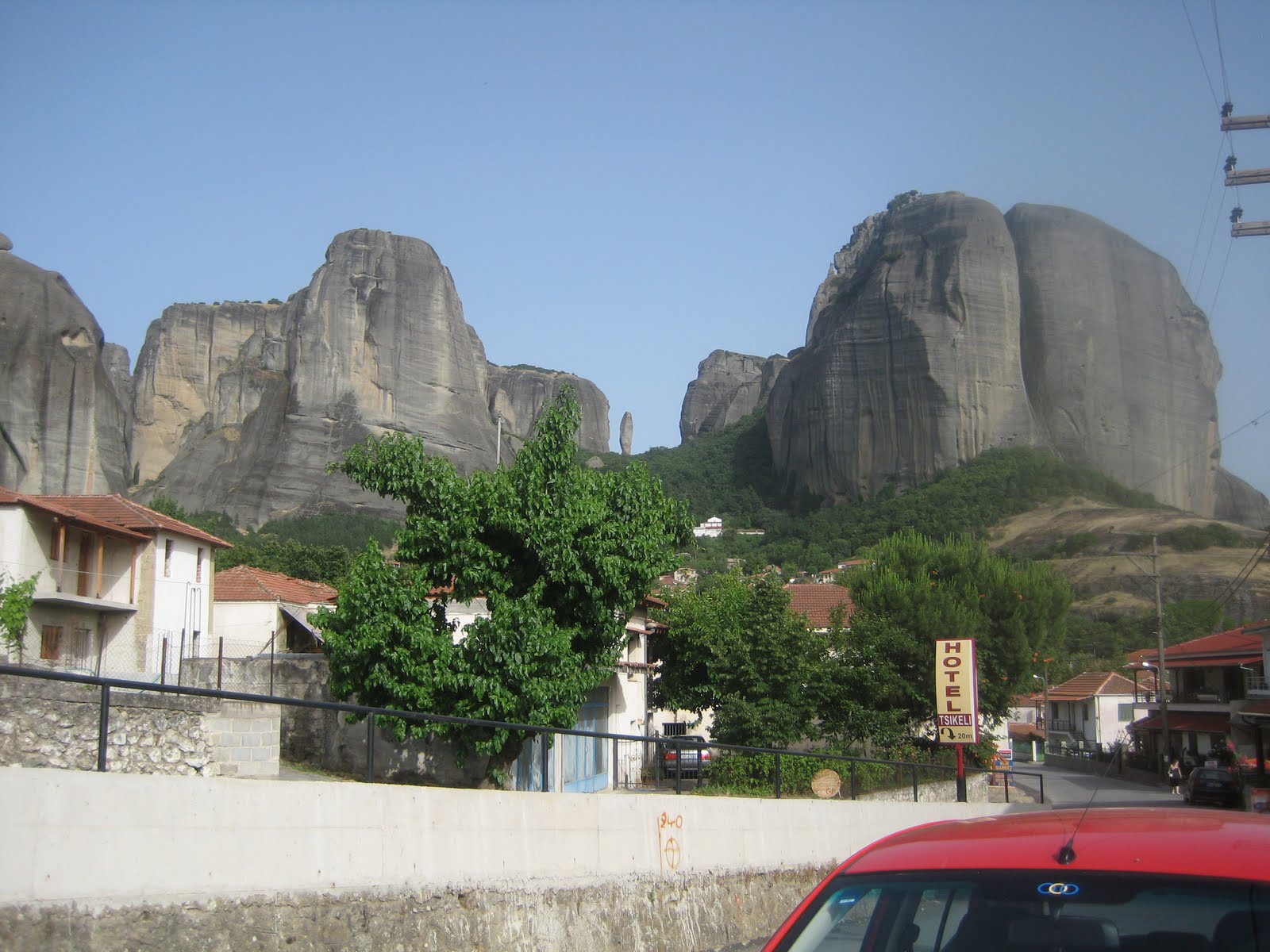
If visiting Meteora, I recommend staying in Kastraki, the small village at the base of the mountains, rather than Kalambaka, the larger and charmless town nearby. I can also recommend the well-situated and reasonably-priced Hotel Tsikelli. Maybe it has something to do with Greece's economic woes, but I have rarely been made to feel more welcome. I arrived in Katraki late afternoon, and even though I had done little more than drive all day, I was completely exhausted. After a delicious (if non-fasting) supper at a nearby cafe, I turned in and tried to sleep.


Seen from a distance, the Meteora monasteries are simply amazing. I cannot imagine how they were ever constructed atop these rock formations. And until the modern world intruded, their location certainly provided the isolation the monastics were seeking. Six main monasteries crown the peaks--Great Meteora, Varlaam, St. Nicholas, St. Barbara-Roussanou, Holy Trinity and St. Stephen. Varlaam and Holy Trinity were closed that day. I visited the other four.

The Monastery of St. Stephen was the first I visited, and my favorite. I take issue with the Rough Guide that dismissed it as "the obvious one to miss if you're short on time." I also was a bit offended by their snarky reference to nuns there who were "keen to sell trinkets." Yes, there is a shop next to the refectory where one can buy these "trinkets," otherwise known as icons. But the only thing I noticed that the nun there was "keen" to do was pray before the icons she had arrayed in front of her, or read from the Psalter she had opened. There comes a time to disregard any guidebook, and this was one of them. The Germans bombed the monastery during World War II and the Communists raided it during the Greek Civil War. So, much of what is seen is relatively new, restored, or built in the post-war years, and some of the iconography is of recent date. But if one is truly interested in the monastery as monastery and not concerned about how quaint and "Middle-Agey" it all is, then St. Stephen's will not fail to impress.

The nuns have converted the old refectory into a small museum. Here, they exhibit some of monastery's treasures--icons, Gospel books, manuscripts, vestments and liturgical instruments--most from the 1600s and 1700s. Although I did not see them, I understand that they have a portion of the skull of St. Stephen, as well as the head of St. Haralambos.

The main church is dedicated to St. Haralambos, and the iconography therein is stunning--I find it hard to describe without gushing. I will just say it is as incredibly moving as any I have seen anywhere. As one enters the nave from the narthex, I was interested to note icons not usually seen in the U.S.--an icon of the Ladder of Divine Ascent on the left of the door, and an icon of Jacob's Ladder on the right. The iconography that held my attention more than any other was on the west wall of the narthex--the Last Judgement. I am simply fascinated by this. The scene is too incredible to describe, but it is all there--Christ above all, the Theotokos, St. John the Forerunner, the Apostles, the Angels, the Gospel laying on the Throne, the Cross, the scales with Angels bringing forth scrolls, the graves being opened, saints and sinners awating judgement, demons trying to tip the scales, the River of Fire with the souls of those who rejected the Love of Christ, Leviathon being ridden by a demon with Judas in his lap, the Dragon, the vision of Daniel, the saints on their knees making supplication, the Garden of Paradise with beautiful trees and peacocks whose door is being unlocked by St. Peter and with the Mother God on a throne and with the Thief carrying his cross in before, the souls in hell where there is no Light, etc. I find it simply beyond my abilities to describe this scene. I stood there in the narthex for the longest time, almost transfixed by what I was seeing.


My first awareness of this particular iconographic subject only dates back to 2007. In that year, I saw a much cruder version depicted in Yilanli Kilise (Church of the Snakes,) one of the cave churches in the Ihlara Valley of Cappadocia. Later that same summer, I came across a version in the church at Ananuri, on the road to Kazbegi in Georgia. In 2008, I saw the Last Judgement depicted at Mar Mousa (Church of St. Moses the Black) in the Syrian desert. I know this sounds for all the world like travel snob name-dropping ("when I was in..."), but my point is that in every instance, whether I was in Turkey, Georgia, Syria or now Greece, this particular iconography stopped me cold in my tracks. And it this I remember distinctly, even if the rest fades with time.

I have always believed in the Judgement. I cannot remember a time when I did not, even though in our American way of doing things ("culture" being too strong a word), we live in vitual and tacit denial of the reality. This certainly characterizes our churches as well, even including our fundamentalist and/or evangelical churches, or my old Restorationist church. Sure, lip service is given to it, but the subject is generally avoided. And while Scripture itself bears witness, I always got the idea that most people tend to put it down as something akin to rhetorical excess meant to spook us into doing right, so to speak--but that in the end, it was not something that was really ever going to happen. I know I am painting with a broad brush here, but I think there is some truth to my analysis. Like I say, I never doubted the Last Judgement, when everything is exposed to light and our real selves revealed. And I knew myself well enough to know that this play-acting we do with repentance and confession would fall away with all other pretense on That Day. In the old days, as much as I would "think about Christ's suffering on the Cross," as the matzo bread and grape juice were passed down the pew, it was never really convincing--nothing had changed, no real repentance occurred, confession went unaddressed, and the guilt continued to pile up. I am just speaking for myself--maybe it was different for the people sitting on either side of me (though I doubt it.) Repentance and confession and salvation were all just intellectual concepts, and there was no real, tangible engagement of same outside of my own mental constructs. And so, the Judgement was a fearful thing. It still is, but with a difference. Before, the Judgement was just an intellectual conception, with me standing alone, with only by "beliefs" for support. Now, I see myself in this very icon. I am among the crowd of naked souls standing before the scales, with my Savior enthroned on high. But it is to Him that I have prayed "Lord, have mercy, " and His Mother is there, interceding for me, and the Angels surround me and keep the demons at bay, and the saints and martyrs of all ages are kneeling in supplication for the sins of the world. I am now part of the story. It doesn't give me certainty, but it does give me hope. And that is what was lacking before.


Next, I drove over to the largest monastic complex on the mountain, Great Meteora. This is favorite of the tour-bus crowd, as well. If sight-seers visit one of the Meteora monasteries, it will be this one. When I arrived, 3 or 4 tour-buses were parked outside. I am afraid this level of tourism will swamp this monastery. I did not see any of the monastics--and I don't blame them for keeping out of sight. The crowds were noisy and had to be quieted by monastery workers, paid no attention to the "Do not touch" signs in the museums or the "No Photographs" signs in the church. Even so, once a group was herded out of the church like cattle, I found myself alone in the nave. The church was on the same order as St. Haralambos, though the iconography was considerably older. The narthex was devoted completely to the trials of the martyrs. Every conceivable type of torture inflicted upon the early saints was depicted. To the outsider, it must all appear to be gruesome and a bit strange. To us, it is just a reminder that to be a Christian is to be something that people kill you for (more on this thought in a post to follow.)

The monastery contained several nice museums where some of their treasures were on display. I particularly liked one 16th-century double icon--with the 40 Martyrs of Sebaste on top, and St. John of the Ladder, St. Mary of Egypt and St. George of Ioannina on the bottom. One room was devoted both to the Greek War of Independence, as well as an Introduction to the Orthodox Faith. I thought that an odd juxtaposition, but perhaps not so in Greece. The displays explaining the Faith in general, and monasticism in particular, were especially well-done. I took the time to copy several of the explanations given in the museum, as follows:

The person of Christ, divinity and humanity combined, risen in glory from the dead, is the centre of visible and invisible creation, the centre of the heavens and the earth. His person is the centre of faith, of worship, of life and of the world. Christ is the one true God. He who completes and holds together all things, comprehending history, the past, present and future of the universe. Giving meaning and purpose to the life of man. And likewise Christ must be the centre of our own soul, our intelligence and heart and being; our passion and our desire, our rest and our rejoicing.

The Holy Church is our Mother. Tender, wise and vigilant, watching over our spiritual well-being. An ever-open embrace, our refuge and comfort, our support and shelter. A healing place for sick souls, a place where strong emotions and passions can be soothed and delayed. It is only the Church which can offer remission for our sins, whatever and however many they may be. Only the Church which has the power to take the shattered fragments of a soul and compose them again into paradigms of holiness--saints, martyrs, and confessors. Our Holy Church is the Ark of our salvation.


Faith is not a matter of understanding, but of confidence. And confidence is not unreasonable, it transcends reason. It does not contradict logic and reason, but goes beyond them. In the Orthodox Church, this transcendence of reason is not its denial but its elevation to a point where it can accept the experience of divine revelation. The transcendent reason of faith is the absolute surrender of our self, our abandonment to the will and mercy of God
.


The Monastery of St. Barbara-Roussanou is entered from below. With my ongoing physical problems, I had to collapse about halfway up the steps and catch my breath--and then some. A kindly priest was coming down the steps and saw the humor in my situation. He smiled and addressed me in Greek, and all I could do was make light of my condition and ask for a blessing . Thus refreshed, I continued my slog up the mountain. St. Barbara's occupied a much small crag, and so the church and other buildings were smaller and more crowded. Nuns were very much in evidence here. Under the circumstances, they cannot be faulted for looking a bit harried. I can only imagine what a relief it must be to close the doors of the monastery every day. The church itself was much smaller--what one might call intimate. I lit some candles here and savored the chance to pray. As I recall, this chapel had perhaps the most intricately-carved iconostasis in Meteora.


My final stop was the small Monastery of St. Nicholas. The lack of parking and the steep climb eliminates the tour-bus crowd. This is one of the small communities in Meteora. The church itself is tiny--actually carved into the side of the mountain. I recall seeing one unusual icon in the church--Adam naming the animals. I also viewed the workshop where the monks were assembling icons--by this I mean the pasting of icon prints onto wooden backs.
>


By the time I made it back down to my car, I was pretty well beat for the day. My bed at the Hotel Tsikelli was a welcome sight. After resting, I walked down to a nearby cafe and ordered the stuffed pepper. Together with salad, french fries and the obligatory Amstel, this made for one of the best meals I encountered on my journey. Despite the crowds, Meteora falls in the "must-see" category when in Greece. I am glad I went there.


Wednesday, July 28, 2010

2010 Travel Notes #6: Traversing Epirus


From the Peloponnese, I planned to make my way across western Greece, from the Gulf of Corinth to Meteora. The route I had chosen would take me through 2 cities I wanted to visit; Arta and Ioannina. The first intrigued me, as it was the capital of the old Despotate of Epirus, and if the pictures can be believed, chock-full of 13th-century churches. Ioannina looked interesting as well, though its fame came later, during the time of Ali Pasha. In Arta, I particularly wanted to see the Church of St. Theodora and the Paregoretissa, as well as the Panaghia Vlacherna nearby. In Ioannina, my goal was the relics of St. George the New, one of the martyrs of the Ottoman Yoke. Little of these plans actually came to fruition, however, as the day was spent primarily in transit--the simple logistical slog of getting from here to there.

The Despotate of Epirus is one of those fascinating asterisks of history. At the fall of Constantinople (the one in 1204, not 1453), the Byzantine ruling class scattered, establishing several small kingdoms-in-waiting. The Lascarids, and later the Palaeologus established a government-in-exile across the Bosphorus in Nicaea. The Komnenos located in far-away Trebizond. And the Emperor's cousin, Michael I Angelos Komnenos Doukas escaped to Arta.
Each had an eye turned towards Constantinople, to which they hoped to return one day, and another eye towards each other, their kinsmen and potential rivals. Although the family names might change--from Doukas to Komnenos to Angelos to Lascaris to Palaeologus to Cantacuzene--the Emperors of the East were all of one family, from the rise of Alexios I in 1081 to the fall in 1453. Repeated marital alliances with the Nemanjics of Serbia and the Assens of Bulgaria further confused the relationships. By the mid 13th-century, one would be hard pressed to find a member of one of these families who was not descended from all. Although marriage between close cousins was strictly forbidden, this web of connections surpassed even that of the Coburgs in the 19th-century.

The drive through Epirus was much easier than the previous day's endurance run. And I was beginning to need some relief. While one medical problem was addressed back in Mystra, others were beginning to compound, leaving me wearied and tired, when I had really not exerted myself at all. The Pindhos Mountains along its eastern boundary isolates Epirus a bit for the rest of Greece. The mountains within the region itself are not as severe as in other regions, and give way to broad river valleys lush with irrigated crops, rather than olives or orange groves. A new north-south expressway provides swift access through the province. Unfotunately, there is one entrance onto the highway, which I missed, and no more for 75 kilometers or so. It was quite literally a case of "you can't get there from here." While stuck on the old road, twisting and turning through the middle of towns and farmland, I would occasionally catch a glimpse of the expressway which roughly paralleling my course. I would see the cars zipping towards Arta, my destination. Obviously there must be a reason for my being forced onto the back road. I just had to wait and see what it was.

I stopped at a gas station on the edge of a small town to purchase a bottle of water. In Greece, there is no such thing as a self-service station, and your gas is just as liable to be pumped by a little old lady dressed in black, as was the case here. Leaning against my car, drinking my water and resting a bit, I took note of a rather handsome church on the adjoining lot. On top of the dome was one of the largest stork's nests I have ever seen. I love to watch for storks and their enormous nests when traveling in the Balkans. Four young storks occupied the nest, waiting for their lunch, no doubt. They reminded me of four Baby Hueys. And then I realized that perhaps it was this, these "God-protected storks," that I was supposed to see on this back road.


In due course, I arrived in Arta. My image of the city was colored by my having seen pictures of various churches in Arta. I thought it to be an old town, with lots of character. Yes, the churches are still there, but Arta is a thoroughly modern Greek city, and all that that implies. Concrete block buildings predominate, traffic is thick, and there are no places to park. Despite my experience in Patras, I am generally not at all intimidated by driving in foreign cities. Arta was doubly frustrating, however, for I did actually pass some of the churches I wanted to see, but there seemed no way to stop and park...anywhere. Finally, I wedged my car into a wide space in the bend of a road. I was not at all sure it ws legal to park there and was uncomfortable leaving it unattended. The makeshift parking space was only a block from the Paregoretissa.


The Paregoretissa has to be one of the most unusual Orthodox Churches I have visited. The structure is unlike any I have seen in all my travels. The Italianate influence is clearly evident in this design, constructed in the late 13th-century, during the reign of Nikophorus I Angelos Komnenos Doukas. A straight-forward, square 3-story building, the only things that gives it away as a church are the 5 domes atop. From the outside, it is a striking building, yes, but not a beautiful one. Once inside, however, I was a bit awe-struck. Standing in the nave, I looked up to the Pantocrator. The ceiling was a full 3-stories above...and then the dome. Paregoretissa is simply magnificent. The iconography is in a fair state of preseveration, as well.


Leaving the church, I walked across the street to a park, where I could sit and rest--and watch my car. By this time, I was feeling particularly unwell and I made a decision to forego the Church of St. Theodora, as well as the Panaghia Vlacherna, and push on to Ioannina. I now regret not making more of an effort here. Theodora was the long-suffering wife of Despot Michael II Angelos Konemnos Doukas--one of our few married women saints. I learned of her life from Mother Nectaria's Evogleite. Her story is a compelling one. I realize that I gave Arta short shrift. Should I ever return to Greece, I hope to remedy that situation.


I pushed west until I crossed the Louras River. Here, I turned north and paralleled the river. Along the way, I passed by the ruins of the Pantanassa Monastery. The monk Job Melias, in his 13th-century biography of St. Theodora, relates how her husband, the Despot built two monasteries as a gesture of repentance for the shameful way he had treated her. Pantanassa was one of them. The site was completely obscured by overgrowth until 1970.


A few kilometers further up the road, I pulled in at a restaurant, wedged between the river and the road. I chose an outside table near the water, between the trout tank and restaurant. A German couple occupied a spot a few tables down. How do I know they were German? One just knows. This late lunch came just in time, and the fresh trout went a long way towards restoring my spirits. The one problem, however, was the "mountain greens." My waiter suggested this option, a local staple, instead of a traditional salad. I was a bit suspicious, as it sounded very much like turnip greens--something I have never yet been hungry enough to eat. When he brought my food, I quickly saw that turnip greens by any other name are still...turnip greens. Not wanting to disappoint my waiter, I made a valiant effort at eating some of this huge mound of greens. I chewed and chewed and chewed and forced down 3 or 4 mouthfuls. My waiter noted that I had left most of them on the plate and I made the best excuse I could--that they had simply given me way too much to eat. We talked a bit. He had been to the U.S. before--New Jersey, I think. I explained, the best I could, about Texas. He encouraged me to visit the churches in Thessaloniki, and I assured him I had every intention of doing so. I lingered here for quite some time, listening to the rushing water of the Louras River. My German neighbor had stripped down to his Speedos and was splashing around in it. I looked upstream.


Ioannina was only a few kilometers further on. The city sounded inviting, as it lay on the shores of a large natural lake. Many of the historical sites there are associated with the Ali Pasha (1740-1821,) a flamboyant autocrat who ruled the more or less independent of the sultan in Constantinople. McLees tells of the fascinating story of his favorite wife--a Christian--the beautiful Kyria Vasiliki. The Kastro is right on the waterfront, as is the old mosque. Ferries ply the waters across the lake to the island village and monasteries. As interesting as all this would be, I particularly wanted to visit the relics of St. George the New Martyr (thanks to John at Mystagogy for post, here .) In Evlogeite!, Mother Nectaria gave no directions, but suggested to stop and ask for its location. This did not sound good. I asked my waiter, and he had never heard of the church. I left the restaurant and drove on into Ioannina. I stopped for gas and asked again. They had never heard of the church at the service station. I drove into the city and found it to be as beautiful as described. Ioannina was much nicer than Arta, even without considering its prime lake-front location. I drove around a bit, hoping to see the church, but without any success. If it had been earlier in the day, I would have taken a ferry out to the island. As it was, I decided to push on to Thessaly and Meteora and the hopes of a soft bed.