Wednesday, January 13, 2010

The Cretan Runner

I have just finished two excellent books by Greek authors: The Boundless Garden, by Alexandros Papadiamandis and The Cretan Runner, by George Psychoundakis, at left. The Boundless Garden came highly recommended, and it did not disappoint. I definitely will be commenting about it in the months to come. But The Cretan Runner came as a surprise. I bought it only because of Patrick Leigh Fermor's Introduction (and I would discourage buying the new edition if it does not contain that section.) Generally, I am not terribly interested in wartime memoirs.

This, however, is an amazing book. And George Psychoundakis was a remarkable man. In 1941, he was a 21-year old Cretan shepherd, whose village of Asi Gonia was remote even by the standards of Crete in that day. Theirs was among the poorest of the families, living in an earthen-floored one-room hut, all looking to George for their very survival. As the Nazis over-ran Crete, Psychoundakis joined the partisans who retreated into the mountains. Here they joined forces with a scattering of British soldiers and spys stranded on the island to form one of the most remarkable resistance movements of the war. And it was in this context that Psychoundakis became the lifelong friend of Patrick Leigh Fermor.

By our standards, we would have called him uneducated. He had, at best 2-3 years of occasional schooling. And yet, this young shepherd could recite--completely from memory--an epic poem of his creation that took 2 hours in the telling. And this is not a book about Psychoundakis, but one written by him. He was unjustly and falsely imprisoned by the Greek government after the war. Before this mistake could be rectified, he spent a number of months in prison. During his imprisonment, he wrote this account in 5 notebooks. A few years after the war, Fermor returned to Crete and found Psychoundakis, who entrusted him with the manuscripts. Fermor immediately realized the extraordinary work he held in his hands, and worked tirelessly for its publication. With few and minimal revisions, the book was published in 1955, largely as Psychoundakis penned it in prison. In later years, he translated the Illiad and the Odyssey into the Cretan dialect.

Fermor describes his first meeting with Psychoundakis:

He wore a black Cretan shirt, his clothing was in tatters and his patched boots-the semi-detached sole of one of which was secured to its upper with a thick strand of wire--were coming to bits on his feet. When he took off his fringed headkerchief to untwist one of his messages, his forehead was shade by a raven-black shock. A small, carefully tended moustache ran along his upper lip. He was small in stature and as fine-boned as an Indian, looking little older than sixteen, though he was actually twenty-one. He was lithe and agile and full of nervous energy. His eyes were large and ark, and his face, in repose, thoughtful and stamped by a rather melancholy expression which vanished at once in frequent fits of helpless and infectious laughter that almost anything seemed to provoke.

When my answers were written and safely stowed by George in their various caches, we lay about talking under the bushes till it grew dark, drinking from a small calabash of raki which Elpida had brought with her from the house, and cracking almonds with a stone. It was plain that George was enraptured with the excitement of our secret life, in spite of the appalling trudges that kept him for ever on the move in those merciless mountains. When the moon rose he got up and threw a last swig of raki down his throat with the words 'Another drop of petrol for the engine'', and loped towards the gap in the bushes with the furtiveness of a stage Mohican or Groucho Marx. He turned round when he was on all fours at the exit, rolled his eyes, raised a forefinger portentously, whispered 'The Intelligence Service!' and scuttle d through like a rabbit. A few minutes later we could see his small figure a mile away moving across the next moonlit fold of the foothills of the White Mountains, bound for another fifty-mile journey.

Psychoundakis's tale is told so earnestly, guilelessly and simply that one sometimes looses sight of the real horror of their situation. The Germans were led to believe that the Cretans would welcome them, and when the exact opposite turned out to be the case, the Nazis turned on them with savage fury, killing entire villages in retribution for partisan activity. But the natives were on their home turf, and effective German control never extended far outside the major towns. Psychoundakis recounts many tales of eluding German patrols, hiding out in caves and monasteries that they knew so well. On one trek, they disguised an Englishman as an old peasant woman, permitting them to walk alongside the Nazi soldiers looking for the very same man. Another escapade resulted in the capture of a German general.

Early in the account, he describes the torching of a German airplane by 3 village teenagers. In time, their names became known and the Nazis threatened to wipe-out their village unless they turned themselves in. The older two eventually did and were sentenced to death, and the youngest (age 16) was captured and put in prison. Psychoundakis describes their execution:

So, after a few days, in a street in Archontiki and under the eyes of all the inhabitants, these two martyrs to freedom and death-deriders stood before the firing squad--naked, hungry, barefoot and in chains. Their last moment was approaching. Their bonds were removed and their executioners, with rifles levelled at their bare breasts, were waiting for the word 'Fire!' The leader of the German party read out the sentence and asked if they had any last words to say. Daskalakis asked for a glass of water which they gave him, and the question was repeated to Vernadakis, who said: 'A glass of wine and permission to sing a matinada.' [this being a Cretan 15-syllable rhyming couplet, usually with a sting in it.] Saying which, naked, barefoot and utterly exhausted as he was from thirst and hunger (for, during their confinement in Ayia jail they had been given neither food nor water, he mustered all the strength of his soul--and what greater strength is there?--and took to his heels. Straight away the firing squad began shooting after him as he ran. But neither the rifle bullets not the bursts from the sub-machine-guns could touch him. He ran like lightening from lane to lane until he was out of the village. Then, as it was difficult to run further without being see, he climbed up into an olive tree and stayed there until night fell. When it was quite dark, he climbed gently down and, slipping through the sentries, fled far away. Later he escaped to the Middle East when he volunteered for the Air Force.

While they were chasing Vernadakis through the village, Daskalakis remained motionless in his place although he too had a chance of taking to his heels and escaping. 'Run for it!' several onlookers shouted, but he refused, saying the Germans would avenge themselves on his kinsmen. It would be better for him to die, he said. In a few moments the Germans were back again, and they opened fire on Daskalakis with fury. He fell at once,l quite transformed and unrecognisable from the bursts of the German machine-guns.

Finally, the character of Psychoundakis himself comes through in this account:

Alas, when I got back to my village, a great disaster awaited me. During the night, unknown people had come and stolen all the sheep my father possessed, about sixty of them. I ran from one village to another trying to find them, but all in vain. The sheep had vanished forever. I was miserable, for sixty sheep meant salvation to a family, especially in those years. What was I to do now? Should I, too, take to stealing, as the custom is in those villages? No. It didn't even pass through my head. Kill the people who had stolen them? Nor that, either. Take them to court? That too was impossible....So I left God to punish them, which He did after His fashion and in His own time. I resumed my peaceful way of life as before.

This, my friends, is what they call a good read.

Saturday, January 09, 2010

Buzkashi


Many now question our purpose in Afghanistan. Perhaps we are fighting, in part, to protect this sort of thing.

The Afghan national sport is called "Buzkashi." The humorless Taliban banned it during their reign, but it has come back with a vengeance following the U.S. invasion, and is now more popular than ever. Friday is buzkashi day in Afghanistan.

The term literally means "goat grabbing." And that is exactly what it is. The game resembles polo, though played with a decapitated goat carcass.The goal is to snatch the goat carcass from whoever has it, race around a flag at the far end of the field, and then race back and drop the carcass in a chalk circle. And most anything goes between each end of the field. The ensuing melee has been charitably described as "lightly-regulated."

American anthropologist G. Whitney Azoy finds buzkashi a suitable metaphor for Afghan life: brutal, chaotic, a continual fight for control (in this case, of a dead goat)...[where] leaders are men who can seize control by means foul and fair and then fight off their rivals. The buzkashi rider does the same.

Haji Abdul Rashid, head of the government-sponsored Buzkashi Federation simply notes that the game reminds Afghans of their warrior culture...and the goat symbolizes their vanquished foe. He states bluntly, Buzkashi is Afghanistan.

Rashid is thinking big. He wants to see buzkashi organized in leagues, with televised matches supported by corporate sponsorship. And yes, he is dreaming of the day when buzkashi is an Olympic event.

I pay no more mind to the Olympic Games than I do any sporting event. But, in the highly improbable event that Rashid's feverish fantasy were to somehow become reality...well, I would probably watch.

Thursday, January 07, 2010

Woo-hoo!


If I have added correctly, then this is my 500th post on this blog. I suppose it is a little self-conscious calling attention to the fact…but then, worrying about that is like locking the barn door after the horses have escaped. Exactly what aspect of maintaining a blog is not self-conscious?

I suppose I should write something especially profound for my 500th post. But as is often the case, the well of profundity is running a bit dry these days. The other impulse is just to post something...anything...to get past this meaningless milestone and get on to business as usual. My inclination is to go with this second option.

That said, I think it appropriate to comment briefly about blogging. I have always been one to keep journals, to make notes of interesting passages I read, to cut-out and save magazine and newspaper articles, etc. This behavior has not stopped just because I now maintain a blog, but continues apace (and these files and papers will one day no doubt fuel a nice bonfire prior to the estate sale.) For me, blogging is simply another avenue to indulge my borderline compulsive habit.

Blogging also tempers, somewhat, a tendency to afflict my opinions on family, friends, neighbors and passers-by (although I still reserve the right to unload on the in-laws during holiday get-togethers.) One of my wife’s cousins once remarked to her, “Well, you know how weird he is.” Considering the world-view from which that comment emanated, I could not have been more highly complimented. But I recognize having a contrary view on most things can be tiresome to others, and that blogging provides a safe outlet for the expression of same, whether it be current events (dismal), politics (it was W's fault), American religiosity (growing sillier by the day), culture (irredeemable), or my favorite--books and travel.

I began this blog on 5 November 2005, and started keeping records of visits in March 2007, when I added the Stat-Counter application. The name John, which I use on this blog, was not the name I was given at birth. Back in 2004, one of the watchdogs of the Church of Christ I left (in the first week in 2005) had been monitoring my comments on several online sites—and keeping a log. For this reason, I wanted to maintain a bit of anonymity, and was consequently reluctant to use my real name. On 19 November 2005, I was received into the Holy Orthodox Church as John, with my patron saint being St. John of Rila. I like the name, thought it a good one to use on the blog, and still do. So, I am sticking with that. For those who might want to know, my real name is not hard to ascertain.

This blog has obviously paralleled my life as an Orthodox Christian. From the beginning, however, I determined to not make this an overtly “Orthodox blog.” The primary reason for that decision was, and remains, that I am simply not qualified. Orthodoxy, as it is absorbed, gives one a differing perspective on most everything. My blogging observations are certainly tinged with that. And I feel free to link to various articles touching on various aspects of the Orthodox Church--the plight of Orthodox believers in the Middle East being a particular interest--but I never really tackle doctrine or "issues" head-on. Nor do I intend to. There is no shortage of those who will, and I defer to their wisdom.

In over 4 years of blogging, I have grown not at all tired of it. There’s a great line from Waugh’s Unconditional Surrender, in which the butler shows a guest into the Crouchback drawing room to wait. He advises, "You'll find plenty to interest you here...that is, if you're interested in things." That’s just it--I remain “interested in things,” and have no desire to retire the blog.

There's no way to say what follows without coming off as overly sappy and sentimental. That is to say that the best part of blogging and this blog is, well…you. Those of you who respond to my posts from time to time treat me gently and indulge my idosyncracies. Comments are generally kind and considerate, intelligent--or at least clever, which often gets you further anyway. It has been my great privilege to meet a few of you in person, and given enough time, I hope to increase that number. So, I just say "thanks," and that I look forward to hearing from you.

Best,

John

Monday, January 04, 2010

Twenty Years Later


I wanted to post this picture 12 days ago, on the 20th anniversary of Ceausescu's fall. Saving newspaper and magazine articles is a lifelong habit--and I do have a filing system in place. On my third foray through my folders, I found the clipping right where it should have been. This is my favorite picture from that period, capturing the exuberance, the rush of excitement and hope of a subjugated populace as their yoke was suddenly, amazingly being lifted.

Those were exciting times for all of us. And now, 20 years later, I suppose it is time to engage in some retrospection and take stock of subsequent developments. That brings me to this recent article in the Los Angeles Times by Michael Meyer, who witnessed the Romanian Revolution firsthand (and who, I might add, is the author of The Year that Changed the World.)

Meyer begins his account with the hasty funeral of Jacob Stetincu:

A light snow came down in Bucharest, covering the mounds next to freshly dug graves, open and gaping in long straight rows. "Here are the fallen," intoned a solemn priest as four men placed a wooden coffin before him on a wobbly trestle. Jacob Stetincu, shot by a sniper, lay wrapped in a thin cotton sheet, wearing a worn blue beret, snowflakes catching in his grayed mustache. After a hurried sacrament, the men nailed his coffin shut, carried him to the nearest grave -- his widow struggling to keep up -- and shoveled in the heavy earth. The priest, working in shifts with a dozen of his brethren, was already shaking holy water on the next victim of Nicolae Ceausescu's brutal reign.

Meyer contends that while the fall of the Eastern Bloc Communist regimes was indeed a victory for "our" side, he suggests that we have learned the wrong lessons from the event, or as he quotes Niebuhr, the "mis-memory" of history.

Yet it was a dangerous triumph, chiefly because we claimed it for our own and scarcely bothered to fully understand how this great change came to pass. We told ourselves stick-figure parables of defiance and good-versus-evil triumph, summed up in Ronald Reagan's clarion call: "Mr. Gorbachev, tear down this wall!"

From the vantage point of 20 years, we should be wiser. The reality is that "our" victory in the Cold War was not what we thought it was, nor did it happen the way we think it did. Most painfully, the myths we spun about it have hurt the world and ourselves.

Meyer identifies four areas where he contends we have misread the real history of the fall of European Communism. I particularly agree with his third point:

A third myth is the most dangerous: the idea of the United States as emancipator, a liberator of repressed peoples. This crusading brand of American triumphalism has become gospel over the past two decades in certain foreign policy circles, especially among neoconservatives. For them, the revolutions of 1989 became the foundation of a post-Cold War worldview. All totalitarian regimes are hollow at the core, they suggest, and will crumble with a shove from the outside. If the inspiration for this was the Berlin Wall, coming down as Reagan "ordered," the operational model was the mass protests in Romania leading to the violent overthrow of the Ceausescu regime.

"Once the wicked witch was dead," as Francis Fukuyama put it, "the Munchkins would rise up and start singing joyously about their liberation." It is a straight line from this fantasy of 1989 to the misadventure in Iraq, and beyond.

This admonition is especially timely in light of those who ill-advisedly advocate an aggressive involvement with the Iranian dissent movement, for example.

The United States contributed uniquely to the end of the Cold War, from the reconstruction of Europe and containment to capitalist economics. But others "won" it, on their own (and our) behalf. Among them were the likes of Jacob Stetincu, all but forgotten in his grave.

Drunk on pride and power, we Americans have tried to rewrite history. Having got it so wrong, it's time to figure out how, and why, and move on.

(A h/t to Milton for the Meyer link.)

Thursday, December 31, 2009

Precious Vessels of the Holy Spirit


A few selections from Precious Vessels of the Holy Spirit: The Lives & Counsels of Contemporary Elders of Greece.


In the hour in which we are tempted we must be patient and pray. Temptation is a clever craftsman. He is able to make small things loom large. Temptation disquiets, saddens, and creates external battles. He knows many arts. He brings man to doubt. For this reason we have many shipwrecks. When we are beset by temptations, that's when the grace of God comes. When one undergoes temptation, he recognizes his weakness, is humbled and attracts the grace of God. Don't let the winds of temptation affect you. They can't do you any harm.

Elder Amphilochios


I am not afraid of death. Not, of course, because of my works, but because I believe in God's mercy.

Elder Epiphanios


Whatever we don't give to God for Him to use, the other will use. For this reason our Lord gave us the commandment to love with all our heart and soul, so that the evil one won't be able to find a place of rest within us.

Elder Joseph


No sacrifice is more fragrant in the sight of God than purity of body, which is realized through blood and great struggles.

We mustn't despair when we struggle and continuously see nothing but the slightest progress. We all do nearly nothing, some a little more, some a little less. When Christ sees our little effort He gives us an analogous token and so our nearly nothing becomes valuable and we can see a little progress. For this reason we mustn't despair, but hope in God.


My brother, don't ask for anything in prayer except for repentance. Repentance will bring you humility, humility will bring you the grace of God, and God will uphold you in His grace and will give you whatever you need for your own salvation, as well as whatever is needed, should the case arise, for you to help another soul in need.

Elder Paisios


Life without Christ is not life. That's the way it is....If you don't see Christ in everything you do, you are without Christ.

It's possible for people to come to the point of despair and see before them the living reality of chaos and say, "We're falling into chaos! Everyone get back, get back, go back, we've been deceived," and thus return to the path which leads them to God, and for our Orthodox Faith to shine. God works in mysterious ways and doesn't want to influence man's freedom. He arranges things so that slowly, slowly, man goes where he is supposed to.

I am not afraid of hell and I do not think about Paradise. I only ask God to have mercy on the entire world as well as on me.

You mustn't wage your Christian struggle with sermons and arguments, but with true secret love. When we argue, others react. When we love people, they are moved and we win them over. When we love we think that we offer something to others, but in reality we are the first to benefit.

What can politicians do for you? They are confused by their psychical passions. When a person is unable to help himself, how can he help others?


Elder Porphyrious


Never be jealous of wealth. Always live modestly and humbly, without egotism. egotism is a terrible sin. When you hear someone being accused, even though it may be true, never add more accusations, but always say something positive and be sorry for the person. take care to always love the poor, the elderly, the orphans, the sick. Spend time with poor people and with those who others humble. Earn your living with the honest sweat of your brow. Don't forget to give alms. this is the path you must tread. Always think of what good thing you will do. These are the things that make up the life of a Christian.

Don't be sad, for we will all depart from here. We are passing travelers. We came here to show our works and to leave.


Elder George

Wednesday, December 30, 2009

On Beauty

I have generally thought well of the work of Roger Scruton, though I have not followed him since the days when I subscribed to The New Criterion. His current association with the neocon American Enterprise Institute is troubling, and certainly raises my suspicions. I do recommend, however, his recent article, The High Cost of Ignoring Beauty, in which he writes of the importance of architecture to the well-being of any culture. A few excerpts:

That question might prompt us to revise the assumption that beauty is subjective. Aesthetic judgements may look subjective when you are wandering in the aesthetic desert of Waco or Las Vegas. In the old cities of Europe, however, you discover what happens when people are guided by a shared tradition which not only makes aesthetic judgement central, but also lays down standards that govern what everybody does....Maybe we see beauty as subjective only because we have given the wrong place to aesthetic judgement in our lives—seeing it as a way of affirming ourselves, instead of a way of denying ourselves.


When it comes to beauty, our view of its status is radically affected by whether we see it as a form of self-expression, or as a form of self-denial. If we see it in this second way, then the assumption that it is merely subjective begins to fall away. Instead beauty begins to take on another character, as one of the instruments in our consensus-building strategies, one of the values through which we construct and belong to a shared and mutually consoling world. In short, it is part of building a home.

No greater aesthetic catastrophe has struck our cities—European just as much as American—than the modernist idea that a building should stand out from its surroundings, to become a declaration of its own originality. As much as the home, cities depend upon good manners; and good manners require the modest accommodation to neighbors rather than the arrogant assertion of apartness.


A street in which people live, work, and worship renews itself as life renews itself; it has eyes to watch over it, and shared forms of life to fill it. Nothing is more important than defending the street against expressways and throughways, against block development, and against zoning provisions that forbid genuine settlement.

How do we get out of the mess?...there must be planning, but it should be envisaged negatively, as a system of side-constraints, rather than positively, as a way of “taking charge” of what happens and where.

And here, it seems to me, is where beauty matters and how. Over time, people establish styles, patterns, and vocabularies which perform, in the building of cities, the same function as good manners between neighbors. A “neighbor,” according to the Anglo-Saxon etymology, is one who “builds nearby.” The buildings that go up in our neighborhood matter to us in just the way that our neighbors matter. They demand our attention, and shape our lives. They can overwhelm us or soothe us; they can be an alien presence or a home. And the function of aesthetic values in the practice of architecture is to ensure that the primary requirement of every building is served—namely, that it should be a fitting member of a community of neighbors. Buildings need to fit in, to stand appropriately side by side; they are subject to the rule of good manners just as much as people are. This is the real reason for the importance of tradition in architecture—that it conveys the kind of practical knowledge that is required by neighborliness.

Traditional architecture concentrates on the generality of form, on details that embody the tacit knowledge of how to live with a building and adapt to it. Hence traditional architecture in turn adapts to us. It fits to our uses, and shelters whatever we do. Hence it survives—in the way that Georgetown and Old Town Alexandria have survived, though hampered, alas, by zoning laws. Modernist architecture cannot change its use, and architects assume that their buildings will have a life span of 20 years. Building with that thought in mind you are not building a settlement, still less a neighborhood. You are constructing an extremely expensive and ecologically destructive tent. The environmental impact of its demolition is enormous, and the energy that goes into building it must be spent again on demolishing it and yet again on replacing it.

People need beauty. They need the sense of being at home in their world, and being in communication with other souls. In so many areas of modern life—in pop music, in television and cinema, in language and literature—beauty is being displaced by raucous and attention-grabbing clichés. We are being torn out of ourselves by the loud and insolent gestures of people who want to seize our attention but to give nothing in return for it. Although this is not the place to argue the point it should perhaps be said that this loss of beauty, and contempt for the pursuit of it, is one step on the way to a new form of human life, in which taking replaces giving, and vague lusts replace real loves.

Monday, December 28, 2009

"If Jesus were alive today"

Occasionally, I may be guilty of constructing Evangelical straw men, from which I wax sarcastic about the excesses and inanities of American pop-religiosity. Not that this takes any great skill, mind you, given the surfeat of material with which to work. In this season of resolutions, perhaps I should resolve to do better in the coming year. Or not.


But this article--Metro Churches Turn to Technology to Spread the Word--truly troubled me, as I found it sillier and even more offensive than most. (Owen by way of Aaron has previously noted the article.) This story is a familiar one by now. To those who turn a critical eye towards the state of religion in America, many of these evangelical churches became unmoored long ago, and are now far at sea. This newspaper account differs little from countless others I have read in recent years documenting evangelical trendiness....except for one line.


Journalist Malena Lott posits: "If Jesus were alive today, would he Twitter? Have a Facebook profile? Flickr account? Post proof of his miracles on YouTube?" I once heard Zbigniew Brzezinski--not one to suffer even good-natured fools gladly--characterize a question put to him by Joe Scarborough as "stunningly superficial." Ms. Lott's inquiry is worthy of the same treatment. Indeed, it is so light and fluffy that the words are in danger of floating off the page.

The entire line of thought is so patently absurd that I completely missed the real significance of the passage. Ms. Lott begins with If Jesus were alive today. Think about it. I do understand what she is trying to say, namely "If Jesus were physically walking the earth today, etc." But that is not what she said.

Such sloppiness can be excused, perhaps, from a journalist. But then, the person to which the question was addressed--the "online community pastor at LifeChurch.tv"--used the exact same wording in his response. He replied: If Jesus were alive, I don’t think he’d have to use social media...His followers all have mobile phones. They’d be spreading his message for him.


I found it absolutely stunning for a purported Christian pastor to say "if" Jesus were alive today. Everything else in the story is secondary when compared to this unintended statement of faith. That is the whole point of the empty tomb, is it not? This is no quibble over semantics. One cannot equivocate on such matters. The whole point of our Faith is that Jesus Christ is alive, and and the only life we have as Christians is when we lose our lives in His.

Such statements should be expected, I suppose, in churches where The Word has become words on a page, where the Living Christ has became the author of useful moralistic teachings, where cheap sentimentality and"assurance" have replaced any sense of asceticism. I do not see this trend abating at all. It will become increasingly difficult, however, to characterize adherents as anything discernibly Christian.

Monday, December 21, 2009

Meryam Ana Church


Earlier, I made note of the recent Swiss referendum which bans the construction of new minarets. Obviously, this action has not gone unnoticed in the Islamic world. A h/t to Josephus Flavius for linking this article, originally from Mere Comments.

It seems a group of Muslims confronted the priest at a Syriac Orthodox Church in Diyarbakir, in eastern Turkey. The three men threatened the priest with death unless the church's bell tower was demolished within the week, this in retaliation for the Swiss action. The priest, Fr. Yusuf, did notify the authorities, but added "It is my job to protect the church, so I will stand here and leave it in God’s hands.”


I particularly took note of the story, for back in 2006, I visited the Meryam Ana Church, briefly met the priest and remained for Vespers. I had read several travel accounts of this beleaguered church, and was determined to see it for myself.

The church dates to the late 4th-century, and is located in the oldest part of the walled Old City of Diyarbakir. A modern city of 1.5 million has all but swallowed up the original town. Even though protected somewhat by its walled compound, the church's location makes it particularly vulnerable to attack. The population swelled in the late 1980s and early 1990s, as Kurdish villagers fled the fighting between the Turkish army and Kurdish guerrillas. The city remains the epicenter for Kurdish nationalism in Turkey.

And, it is a dangerous place. Deservedly or not, Americans have the reputation of being squeamish travelers, generally staying with the herd and keeping to the main road. Upon coming home, I have always been baffled by those who ask me if I was frightened over there. No, if I am frightened of anything, it is when I come home to one of the most violent countries on earth. But Diyarbakir is the exception to the rule in Turkey. You take extra precautions in the Old City, and you do not venture out after dark, even in the hotel district. My point is just this: Diyarbakir is the kind of place where such threats made against the priest of Meryam Ana are not idle ones.

Were this barbarity to be carried out, most Turks would be horrified and embarrassed. Such thuggery is in no way representative of the country. But if the small Orthodox community at Meryam Ana--witness of 1700 years of the Faith in that city--were to disappear forever, there would be no tears in Ankara for the loss. For in Turkey, all things must be Turkified, and the existence of these Suriani--as also the Ecumenical Patriarch--are inconvenient reminders of what came long before, and by implication and comparision, highlight the relative newness of a purely Turkish Anatolia.

(I wrote of my visit, here, back in 2006. I had been an Orthodox Christian for only 7 months at that time, so some of my commentary on such matters may be more crudely put than I would do so today.)


This photograph graces the cover of the latest Eighth Day Books catalog. The image of Londoners calmly scanning the shelves of a bombed-out London bookstore in 1940 is one that captivates me. The picture, I think, is also one rich in symbolism for our age. Considering this, what caption would you give to the photograph?

Thursday, December 17, 2009

The Cross at the Side of the Road


I have been doing quite a bit of job-related driving recently. Last week I drove to near Beaumont, then over to Austin and back home on one circuit. Earlier this week, I was on the Oklahoma border. In better economic times, I would have probably declined these jobs, as they are outside of our normal trade area. These days, we do not turn anything down. Not only can we do that job, we can do it tomorrow.

A drive deep into southeast Texas is an interesting experience. Of all the regions of our state, I would have to say this area is the least stereotypically Texan. To those of us located even just a few hours north, it seems more an extension of southwestern Louisiana, but without the Cajun flavoring. The flat land was always poor and never much good for farming. The region remains impoverished, given to logging and trailers.

I never mind driving, for there is always something to see along the way. Roadside churches are a never-ending source of interest. In one town, I passed a storefront church--the New Life Church (but of course)--which, in its storefront window promoted not only the church, but its fresh shrimp and catfish, as well their print shop for tee-shirts and banners. They also managed to find room for a poster denouncing "Obamacare." Further down the road, I passed the ramshackle Church of Ace, which struck me as funny, in a "Church of Butch" kind of way. But, I later discovered that Ace is the name of a now near-extinct community there, which explains the wording. Still further on, I passed the Community Missionary Baptist Church, a modest structure to be sure, but neat as a pin. On the sign out front, they proclaimed: "Teaching the Bible, verse by verse." You have no doubt what these people are all about. About 750 feet down the highway, I passed another, more substantial Missionary Baptist Church. The story here is clear, if you know how to read the signs. The smaller church split off from the larger church, and their statement of purpose, as spelled out on their sign in front, served as something of a rebuke to the older church, where apparently, they perceived that the Bible was not being taught, verse by verse.

But poking gentle fun at small-town Texas religious idiosyncrasies is not where I am going with this story. The placing of crosses and memorials at the site of highway traffic deaths has become a common practice (This was not done in my youth, and seems to be a phenomenon of the last two decades or so.) On a long stretch of straight highway, I noticed a particularly large white cross in passing. Something about this memorial caught my eye. I pulled over and made a u-turn and went back to verify what I thought I had seen. A small sign next to the cross said simply "We will miss you Josh Henry." Upon closer inspection, I noticed that friends had written notes to his memory all over the white cross. His cap was hanging over the top of the cross, and his hard-hat was hanging on the left bar of the cross. A football had been propped-up against the foot of the cross. A couple of beer bottles were standing upright nearby. The immediate area had been swept clean, and in what had originally caught my eye, a ring of crushed Bud Light beer cans encircled the cross.

I did a google search a few days later, and learned a few more details. Josh died after being thrown from a truck that wrecked on October 17th. He was 21 years old. The particulars follow a sadly familiar script: 2:30 in the morning, 92 miles per hour, and of course, driving under the influence of alcohol. The driver walked away from the mishap, but has been charged with involuntary manslaughter.

I do not know about his religious affiliation, but would guess him to be nominally Baptist or Pentecostal or some variation thereof, as is normative for the area. His funeral was probably overflowing in attendance, and no doubt the preacher comforted the family with his assurance of heaven, based on a childhood profession of faith. Back in my Church of Christ days, we snidely referred to this as "preaching someone into heaven." [We, of course, eschewed such behavior, as I am not sure we really believed anyone was actually going there.] This is all speculation of course, on my part. I am just guessing, based on my knowledge of the culture.

But Josh's makeshift memorial serves a stark rebuke to any funereal platitudes, smooth words and warbling Southern gospel hymns. It seems to me that the friends who erected this memorial weren't buying any of that at all. This young construction worker loved football, beer and having a good time with his friends. And now, for his buddies, abruptly and incomprehensibly, he is gone, leaving a gaping hole where once existed their life with him. We exert so much time and effort in the construction, maintenance and nurturing of the Lie--the unreality of our existence, if you will--that is to say, our denial of the fact that every day is the day of our death; if not today, then certainly tomorrow. And for all of us, there comes a time when this edifice crumbles in the face of the Real. Josh's friends--confronting eternity--struggled to comprehend this reality. Does he live on only in their memories? Or is there more? And why this way? Their messages and testimonies scribbled on the roadside cross, in a pitiable attempt to hold on the memory of Josh, and the placement of tokens of their life with him, spoke volumes to me. For we are all pitiable and feeble. We all seek to hold tight to that which is slipping away. We mourn over death, and ask why. For Josh's friends, my prayer is that they one day will know that this corruptible must put on incorruption, and this mortal must put on immortality and that in the end, Death is swallowed up in victory. And for Josh, all I can say is all I know to say--With the Saints give rest, O Christ, to the souls of Thy servants, where there is neither pain, nor sorrow, nor sighing, but life unending.

Wednesday, December 16, 2009

Orthodoxy in Colonial Virginia?

.

Orthodoxy in Colonial Virginia? It seems that way.

Read here and here.

And by all means, set aside an hour to listen to the podcast.

Sunday, December 13, 2009

Mourning in Seborga


It is with some sadness that I note the passing of Giorgio I, Prince of Seborga. You know.....Seborga. His recent death marks the end of a remarkable 46-year reign, and throws the future of the principality in some doubt. There may be some readers who have not followed Seborgan events closely, and I dare say even some who are not quite certain of the principality's exact location. Seborga, within sight of the Mediterranean, and near the Franco-Italian border, occupies a hilltop midway between Fascia Piana and well, the end of the road. Seborga encompasses a total of 5 square miles, and is home to 2,000 citizens, 350 of whom live in the capital city.

Prior to 1963, the prince was simply Giorgio Carbone, a wholesaler of mimosa flowers. But that year was pivotal in the annals of Seborgan history. According to Carbone, about 280 years ago, Seborga slipped through the cracks of European diplomacy and empire-building, leaving it, in effect, independent. From 954 until 1729, Seborga was a principality in the Holy Roman Empire. In 1729, the Vatican sold it to the House of Savoy. The new owners, however, failed to register the transaction which invalidated the sale, according to Carbone. Seborga was omitted from the dictates of the Congress of Vienna in 1815, and was not specifically included in the act of unification of Italy in 1861, nor in the formation of the Italian republic in 1946. To Carbone, it was clear that Seborga had never been a part of Italy. And by 1963, a majority of Seborghini agreed.

The principality rewarded Carbone by electing him prince, as historically Seborga had an elected, rather than hereditary prince. By a vote of 304 to 4 in 1995, Seborgans ratified their independence and made Carbone prince for life. Giorgio graciously accepted the title of "His Tremendousness" from his loyal subjects. But he remained steadfastly a man of the people, holding court in the Bianca Azzura bar.


Lest anyone think that the Prince Giorgia did not take his responsibilities seriously, it must be noted that he "established a palace, wrote a Constitution, and set up a cabinet and a parliament. He chose a coat of arms, minted money (with his picture), issued stamps (with his picture) and license plates, selected a national anthem and mobilized a standing army, consisting of Lt. Antonello Lacala." Perhaps his most memorable achievement was the formulation of a national motto: Sub umbra sede (Sit in the shade).

About 20 nations, in one fashion or another, have recognized Seborgan independence. Unfortunately, Italy is not one of them. Rome, a bit thin-skinned in these matters, remains insistence that the Seborghini pay Italian taxes.

One of the highlights of his reign was his championing of smoking in the principality. "Early in his reign the prince, a heavy smoker, passed a law to encourage smoking." His Tremendousness engaged in a brief power struggle with the mayor of Seborga. This tension soon passed as the mayor recognized that the princely court was something of a tourist draw, and the prince, in turn, realized that the mayor did all the boring work.

I generally take a dim view of secessionist movements--though the prince would contend that you cannot secede from something you were never a part of to begin with. We have our own secessionists here in Texas. They are generally regarded as being bores and crack-pots. We like to think (hope) they are a distinct minority. Texas is too big and crazy to secede. I think we would be a menace on the world stage. But if you are small enough, and eccentric enough, with just a dash of panache, then I think it is something I could get behind and support. There are certainly worse ways to confront our soulless modern world. So, three cheers for Seborga! They make a hellavu stronger case than does say, "South Ossetia." Those interested in further Seborgan studies might start here , here and here.


At the Seborgan border

Monday, December 07, 2009

The Problem with Infamy


To Americans of a certain age, this date never passes without notice. Obviously, I am referring to the Japanese surprise attack on Pearl Harbor on the morning of December 7, 1941. President Roosevelt famously pronounced it a "date that will live in infamy." Though long before my time, I grew up hearing of it from those who lived through that era. The significance fades, however, as later generations come to view it as just so much old history, a date to memorize for a test.


Ironically, FDR's memorable phrase was eerily similar to one made almost 55 years earlier, when King David Kalakaua was forced to cede the harbor to the Americans. His sister, later Queen Liliuokalani, termed this "a day of infamy." And it was not long (1893), before American business interests had cemented their hold on the country, forcing her abdication in one of our earliest, and most ignoble efforts in regime change.


Our national myths are of increasing fascination to me. By the word "myths," I certainly do not mean any untruth, but rather stories, and the way in which they shape and form our historical consciousness as a nation. With Pearl Harbor, the narrative emphasizes the unexpected and brutally inexplicable nature of the attack. And of course, it was. But in the simplest telling of the story, Americans were just out in the middle of the Pacific, minding our own business, if you will, when "out of nowhere" we were attacked without cause. The heroism and sacrifice of that day should never be forgotten, nor its significance diminished. And academic revisionist history simply for the sake of revisionism and/or notoriety is a tiresome by-product of our cynical post-modern world. And yet, history is a complicated thing. The only point I want to address is why we view the attack as something totally unforeseen and unimaginable (and yes, there were those, both in and out of government, who feared an attack, but....by and large, we were caught completely off-guard.)


My point is this: nothing in history is unprecedented, save for that one Event, the very hinge of history itself, and even that was foreshadowed. The attack on Pearl Harbor--as true of other attacks before and after--was not at all arbitrary, but the natural consequence of policies, actions and events. Diplomacy That Will Live in Infamy, written by James Bradley, examines that very point. The author is himself the son of a flag-raiser of Iwo Jima, and he was long-intrigued by what motivated the Japanese attack and the resultant war in the Pacific. He found the answer not in the pre-war policies of Franklin D. Roosevelt, but rather in those of his kinsman, Theodore Roosevelt during the days of the Russo-Japanese War. Teddy Roosevelt received the Nobel Peace Prize for his efforts in mediating the end of that war. But TR was hardly a disinterested party, strongly favoring the Japanese position. As early as 1900, Roosevelt was pushing for Japan to obtain the Korean peninsula.


President Roosevelt was no fan of the Russians: “No human beings, black, yellow or white, could be quite as untruthful, as insincere, as arrogant — in short, as untrustworthy in every way — as the Russians,” he wrote in August 1905....The Japanese, on the other hand, were “a wonderful and civilized people...entitled to stand on an absolute equality with all the other peoples of the civilized world....When, in February 1904, Japan broke off relations with Russia, President Roosevelt said publicly that he would “maintain the strictest neutrality,” but privately he wrote, “The sympathies of the United States are entirely on Japan’s side.” ”


Roosevelt's duplicity as an honest broker between the Russians and Japanese is apparent in correspondence with his son.

“I have of course concealed from everyone — literally everyone — the fact that I acted in the first place on Japan’s suggestion ... . Remember that you are to let no one know that in this matter of the peace negotiations I have acted at the request of Japan and that each step has been taken with Japan’s foreknowledge, and not merely with her approval but with her expressed desire.”

And of course, with our acquiescence the Japanese did get Korea. But Roosevelt, thought the Japanese would be content to stop there, and let the great powers--of which we were now the junior member--divvy-up the rest of Asia. The Japanese, it seems, thought differently. Bradley notes that they reference that very point in their 1941 Declaration of War: “It is a fact of history that the countries of East Asia for the past hundred years or more have been compelled to observe the status quo under the Anglo-American policy of imperialistic exploitation and to sacrifice themselves to the prosperity of the two nations. The Japanese government cannot tolerate the perpetuation of such a situation.”

The attack of Pearl Harbor can be better understood in light of Japanese actions during the Russo-Japanese War, and our strong support for them at the time. Adm. Yamamoto, who planned the 1941 attack, patterned it on their surprise assault on the Russian fleet at Port Arthur, in Manchuria, noting “favorable opportunities were gained by opening the war with a sudden attack on the main enemy fleet.” At the time, the Tsarist government protested this violation of international law. Theodore Roosevelt, however, wrote "I was thoroughly well pleased with the Japanese victory, for Japan is playing our game.”

For his efforts, Theodore Roosevelt became the first American to be awarded the Nobel Peace Prize. No one in Oslo was aware of his collusion with the Japanese. Bradley contends that it was his support that "emboldened them to increase their military might — and their imperial ambitions. In December 1941, the consequence of Theodore Roosevelt’s recklessness would become clear to those few who knew of the secret dealings. No one else...realized just how well Japan had indeed played 'our game.'"


Wednesday, December 02, 2009

Not in our neighborhood


Interesting news out of Switzerland this week...In a national referendum,the Swiss voted by a margin of 58% to ban the construction of minarets. Okay. Frankly, I have mixed feelings about this. First, Switzerland is not exactly being overrun by minarets (there are currently 4), and most Muslim immigrants to Switzerland are from the former Yugoslavia--in short, already European. I think, perhaps, that the horse is already out of the barn, as they say. This law will do nothing to facilitate Muslim assimilation into Swiss society, if that is even a possibility. And one suspects that the Swiss are not alarmed at how a growing Islamic presence affects the remnant of their Christian culture, but rather that Muslims threaten Swiss secularism.

As expected, there has been considerable outcry over the measure, it being roundly condemned by secular Europeans who find themselves a bit embarrassed by it all. Oh, the intolerance! One woman huffed, "this is not my Switzerland." Yes, nothing says Switzerland quite like Heidi, Edelweiss and minarets.

All that said, I find myself in sympathy with the measure. When thinking through the ramifications of this measure, I remembered the medieval churches of Bulgaria. There's not that many of them, really. 500 years under the Ottoman thumb took its toll on that sort of thing. The ones that survive from that era (several I visited in Arbanassi) are not typical soaring Orthodox temples. They are somewhat squatty and barn-like in appearance, as the Turks disallowed churches from being higher than the local mosque. But one might say that that is ancient history. [I think the secular West--we Americans, particularly--may be the only people who think in terms of "ancient" history; to everyone else, there is simply history.] Contemporary restrictions against Christians remain the norm under Islamic regimes, excepting perhaps Syria, Jordan and Lebanon--for now. So should Swiss Muslims--even Europeanized former Yugoslav Muslims--expect the very consideration from the West that their coreligionists refuse to grant? I simply think the question should be framed for discussion in this context. Finally, the minaret is not simply a quaint Arabic architectural preference. The infamous old quip of now Turkish Prime Minister Erdogan--"minarets are our bayonets"--was much quoted by proponents of the measure. And while he may now regret having ever said it, there is much truth in the statement. The minaret is meaningless if not connected to the adhan, the Muslim call to pray. As is commonly known, the muezzin's call to prayer is usually broadcast by loudspeaker from these minarets, 5 times a day. In Islamic countries, the adhan is all-pervasive and intrusive, impossible to ignore or escape--as is the intention. The minaret and the adhan are inherently triumphalist. As I understand it, the adhan is not broadcast from Switzerland's 4 minarets. For now. Finally, the vote may offer a bit of hope that perhaps the cultural suicide of western Europe is not completely a foregone conclusion. We'll see.

Sunday, November 29, 2009

Remi Brague on Judaism, Christianity, Islam and the Middle Ages


A h/t to David for this, The Myth that Muslims Saved Civilization. That post led to this article, The Legend of the Middle Ages, examining the work of French scholar Remi Brague, author of The Legend of the Middle Ages: Philosophical Explorations of Medieval Christianity, Judaism and Islam. This article is well worth reading in itself, but also contains links to two interviews with Remi, here and here. I highly recommend the interviews, particularly the latter. Some excerpts, below:

(From the first interview)

But at that point we see that the expression conceals a second trap, symmetrical to the first: it implies that in these three religions, which do, in fact, have a book—as do other religions—the contents of revelation would be that book. As it happens, however, in Judaism that content is the history of God with his people, whom he liberates and guides by giving them his Teaching (torah); In Christianity, it is the person of Christ, who, for Christians, is a concentrate of the previous experience of Israel. The written texts record that history, or, in the case of the Talmud, gather together the discussions of the scholars regarding the interpretation and application of the divine commandments. But in no way do those books constitute the actual message of God to humankind. It is only in Islam that the revealed object is the Book. In the final analysis, the only religion of the book is Islam!

Why does this matter? Because the very way in which the god speaks, the very style of his logos, decides how that logos can be elaborated. If the divine word is a law, it has to be explicated and applied with maximum precision. But that law says nothing about its source. If that divine word is a person—and, inversely, if that person is a word stating who is its emitter—that is one step toward a certain knowledge of God.

As for the problem of the basis for coexistence, you have put your finger on a fundamental difficulty. It contains a paradox: what is troublesome is not that any one religion finds another strange, but rather a certain manner of interpreting a real proximity. What exasperates Jews is that Christians claim to understand “their” book better than they do themselves. In similar fashion, what perplexes Christians—and why they often refuse to recognize Islam—is that Islam sees itself as a post-Christianity destined to replace that religion.

For Islam, the survival of the Christian religion is an anachronism. Islam presents itself even as the true Christianity, given that, according to Islamic thought, Christians have disfigured the authentic Gospel, just as the Jews, for their part, have sold out the authentic Torah. Thus it is out of the question to appeal to common Scripture. This means that, from the Muslim point of view, the “Islamo-Christian dialogue” is a dialogue between true Christians (that is, the Muslims themselves) and people who imagine themselves to be true Christians but are not. This is why dialogue interests Christians more than it does Muslims.

The (very relative) success of my book on Europe, with its translations, continues to amaze me. But I sometimes wonder, when my morale is low, if I might not have done better to use the time I spent writing it to learn Egyptian or Akkadian. The civilizations that used those languages offer the advantage of being thoroughly dead. But are Europeans really living? Do they want to continue to live? Or are they zombies frantically agitating their limbs so as to pass for being truly alive?

Question: One last and perhaps more personal question: What place can someone who believes in one religion make for other religions?

Brague: A place where? In his library: in his quality as a cultivated man, he will give their documents shelf space, and he will strive to know something about them in order to keep himself from saying really stupid things about religions that are not his own. He may eventually discover fine expressions of religious sentiment in authors who profess other religions than his own and piously make them his own.

Can he respect those religions? Properly speaking, no. Not because he is or is not a believer, and not because he adheres to religion A rather than to religion B, but quite simply because he values the meaning of words. Religions are only things, and one can only respect persons. One can no more respect a thing than listen to a painting. I respect no religion, not even my own. I respect those who believe in all religions, not because they are believers, but inasmuch as they are human beings.

More specifically, I have no esteem for belief in and of itself. I detest the recent habit of considering the act of belief as having a value in itself, independent of its content. And I mistrust those who attempt to discover connections between “believers,” even to lump them together, without asking themselves what they believe in. One can believe in flying saucers, after all! There were sincere Nazis and convinced Leninites. And the Carthaginian fathers who had their sons burned alive as a sacrifice to the god Moloch (the scene is narrated by Flaubert, but the facts are true) must have “believed in it” strongly. For me, a belief is as good as its object, neither more nor less.

To speak of the Christian heritage of Europe bothers me. And for even greater reason, speaking of “Christian civilization.” Christianity was founded by people who could not have cared less about “Christian civilization.” What interested them was Christ, and the reverberations of his coming on the whole of human existence. Christians believed in Christ, not in Christianity itself; they were Christians, not “Christianists.”


(From the second interview)
Could you give any examples of frequently occurring errors, which you feel compelled to correct from your particular expertise in medieval Jewish, Christian, and Islamic philosophy?

Yes. For example: people keep on referring to Judaism, Christianity, and Islam as the three monotheistic religions, as the three “religions of the book”, and the three religions of Abraham. This is three times nonsense. To speak of the three monotheistic religions is incorrect, because there are more than three. More importantly, Judaism, Islam, and Christianity are monotheistic in very different ways. In the Jewish tradition, God is the God who is loyal in history, and frees his people from slavery in Egypt. In Christianity, God consists of the mutual love between the Father, the Son, and the Holy Spirit. For Muslims on the other hand, God is a one solid block.

The second misunderstanding is the idea that there are “three religions of the book”. That is misleading, because the meaning of the book is very different in each religion. In Judaism, the Tenakh is a written history of the covenant between God and the people of Israel, almost a kind of contract. In Christianity, the New Testament is the history of one person, Jesus, who is the incarnate Word of God. In Islam, the Koran is "uncreated" and has descended from the heavens in perfect form. Only in Islam is the book itself what is revealed by God. In Judaism God is revealed in the history of the Jewish people. In Christianity God is revealed as love in the person of Jesus. Judaism and Christianity are not religions of the book, but religions with a book.

The third misconception is to speak of “the three Abrahamic religions”. Christians usually refer to Abraham as a person who binds these three religions together, and who is shared by them. In Judaism, he is the “founding father”. But in the Koran it is written: “Abraham was neither a Jew nor a Christian.” (III, 67). To Muslims, Abraham was a Muslim, as was the first man, Adam. According to Islam, the first prophets received the same revelation as Mohammed, but the message was subsequently forgotten. Or it was tampered with, with evil intent. So according to Islam, the Torah and the Gospels are fakes. All in all it must be said, that the religions cannot easily be compared. There are fundamental differences. Yet they are constantly discussed as if they were essentially the same thing.


Some would say that there are many fundamental differences even within Christianity or Islam. Are you ever rebuked for speaking of Islam as if it were a singular whole, whereas in reality there are many different forms of Islam in the world?

...I am an “essentialist”. I cannot say very much about individual Muslims, but I know some things about Islam’s basic claims, that each and every Muslim shares: the Koran as dictated by God, Mohammed as the “beautiful example”, Mecca as the direction of prayer, etc. I don’t know how Europe should integrate its Muslim immigrants, and I’m not saying that theology can provide all the answers. But social sciences and statistics don’t either. To understand Islam however, you must be willing to take the Islamic interpretation of Islam seriously. You must study its theology, the way it understands itself.


What are your views on moderate forms of Islam?

A moderate Islam would be a very good idea. There are moderate Muslims, but Islam has its inner logic, as do other religions.


What about the Islamic societies in Moorish Andalusia in Southern Spain, in the Middle Ages? Much is said about them being quite tolerant.

Many well-meaning myths circulate about Islamic Spain. The Muslims there were indeed quite tolerant towards each other. But in the oft-romanticized city of Cordoba, the family of the Jewish philosopher Maimonides was banished, Averroes was exiled, and many Christians martyred. If there was indeed some form of Islamic enlightenment in the tenth century under the influence of thinkers such as al-Farabi, it was buried in the eleventh. Philosophy never reached mainstream Islam. An “enlightened” thinker such as Averroës was completely forgotten in the Arabic-speaking world; but his works were widely studied in Hebrew and Latin. And the original texts were republished in Europe from the mid-nineteenth century on.

Incidentally, in one of his books Averroës emphasized that heretics should be killed (see Incoherence of the Incoherence, XVII, 17).


Why did philosophy play such an important role in Europe but not in the Arab world, when many classical (Western) philosophical texts were only preserved as Arabic translations?

Philosophy has always been marginal in the Islamic world, but it blossomed in Europe. Why? Well, it was not because of a difference in the sources: both had Aristotle and some Neo-Platonist texts. Although Europe had to put up with only the beginning of Aristotle’s logical works and waited till the 12th Century for the rest to be available in Latin. Also, there was no difference in the genius of their philosophers. Thomas Aquinas was no more brilliant than al-Farabi. The big difference was that philosophy was never institutionalized in the Islamic world, as it was in Europe, thanks to the universities. All great Islamic philosophers were amateurs. They practiced law or worked as doctors, because philosophy didn’t exist as a profession. Therefore, philosophy remained an army with only generals; whereas in Europe it was taught at universities, where the philosophers also trained lawyers, physicians, and theologians.

By the way, nearly all texts translated from Greek in the Middle East were translated by Christians. There is only one example of an early Islamic thinker who studied a non-Islamic language: al-Biruni. That is another difference: Islamic scholars read the classical works in Arabic translations; whereas in Europe, some people in the Middle Ages—and the whole intellectual elite from the 15th Century on—learned the classical languages. They did this to read the originals.


You frequently emphasize the importance of learning classical languages. Why?

Learning classical languages is essential to European civilization....Europe’s luck was its initial poverty. For a very long time, Europe remained far removed from the existing cultural centers in Asia. Europeans were barbarians, inhabiting distant, freezing northern shores. And they knew this about themselves. Studying classical languages, and thereby imbibing a civilization wholly different from their own, made them conscious of the fact that they were stinking barbarians, who needed to wash themselves with the soap of higher civilizations. The Romans were well aware that they were culturally inferior to the Greeks. But they also had the courage to admit it. And that is precisely what gave them the strength to absorb the Hellenic civilization, and spread it to the lands they conquered. The essential characteristic of European culture is that it is ex-centric. Not in the sense of an Englishman who takes a bath wearing his bowler hat, but in the sense that the two sources of her civilization, Athens and Jerusalem, lie outside the geographical area of Europe itself. European culture is based on the recognition that we are barbarians who civilized ourselves by internalizing ‘strange’ cultural sources.


And that’s unique to Europe?

Yes, Western civilization is something very strange and unusual. Most civilizations have only one centre. Islam has Mecca. Ancient Egypt had Memphis. Babylon had Babylon. But Western civilization had two sources, Athens and Jerusalem—the Jewish and later Christian tradition and that of pagan antiquity—often described as being in dynamic conflict. This opposition is founded on the opposition of Jew and Greek, borrowed from Saint Paul, which was then systemized in different ways: Hellenism versus Hebraism, the religion of beauty versus the religion of obedience, reason versus faith, aesthetics versus ethics, etc. The curious thing is that one was never swallowed by the other. Europe is neither Jewish nor Greek. In “Rome” in Christianity (e.g., the Roman Catholic Church), Jerusalem and Athens are simultaneously joined and kept apart.

With the coming of Christianity the preceding cultures were not destroyed, but a new civilization was formed. As the Romans recognized that their culture was "secondary" to that of the Greeks, the Christians recognized that Judaism preceded Christianity. This understanding gave European civilization a unique openness and humility towards the enormous cultural achievements of the past. This humility has been a great strength. It fosters the awareness that you cannot simply inherit a civilizing tradition, but that you must work very hard to obtain it—to control the barbarian inside. This has given European culture the possibility of renaissances: a renewed appreciation of the sources of our culture, to correct what has gone wrong.

This becomes apparent in the different ways in which Islam and Christianity approached their older Greek and Jewish sources. The difference could be described by the words “digestion” and “inclusion”. In Islam, the original Jewish and Christian texts were digested, changed into something completely new, purely authentic to Islam itself. In Europe on the other hand, the original texts were left in their original state. The Christian Old Testament and the Jewish Tenakh are almost exactly the same; and Christians recognize the Jewish origins of the books of the Old Testament. Similarly, the Church Fathers took up classical philosophy, and Thomas Aquinas studied Aristotle and included Aristotelian notions in his theology. Yet scholars have never stopped reading the works of Aristotle himself. Do you think there is a threat that Europe may lose this unique openness? Is the West becoming ‘normal’?

With the decline of Christianity and classical education, the West is indeed becoming less and less interested in the classical sources of our civilization. Knowing less about our own civilization also seems to make us lose the ability to listen carefully to what we could learn from others. The Chinese show us that to survive you must work. And what do we do? We call them “yellow ants”. Muslims show us that to survive, you must procreate. We call them “fundamentalists”. Americans could teach us that you must not blind yourself to the fact that you have enemies. And what do we do? We call them “cowboys”.


Why are we allowing this to happen?

Perhaps we have become victims of our own success. It seems Europeans have eaten the carrot of civilization that used to spur them onwards. To survive, we must learn to remain humble, in spite of our successes.

Saturday, November 28, 2009

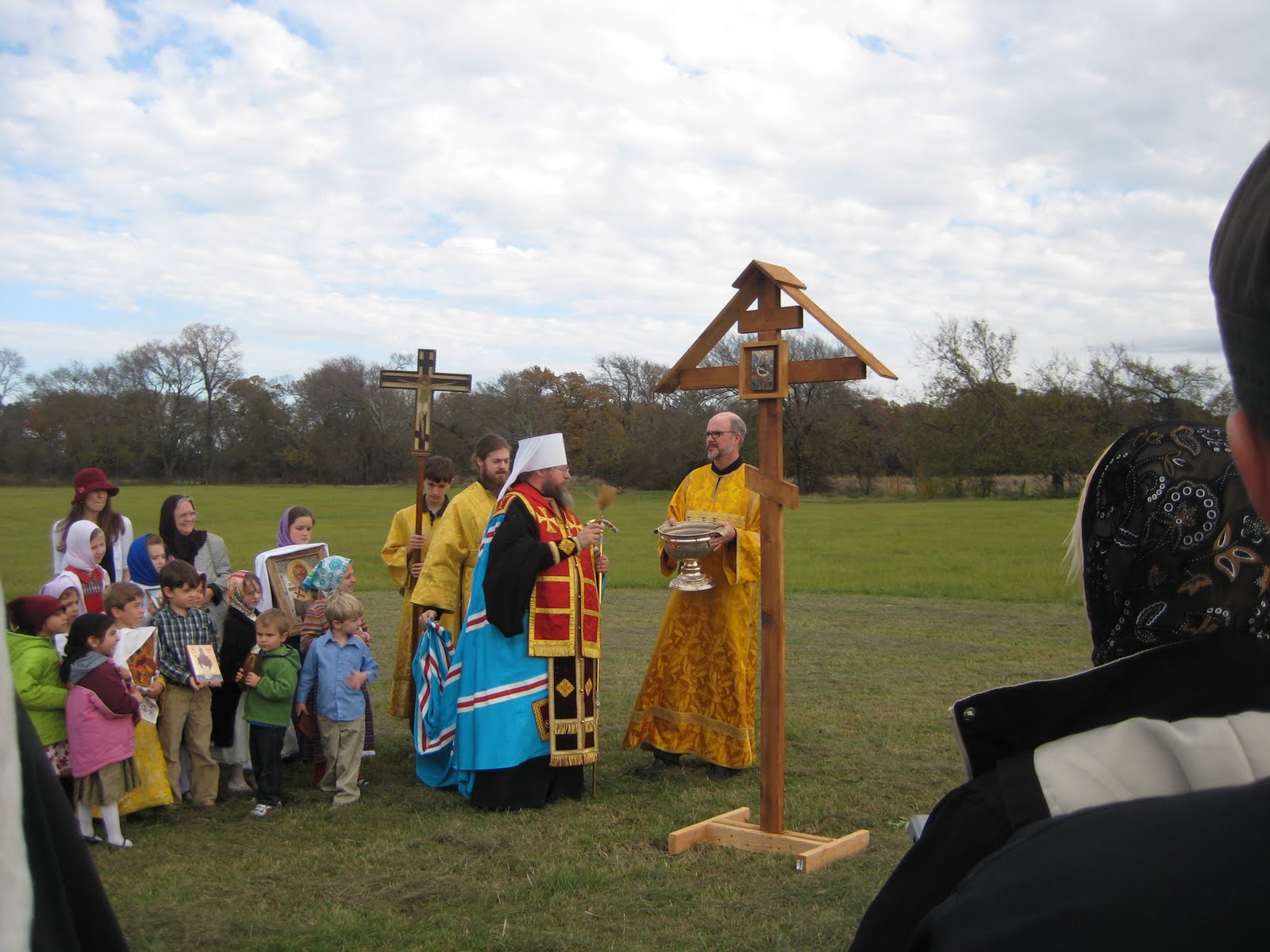
The Nativity of our Lord Jesus Christ Monastery

I had the great privilege today (28 November) to attend the blessing and founding of The Nativity of our Lord Jesus Christ Monastery in Kemp, Texas. Metropolitan Jonah and Vladyka Dmitri presided, with about 135 in attendance.


Tuesday, November 24, 2009

Well Said

This, I like:

I remember being taught that the steps of discipline in regards to prayer are as follows: first just saying the prayers, then paying attention to the words that one is praying, then comprehending mentally what one is praying, and then finally, the movement from the head to the heart. I can think of no teaching or text or Saint that has ever said that one needs to feel prayerful.

and--

I am reminded of how some Georgians at my parish related how the Orthodox culture in America is so strange to them because everyone is so self conscious about it.

from Pactum Serva.

"Where there is no solution, there is no problem"


Two views on the Israel, Palestine and the "Peace Process":


I believe that the Jewish settlements should be allowed to be expanded upon, because that population of Israel is, is going to grow. More and more Jewish people will be flocking to Israel in the days and weeks and months ahead. And I don't think that the Obama administration has any right to tell Israel that the Jewish settlements cannot expand.

(Sarah Palin to Barbara Walters)


The only thing driving the peace process today is inertia and diplomatic habit....It is now more of a calisthenic, like weight-lifting or sit-ups, something diplomats do to stay in shape, but not because they believe anything is going to happen....It is time for a radically new approach....Take down our “Peace-Processing-Is-Us” sign and just go home....Let’s just get out of the picture. Let all these leaders stand in front of their own people and tell them the truth: “My fellow citizens: Nothing is happening; nothing is going to happen. It’s just you and me and the problem we own.”

“When you’re serious, give us a call: 202-456-1414. Ask for Barack. Otherwise, stay out of our lives. We have our own country to fix.”

It is obvious that this Israeli government believes it can have peace with the Palestinians and keep the West Bank, this Palestinian Authority still can’t decide whether to reconcile with the Jewish state or criminalize it and this Hamas leadership would rather let Palestinians live forever in the hellish squalor that is Gaza than give up its crazy fantasy of an Islamic Republic in Palestine.

If we are still begging Israel to stop building settlements, which is so manifestly idiotic, and the Palestinians to come to negotiations, which is so manifestly in their interest, and the Saudis to just give Israel a wink, which is so manifestly pathetic, we are in the wrong place. It’s time to call a halt to this dysfunctional “peace process"....If the status quo is this tolerable for the parties, then I say, let them enjoy it. I just don’t want to subsidize it or anesthetize it anymore. We need to fix America. If and when they get serious, they’ll find us.

(Thomas Friedman, from November 8th)

Monday, November 23, 2009

Two Novembers


Yesterday marked the 46th anniversary of the assassination of President Kennedy. I was too young to remember much about it, although I recall first hearing of it as I came in from the school playground. My parents, of course, had voted for Kennedy. In those days, we did not spend much time in front of the television, or at least not as a family. But this was different, and I recall all of us watching coverage as events unfolded in Dallas and Washington. I was too young to have known of the passionate hatred directed against Kennedy by many in Dallas and in my part of the state.


At that time, a man who would later become my close friend (and mentor) was in his late 20s, living on his East Texas farm. He had gone to Dallas on business, and returned home on the 21st of November. My friend, also a Kennedy man, remarked to his wife that he was shocked, and perhaps a bit shaken by the vitriol he heard against the President in Dallas. The next day he was driving across his pasture and stopped to speak to a seismograph crew going across the meadow. One of them heard the radio coverage of Kennedy's motorcade from my friend's truck and said, "somebody ought to kill the sonofabitch." Not wanting to hang around, my friend eased on across the pasture. Not two minutes later came the news that the President had been shot. He said had he still been by the seismographers, he would have decked the man who had said that.


My friend and I meet every week for lunch, and have done so for over 20 years now. In that time, I have heard many stories, but he related this one only recently. And the context for the telling of it was the similarity he sees with the current extreme and radicalized political discourse again gripping our region.
And then today, another friend sent me this. The recent edition of Esquire (a magazine I am not in the habit of reading) carries a story comparing Kennedy-hatred of 1963 Texas with Obama-hatred of 2009 Texas. The focus of the story is the U.S. Representative from the city in which I work (I live 150 feet into the next district, though my representative is hardly any better.) The story also contains a letter written from a resident of my city 2 days after the Kennedy assassination. The story and letter are fascinating--and sobering. I'm afraid my region had, and has, much to answer for.