I started this blog back in late 2005. For a few years, I posted fast and furiously--138 in 2007. Then gradually it dropped off to the point where I only had 1 post for 2021. What happened? Facebook happened. I let myself be lured by FB's siren song. But I have taken a step or two back from the brink of that abyss. And now I have started blogging again, in a small way. For a number of reasons, I have moved over to Substack. I can be found there at terrycowan.substack.com. This site will stay up, but dormant. So, subscribe (it's free) to my new venture, and I look forward to starting the conversation up again. Best regards, Terry Cowan
Saturday, April 09, 2022


Tuesday, June 01, 2021
Some Artistic Detours
I visited a few art museums on my recent road trip across the Deep South. I have always appreciated beauty, but as the shadows lengthen, so to speak, I have become much more aware of it than before, whether in nature, architecture or art. I do not like just any type of painting, however. I start losing interest at Impressionism, then quickly cool to Cubism, Modernism, Surrealism (excluding Bosch), and any sort of abstract art, which I do not even consider to be art. If abstract art is supposed to speak to us, then I do not like what I am hearing.
My first stop was the Brooks Museum in Memphis, founded by wealthy patrons of the arts in that city. The building is grand enough, anchoring the entrance to Overton Park. I was not particularly impressed with their collection, finding more noteworthy works in much smaller cities. The Brooks does have, however, the most extensive collection of Carroll Cloar, an important 20th-century Southern artist. This was the main reason I sought out the museum. They were nice enough, but my favorite, unsurprisingly, turned out to be Figures in Hell, by the followers of Hieronymous Bosch (ca. 1500).

In Oxford, MS, I had hoped to visit the museum at Ole Miss. That institution contains most of the paintings of Theora Hamblett. The museum has not yet reopened, however. “Miss Theora,” in Southern parlance, was a sort of Deep South Grandma Moses. She ran a boarding house near the campus and took up painting late in life. Her primitivist works most often depicted children, trees and household scenes. More and more, however, her work began to reflect her spiritual visions, as she believed she received angelic messages directly.

Oddly enough, she was “discovered” at the same time and place as Andy Warhol, and her work soon became collectible to the cognoscenti, exhibited in New York, Paris and elsewhere. Miss Theora’s style is not exactly my sort of thing, but I found them intriguing, nonetheless. I had another reason for searching her out, for it turns out Theora was a distant relative. Her grandmother was the sister of my great-great-great-great-grandmother, which makes us, well, hardly kin at all. I correspond with a couple of cousins who knew her. But no matter, I enjoyed going down this rabbit hole.
While in the area, I searched out her grave, in the isolated Hamblett Cemetery. This is William Faulkner’s Yoknapatawpha territory. The unkempt cemetery, atop a forlorn and scraggly knob and surrounded by a commercial pine forest, fits the stereotypical image of Faulkner’s creation. Her grave is nice enough, obviously erected by her devotees. Her father, a first cousin to my great-great-great-grandmother, was seventy-one year old at her birth. She lies buried next to him.

While I was staying in eastern Georgia, I visited the Morris Museum of Southern Art in Augusta. In my estimation, this is one of the hidden gems of the South--so many great pieces. A few that were memorable: Atonement by Luke Allsbrook, Dog Thief by William J. Petrie, Surprise Attack near Harper’s Ferry by John Mooney, The Price of Blood by Thomas Noble Satterwhite, and Georgia Crackers by Pamela Vinton Ravenal.
I found Satterwhite’s work to be deeply compelling. Despite the fact that he was a committed abolitionist from Kentucky, he actually fought for the Confederacy. In his post-war career, his paintings tended to reflect his views toward slavery. The Price of Blood is one such work. The painting depicts a wealthy Southern planter, relaxing beside a library table, behind which stands a man of business, a slave trader. The gold coins of the transaction lie neatly piled upon one end of the table, with the brandy decanter and glasses anchoring the other. On the left stands a barefoot young mulatto man staring away from the other two men. He is the son of the man who has just sold him. I plan to incorporate this painting into my teaching from here on out.

The artist that really grabbed my attention was William Joseph “Billy Joe” Petrie (1951-1994). I stopped in the gift shop to pick up a few postcard prints of some of the paintings. I collect them and then paste one into my journal, every twenty pages or so. The museum had a sale table of old art catalogs from earlier exhibitions, selling for a dollar each. I picked up a few, including one of the 2005 showing of Petrie’s work. That night, back in my cabin, I read it from cover to cover. I was hooked. His paintings were often of a comical nature, my favorite being Losing My Religion. A young man is exiting a little Baptist-looking country church, a gobsmacked look on his face, with his fingers clutching at his collar as if he couldn’t breathe. In the doorway, the smiling pastor is greeting congregants as they leave, including, it seems, the Devil himself.
The catalog contained a link to a documentary (In Dreams Awake). I learned that Petrie grew up on a Kentucky tobacco farm. He went away to college for a while, but came right back to the farm and family he loved. Petrie single-handedly restored a ramshackle storage shed into his home and studio. And except for a couple of years in Greece, and various other travels, this is where he would stay the rest of his life. He worked in the fields all day, but once the workday was over, he would paint. Friends he made elsewhere flocked to Kentucky, just to be near him. And being near him meant working in the fields during the day, so the farm never suffered from a labor shortage.

Petrie died tragically after falling off a twenty foot ladder. He was taken to the local hospital where the doctor pulled a bottle of medicine out of an open box and administered it to Petrie for the pain. This turned out to be a completely different medication, triggering a diabetic coma from which he died two days later.
During our nation’s bicentennial, the local Women's Club commissioned Petrie to paint a mural within the courthouse that would depict the sweep of Grant County history. Petrie’s homosexuality was not a great secret. Because of this, a local fundamentalist preacher years later would punch a hole in the mural, claiming the loinclothed Indian depicted therein was homoerotic.
On my way back home, I stopped over in Laurel Mississippi, best known today for Ben and Erin Napier and their Home Town on HGTV. Let me just say that Ben and Erin are in no danger of running out of homes to restore in the town. While there, I visited the Lauren Rogers Museum.

Laurel has never been the stereotypical Southern town. It was never really plantation country and Jones County (which may or may not have seceded from Confederate Mississippi) was an island of Unionism in a sea of radical Secessionism. Beginning in the 1890s, Laurel boomed as the center for the exportation of yellow pine lumber, making it, for the first time, a center of great wealth. Laurel’s Silk Stocking Row is about three blocks wide and twelve blocks long, and will compare with any wealthy enclave anywhere. Lauren Rogers (1900-1923) was an only child and heir to two immense timber fortunes. He graduated from Princeton, returned home and married in 1921. He was considered to be intellectually gifted and had a great appreciation for art. He and his wife started building their home just north of downtown, but he died suddenly of appendicitis. His grief stricken parents pulled the house back down to the foundation, and then rebuilt it as the Lauren Rogers Museum. They and other wealthy Laurel families established a Foundation, to which they poured money and paintings. The institution also contains his 10,000 book library. They have never charged an entrance fee. I was greatly impressed with this art museum--absolutely remarkable for a town such as Laurel.
Friday, May 21, 2021
A Few Old Churches Down South
 |
| St. Clement's, Vaiden, MS |
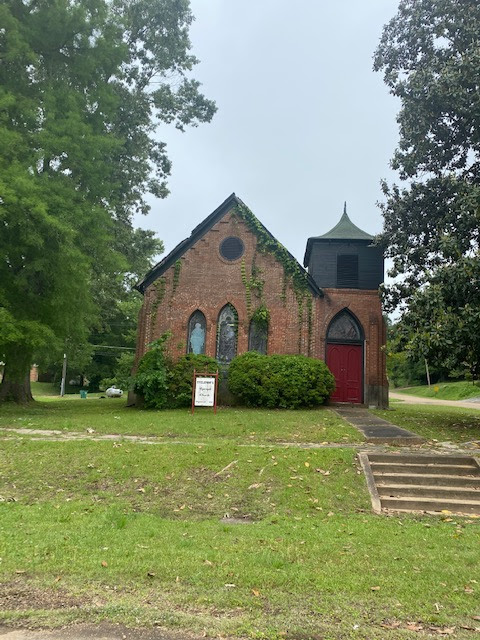
When I am on a road trip, I am always on the lookout for old churches. Modern church architecture interests me not at all, other than to be appalled at what they spent good money to erect. Most of these seem a testament to what Theodore Dalrymple refers to as “The Equality of Ugliness: If we can’t live in a beautiful place, we must all live in an ugly place.”
 |
| Ch. of the Ascension, Water Valley |
From my most recent trips, here are a few from the Pentarchy of Southern Protestant Religiosity--Episcopal, Presbyterian, Methodist, Baptist, Church of Christ--as well as one ringer. To all my friends in these fellowships, please excuse the barbed commentary. I did try to spread it around equally.
Episcopal:
An Episcopal Church in a small Southern town is a sure sign that there was once a degree of concentrated wealth in the locality, with probably some pretensions of culture. I am sympathetic, though a bit ambivalent to Southern Anglicanism. I find it hard to credit them, given the messiness of their founding, spawned as they were from the overheated loins of Henry VIII. I have read too much Eamon Duffy to be a fan of the English Reformation in general, and Cranmer and his Book of Common Prayer in particular. It seems to me that the Elizabethan via media is just Latin for “neither fish nor fowl.” But they did build beautiful churches, which is the purported purpose of this piece.
 |
| Christ Episcopal, St. Joseph, LA |
I found one in the little crossroads of Vaiden, Mississippi. I had stopped to photograph the gravestones of two uncles who had died in camp there in 1862. The town itself proved of interest. Vaiden is the county seat, though too small to support a proper courthouse square. They do, however, have the requisite statue to Confederate veterans. Besides a few old homes, the only other notable architecture is this, St. Clements Episcopal Church from 1859. The church is not currently in use, and a couple of boarded-up windows on the north side are a bad omen. Clearly, the structure is in need of a benefactor.
I found the pristine Church of the Ascension in the bustling downtown of Water Valley, Mississippi, quite a contrast to Vaiden. It reminded me of two other Episcopal churches seen in recent ramblings: 
St. Nathaniel's Episcopal, Melville, LA
Christ Episcopal in St. Joseph, Louisiana, and the St. Nathaniel’s in the dying town of Melville, Louisiana. Once this was a thriving port on the Atchafalaya River. The railroad crossed the river at that point, but the highway did not. Melville is no longer a port of call, and the freight trains crossing there have no need to slow down. In short, Melville is now a backwater at the end of what amounts to a dead-end road. The market there still operates and makes a pretty good muffalata. Back in the day, distant cousins of mine were a big part of the Episcopal Church there and they lie buried under the concrete slabs adjoining, a necessity in this part of the state. The church is now used by the local Woman’s club.
Presbyterian:
There are few rural Presbyterian churches in Texas, but once you cross the Mississippi they are more frequent, though still running far behind the old churches of other sects. But invariably, when you do find them, they are usually quite beautiful. I’m not entirely sure why this is so. Presbyterians always placed a premium on education and perhaps this had something to do with it. Or maybe it was to compensate for the Calvinism contained within. No matter, I always stop to give them a look.
 |
| Presbyterian Church, Rodney, MS |
Historic Rodney Presbyterian is one of the lucky ones. Not in active use since the 1920s, this is about all that is left of Rodney. It is now deep into restoration, thanks to the efforts of an energetic and far-sighted historical foundation.
 |
| Lebanon Church, Toccopola, MS |
 |
| Union Church, Perdue Hill, AL |
Zipping down Highway 84 in southern Alabama, I found the pre-1880 Union Church (formerly Presbyterian) in Perdue Hill.
 |
| Bethsalem Presbyterian, Jefferson, GA |
And finally, there is the first Presbyterian church in Georgia, Bethsalem in Jefferson. My 5th-great grandparents were communicants there in the 1780s, long before the present church was erected. Presbyterian churches were usually classy affairs up until 1960 or so, when they discovered modernism. The least said about those built subsequently, the better.
Methodist:
The much more numerous old Methodist churches of the South give the Episcopalians and Presbyterians a run for their money; maintaining some of the same aesthetic sensibilities without all the theological rigor, such as it is. The oldest I visited was the 1810 Wrightsboro Meeting House. Founded in the 1760s, this is one of the oldest settlements in Georgia, after Savannah and Augusta, and marked the furthest extension of Quakerism in the South. The Quakers laid out an expansive townsite in the midst of their 40,000 acre grant. By the time William Bartram visited in 1773, he described the settlement in almost Edenic terms.
 |
| Wrightsboro Meeting House, GA |
But other peoples started moving in as well, and the Quaker declension was in full throttle. Some of my family moved here in the 1770s as good Quakers, only to reappear as something altogether different in the late 1790s in Kentucky. By the time this meeting house was erected in 1810, the Quakers were either gone or assimilated, leaving only silent field stones in their burial ground about a mile to the east.
 |
| Methodist Church, McKinley, AL |
An excellent example of antebellum architecture for prosperous Methodists is the 1847 church in Jefferson, Alabama. Nearby, but in a much more rural setting is the striking church in the
extinct 
Methodist Church, Jefferson, AL
town of McKinley, complete with a beautiful blue stained glass window. Their earliest and longtime pastor, my 4th great-grandfather Daniel Monaghan, lies buried across the road.
Finally, there is the late 19th-century Methodist church in the port city of St. Joseph. The church is abandoned, as they have a newer ugly Methodist church on the main road. The sagging structure needs help soon.
 |
| Methodist Church, St. Joseph, LA |
Baptist:
 |
| Baptist Church, Rodney, MS |
The Baptists are the default church of the South; there's more of them than all other denominations combined. This very ubiquitousness is, however, their weakness, in my opinion. The broadness of the Southern Baptistocracy sometimes makes them lazy, and leads to their not being taken seriously. And it is not as if they never built lovely churches in the old South, for there were quite a few. I think the sheer weight of the pervasive banal modern Baptist architecture may have colored my perception. The Baptist church in Jefferson, Alabama is as stately as any. The one fast sinking in Rodney, Mississippi is a gem, though one soon to be lost. The 1888 Barbara Lowery Baptist Church in Perdue Hill, Alabama makes an impression, as does one from a later era, Ramah Baptist in Palmetto, Georgia. But I am afraid these tend to be the exceptions.
 |
| Baptist Church, Jefferson, AL |
I do like the simplicity of the Friendship Baptist Church in Wilkes County, Georgia, where I stopped to place small monuments to my 6th-great grandparents either buried there or nearby.
And one occasionally finds little churches like this--Mt. Nebo Baptist in remote Wilkinson County, Georgia. It is as plain as can be, but they did at least have a cross on the roof. I was checking out the old cemetery adjacent, where my 7th-great uncle Dr. John Taliaferro (1734-1821) is buried. In this truly rustic locale, I was pleased to see a knock-off statue of the “Bird Girl” from “Midnight in the Garden of Good and Evil.” I appreciate it when someone stretches for beauty.
 |
| Ramah Baptist Church, Palmetto, GA |
 |
| Friendship Church, Wilkes Co., GA |
 |
| Baptist Church, Perdue Hill, AL |
 |
| Mt. Nebo, Wilkinson County, GA |
Churches of Christ:
 |
| Pineywoods Church of Christ, AL |
Outside of northern Alabama, Tennessee and Texas, one doesn’t see that many Churches of Christ, particularly if you are grading on the Baptist scale. And one almost never sees an historic old Church of Christ building (The isolated Midway congregation in Lampasas County, Texas, where my grandmother worshipped in the 1920s remains, but this is the exception.)
There is a reason for this. After the Civil War, the Christian Church, a unity movement that was never really that united, underwent a rolling 50-year split. One faction, the Disciples, desired mightily to swim in the broad river of American mainline Protestantism. In their headlong pursuit of the same, they ended up with the church buildings, the pianos, and German higher criticism, but in the end suffered the fate of the mainline denominations, perhaps more so than any. The fundamentalist wing, who assumed the name “Churches of Christ” exclusively, was left high and dry, but defiant and clinging to an aggressive and very particular biblical hermeneutic.
I spent 25 adult years in this church--the 7th generation on my grandmother’s side--and I have studied its history in depth. I am familiar with the extreme iconoclasm of their worship and worship spaces where even crosses are verboten. Even so, I was still startled by the starkness of this church, the Pineywoods Church of Christ in rural Randolph County, Alabama.
I found myself at the end of a dirt road, searching a family cemetery, which is literally in the church’s front yard. All of those buried there were my distant relations, one way or the other. Any before I left, I met two more (above ground) who came down on a golf cart to see what I was up to. I was interested to see that they still maintained the rural custom of mounding-up graves. I used to do the same with my favorite uncle at the family graveyard in the Texas Hill Country.
After my genealogical snooping, I walked up to the church to have a look in the blindless windows. Inside and out, this was as plain a church building as I have ever seen. Homemade pews, a lectern, and behind that, a huge classroom size dry-erase board. That was it--nothing else, not a thing on the walls. This was a building designed for instruction; a true “meeting house,” rather than a church. I was reminded of something I heard recently on a podcast of Jonathan Pageau interviewing Paul Kingsnorth:
The Reformation changes the role of the church from being a center for ritual into being a sort of center for moral teaching...what you are getting is a lecture...a lecturer who tells you what Jesus wants you to do.
This is where that road ends. But Kingsnorth's warning applies not only to this humble Church of Christ, but really to all the churches I have noted here and their successors; for this congregation is just an extreme manifestation of the movement that characterizes them all. Time eventually takes care of all our human efforts. But the tragedy here is not the March of Time, but rather the disinterest of those who once believed. To continue with Kingsnorth, just a bit:
As soon as you experience a ritual you think, Oh Goodness me, this is what it is supposed to be about. God’s in the room. A culture can’t survive without rituals and they were all designed to take people to the Divine in some way.
Unitarian-Universalists:
 |
| Universalist Church, Camp Hill, AL |
And now, for the outlier: I would just about expect to see a Sikh temple as I would an old Universalist Church in the South. But that was before I visited Camp Hill, Alabama, a rural hamlet famous for the Lyman Ward Preparatory School, stretched out along a hilltop south of town, and infamous for the 1931 lynching carried out against the Alabama Sharecroppers Union. The First Universalist Church of Camp Hill was established in 1846, with this imposing church built in 1909. It claimed to be the largest of their churches in the Southeast for much of the 20th Century. One is tempted to substitute “only” for “largest.” Remarkably, the congregation continues on in rural, Trumpy Alabama. On their Facebook page, they have posted a meme with a quote from Ralph Waldo Emerson:
Make your own Bible. Select & collect all the words and sentences that in all your readings have been to you like the blast of a trumpet.
Thomas Jefferson would have approved, I think.

Wednesday, May 12, 2021
A Literary Detour
 I turned off Interstate 20 at West Monroe, Louisiana, intending to check out the state's only meadery. only to discover that the establishment had burned about two months earlier. No matter, for I was able to see this town's quirky old downtown district, which warrants a closer look some other time. I have been crossing north Louisiana for over forty years, and I never imagined there would be anything worth exiting past Shreveport until, of course, you get to the Daquiri Drive-Inn at Delta.
From there, I angled northeasterly across the southeastern corner of Arkansas where I crossed the Mississippi River at Greenville. A wealthy cotton port on the river for most of its history, Greenville is one of those places you go if you are looking for vestiges of the Old South as popularly imagined. I was seeking, however, the City Cemetery, in order to visit the grave of William Alexander Percy.
William Alexander Percy (1885-1942) was a Southern writer, poet, man of letters, and aesthete. He is most noted, however, as the mentor of the young kinsman he raised, Walker Percy, who went on to become a famous writer in his own right, and one of my favorites. I read the senior Percy's Lanterns on the Levee many years ago, and have only recently discovered his poetry.
The immense forested cemetery is a bit of a mess--low-lying with standing water (though the Percy plot is on a raised bed), monuments jumbled in every direction, with the vegetation just waiting to take over at the first sign of neglect. In short, it is not as impressive as you would think for a wealthy, prideful place as Greenville. The adjacent Jewish cemetery, itself larger than many city cemeteries for a town this size, by contrast is orderly, high and dry, and meticulously maintained.
The Percy plot is the main attraction due to this larger than life-size statue of a somber, pensive knight, leaning on his sword (no doubt harkening back to the noble medieval English Percys, which this family very much does.) The statue was erected in 1930 for William Alexander Percy's father, LeRoy Percy, a successful planter, attorney, and for a short time, U. S. Senator from Mississippi. The Percys were a notable, but altogether tragic family (see Betram Wyatt-Brown's The House of Percy: Honor, Melancholy, and Imagination in a Southern Family.) On the reverse of the monument is the poem by Matthew Arnold which ends with the lines:
Charge once more then and be dumb,
Let the victors when they come,
When the forts of folly fall,
find thy body by the wall."
William Alexander Percy's simple but elegant slab fronts the stature. An adjacent 1882 epitaph of an earlier LeRoy Percy simply reads "gentleman."
My family rolls their collective eyes about my fanciful plans for our family plot, but at least they do not have to worry about something like this. To reference an inside family joke, I would have to sell the farm. I am not at all sure that the Percys didn't have to do so as well.
The good die when they should live, the evil live when they should die; heroes perish and cowards escape; noble efforts do not succeed because they are noble, and wickedness is consumed in its own nature. Looking at truth is not at first a heartening experience--it becomes so, if at all, only with time, with infinite patience, and with the luck of a little personal happiness.
William Alexander Percy, Lanterns on the Levee
Saturday, September 05, 2020
Summer Reading
This has been a weird summer, for me as it has for most. I have read more than I first thought. I catalog my books only after they have been read, and this is the stack since early summer.
Solovyov and Larionov by Eugene Vodolozkin. Of course he is best known, at least in Orthodox circles, for Laurus. This is his first novel, from about 11 years ago. Vodolozkin is a good storyteller, and this particular tale jumps back and forth between immediate post-Revolution Russia and early post-Soviet Russia. I recommend it, but if you are looking for another Laurus, this is not that. I look forward to reading more from Vodolozkin.

The Quest for Shakespeare by Joseph Pearce. The thrust of this work is the apparent recusant Catholicism of William Shakespeare, hiding in plain sight, you might say. The author certainly lays out a convincing case for it. Pearce’s own story is an interesting one; starting out as an English skinhead and then converting to Catholicism. He is a prolific writer of Catholic polemics, as well as a popular speaker in traditionalist circles. His best works seem to focus on English literary figures who converted to Catholicism, such as Literary Converts.
Too Much is Never Enough by Mary L. Trump. This is not the sort of book I usually buy and I doubt that it will remain in my library. But, I am glad I read it. Ms. Trump does not tell me anything about the kind of person DJT is that I did not already know, or anything that should not be perfectly obvious to anyone who views his actions and words with open eyes. I know what Trump is. I was curious to learn how he got that way. The family is, charitably speaking, grotesque. The women come off no better than the men. By the time he was 8 to 10 years old, the die was already cast for DJT; out of control with a father who laughed at every outrage, humored any whim, funded any debacle. Trumpists dismiss this as the work of a disgruntled heir and a homage to her father against the rest of the family. I will just say that first, she has ample reason to be disgruntled, and second, even her father does not come across all that sympathetically.
Beyond the Dreams of Avarice by Russell Kirk. I enjoy reading Kirk, and this collection of essays did not disappoint. He is credited with being the founder of modern American Conservatism, providing an intellectual foundation to traditionalist thought. I think History will be kind to Kirk in a way that it will not be, for example, to William F. Buckley. He has been gone about 26 years, I think, and long before that time he was something of a Voice in the Wilderness. against what the Conservative Movement was becoming. Those Americans who wear the label Conservative today would be largely unrecognizable to Kirk.
Monsieur Ouine by George Bernanos. Ugh. In the type of journals and sites I visit, Bernanos, said to be one of the great French Catholic writers, is occasionally mentioned as the sort of author who writes the sort of books that someone like me would tend to read. He claimed that this was his greatest novel. I determined that I would finish the thing; mostly dialogue, between which characters I was never really sure. A young boy was killed. An old man died. A floozy woman’s carriage turned over–why and exactly how, I was never able to determine. I was no better informed once I finished than when I began.
Malicroix by Henri Bosco. This author redeems French literature from his contemporary, Bernanos. He writes a compelling, somewhat macabre, and ultimately satisfying read, set in the rural South of France. Bosco has something to say, and I will be looking for other of his works.
Bearings & Distances by Glen Arbery. I rarely read contemporary fiction. I made an exception for Arbery, a professor at a Catholic college in Wyoming, I believe. I was intrigued to read this well received work, it as it had a land surveying angle, the profession in which I spent 35 years. He also sets the story in the South, where politeness, hospitality and sweet tea often provide a thin protective veneer over the mayhem, murder and madness just underneath. Arbery tells a good story, with important lessons about the persistence of family and faith in spite of it all.
Old House of Fear by Russell Kirk. In the early 1960’s, Kirk wrote three novels, today largely unknown. This is the second one I have read. The first was set in post-colonial sub-Saharan Africa, while the setting for this one is on the desolate outermost island in the Hebredes. If he had stayed with writing novels, I think he would be better known today than he is now. These are remarkable stories well told. For many years I have scribbled down memorable passages I read along the way, but they are rarely dialogue from novels. No so with Kirk’s work. Of course his philosophy comes through, as you would expect. But he never beats you over the head with it; he never lets it get in the way of a good story. I will be looking for that third novel, but they are a bit hard to find.
Lost Property: Memoirs and Confessions of a Bad Boy by Ben Sonnenberg. Let’s be clear about this: Sonnenberg is not a sympathetic character. He is urbane, hedonistic, well-fixed, well-read, well-traveled and all that. But there is an emptiness to it all. He knows he is a snot and couldn’t care less. But there is a brutal honesty to his writing; so sharp, so clever, so incisive, that you really can’t put it down.
Proceedings of the Anthony Powell Society Conference, 31 August – 2 September 2018, Merton College Oxford. I did actually read this. The proceedings were edited by longtime friend, Dr. Keith Marshall and the subject was “Anthony Powell and the Visual Arts.” For Powellians, all the papers were certainly worthwhile, but the real treasure was the 78 pages of color plates in the center of the volume. Well done, Keith!
The Crisis in Western Education by Christopher Dawson. My two favorite 20th-Century historians were Sir Steven Runciman and Christopher Dawson, two very different individuals, to be sure. Given enough time, I hope to read everything that each of them published. This 1961 work has been reissued in recent years. Dawson is hardly popular today, but his work on the nature, development and transmission of a culture have stood the test of time, and, in light of contemporary events, have proved to be quite prescient.
Saturday, July 13, 2019
England and Wales, 2019


I charted an ambitious itinerary, though hardly the marathon of some of my previous expeditions. After making a stop in London's Kensal Green Cemetery, I left the city as quickly as possible, making first for Cambridge and the Fitzwilliam Museum, then on to a small riverside inn in nearby Holywell. As luck would have it, they were having their annual well-dressing festivities at the Holy Well of St. Ivo, right down the way. The next day, we were on to Ely, a quick visit with my Spanish friend and almost-cousin Andres, then Little Walsingham, and around the Norfolk coast and back into the East Midlands, staying at an old Edwardian hotel in the working-class town of Wellingborough. Then with a few stops along the way, we made our way to the misty Peak District, but not before a stop Leicester Cathedral for Richard III and at the Ye Olde Trip to Jerusalem pub in Nottingham. The first item of business was to purchase some proper English duds for me in Bakewell: a rain jacket and a pair of wellies. After partaking of the Peak District for a couple of days, we dipped into Birmingham to view the Pre-Raphaelite works there, then stopped by St. Kenelm's Church and holy well, then the Arts and Crafts masterpiece of Wightwick Manor, before settling-in for a number of days in the Welsh Marches. Although we technically stayed in far western Shropshire and Herefordshire, we were all over eastern Wales as well. The attractions here--hiking in the most scenic region of the U.K., snug little pubs, Guinness and homemade gin,

I was in full history professor mode, and the trip definitely took on historical and literary overtones, with me overseeing a variation of Six Degrees of Separation for a number of British authors and artists. Centering on the interrelated notable English families of Asquith and Horner, with stops at the graveyards in Mells and Sutton Courtenay, I was able to link together Edward Burne-Jones, Simeon Solomon, Sigfreid Sassoon, Wilfred Owen, Edith and Osbert Sitwell, Fr. Ronald A. Knox, Anthony Powell, Evelyn Waugh, Alastair Graham, Steven Runciman, Steven Tennant, George Orwell, Prince Antoine Bibescu, Patrick Leigh Fermor and others. And from a small stretch of country road in the Ewyas Valley, I brought in Fr. Ignatius, Digby Dolbein, Francis Kilvert, Eric Gill, David Jones, and Bruce Chatwin. Visits to favorite bookstores in Brampton Bryan and Hay on Wye, necessitated that I had unpack the extra soft suitcase that I had folded up inside my main bag.

In addition, I was able to visit with several literary acquaintances made through the years. We had tea with Nicolas and Frances McDowell, proprietors of The Old Stile Press, at their lovely home on the Wye River. We talked of many things, including the Richard Barnfield and Alice Meynell works I received from them. Late in the trip, we had a fascinating meeting with Tom Sawford at a Middle Wallop pub. If enthusiasm counts for anything at all, then Tom is far ahead of the game. He is responsible for this website devoted to all things Patrick Leigh Fermor. Tom presented me with a first British edition copy of Between the Woods and the Water, for which I was deeply touched. Finally, at Caffe Nero in Heathrow Terminal 5, James and I visited with my longtime correspondent, Keith Marshall and wife Noreen. Keith is the moving force behind The Anthony Powell Society, of which I am a founding member. We enjoyed a quick hour discussing AP, parting with hopes for future meetings. And in one obscure and only tangentially literary association, we chatted with a nice elderly monk, whom I had met before, at the Orthodox Shrine of St. Edward King and Martyr. I thought this jogged something in my memory, and once home discovered he had been mentioned in passing in the recent biography of Sir Steven Runciman.

We largely stayed in small inns, usually just a cluster of rooms above a pub. This suited to a tee. We probably had nicer rooms in the venues more on the hotel end of the spectrum, but at the cost of the low key ambiance we were after. I believe that the countryside was something of an eye-opener for James. And I'm not above learning a thing or two along the way myself, even at my age. Over a short course of time, I became a full-fledged convert to the British style of drinking ale and beer; no more ill-considered complaints from me along those lines. In fact, I now actually prefer it that way, and a pint of Guinness in particular. James was an excellent coach in this regard. I do not mean to imply that it was all boozy Guinness nights. On some days I opted for G & Ts.

Given my interests, we found ourselves visiting a number of old churches, both large and small. There are, sad to say, simply too many of them, given the U.K.'s post-Christian, if not post-post-Christian culture. Some of the smaller churches have been converted to other uses, while others sit closed up amidst overgrown churchyards. The lucky ones still have a semblance of parish life, sometimes even a vibrant one at that. The larger churches and cathedrals are the ones where I feel most removed from any real sense of holiness or that it is still even a place of worship. And whether large or small, seemingly all have to resort to using their building for community centers, concerts, plays and lectures to try and make ends meet. The larger cathedral churches are sometimes roped off, where admittance is charged to stroll through the sanctuary (such as in Ely). Pleas for donations are everywhere. Many of them post figures of how much it costs every day to keep the church open. I am suspicious of these figures, but if true then I think I would just throw up my hands in hopelessness.

Without being too judgmental about it all, I would say that the problem is baked-in. In Orthodox lands, the scale is much smaller. Even in larger churches with a soaring dome, the interior space is actually quite small and intimate. And the simplicity of Orthodox design means that these churches could be rebuilt or restored or repaired through the ages relatively affordably. The English churches, once they left the simplicity of the Anglo-Saxon age and moved into the Romanesque and then the Gothic high Middle Ages, seem to me to be ever more difficult to maintain or repair given their height and immense size. I'm not sure how they will be able to do it, going forward. If the U.K. were still a land of church-goers, then this would not be a problem, but it hasn't been that for a long time. One thing I have noticed, is that in their interpretive instructions to visitors, they often note how the church had once been awash in color, before, of course, things started going off the rails in the English Reformation.

In one Norman church, tucked away in a corner of Radnorshire, I showed James an
exquisitely sculptured font dating from the early 1100s; said to be the best preserved from that era in the entire country. Amidst the intricate design was a Norman version of the Harrowing of Hell, a familiar subject in Orthodox iconography. Six weeks earlier, half a world away in a tiny Orthodox church high in the remote Caucasus mountains, we viewed the same scene, albeit on a frescoed wall. More than anything else we've seen and talked about recently, this spoke to the overall unity and universality of the Faith prior to the Reformation.
Before leaving home, I figured this would be my last trip to the U.K. (as well it might be). But if I am granted enough time, I will return. I am already thinking about next summer--Ireland, the Isle of Man and the North. We will see. But from this journey, a few of my favorites, below:
FAVORITE SCENERY AND/OR VIEWPOINT:
Offa's Dyke Path atop the Black Mountains, even with Llanthony; views of Ewyas Valley and Wales to the west and the Golden Valley and Herefordshire to the east.
The B4391 between Llanfyllin and Pennant Melangell in Wales
The road approaching Trevique Farm, off the B2363 out of Boscastle, Cornwall.
FAVORITE COUNTRY ROAD:
The drive between The Bridges and Church Stretton in Shropshire.
FAVORITE HIKING:
Offa's Dyke Path in the Black Mountains of Wales
Coastal Pathway in northwest Cornwall.
FAVORITE SMALL TOWN:
James loved Hay on Wye--no argument there.
Bakewell in the Peak District is also a contender
FAVORITE VILLAGE:
Most any of them
FAVORITE PUB:
The Stiperstones Inn, Stiperstones, Shropshire--home of their homemade Whinberry Gin
The Napoleon Inn, Boscastle, Cornwall
The Cobwell Inn, Boscastle, Cornwall
The Jug and Glass, Peak District--where I was introduced to the "Gimm's Cup," a Pimm's Cup topped off with cucumber gin
FAVORITE CHURCH:
James' favorite by far was Abbe Dore in Herefordshire, and I agree.
For a quintessential village church, St. David's at Kilpeck, Herefordshire is hard to beat

Subscribe to:
Posts (Atom)