Friday, May 05, 2006

A Little Foolishness


I have recently enjoyed re-reading from one of my favorite theologians and perhaps the greatest American writer of the 20th Century: Flannery O’Connor. To the uninitiated, her tales could be dismissed as Southern gothic grotesqueries. But as someone who has always lived in the small-town South, I find her characterizations are never far off mark. On innumerable occasions, my wife and I have found ourselves sitting around the kitchen table, discussing some situation or another, and remarking that it is something straight out of Flannery O’Connor. Her stories are all about the persistent intrusion of grace and redemption into our world, though never in ways that the protagonists would ever imagine.

I have particularly enjoyed reading her 1954 story, “The Displaced Person.” Often called “D.P.s” for short, the term refers to post-WWII European refugees. The story particular resonates in light of the current hubbub over immigration in this country. Mrs. McIntyre is a strong-willed, self sufficient Georgia farm woman. The Shortleys are the white couple who (mis)manage her operation. Several black farm workers live on the place, as well. Their world is turned upside-down when Father Flynn, an aged Irish-Catholic priest, arranges to place a refugee Polish family on the farm. These hard-working “D.P.s” soon engender jealousy and hostility from the insular farm community—exposing the racism, xenophobia, prejudice, selfishness and just plain small-mindedness of their hosts. The story ends tragically, but through suffering O’Connor forces her characters to face their own “displacedness” and to recognize, however reluctantly, the workings of God in their life. One of the clear messages of the story is that we are all “displaced persons.” None of us are in our true country.

I find two of O’Connor’s symbols of especial interest: a peacock and the priest. I believe that the peacock represents the persistent (and unwanted) presence of the Divine on the farm. In fact, the peacock is something of a rebuke to many of the characters, “his attention fixed on something no one else could see.” All try to ignore it, save the priest. Father Flynn was "glowing with pleasure" when he viewed the sublime beauty of the bird—“a vision for them all.” When the peacock spread his feathers, “the priest stood transfixed, his jaw slack,” exclaiming “Christ will come like that!” and later, “the Transfiguration!”

Of course, Mrs. Shortley will have none of that. The story actually begins with “the peacock was following Mrs. Shortley up the road…” Later, with its tail spread before her “she might have been looking at a map of the universe but she didn’t notice it any more than she did the spots of sky that cracked the dull green of the tree.” To Father Flynn’s admiration, Mrs. Shortley responded that it was “nothing but a peachicken.” Mrs. McIntyre was no better, dismissing the glorious bird as just “another mouth to feed.” She admitted that she kept it only out of superstitious fear, but “when the peachicken dies, there won’t be any replacements.”

Father Flynn represents—on an obvious level--the Church, or at least her testimony in the world, the Gospel. The Southern ladies are equally dismissive of this Church and all his talk about Christ. “Mrs. McIntyre’s face assumed a set puritanical expression and she reddened. Christ in the conversation embarrassed her the way sex had her mother.” She rebuked the priest and explained to him that she didn’t find herself “responsible for all the extra people in the world.” As he would talk to her about the doctrines of the church, she would wonder “where she had ever seen such an idiotic old man.” Yet, in the end, alone and paralyzed, only Father Flynn came to visit, talking to her about the “doctrines of the Church.”

Mrs. Shortley had even less use for the priest and “his visits irked her more and more.” She called him foolish—“He don’t look smart…kind of foolish.” She told her husband, Chancey, of the priest and the Poles, that “these people did not have an advanced religion. There was no telling what they believed since none of the foolishness had been reformed out of it.” Declaring that the priest was planning to “plant the Whore of Babylon in the midst of the righteous,” the undeceived Mrs. Shortley observed that “they’re full of crooked ways. They never have advanced or reformed. They got the same religion as a thousand years ago. It could only be the devil responsible for that.” Yet “she had never given much thought to the devil for she felt that religion was essentially for those people who didn’t have the brains to avoid evil without it. For people like herself, for people of gumption, it was a social occasion providing the opportunity to sing; but if she had ever given it much thought, she would have considered the devil the head of it and God the hanger-on.” Mrs. Shortley compared the priest and the Poles unfavorably to her son, H. C., who “was going to Bible school now and when he finished he was going to start him a church. He had a strong sweet voice for hymns and could sell anything.” She knew “that the Lord God Almighty had created the strong people to do what had to be done and she felt that she would be ready when she was called.”

Foolishness. I understand the mind of Mrs. Shortley--the self-sufficient, self-satisfied myth of “strong people,” secure in their own country. This characterizes much of my own upbringing. The priest and all he represents would have been to me and mine, foolishness. Like Mrs. Shortley noted, our religion had had all the foolishness “reformed out of it.” And the beauty. And the mystery. And the glory. And the humility. To the extent that I have had any spiritual growth at all, it is has been away from my own knowledge, my own logic, my own rationality, my own opinion, and towards foolishness. Thank God for foolishness. Even Mrs. Shortley at the last "seemed to contemplate for the first time the tremendous frontiers of her true country." We all do eventually, one way or another.

Friday, April 21, 2006

More from St. Ephraim the Syrian


Last month, I commented on my discovery of A Spiritual Psalter by St. Ephraim the Syrian. This book continues to be a blessing to me, and has really helped me through the Lenten season. The psalter contains 150 prayers and hymns. I started off bookmarking those that were especially meaningful to me, but I was soon bookmarking just about every other page.

Outside of Orthodoxy, I suspect St. Ephraim is a fairly unknown figure, and this is certainly the case within Protestant circles. Without criticizing the Prots (for I was one most of my life), it seemed we often acted as though church history began with the Reformation. My particular religious heritage did make a lot of noise about the "first century church," but there was no place in it for the writings of the 2nd, 3rd, 4th and 5th century saints and martyrs. St. Ephraim, and others such as St. Cyril, St. Athanasius, St. Gregory, St. Basil, St. John of Damascus were unknown to us (and if known, we would have never put the "St." in front of their names). Also, evangelicals have sometimes acted as if they "discovered" the concept of grace. St. Ephraim knew a thing or two about it in the 4th century, it seems.

Having thus exposed the wiles of the enemy, tell him with conviction: I have had enough of you, O devil. And leave the evil one and join yourself to the man-befriending God. Are you wounded? Despair not. Have you fallen? Get up and say bravely: now I have begun. Fall down before your merciful Master and confess your sins.

But before you say anything He will already know what you intend to say. Before you open your lips, He will see what is in your heart. You will not be able to say, "I have sinned," before you see Him stretch forth His hands to receive and embrace you.

Approach with faith and He will cleanse you straightway as He cleansed the leper, lift you from your bed as He lifted the paralytic, and raise your from the dead as He raised Lazarus.


One of my favorite old-time gospel hymns was "Marching to Zion." It still resonates with me and I love the mental picture it conveys. What I now realize is how impoverished that march is without being accompanied by, and encouraged by the likes of St. Ephraim and all the others.

Monday, April 17, 2006

More Bad News


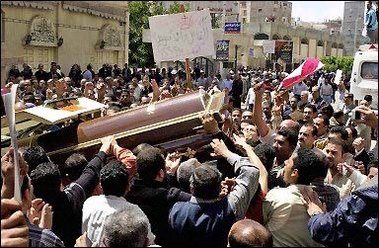
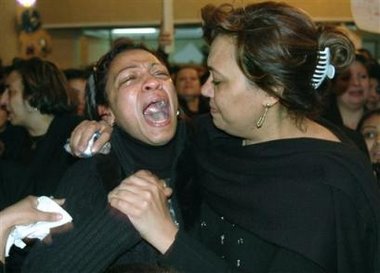
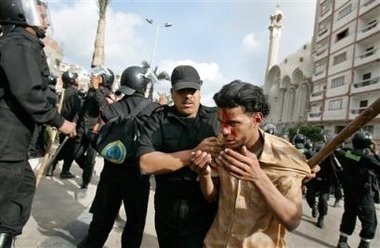
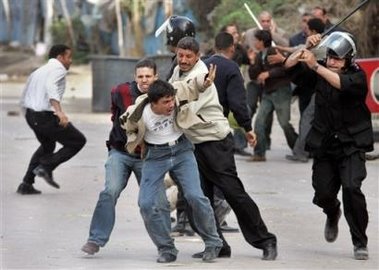
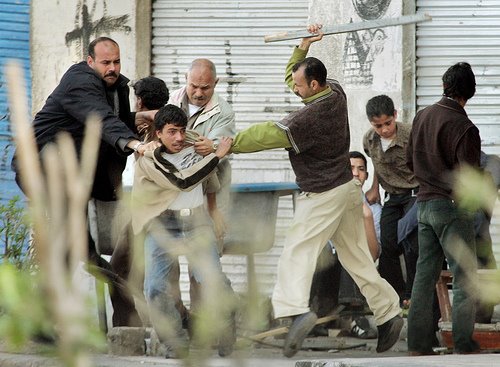
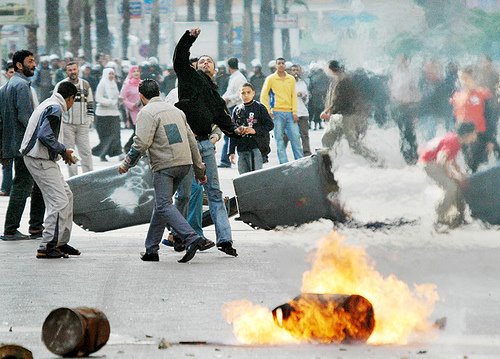
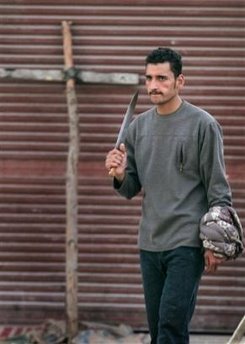
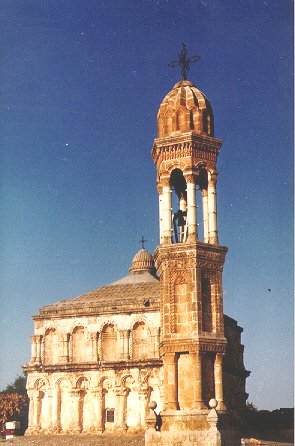
The violence in Egypt seems to be escalating. Typically, it is receiving little press over here. A short AP story did note, however that "this attack was the first in recent memory in which Muslims attacked Christians inside the churches while they were praying" and they quoted from an official in the Orthodox Church in Alexandria, who said "these tensions are the harvest of 30 years of Muslim fundamentalists spreading hate speech from the mosques.” Go to Sand Monkey's blog here for the full story, as usual.
These pictures tell the story.


Friday, April 14, 2006

A Bad Friday in Egypt


It seems that Muslim extremists have attacked Coptic churches in Egypt (again), resulting in 1 death and at least 12 injuries. See story here. Middle East news agencies typically discount the attacks as aberrant behavior, with the attackers characterized as mentally unstable (see here). Yeah, right. For the real story and voices of sanity from Muslim Egypt, check out Big Pharoah here and Sandmonkey here. The comments to Sandmonkey's post are particularly good. Just food for thought as Americans--Catholic and Protestant this Sunday, and we Orthodox next Sunday--toddle off to Easter services at our safe and comfortable churches.

Sunday, April 02, 2006

A Real "War on Christians"


Yesterday, I went on at some length about Tom Delay and his appearance at the "War on Christians" conference in Washington. I noted that what the conferees considered "war"--Hollywood, liberal media, political activism, etc.--was weak tea indeed when compared to the real life war on Christians in many parts of the world. An excerpt from Lawrence F. Kaplan's excellent article carried in today's Dallas Morning News is exactly what I'm talking about.

There are about 800,000 believers remaining in Iraq's ancient Christian community, mainly Chaldean Catholics and Syrian Orthodox. There used to be more; many more. It seems that these Christians are "today's victims of choice." In fact, it is the one thing that the Sunnis, Shiites and Kurds can all agree on--the brutalization of their Christian neighbors. Even though Christians predated Moslems by over 500 years in Iraq, they are nevertheless seen as emissaries of the West. Because of this, they are especially targetted for kidnappings, executions and beheadings. Many of the churches have been bombed, and more and more Christians are worshipping at home, or even in the crypts (how is that for some 1st Century authenticity!) Anyone that can get out is doing so. Most can't. What is the US government doing? Nothing. What are American evangelicals doing? With typical perceptiveness, they are oblivious to the Iraqi's plight and are actually making the situation much worse.

For the entire article, go here. But at least read the following excerpt:

To the lengthy indictment of Christians, their persecutors have also added the charge of proselytizing. Unlike American soldiers, who mean to save Iraqi lives, the American evangelicals who followed on their heels mean to save Iraqi souls. The infusion of pamphlets and missionaries from organizations like the International Mission Board of the Southern Baptist Convention enrages Iraqi Muslims, who, Iraqi Christian leaders claim, increasingly conflate their congregants with "the crusaders" – and, too often, treat them as such.

"The evangelicals have caused such problems for us," says Mr. Kanna. "They make the Sunni and Shia furious."

Even though Iraq's Christians suffer in the name of their American co-religionists, their fate seems not to have made the slightest impression on much of the evangelical establishment. Their Web sites and promotional literature advertise the importance of creating new Christian communities in Iraq while mostly ignoring the obligation to save ancient ones. Nor, with a few exceptions, have mainstream church leaders in the United States broached the subject, either. Dr. Carl Moeller, the president of Open Doors USA, an organization that supports persecuted Christians abroad, pins the blame on Christianity's own sectarian rifts. "The denominations in Iraq aren't recognized by Americans," he explains. "The underlying attitude is, 'They're not us.' "


What have we done?

Saturday, April 01, 2006

The Almost Formerly Important

"When the powers that be are done with you, we mainline liberals will have a rocking chair for you at the retirement home of the formerly religiously important."

Jason Byassee, addressing evangelicals in the March issue of Christianity Today. For more, go here.

An Odor of Mendacity

I have been out of town for the better part of a week, and removed from my usual sources of information (not a bad thing, actually). In getting caught up on the news, I find that our old buddy Rep. Tom Delay is still in the headlines, this time from a speech given at a “War on Christians” conference in Washington. From someone who is still "working out my own salvation," I'm not about to pass judgment on someone else's faith. Yet public piety and cheap religiousity is always suspect, particularly from someone who, in his Texas Legislature days was nicknamed “Hot Tub Tom” by his colleagues (this, in fact, from a colleague).

In reading about the conference, I remembered just who Delay reminded me of. In the 1958 movie adaptation of the Southern gothic stage classic, Cat on a Hot Tin Roof, the actor Jack Carson portrayed Big Daddy Pollitt’s oily, fast-talking and conniving older son, Gooper. Yep, Gooper. Tom Delay is simply Gooper Pollitt writ large on the national scene.

The theme of the Washington conference leaves me uneasy. Delay told the adoring crowd that “the enemies of virtue may be on the march, but they have not won.” Now, there is nothing inherently wrong with that statement—it is indeed, the Christian hope, for in the end, the Enemy will NOT win. But, you know this is not what "Team Delay, with its paladins of public piety" had in mind. In their war, the battle is waged with conservative political activism, PACs, Capitalism as gospel, while railing against Hollywood, the gay-rights crowd, and of course the liberal media and so on. There is, of course, a battle going on, but its true nature is more accurately described in Ephesians 6:12. The conference organizer likened Delay’s deepening ethical and legal problems to Christ’s Passion, concluding that “God always does his best work after a crucifixion.” I kid you not, he actually said that. You can’t make up crap like this.

But I guess the real thing that bothers me is that it cheapens and takes away from the very real, “war on Christians.” We caught a glimpse of that last week in the trial of the Abdul Rahman. The entire Soviet era was very much a “war on Christians” as perhaps millions of Russian martyrs attest. Ever so often, churches (and Christians) are bombed in Pakistan. Christians are arrested in Iran. Just a few years back, the Indonesians were butchering the Catholic East Timorese. The Sudanese government—before their current butchery in Darfur—were killing Christians in the south of that country. My church has a large contingent of Orthodox Christian refugees from Eritrea. The Egyptian Copts are routinely persecuted. The diminishing Arab Christians in the Middle East, after 1400 years of dhimmitude, are now caught in the squeeze between the Muslim and the Jews, as well as suffering the backlash from Western policies in the region. Now these are real, actual “wars on Christians.” But I doubt that this is what Delay was thinking about. Perhaps he should.

This brings me back to Cat on a Hot Tin Roof. My favorite lines include:

BRICK: Have you ever heard the word “mendacity”?
BIG DADDY: Sure. Mendacity is one of them five dollar words that cheap politicians throw back and forth at each other.
BRICK: You know what it means?
BIG DADDY: Don’t it mean lying and liars?
BRICK: Yes, sir, lying and liars.

And then this from the movie:

What's that smell in this room? Didn't you notice it, Brick? Didn't you notice the powerful and obnoxious odor of mendacity in this room?

A powerful and obnoxious odor of mendacity, indeed.

Friday, March 24, 2006

The Spiritual Psalter

St. Ephraim the Syrian is a favorite of mine among the Church Fathers. His writings continue to affect me in wonderful ways. I recently purchased a small book entitled A Spiritual Psalter, or Reflections on God, excerpted by Bishop Theophan the Recluse from the works of our Holy Father Ephraim the Syrian. I highly recommend it. I don't know how readily available the book is, but I do know you can purchase it from the St. Isaac the Syrian Skete here. I have copied a couple of examples from the book, below:

#41

Woe is me, to what judgement will I be subject, and of what disgrace am I worthy! My inner self is not like my outward appearance: I talk about how to fee oneself from the passions, but day and night I myself think about disgraceful passions. I conduct discussions about purity, but myself, I indulge in indecent behavior.

Alas! What trials await me? the truth is that I bear the image of righteousness, but lack its capacity. What face shall I who am guilty of such indecency wear when I approach the Lord God Who knows the secrets of my heart? When I stand in prayer, I am afraid gha fire will descend from heaven and burn me up, as it happened in the desert that there came out a fire from the lord that consumed the men who offered strange incense.

What can I expect, I who am weighted down with sucha heavy burden of sins? My heart is consumed with fire, my mind is clouded, righteous thougths have failed in me: like a dog do I ever return to my own vomit.

I have no boldness before Him Who will try my heart and inner workings. I have no clean thoughts, no tears while praying. Although I sigh and fall prostrate on my shame-filled face and beat my chest--this is a dwelling place of passions, a sweatshop of evil thoughts.

Thou knowest, O Lord, my passions hidden in darkness; the sores of my soul are known to Thee. Heal me, O Lord, and I will be healed. If Thou wilt not build the hourse of my soul, I labor in vain trying to build it myself.

It is true that sometimes I prepare myself to do battle with the passions when htey war against me; but the evil wiles of the serpent paralyze the efforts of my sould with sensuality and yield to them. Though no one visibly ties my hands, the invisible passions drag me away like a captive.

O Lord, enlighten the eyes of my heart, that I might rightly recognize the deceit and the malice of the passions. May Thy grace shield me, that I might be able to stand firm and resist, having girded my loins with courage.

Once Thou, O Lord, didst provide safe passage through the impassable sea for Thy people. Thou gavest Thy people who thirsted water out of a hard rock. Thou alone, according to Thy grace, didst save the one who fell in with theives. Have mercy upon me as well, for I have also fallen into the hands of thieves and, like a captive, I am bound by wicked thoughts.

No one is trong enough to heal the passionate temperament of my soul except Thou, O Lord, Who knowest the depths of my soul. Condescend and save me by Thy kindness!


and

#50

Have mercy on me, O God, according to Thy great mercy, and according to the multitude of Thy compassions, blot out my trangression. For if Thou wilt have mercy on me and free me from the pitiful affliction of the passions--if only Thou wilt have mercy on me, then will I willingly obey Thy grace.

If Thou wilt do this according to the greatness of Thy goodness, then wilt Thou deliver me. If Thou wilt pour out upon me Thy goodness, I will be saved.

I am certain that this is possible for Thee. I know that Thou hast forgiver and dost forgive all who turn to Thee with all their strength.

I confess that I have enjoyed the benefits of Thy grace many times already; but each time I have rejected Thy grace and sinned as no other has sinned.

But Thou, Who has resurrected the dead, raise also me who am deadened by sin. Thou Who hast healed the blind, enlighten the clouded eyes of my heart. Thou Who hast delivered Adam from the mouth of the serpent, pull me out of the mire of mine iniquities; for I too belong among Thy sheep, though I have by my own free choice become food for lions.

Sins have made of me a god; but, healed by Thy grace, I will become Thy son. I was thrown out like a corpse, but if Thou so desirest I will be brought to life.

I know that I have sinned consciously, but I have Thy saints to pray for me. I know that I exceed every measure with my sins, but Thy goodness is unsurpassable.

Thou Who hast preferred the publican, prefer also me, who recognize that I have done many more vile deeds than he. Thou, O Lord, hadst mercy on Zacchaeus who was unworthy. Likewise have mercy on me who am also unworthy.

Paul was once a wolf, and chased the sheep of Thy flock; but according to Thy grace he became a pastor who diligently cared for the sheep.

I know that he sinnes in ognorance, and that he was vouchsafed forgiveness of his sins and much grace because of his ignorance. But Thou, O Lord, condemn my sin committed in knowledge, and have mercy on me according to Thine exceedingly abundant grace.

Thursday, March 23, 2006

A Fool for Christ (continued)

I try to read the New York Times whenever I can. I often differ with their positions, but for better or for worse, they still frame the debate in this country. I can support wholeheartedly, however, their stance in today's editorial about the Afghani on trial for Christianity (see previous post). You'll find no mealy-mouth platitudes, here.

Wednesday, March 22, 2006

A Fool for Christ


Before you get too comfortable with the status of the new Afghani democracy, you might want to read this. It seems Abdul Rahman is on trial, facing a death sentence for the greatest crime one can commit in Afghanistan. That's right, Abdul Rahman is a Christian. He even confessed to his crime: "They want to sentence me to death and I accept it, but I am not a deserter and not an infidel. I am a Christian, which means I believe in the Trinity."

The Afghani government--desperately seeking a way out of this public relations nightmare--has hit upon a solution: declare Rahman insane, as no Muslim in their right mind would convert to Christianity. "We think he could be mad. He is not a normal person. He doesn't talk like a normal person," prosecutor Sarinwal Zamari told The Associated Press. But this isn't anything new--as St. Paul noted, "we are fools for Christ" (1 Cor. 4:10).

The charges would be dropped if only Abdul would renounce Christ. The prosecutor, Abdul Wasi, said he had offered to drop the charges if Mr Rahman converted back to Islam, but he refused. "He would have been forgiven if he changed back. But he said he was a Christian and would always remain one," Mr Wasi said. "We are Muslims and becoming a Christian is against our laws. He must get the death penalty." At least give the prosecutor credit for being honest. There is no way Western apologists can put a smiley face on that kind of statement. Of course, this reminds me of the innumerable accounts of the early martyrs. All they had to do was deny Christ before their Roman accusers and their lives would be spared. Invariably, they refused to do so.

For an always colorful discussion of this and other Middle Eastern outrages and absurdities--but from an Egyptian perspective--check out Sand Monkey here.

For a courageous commentary on this issue, and the plight of Christians in the Middle East in general, from a Jordanian Christian read here.

And say a prayer for Abdul Rahman.

Friday, March 17, 2006

Open at Both Ends


Flannery O'Connor, who always had a way of getting to the heart of things, once observed that "one of the good things about Protestantism is that it always contains the seeds of its own reversal. It is open at both ends--at one end to Catholicism, at the other to unbelief." I have come to agree with O'Connor--that Protestantism is inherently self-destructive. This may seem a strange notion, living as we do in the Land of the Megachurch. But historians, I suppose, take a little longer view of things. Anyway, for a good read on what is going on in Evangelicalism today--and a fine example of the last part of O'Connor's statement--read the review of George Barna's Revolution in Christianity Today here.

I am particularly struck by this disturbing paragraph from the article:

Churching Alone

Still, Revolution's emphasis on personal choice would make a marketer rejoice and an apostle weep. Barna expects to see believers "choosing from a proliferation of options, weaving together a set of favored alternatives into a unique tapestry that constitutes the personal 'church' of the individual." The phrase "personal 'church' of the individual" must be the most mind-spinning phrase ever written about the church of Jesus Christ. Could it be that we evangelical Protestants, who have done more to fragment Christendom than any other group, are now taking that to the logical extreme: a church at the individual level, each person creating a personal "church" experience? At any other point in church history, "personal church" would be nonsensical. In today's America, it's the Next Big Thing.

On the Road—Part 4


Occasional thoughts on my spiritual journey

In my previous installment on this topic, I related my first exposure to the Orthodox faith during a 2003 trip to Bulgaria. Upon return to the US, my life quickly resumed its familiar pattern of work, home, and church. Things rocked along much as they had before--that is, until my encounter with the Church Fathers.

Above all else, you could characterize me, my wife and my son as readers. One cannot sit or lie down anywhere in our home without being within arms reach of a book, magazine or newspaper. Our bedrooms are no different, with books stacked on the floor and nightstands. And that’s the way we like it. About two months after my return, I was sleeping in our son’s bed, as we had overnight company who were using our bedroom. I reached underneath the bed to extract a book to read before going to sleep. What I pulled out was a small volume entitled Early Christian Writings: The Apostolic Fathers. I remember buying the book at a used book store about 15 years earlier, but had never gotten around to reading it. I suppose I was ready for it now.

I chose the section on Ignatius, probably because it consisted of only 7 short letters. As a history major, it is somewhat embarrassing to admit now that I really knew nothing of the man. In the short introduction to the letters, I learned that he was the third bishop of Antioch; had been so from about 69 AD; and penned these letters on his way to martyrdom in Rome in 107 AD.

Yet even this biographical information was challenging to my own particular religious presuppositions--for I was a Protestant of the Restorationist persuasion. Briefly put, we subscribed to the “great apostasy” view of church history. Adherents believe that the church went into a steep doctrinal tailspin soon after the death of the last apostle, John. Although pockets of “New Testament Christians" were supposedly in evidence throughout the ages, things basically continued to deteriorate until the Reformation, which saw a partial recovery.

But while we saw the Reformation as corrective, we viewed it as incomplete, a half-measure, as it sought only to reform, rather than restore the church to its New Testament purity. This view remains distinctly ahistorical, seeing the church as being above history and not being subject to historical forces; that it could be “restored” at any time using the “blueprint” of the New Testament. This restoration had to wait until the early years of the 19th century, however, when American frontier revivalists initiated what we referred to as “the Restoration Movement.” So, after 1700 years or so, it would seem that someone had finally figured out how to interpret the Bible correctly. Now, I say that a little facetiously and I realize that I am painting with a very broad brush here. Many sincere, faithful Christians in Restorationist churches today would scoff at this simplistic view. Indeed, perhaps sensing the inherent fallacies in the argument, most of the churches are downright sheepish about using this terminology anymore. And yet, this view accurately describes how Restorationists see themselves in history and remains the foundational understanding which under girds all these churches and sets the parameters for the way they continue to “do church.”

The Restoration Movement was very much a product of the American frontier, drinking deeply from prevailing concepts of liberty and individualism and being nourished on the tenets of the 18th century Scottish Enlightenment. They were confident that the intelligent, sincere inquirer could open his Bible, and with logic and rationality, deduce what God wanted him to do. They could avoid all the fractious, bickering denominations and become simply “New Testament Christians." From this vantage point, the early leaders gleaned from scripture that the "first century church" was autonomous in its governance, with each local congregation being led by elders, and being served by deacons, with emphasis on the priesthood of all believers. They perceived no organizational structure beyond the local congregation. The historical development of a hierarchy culminating in the papacy (and they had no concept of developments in the East as being anything separate and apart from Catholicism), was nothing more than the fulfillment of the prophetic warnings of Paul. This was our basic view of church history and when we read the pages of the New Testament, this is the church we saw.

This brings me back to Ignatius and his letters. For the church he quite plainly described was not this church. As Paul, the scales literally fell from my eyes. While I often have trouble remembering names, I am pretty good with chronology. The fact that Ignatius wrote these letters in 107 AD is not in dispute. This means, that to a large degree, his life overlapped the ministry of the Apostles. So, even though the date is 107 AD, this is clearly “first century” stuff. Ignatius’ church was one of bishops and clergy and deacons and laity. The unity of the church was his greatest concern as he approached his martyrdom. He admonished the churches at Ephesus, Magnesia, Trallia, Rome, Philadelphia and Smyrna to be united in Christ; to be submissive and obey their bishops, indeed to “be as submissive to the bishop and to one another as Jesus Christ was to His Father, and as the Apostles were to Christ and the Father; so that there may be complete unity, in the flesh as well as in the spirit.” He spoke freely and with warm, collegial affection for the bishops in these other cities.

Now the Restorationist would have a ready answer for this. They would say that this development was indeed the apostasy that Paul had warned about—the whole “wolves in sheep’s clothing” thing; an apostasy from “simple New Testament Christianity" into a hierarchical power structure. But this response is woefully inadequate. For the general view is that this digression evolved slowly over time. Ignatius was a contemporary of the Apostles. The fact that he served as the third bishop of Antioch from 69 AD to 107 AD places him squarely in the Apostolic age. So, the system of bishops, clergy and deacons were solidly in place by the end of the Apostolic era, rather than a digression that occurred after the Apostles. And if this system was heretical, as Restorationists maintained, then where was the outcry? Where were the voices of opposition? There were none. In fact, the “first century church" understood itself the way Ignatius described it. To be sure, there were schismatics, but they were, as Ignatius related, those who “denied that the Eucharist is the self-same body of our Saviour Jesus Christ.”

The bottom line is this: the church of Ignatius’ day--who studied at the feet of the very Apostles of Christ, who were part of the very same culture, who spoke the same language, who lived out their lives in that particular part of the world, who faced martyrdom for their faith-—understood scripture and Apostolic teaching one way. The church of the American frontier—separated by 1700 years and thousands of miles, a product of the western European Protestant Reformation, endued with the tenets of the Scottish Enlightenment and American pioneer individualism, reading English bibles translated from Latin bibles translated from the original Greek—understood scripture another way. Which had more credibility? Put in this light, the answer seems obvious. And yet I often heard it remarked in bible studies that we were much better off than the “First Century Christians," since we had “the word,” meaning of course, scripture and they didn't (Imagine that, having only the Apostles and their teaching!) That statement always bothered me, but only in time did I come to realize the misguided arrogance, and ignorance, behind it.

Frankly, the issue of church governance and authority was not “the” issue with me. But this raised a question in my mind that refused to go away. If we were so decidedly wrong about this, if our reading of scripture here was so fractured by the prism of our Protestant presuppositions, then what else did we have wrong? The question became for me, what do I do with this new insight?

Saturday, March 11, 2006

Interview with Dr. Wafa Sultan

Today's NYTimes carries a fascinating story on Dr. Wafa Sultan, a Syrian-American psychiatrist. A recent interview on Al Jazerra TV has made her something of an international sensation. She is being hailed by many as a much-needed voice of reason from the Islamic world. Others are denouncing her as a heretic, deserving of death. A passage from the story follows:

Perhaps her most provocative words on Al Jazeera were those comparing how the Jews and Muslims have reacted to adversity. Speaking of the Holocaust, she said, "The Jews have come from the tragedy and forced the world to respect them, with their knowledge, not with their terror; with their work, not with their crying and yelling."

She went on, "We have not seen a single Jew blow himself up in a German restaurant. We have not seen a single Jew destroy a church. We have not seen a single Jew protest by killing people."

She concluded, "Only the Muslims defend their beliefs by burning down churches, killing people and destroying embassies. This path will not yield any results. The Muslims must ask themselves what they can do for humankind, before they demand that humankind respect them."


For the rest of the article go here. I recommend it.

Tuesday, March 07, 2006

The Great Canon of St. Andrew

I am currently reading through The Great Canon of St. Andrew in Frederica Mathewes-Green's The First Fruits of Prayer. Thanks to Jim over at neepeople for a great link to an interview with FMG about the book here. Also, Gabriel has a very good link to the Canon here.

I particularly like the following exchange from the interview:

7. Is this the kind of spiritual writing that makes converts, or do you have to be pretty intensely prayerful already to get into it?

I think there was a time when this kind of writing made converts — when hard-edged challenges broke through defenses, and led from sudden tears to joy. Recently, we’ve been in a culture where "Pal Jesus" was mostly in the business of emotional reassurance. I see a new interest, however, in "grown-up" spirituality, that grapples honestly with the unspoken loneliness, despair, and fear right under the smiley-face surface. This is especially true of people younger than the Baby Boomers. I hope that the Great Canon will surprise some readers by confronting them with a side of Christianity they don’t often see these days, one that is simultaneously tough and healing.


I think FMG may be on to something here. We Baby Boomers have always been into comfort and reassurance. The younger generation may be ready for, as she says "grown-up" spirituality.

Friday, March 03, 2006

The Return of the Suriani


One of the best books I've read in recent years has been William Dalrymple's From the Holy Mountain: A Journey Among the Christians of the Middle East. The author journeys among the diminishing and beleagured Christian remnant--largely Orthodox--in the Middle East. From Mount Athos to Constantinople to southeastern Turkey to Syria to Lebanon to Palestine to Egypt; none of the situations was as dire as that of the Syriac Orthodox Christians in southeastern Turkey. Some 200,000 lived in the area in the late 1800s, but their number had been reduced to about 900 by the time of Dalrymple's visit in 1994. A few tenacious monks hung on for the remaining families, but the author predicted that these would be gone in a generation. The Syriac Christians received no help from the Turkish goverment, as Kurdish guerilla groups saw the Christian minority as easy pickings. The Syriac Christians abandoned whole villages in the face of the Kurdish attacks. The Christian goldsmiths and silversmiths--who had been renowned for hundreds of years in Mardin and Midyat--closed their shops and abandoned their ancient and exquisite homes to new owners.

With this in mind, I was pleasantly surprised to read the lead article in the March issue of Touchstone. Joel Carillet writes of his visit there in December 2004 in The Return of the Suriani: A Visit to a Christian Minority in Turkey that Refuses to Die. Carillet found, to his surprise, not a dying community, but one that showed signs of rebounding, with people returning from Germany and Sweden, new construction at the monasteries and renewed hope for the future. He visited the Mar Yacub, Mar Gabriel and Deir Zafaran Monasteries, as well as the Church of the Holy Martyrs. The oldest monastery dates to AD 397. Some estimates now place the Syriac Christian population there at 5,000.

Part of the change is, of course, Turkey's push to join the EU. Europe is closely watching how the Turks treat their minority groups. In same cases, the government has even moved Kurdish families out of Syriac villages they had occupied. Tourism is increasing, and the monks are pleased and hopeful that many of the visitors are Turks who are learning (finally) of the Syriac Christian culture.

I like the following passage from the article:

Evening vespers were held in a room built in AD 512, making it one of the world's oldest functioning churches. Inside the stone walls darkness was broken, just barely, by two candles. The congregation of monks, nuns, and students--about 25 people--chanted together in Aramaic, the language of Jesus. The archbishop stood before the congregation wearing a robe that has changed little in over a thousand years. The entire setting was like having stepped out of a time machine, a lesson in the history of the church well before Christians ever made it to America and thought up things like seeker-friendly services.

But what struck me most was how they prayed: on their knees, face to the floor. It was a form of prayer that demanded something of the body and not just the mind. And it was also a reminder that when Islam was starting out, it borrowed much from Christianity. Except for the sign of the cross, which the congregants made between prostrations, and the presence of women in the same rows as men, this prayer could have been in a mosque.


If all goes well, I will visit this area myself in June. For more pictures from the Tur Abdin, go here.

Wednesday, March 01, 2006

The Prayer of St. Ephraim


During Lent, Orthodox believers pray the Prayer of St. Ephraim during weekdays. St. Ephraim is one of my favorites among the Church Fathers. There is a good link to Prayer of St. Ephraim here and to his writings here.

Tuesday, February 28, 2006

Uncurious George

(Humor me while I go off on a political rant. This should get it out of my system for a while, though.)

Frankly, I’m having trouble with my politics these days. Years ago, I suffered a tragic accident in a voting booth. Yes, that’s right—as an impressionable young college student, I cast my first vote for Jimmy Carter. My complicity in the resulting horror of his administration has scarred my political life. I went the Libertarian route for a while, but found refuge in the GOP by Reagan’s second term. Here I discovered a respect for tradition and an acceptable mix of idealism and pragmatism. But my heroes in the conservative movement were people like Bill Buckley and Russell Kirk—hardly icons for today’s GOP.

A short list of my peeves regarding the Republican Party would include the following:

• A foreign policy seemingly crafted in equal parts by Pat Robertson, Benjamin Netanyahu and Daffy Duck
• Sporadic attention to our ever-looming energy crisis
• Tom Delay
• Fiscal irresponsibility
• No commitment to a policy of natural conservation
• Tom Delay
• Tax-cutting seen as the highest virtue
• The leader of the Free World who cannot string 3 coherent sentences together, who drops the “g” off the end of words and insists of saying “gonna” instead of “going to,” regardless of the audience
• Slavish patronization of the religious conservative base by emphasizing hot-button issues, with little real attention to the fundamentals that maintain societal stability
• And of course, Tom Delay

And yet, every time I am tempted to stray off the reservation, Jimmy Carter and/or Al Gore will give another speech, and I will scurry back—aghast at what I’ve heard. In fact, I’ve taken to calling myself an “Al Gore Republican.” But beyond these two no-class acts, I have real problems with the Dems, as well. Their short list would include:

• Elevation of the so-called “Woman’s Right to Choose” as a religious article of faith, from which there can be NO dissent
• The politics of racial polarization
• Jimmy Carter and/or Al Gore
• A party that still thinks it is running against Herbert Hoover
• Naiveté on all levels—cultural, political, economic, religious, diplomatic
• Jimmy Carter and/or Al Gore
• A party that actually expects you to believe the simplistic platitudes offered as policy
• Judicial litmus tests
• A party that professes that there can be no such thing as gay rights short of an absolute societal acceptance of gay marriage
• Shameless pandering to their special interest groups
• Demagoguery
• Smug self-righteousness
• And of course, Jimmy Carter and/or Al Gore (Oddly enough, the Clintons don’t bother me much. Go figure.)

Our options remind me of Jeeves’ characterization of Bertie Wooster’s Aunts Vera and Agatha as being caught between Scylla and Charybdis--godawful choices on either side.

These morose sentiments are not helped by the 2 books I’ve recently finished reading: Robert Fisk’s The Great War for Civilisation: The Conquest of the Middle East and George Packer’s The Assassin’s Gate. Each addresses the on-going conflict in the Middle East. Bush supporters will find little comfort in either.

Fisk has been a Middle East correspondent for the Independent for over 30 years and has lived in Beirut since 1975. He knows everybody and has interviewed everybody from Osama to Saddam to Sharon to you-name-it. His work weighs in at about 1100 pages—a wide-ranging, impassioned and almost obsessive effort to tell the whole story. From the Armenian Genocide, to the Western overthrow of the democratic Persian government of 1953, to Nasser, to Algeria, the Jewish-Palestinian conflict from the initial occupation of Palestine, Jordan, Syria, the Saudis, and of course Iraq—it’s all there. One finds the speeches of the French commander in Algeria in 1830, the British commander in Mesopotamia in 1920 and Cheney/Rumsfield in 2003 to be eerily and depressingly similar. Fisk’s account is marred somewhat—perhaps in desperation--when he succumbs to a shrill screed against Bush in the last 150 pages or so. This is unfortunate as it distracts from the legitimate points he has to make. Packer’s book focuses solely on Iraq and is, on the whole, a little more balanced.

Reading these accounts (and others) reinforce a number of recurring truths.

• First, our disfavor in much of the Middle East is not because of our “freedom,” as politicians are fond of stating. That is just silly. Nor is it necessarily because of our decadence—though here they would certainly have good reason. They oppose us because of our policies, pure and simple. Not just the policies of this administration, but the on-going heavy-handedness of the Western powers, going all the way back to the days of the English and French colonialists. (Mind you, I am NOT an apologist for the Islamic world; far from it. But that doesn’t justify our own bone-headedness.)
• Second, our eventual invasion of Iraq was a foregone conclusion from the first days of the Bush administration, come hell or high-water.
• Finally, there was not a lack of intelligence going into the Iraqi war. It was there. But if the data differed from the “game plan,” if it contradicted the set world view of the decision-makers, then it was discounted or never saw the light of day. President Bush, with absolute surety, seemed taken aback when the occasional piece of real information permeated the protective bubble around him.

This brings me (finally) to what is sticking in my craw about President Bush; namely this singular lack of curiosity about the world. I think it is instructive that in his pre-political life, Bush never traveled (summering in Kennebuckport doesn’t count). I find this odd. With family money and connections, he was positioned to be as informed and experienced in the world as anyone could be. Yet, he doesn’t seem to have availed himself of this opportunity. Bush is certainly comfortable in his own skin, self-assured in his worldview. This can be a good thing: backbone and resolve are needed in a time of crisis. But we also need intelligence and perception.

So what is the solution? There is none, of course. I’m reminded of a line from one of my favorite movies, “Situation hopeless, but not serious.”

Saturday, February 25, 2006

Help Needed!

As a relatively new blogger (going on 4 months), I will be the first to admit that I am somewhat at sea here on the technology end of things. I seem to have a problem with the left side of my blog template. Notice how the links get smaller and smaller as you go down the page. A magnifying glass is needed by the time you get to some of the lower links (sorry about that, Jared). I want to add more, but I won't if they are going to be that small.

I have checked the template and everything seems to be entered the same. Any suggestions out there?

Friday, February 24, 2006

Current Reading List

I have a bad habit of trying to read too many books at the same time. My current list includes:

The Great War for Civilisation: The Conquest of the Middle East by Robert Fisk

The Mountain of Silence: A Search for Orthodox Spirituality by Kyriacos C. Markides

First Fruits of Prayer: A Forty-Day Journey Through the Canon of St. Andrew by Frederica Mathewes-Green

No Man is an Island by Thomas Merton

The Philokalia (Volume I) compiled by St. Nikodimos of the Holy Mountain

The Assassin's Gate by George Packer

Orthodox Saints (Volume I) by George Poulas

Tuesday, February 21, 2006

Birds Without Wings

Several of the blogs linked here (Prochoros, Pontifications, This is Life) have, in recent days, posted stories about the continuing Turkish pressure on the few remaining Orthodox Christians in Turkey. About 2,000 Greek Christians hang on in Istanbul, and their future, as well as that of the Ecumenical Patriarchate, does not look hopeful.

Within the memory of some, Istanbul teemed with Christians. And not only that, but Christians lived throughout Anatolia as they had for 1900 years. But no longer. In fact, they are now so completely gone that the Turkish nationalists have nearly achieved their goal of eradicating any memory that they were ever there. Lest we Americans take too much comfort in our own triumphalism, let us soberly contemplate that this was, more so than anywhere else, the Christian heartland.

One of the best works of literature I read in 2005 was Louis de Berniers' Birds Without Wings. With great sympathy and affection, the author relates the story of a simple village in southwestern Asia Minor. The lives of the villagers are interconnected and overlapping, as would be expected. The village is a pleasant mixture of Greek Christians, Armenian Christians and Turkish Moslems, all of whom, interestingly enough, consider themselves good Ottomans. But they find themselves swept over by the flood of history--the Great War, the Armenian Genocide, the Greco-Turkish War and finally, the expulsion of the Greeks in 1923. de Beniers weaves a tragic and unforgetable story.

That brings me to another book recently read. Fr. Gregory encouraged me to read St. Arsenios the Cappadocian. Fr. Arsenios (1840-1923) was the village priest of Farase, in eastern Cappadocia. He, along with the Christians of Farase were expelled to Greece in 1923. He died 40 days after arriving there (as he predicted he would).

The most memorable story in the book is the final one. As with the fictional families in Birds Without Wings, the Farase Christians lived among Turkish Moslems. A Christian woman and a Turkish woman were best of friends. The Turkish woman told her Christian friend a secret: she wanted to become a Christian. The Greek woman went to Fr. Arsenios with the story. He told her to instruct the woman in the Christian faith. She did so, and the Turkish woman was secretly baptized, being given the name Eleftheria (Greek for "Freedom"). This was kept secret, as her own family would kill her if they knew she had become a Christian. She was able to partake of the Eucharist about 3 times before she became bed-ridden. As she was on her deathbed, she expressed a wish to her Christian friend that she wished more than anything to be able to partake of the Eucharist one more time. As her Turkish family was gathered around, this seemed impossible. The friend informed Fr. Arsenios. He took a small apple, cut a plug out of it and inserted the Holy Communion and then plugged the apple back up. He sent the apple back with the woman to her friends bedside. She entered with her arms folded and the sick Turkish lady knew what she meant. She gave her the apple, which she joyously ate, and soon afterwards died in peace.

On The Road--Part 3

Occasional thoughts on my spiritual journey


I hesitate to relate the following story, as it is entirely subjective. The particulars are true to me, but that is as far as it goes. With that caveat, I will proceed.

My friend, Bill and I traveled to Bulgaria in 2003. We were both frequent-flyer-mile rich and cash poor. I suggested Bulgaria, half in jest at first, as an inexpensive destination. Yet, the more we thought about it, the more excited we became about going there.

Of course, it was in Bulgaria that I first came into contact with the Orthodox Christian faith. The most noted tourist destination in Sofia is the Alexander Nevski Cathedral--an immense pile capped with dome upon dome. I thought the interior to be dark and cavernous, illumined here and there by candles. As my eyes became more accustomed to the dim light, I began to appreciate more what surrounded me. The walls and domes were covered in murals depicting biblical scenes. I grew dizzy as I following the biblical story to the depiction of Heaven on the domes.

I began to observe the worshippers. They would come in, cross themselves, take a few candles and then make their way around to the various icon stands. There they would light their candles, cross themselves, bow, kiss the icon and then move on to the next one. I particularly watched one young man before an icon of the Virgin Mary and Child. He slowly crossed himself in wide, sweeping motions, then bowed and touched the ground. He did this 3 times. He then stood silently for a while, obviously in prayer. He then kissed the icon and moved on to another.

As I was taking all this in, I realized that this flew in the face of everything I ever thought I knew about the Christian faith. My logical, rational, intellectualizing, Protestant/Restorationist faith told me that all this was mere superstitious nonsense; idol worshipping of the worst sort; formalistic and ritualistic and not at all heart-felt. I knew with certainty the derision these actions would elicit back home. But my heart told me something different. I had caught a glimpse of something rarely seen in American public or religious life--genuine reverence and humility.

But the moment passed. We moved on and strolled over to the City Park, where we enjoyed a Zagorka and watched the old men play chess.

Two days later, we found ourselves at the Rila Monastery, wedged in a narrow mountain valley in southwestern Bulgaria. The monastery is Bulgaria's Mount Vernon, Lincoln Monument, Gettysburg and Mount Rushmore rolled all into one. Here, more than anywhere else, the Bulgarian monks and patriots preserved their faith and culture through 500 long, long years of Turkish oppression.

The Rila Church is a colorful, though modest-sized chapel, located within the walls of the fortress-like monastery compound. I suppose I was a somewhat jaded traveler. I was familiar with St. Paul's, Westminster Abbey, Salisbury Cathedral, Winchester Cathedral, Yorkminster, St. Gile's Kirk, Notre Dame, St. Denis, Mount St. Michel, St. Trophime and even Zwingli's Grossmunster. I took them all in stride--appreciative, but not really affected; my iconoclastic ideals remaining firmly entrenched.

But nothing prepared me for this small chapel in rural Bulgaria. Every inch of the interior seemed covered in murals and icons--with the entire redemptive story of God's dealings with mankind laid out before me. Innumerable candles (as I then realized represented prayer) flickered everywhere. And before the altar was an incredible golden iconostasis. I could not "tag" this church as I had the cathedrals of western Europe. In fact, I could only take a half step at a time. I was overcome with awe, and a sense that here was something very, very authentic; here was something very, very special; indeed here was something holy. I had never felt this before, and certainly not in any church.

Bill and I walked out of the church and continued our travels, much as before. I doubt I fully realized it then, but I walked out of there a different man. In time, this holy place would work its change on me.

Monday, February 20, 2006

Fear or Mercy?

I recently received an email from a good friend of mine, in which he posed several interesting questions. They are, in fact, questions that I think many Christians wrestle with at some point in their journey. The basic question boils down to whether we serve God out of love for Him, or fear of Him. My short answer would be ... yes. All kidding aside, I often find that the questions we posit as "either/or" are actually "and." And I also believe that this dichotomy between the fear of God on one hand and the love of God on the other, is somehow a product of the juridical view of Christianity that emerged from medieval scholasticsm in the Christian West. The tension that exists between the two views is not one found in scripture, nor in the life of the early church, nor (as I can tell) in the Christian East. That being said, my friend's letter is attached below, in its entirety. I will respond at the end, and encourage other (and more learned) input. (S-P, that means you!)

My friend writes, as follows:


Why should we fear God? My answer to this may be readily obvious to someone that was raised in church or conducted more study on the matter. But it came to me when I was reading Psalm 103, where there is both praise for God’s mercy and warning of God’s anger and punishment. This has always been a confusing point for me. I think of God as merciful and loving, so fearing God has always seemed unnatural. I think it is commonly taught that we will be punished for our sins. This makes God seem spiteful and revengeful. Here, I would like your comments on the subject. Below is the thought that I had. Basically, I think there is a bad Public Relations job being done. We should have faith because Jesus is the Light and the Truth, and we have an eternal gift awaiting us. It shouldn’t be that we are afraid of the church and faith in general because we may be punished for our sins. “Jesus shall come again to judge the living and the dead.” I think people use this “judgment” to attempt to conform people to their way of thinking or acting, and then say we should fear God’s judgment. Unlike us, the holy trinity is not revengeful. I would say that mercy and forgiveness of sins are the staples of the Lord’s judgment, not pain and punishment. I am taking a glass is half full approach. We are judged to receive eternal life, we are not judged to be damned to hell.

We fear God because of his Mercy!

God has granted us the possibility of eternal life which is greater and to be more valued than any experience on earth. However, to obtain this life we must have at the very least faith. Psalm 103:10 “He has not dealt with us according to our sins, Nor punished us according to our iniquities.” If I am to be given eternal life then this is an understatement. I am flawed, I continue sin, but I still live in hope of salvation and fear of my own transgressions. However, I do not fear god, for he is merciful. I fear my own actions and short comings, and hope that I may be forgiven.

If God did not have forgiveness and did not show mercy, there would be no need to fear him. If we were judged on our acts there would be no one spared. Without mercy we would be lost. If you reach a place where there is no hope then we loose accountability for our actions and thoughts.

I have said all of this to ask a question: Do you fear God, and if so, why?


I will start by answering my friend's initial and concluding question. I fear God because He is God and I am not. As a created being, I fear my Creator, who is Uncreated.

Psalm 103 is one of the best! And yes, the Psalmist does speak (a bit) of God's anger, but the psalm is overwhelmingly tilted towards the mercy and goodness and love of God. In fact, in reference to anger, he is said to be "slow to anger." So the main thrust of Psalm 103 is the mercy and goodness of God.

I think of God as merciful and loving, so fearing God has always seemed unnatural. Well, I think of God as merciful and loving, as well, but it doesn't follow then that fearing God would be "unnatural." I view it as the most natural thing in the world. What is "unnatural" is the lack of fear of God. In the West, in years past, a popular conception of God was that of a temperamental, almost capricious judge, who could be angered and who exacted punishment from those who went astray. Evidence of this mentality is not hard to find. Just read the papers after any disaster, and some televangelist will by running off their mouth as to how this was the punishment of God for (fill in the blank). Also, my Protestant and Catholic friends will have to bear with me on this point. I'm not picking on "the West," but I frankly do not find this mindset in the Christian East. I think we err when we ascribe human emotions to God. Within the language of scripture, licence is taken from time to time to make the point understandable to our feeble intellects. But we know that God is unchanging. And we know that God is Love. The believer basks in the glorious light of God and receives nourishment from it. To the one who turns his back on God, this same light is blinding and burning. So, I really don't see the tension between a loving God and fearing God. God is Love. I love Him because of His love for me. But, as the creature, in light of my own unworthiness, I fear the overwhelming awe of Who He Is. But this is a different "fear" than the fear I would have if I believed that when (not if) I screw-up today, He is gonna zap me!


I think it is commonly taught that we will be punished for our sins. This makes God seem spiteful and revengeful. -- Yep, this idea is unfortunate. It is as though we have made God in OUR image. But again, I believe it goes hand in hand with a juridical view of salvation, as opposed to viewing salvation as a healing.

we are not judged to be damned to hell. --- Well, we damn ourselves.


“He has not dealt with us according to our sins, Nor punished us according to our iniquities.” These 2 lines are some of the most comforting in all of scripture. I also like the line from Psalm 130--"If You, O Lord would mark iniquities, O Lord, who could stand?" Believe, me I need to hear verses like this! And I agree with your closing comments about mercy, but I would hesitate to say "I do not fear God, for he is merciful." I cling to the mercy of God--for like you said, "I fear my own actions and short comings"--but, but, but to me, the fear of God is just the other side of the same coin. Yes, I love Him because He first loved me. But, in light of the fact that I'm pretty unlovable, in light of the only dim conception I have of Who He Is, and the very vivid realization of exactly who I am and who I am not; I fear Him. I love Him. It's all the same to me.

Now, somebody help me out with this.....

Saturday, February 18, 2006

Huh?

The religion section in the Saturday Dallas Morning News is always good. My favorite bit today was the following:

The United Methodist Church is moving its 2012 general conference from Richmond, VA., to Tampa, Fla.
The reason: Richmond is home to a minor league baseball team, the Braves. And the Methodists, who convene every four years, have a policy against meeting "in cities that sponsor sport teams using Native American names and symbols."
Tampa is home to pro football's Buccaneers, prop baseball's Devil Rays and pro hockey's Lightening, as well as the University of South Florida Bulls.


Geez. Isn't it edifying to see the Methodist hierarchy forcefully addressing the really crucial, substantive issues facing the church today? The Methodists have had a pretty good 250 year run, but if this is typical (and I'm afraid it is), then it looks as though things for them are just about ...... over.

Sunday, February 12, 2006

More Merton

If, in trying to do the will of God, we always seek the highest abstract standard of perfectioin, we show that there is still much we need to learn about the will of God. For God does not demand that every man attain to what is theoretically highest and best. It is better to be a good street sweeper than a bad writer, better to be a good bartender than a bad doctor, and the repentant thief who died with Jesus on Calvary was far more perfect than the holy ones who had Him nailed to the cross. And yet, abstractly speaking, what is more holy than the priesthood and less holy than the state of a criminal? The dying theif had, perhaps, disobeyed the will of God in many things: but in the most important event of his life he listened and obeyed. The Pharisees had kept the law to the letter and had spent their lives in the pursuit of a most scrupulous perfection. But they were so intent upon perfection as an abstraction that when God manifested His will and His perfection in a concrete and definite way they had no choice but to reject it.

Let me then wish to do God's will because it is His will. Let me not seek to measure His will by some abstract standard of perfection outside Himself. His will is measured by the infinite reality of His love and wisdom, with which it is identified. I do not have to ask if His will be wise, once I know it is His.


Thomas Merton, No Man is an Island, pages 70-71.

The Way of a Pilgrim

How good and kind our Lord Jesus Christ is, and how great is His love! In what different ways He draws sinners to Himself. With what wisdom He uses things of little importance to lead us on to great things.

from The Way of a Pilgrim, page 126.

Friday, February 10, 2006

The Spirit of Inquiry

Like many, I have been dismayed by the recent rioting of angry Moslems protesting the depiction of Muhammad in European cartoons. I do have some mixed feelings about all this. One the one hand, I try to follow the old saying, “don’t go begging trouble.” And by publishing the cartoons, this is exactly what the European newspapers did in fact do.

But on the other hand, I do understand and agree with the position taken by the newspapers. Muslim minorities in western European are increasingly attempting to impose on the whole of their adoptive countries--at least as it pertains to Islam—those restrictions which would be a matter of course in Islamic societies. This would mean absolutely no questioning of Muhammad and Islam, no criticisms of Islam, no critical inquiry of Islam and certainly no jest at the expense of Islam. One could better understand this if meant only for the Islamic community, but rather the pressure is to apply these standards to the whole of European society. Recognizing the threat this poises to the very continuity of their culture, the newspapers took a stand against Islamic intolerance and censorship.

I suspect many moderate Muslims are dismayed and embarrassed by the senslessness and silliness of this spectacle. For they must realize that the rioting did far more damage to Islam's reputation than the scribblings of a Copenhagen cartoonist (I love cartons. I have seen these cartoons and frankly, they are not that good). I also suspect that the rioting was not exactly spontaneous, but was, in fact, pretty well orchestrated. The irony is that most of the rioters had plenty to demonstrate about. They are largely poor, trapped in a stagnant society—culturally, economically and politically—with little hope of relief on any front. And yet, they rioted not over these factors which affect their lives on a daily basis, but over cartoonists in far-away Copenhagen.

Clearly, Islam and the West, or really "the Rest," are not playing by the same rulebook. Whether Orthodox, Catholic or Protestant, we all seem to flourish in what I term "the spirit of inquiry." I believe it to be in some way rooted in the very nature of our faith. We question. We inquire. We criticize. We doubt. The downside is that we have elevated this questioning to almost an article of faith; so much so, that in Europe and America many have questioned and reasoned themselves right out of any faith. Our society will have to confront the shipwreck that is our faith. But this is in spite of the nature of our faith, not because of it.

And undeniably, this inquisitive spirit finds fruition in all aspects of our society--the arts, our economic system, scientific experimentation, exploration, and political institutions. Now the sceptic may point out the excesses of western Christianity in history--and they are not hard to find--but they primarily consist of Roman Catholic heavy-handedness in the Middle Ages, forced conversions of natives by Spanish missionaries and the atrocities associated with the religious wars which washed across central Europe in the 1600s. But these events were not really normative for Christianity as a whole, and that temperament did not prevail for the faith. Christ calls us, but never forces us. He tells us that "I am the Way, the Truth and the Life. No one comes to the Father except through Me." And every believer has to face that statement at some point, to believe it or not, to follow or to turn back. We follow our Shepherd willingly. We are never herded and prodded like cattle.

I would like to say that the Islamic response to European cartooning has been an abberation, an exception. Sadly, I find it fairly normative. Historically, they have shown little interest in the outside world, secure in an unnerving surety of their absolute correctness of their own beliefs. This lack of inquiry spills over into all aspects of an Islamic society. An oft-quoted statistic notes that the country Spain translates more books inn one year that the entire Islamic world has ever translated. In Turkey, the most secular of all the Moslem nations, authors and intellectuals are prosecuted for acknowledging the truth of the Armenian genocide. In Iran, the president implies that the Holocaust is a Jewish hoax. Throughout the Middle East, the farcical Protocols of the Elders of Zion is accepted as absolute fact. David Pryce-Jones, in the current issue of The New Criterion, noted that "this mind-set--and the cultural assumptions that stem from it--goes a long way towards explaining the phenomenon of the loss of creative energy, of scholarship, or inquiry, which afflicted the whole House of Islam, inducing an unrealistic self-perception that could only generate stagnation."

But this is nothing new. In the waning days of Constantinople, the Byzantine emperor John VI Cantacuzenas (d. 1383) observed the following:

The Muslims prevent any of their own from engaging in dialogue with Christians, in order it seems, to keep them from ever learning the truth clearly through such an exchange of views. The Christians, however, confident that their faith is pure and the dogmas they hold are right and true, do not in any way hinder their own; on the contrary, every Christian has full permission and authority to converse with anyone who wishes or desires to do so."

Clash of civilizations? Yep. But it is the same one that has been going on for nearly 1400 years now. Perhaps this wisdom is finally beginning to sink in to the consciousness of the inheritors of the oh-so-enlightened West.

Sunday, February 05, 2006

Prayer

Prayer--our desperate need for it--has been on my mind a lot lately. My readings have been leaning in that direction, as well. Clearly, the thing is, of course, not so much to think about prayer, nor read about prayer, but to pray. I have a long way to go, in that area, but spending more and more time in the Psalms is a big help.

I was also blessed to attend a retreat yesterday with Fr. Patrick Reardon as speaker, the subject being--prayer. He used Luke 18—with the examples of the persistent widow, the publican and the Pharisee, and the beggar on the road to Jericho--as a springboard to talk about the cultivation of constant prayer. As these stories illustrate, prayer is meant to be repetitive and persistent. Fr. Patrick even suggested that we should never answer the phone without saying a prayer first. Lord, have mercy. We should never have a conversation without praying first. All our conversations should be 3-way. Lord, have mercy. We should never start our cars without praying first. Lord, have mercy. I suspect those who ride with me already do this :) Later, he discussed the hours of prayer (matins, 3rd, 6th, 9th, and vespers) and how these were in place during the 1st century. What I found intriguing, however, was his explication of how Christ-centered these blocks of time were; how each was tied in some way to the crucifixion of Christ. He noted that the ancient Christians thought a great deal more about Jesus Christ on the cross every day than modern Christians are wont to do. He concluded that our prayers should be saturated in the blood of Christ. Anyway, his talk was timely for me.

Some recent readings on prayer that I’ve found useful are, as follows:

St. Mark the Ascetic (5th Century), On the Spiritual Law: Two Hundred Texts

22. There are many different methods of prayer. No method is harmful; if it were, it would be not prayer but the activity of Satan.
25. At the times when you remember God, increase your prayers, so that when you forget Him, the Lord may remind you.
113. He who prays with understanding patiently accepts circumstances, whereas he who resents them has not attained pure prayer.


St. Evagrios the Solitary (4th Century), On Prayer: One Hundred and Fifty-Three Texts

31. Do not pray for the fulfillment of your wishes, for they may not accord with the will of God. But pray as you have been taught, saying: Thy will be done in me (cf. Luke 22:42). Always entreat Him in this way—that His will be done. For He desires what is good and profitable for you, whereas you do not always ask for this.
38. Pray first for the purification of the passions; secondly, for deliverance from ignorance and forgetfulness; and thirdly, for deliverance from all temptation, trial and dereliction.
39. In your prayer seek only righteousness and the Kingdom of God, that is, virtue and spiritual knowledge; and everyting else ‘will be given to you’ (Matt. 6:33).
40. It is right to pray for your own purification, but also for that of all your fellow men, and so to imitate the angels.


C. S. Lewis, Letters to Malcolm

Now the disquieting thing is not simply that we skimp and begrudge the duty of prayer. The real disquieting thing is that it has to be numbered among duties at all. For we believe that we have been created ‘to glorify God and enjoy him forever.’ And the few, the very few, minutes we now spend on intercourse with God are a burden to us rather than a delight, what then?

Thomas Merton, No Man is an Island

Prayer is inspired by God in the depth of our own nothingness. It is the movement of trust, of gratitude, of adoration, or of sorrow that places us before God, seeing both Him and ourselves in the light of his infinite truth, and moves us to ask Him for the mercy, the spiritual strength, the material help that we all need. The man whose prayer is so pure that he never asks God for anything does not know who God is, and does not know who he is himself; for he does not know his own need for God.

Finally, Tom Howard, in Evangelicalism is Not Enough, said something to the effect that our feelings have nothing to do with why we pray. Rather, we pray because that is what the people of God do.

Friday, January 27, 2006

Where to go in 2006

The Travel Section in last Sunday's NY Times was entitled "Where to Go in 2006." I was intrigued to see that one answer is, apparently, eastern Europe.

ESTONIA--The new "hot spot" is Tallinn, the capital, which they bill as "Vegas on the Baltic." Cheap alcohol attracts hordes of nearby Finns on "booze cruises," and now many Brits on packaged bachelor-party junkets. Gee, they make it sound sooo enticing. I believe I will pass.

LATVIA--They are now being billed as the "next Czech Republic." If Riga is the "new Prague," can Minsk be far behind as the "new Riga?" ;)

LITHUANIA--Not wanting to be left behind by its Baltic neighbors, Lithuania is capitalizing on its Soviet past. A theme park near Grutas is known as "Stalin World," and is "styled after a Siberian labor camp, with statues of Marx, Stalin and other Communist icons..." Okaaaay.

MONTENEGRO--Yes, Montenegro, which they say is poised for a major comeback and is the "fastest growing travel and tourism economy in the world." The article shows a picture of a tiny island in the Adriatric, capped with terra-cotta cottages and villas behind its medieval wall. But they note that the European glitterati have already been spotted on its cobblestone streets, which means, of course, that it is too late for the rest of us.

BULGARIA--I was glad to see some notice finally taken of one of my favorite places. They touted Bulgaria as offering "vistors a rare chance to see Europe as it once was--before the euro, before World War II, before electricity." Ouch. That's a little harsh, I think. They do give credit to bustling Sofia, but note that Bulgaria "is a nation that can celebrate a refreshing lack of progress." The writer is quite enthusiastic about visiting Bulgarian monasteries and their growing interest as a tourist destination, which he equates to "casle-hopping in Tuscany." I do believe this is happening. When I visited Rila Monastery in 2003, it was a life-changing experience. When I returned in 2004, I shared the experience with a busload of Japanese tourists. But with much of Bulgaria, you have it pretty much to yourself. For a while, anyway.

And now, a little further afield:

ETHIOPIA--I was intrigued by the picture of the royal palace at the old city of Gonder, which is known as "Africa's Camelot." They also reference the historic churches at Axum, where the Church of St. Mary supposedly contains the Ark of the Covenant. Ethiopia is one of the few places in Africa that I want to visit someday.

BODRUM, TURKEY--The Times touts this town on the Aegean coast as the "next St.-Tropez." I have been to Bodrum, briefly. When my Turkish tourist agent botched my ferry reservations to Samos and then on to Patmos, I had to make a midnight dash to Bodrum to try and catch the hydrofoil to Cos, from which I could make connections to Patmos. Bodrum is appealling--an idyllic setting nestled between the bay and an old crusader fortress. It could just as well be on the Cote d'Azur. The ubiquitous call to worship which blares from the minarets 5 times a day, however, reminds you that you are in Turkey, not the South of France. Sadly, given demographic trends in
western Europe, and the general wishy-washiness of many, it may not be long until this call to worship is a familiar sound there, as well.

KABUL--This piece, describing the opening of the 5-Star Serena Hotel in downtown Kabul, is my favorite. The writer observes that "the hotel is surrounded by a perimeter wall, and, at the entrance, an obstacle course of barriers--wide metal tubes filled in with concrete--leads to a thick steel gate garded by three men with Kalashnikovs." If you book a room at the Serena Hotel, you might want to consider spending the day in the bar, as "explorations on foot in the area are considered risky, according to the hotel guards." All this for only $230 a night.

Finally, this quote from Simon Doonan, creative director, Barneys New York:

I'm longing to go to a place, preferably by a warm ocean, where nobody is fashionable or groovy or hip or has as iPod or a pierced tongue. This place would have no trendy shops, only dusty old emporiums with out-of-date dead-stock merchandise through which I could rummage unhindered. The local cuisine would be plain and uncomplicated, and the indigenous people would be neither friendly nor hostile. In other words, I am looking for a place that has not been tainted by people like myself.

If you find it, Simon, please let me know. I promise I won't tell anyone else :)

Wednesday, January 25, 2006

Welcome!

To my local friends/family who have recently stumbled across this blog--you know who you are :)--and are wondering what in the Sam Hill is going on, I say--welcome! Don't be alarmed. I am still the same person I have always been, on the same journey I've always been on. Of course, if that was a problem before, then I guess it still is!

Tuesday, January 24, 2006

Evangelical is Not Enough

Three or four years ago, I read Evangelical is Not Enough by Thomas Howard, a Catholic convert from evangelical Protestantism. A small book, but a powerful read. A few selections follow:

The worship of God, surely, should be the place where men, angels, and devils may see human flesh once more set free into all that it was created to be. To restrict that worship to sitting in pews and listening to words spoken is to narrow things down in a manner strange to the gospel. We are creatures who are made to bow, not just spiritually . . . but with kneebones and neck muscles... (page 37)

To anyone who was swept away by the great cathedrals I would have pointed out crisply that Jesus built no such edifices. In so doing, I would have ignored the overwhelming fact that, while He built no such edifices, He spoke words of such power and glory that they burned into the hearts of men and kindled all the skill and creativeness that was in them. His words did not spread a frost over human potential. They roused and vivified us and set us free to do all of our work for the glory of God, whether that work meant cups of cold water, prayers, building, baking or typing. The Word became flesh. The word always becomes flesh. What is true in a man's heart will take on the mantle of good works, or of stone, or of gilded illuminating around the border of a manuscript, or of well-baked bread.
(page 64)

One's coming to God has nothing to do with how one feels . . . . you do it because that is what the people of God do. Moreover, in so doing, you discover that, far from being mere drab duty, it orders your life and undergirds it and gives it a rhythm . . . if he has learned to look on prayer as a plain habit, he will find that it is not so much of a struggle. (page 70)

The Bible is not a handbook for everything. It opens up the vision of God for us mortals, and this vision comes upon our mortal life and redeems it and transfigures it and glorifies it, so that all that we are springs into new vigor. Far from quelling our human potentialities and yearnings and capacities, it redeems them and sets them free . . . . To prohibit ceremony, or even to distrust it, and to reduce the worship of God Himself to the meager resources available to verbalism, is surely to have dealt Christendom a dolorous blow.
(page 100)

The Way

How good and kind our Lord Jesus Christ is, and how great is His love! In what different ways He draws sinners to Himself. With what wisdom He uses things of little importance to lead us on to great things."

The Way of a Pilgrim, page 126

The Middle of the Road

The following is a quote from my common-place book from 1996. I still like it.

[He] was the true incarnation of the obvious and natural young man, and it was far better to be exactly like that, to walk and skip down the very middle of the road, than peer and sidle away into the shadowed margin....Wasn't it rather this host of perfectly normal people, who had by their sheer weight kept back all chance of enlightenment? There they all marched along in the middle of the road, singing "Onward, Christian Soldiers" without any notion of what Christianity or fighting meant, except that you were kind and bluff and hearty and taught the village boys to resist the temptations to which you had yourself succumbed. But anyone who imagined that there were strange little-known districts in the hinterland of the human spirit, who ventured on the dubious and secluded places, was to them an object of slightly contemptuous pity. They were quite certain of themselves: they knew that there were no shy wild beasts which lived in the forests, just as they knew that there were no unicorns....

E. F. Benson, The Inheritor, page 56-57

A Good Start for the Day

On my drive into work this morning, I was searching for something to listen to on the radio. I paused at my local classical music station just in time to hear the long version of the Polovtsian Dances from Borodin's Prince Igor. Man, what a rush!

Saturday, January 21, 2006

C. S. LEWIS "QUOTE OF THE WEEK"

There is one vice of which no man in the world is free; which every one in the world loathes when he sees it in someone else; and of which hardly any people, except Christians, ever imagine that they are guilty themselves....
The essential vice, the utmost evil, is Pride. Unchastity, anger, greed, drukenness, and all that, are mere fleabites in comparison: it was through Pride that the devil became the devil: Pride leads to every other vice: it is the complete anti-God state of mind....
As long as you are proud you cannot know God. A proud man is always looking down on things and people: and, of course, as long as you are looking down, you cannot see something that is above you....
The real test of being in the presence of God is that you either forget about yourself altogether or see yourself as a small, dirty object. It is better to forget about yourself altogether.


C. S. Lewis, Mere Christianity, bk 3, ch. 8

Thursday, January 12, 2006

From the Monastery of the Archangel Michael


The Monastery of the Archangel Michael is located near the village of Prissovo, south of Veliko Turnovo in north-central Bulgaria. Isolated and difficult to find, the monastery was at one time much larger--all that now remains is the church and a few outbuildings. On our first trip here, two monks were gathering hay by hand and putting it into large bedsheets to carry to the barn. The older monk invited us to his room where he shared a cup of cold coffee with us. The church contains a beautiful iconostasis and one of the most eerie icons (?) I have ever seen (see picture). It looks as real as a photograph. I wasn't sure whether to call it an icon or not, but it was on the wall amidst the more traditional icons. Has anyone ever seen one like this, or have any insight into this?

Wednesday, January 11, 2006

Grass Partakes of Fire

From lips defiled and a vile heart,
from an impure tongue and a soul defiled,
receive my prayer, O my Christ,
and do not despise my words,
my appearance,
nor my shamelessness.
Grant me boldness, my Christ,
to say what I desire.
Even more, teach me
what to do and say.
I have sinned more than the harlot
who, on learning where Thou wast,
bought myrrh and came boldly to anoint Thy feet,
my God, my Master and my Christ.
As Thou didst not turn her away
when she came with her heart,
so, O Word, turn me not away,
but give me Thy feet to hold, to kiss,
and to anoint bodily with a stream of tears
as with a precious ointment.
Wash me with my tears, O Word,
and cleanse me with them!
Remit my transgressions
and grant me forgiveness.
Thou knowest the multitude of my evil;
Thou knowest also my wounds!
Thou seest my scars;
Thou knowest also my faith!
Thou seest my intentions
and hearest my sighs.
Nothing is hidden from Thee,
my God, my Maker, my Redeemer,
not even a teardrop,
or part of that drop.
Thine eyes have seen
that which I have not yet done.
Thou hast inscribed in Thy book
things yet to happen.
See my humility!
See each of my labors
and all of my sins!
Forgive me, O God of all,
that with a pure heart,
trembling thoughts, and a contrite soul
I may partake of Thine undefiled
and most Heavenly Mysteries
which enliven and deify
all who partake of them with a pure heart.
Thou hast said, O Master:
"Whoever eateth My Body
and drinketh My Blood
abideth in Me and I in him!"
True is every word
of my Master and God!
When I partake of Thy divine and deifying grace,
I am no longer alone --
I am with Thee, my Christ,
the Light of the Triple Sun
-- Which enlighteneth the world.
May I not remain alone,
without Thee, O Lifegiver, my Breath,
my Life, and my Joy,
the Salvation of the world.
I approach Thee, therefore, with tears,
as Thou seest,
-- and a contrite soul.
I beg to receive
deliverance from my sins.
May I partake uncondemned
of Thy life-giving and spotless Mysteries,
that Thou mayest abide,
as Thou hast said,
-- with me, the thrice-wretched.
May the tempter not find me
with Thy grace
and seize me deceitfully
and lead me, deceived,
-- from Thy deifying words.
Therefore, I shall fall down before Thee
and fervently cry:
"As Thou didst receive the prodigal
and the harlot who came to Thee,
O Gracious One,
receive me, prodigal and defiled."
With a contrite soul I approach Thee now:
I know, O Savior,
that no one hath sinned against Thee
as I have,
-- nor done the deeds that I have done.
But I also know
that neither the greatness of my transgressions
nor the multitude of my sins
surpasseth the great patience of my God
-- and His extreme love for man.
Through Thy merciful compassion
Thou dost cleanse and brighten
those who repent with fervor,
making them partakers of Light
-- and full communicants of Thy Divinity.
To the astonishment of angels
and human minds,
Thou dost converse with them often
as with Thy true friends.
This maketh me bold, my Christ;
this giveth me wings!
Emboldened by the wealth
of Thy generosity towards us,
with both joy and trepidation,
I who am grass partake of fire.
O strange wonder!
I am sprinkled with dew
and am not burned,
as the bush burned of old
-- without being consumed.
With grateful thoughts
and a grateful heart,
with my grateful members,
my soul and my body,
I now fall down
and worship and glorify Thee, my God,
for blessed art Thou,
now and for ever.


-- St Simeon the New Theologian, Sixth Prayer before receiving the Immaculate Mysteries. Taken from "Daily Prayer for Orthodox Christians," St Mary of Egypt Orthodox Church, Norcross, Georgia, 1995.

Sunday, January 08, 2006

Some Comparisons

"Well, if its a symbol, to hell with it."

(Flannery O'Connor responding to Mary McCarthy regarding the Eucharist)

Flannery O'Connor and the Christ-Haunted South, Ralph Wood, p. 23.


In recent months, I have been making the transition from evangelical Protestantism to Orthodox Christianity. While the journey has been exciting and exhilirating, I realize that I need to curb my enthusiasm somewhat and resist the urge to pontificate on matters I am only just beginning to grasp. This goes against my nature, but I probably need to just be quiet, listen and learn. I also need to resist the natural impulse to disparage my former religious affiliation. A more productive course would be to recall my many years there and remember that the seeds that found fruition in Orthodoxy were planted in this very same church.

All that being said [my friends will recognize here that this is my cue that I'm going to go ahead and pontificate anyway!], I have recently had occasion to compare the worship in each. As I live over 100 miles from an Orthodox church, and my wife remains a faithful Protestant Christian, attendance can be a difficult proposition at times. For example, I recently attended the Feast of Theophany at my Orthodox church. Then on a recent Sunday, I found myself at the large, progressive Protestant church that I attend with my wife. The contrast could not be more striking. And it is here that I believe a few cautious observations are in order.

First, I'm still learning about the Liturgy--and know that I will be from now on. Also, the fact that about half the service is in Greek sometimes leaves me fumbling through my liturgy book. But despite this, there is no doubt in my mind what I am doing (worshipping). There is no doubt in my mind whom I am doing it with (the Body of Christ). The object of our worship is never in doubt (the triune God). I find the Divine Liturgy to always be fresh and exciting. If we were given to much sitting, you could even say that I would be on the edge of my seat :) Everything builds toward Holy Communion. As that time comes, I approach the altar, in the midst of the whole church, with a mixture of humility, joy and palpable excitement. And at that moment, time indeed seems to stand still. These are a few of my early impressions as an Orthodox Christian.

Now that brings me to my Sunday experience at our familiar evangelical church. Truth be told, this church is warm, welcoming and caring. I suppose though, as I become more and more Orthodox in my sensibilites, the more foreign this type of worship seems. The song service was actually well-done, though it now strikes me as sing-songy, sentimental and lacking in substance. We viewed a video presentation in which several of the teenagers spoke to how meaningful the youth group was to their lives. Then a couple of men gave testimonials about how a particular class or ministry had impacted their lives.

In due course, it was time for the communion service. This church is based in the Restoration Movement, so communion is faithfully observed every Sunday. The general practice is as follows: some men of the congregation come to the front, pray over the bread and the grape juice (which are viewed as only symbols) and then pass the trays up and down the pews as each individual partakes individually while supposedly thinking on the crucifixion. This particular morning, the speaker praying over the symbols also gave a short devotional beforehand. He compared what we were doing to a football scrimmage. That's correct--football. The fact that I despise our football culture and refuse to watch it made this particularly hard to stomach. The analogy had something to do with the fact that what we were doing in the "worship center" was just a scrimmage, whereas the real game would be when we left the building and started evangelizing. Our leaders were cast as coaches, and just like in a real football game, they would not be on the field with us. Incredibly, the football terminology and analogies continued into the prayers over the bread and grape juice, with some language about the Lord giving us strength to play the roles that He had set out for us. And this was my Protestant communion service.

I was dumbstruck. I'm sure the preacher had something warm and fuzzy and encouraging to say in the sermon afterwards. But frankly, I was so rattled by the communion travesty that I didn't hear any of it. In fairness, this is not usual, but next week it could be something completely different, in the never-ending effort to keep things new and interesting. That's the rub actually. There's no end to this sort of thing. Always seeking to be timely and "relevant," a church in fact loses what is timeless and ultimately become irrelevant. O'Connor's exasperated statement rings true.

Sunday, January 01, 2006

A Plan for the New Year

I have been unable to upload a Calvin and Hobbes strip for some insightful New Year's commentary.

Soooo, try to imagine the following scene:

Calvin and Hobbes are walking in the snow....

First Frame:
Hobbes: ARE YOU MAKING ANY RESOLUTIONS FOR THE NEW YEAR?

Second Frame:
Calvin: YEAH. I'M RESOLVING TO JUST WING IT AND SEE WHAT HAPPENS.

Third Frame:
Hobbes: SO YOU'RE STAYING THE COURSE?
Calvin: I STICK TO MY STRENGTHS.