Rod Dreher takes on President Bush's recent speech before the American Legion. He observes:
Lord have mercy, will he not observe that to more than a few people in the Muslim world, freedom does not mean the same thing it does to Americans. Freedom means freedom to live as they believe God has commanded them to live. Democracy means electing people who will implement God's law, as they understand it. This crazy hubris, believing that everybody in the world wants the same thing as Americans, is wrecking us.
For the full article, read.
In last weekend's Dallas Morning News Dreher writes about Suyyid Qutb, founder of the Muslim Brotherhood and the "philosopher of Islamic terror." His conclusions are worth reading. Go here.
William J. Abraham is a Professor at Southern Methodist University's Perkins School of Theololgy. In spite of that, he hits the nail on the head, here.
And finally, common sense and reality from, of all places, The Boston Globe, here.
Monday, August 28, 2006


Travel Journal--26 June 2006
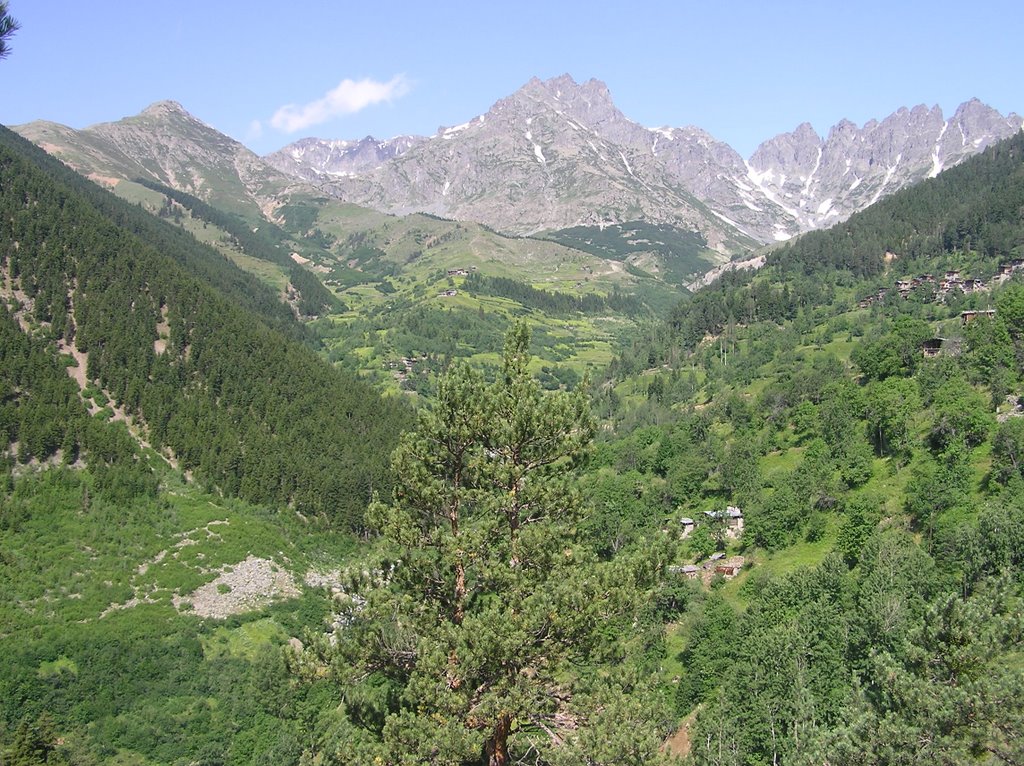 I awoke on the morning of June 26, 2006 in a Swiss-style chalet high in the Kackar Mountains of northeastern Turkey. I had left the Republic of Georgia 11 days earlier. This area of Turkey is known in the travel guidebooks as the Georgian Church country. The region was once part of Georgia, both ethnically and politically and a few ruined, soaring Georgian-style Orthodox churches from the 10th-12th century remain. Even so, they are quite a draw. I had hoped to visit four. While this appeared to be easily managable looking on the map, the reality of the mountainous terrain and twisting dirt roads defeated this goal. We managed to visit three, and by that time I was ready to come down out of the mountains.
Our pension was in Barhal, a small village wedged between the base of a mountain at the confluence of 2 rushing streams, 19 miles and 1 hour and 20 minutes up a torturous dirt road from Yusefeli. If you are looking to get away from it all, Barhal is a likely spot. A dolmus or two make the run up from Yusefeli, but the village doesn't see much traffic beyond that. My bed and board, including supper and breakfast cost $25. The only other tourists there consisted of a party of Swiss mountaineers. Incredibly fit, they all seemed about 6'2", wore hiking shorts and boots, and looked liked they could be extras from any old Nazi propaganda film. I had to wonder--if you are Swiss trying to decide where to go on holiday, wouldn't you rather go to the beach than the mountains?
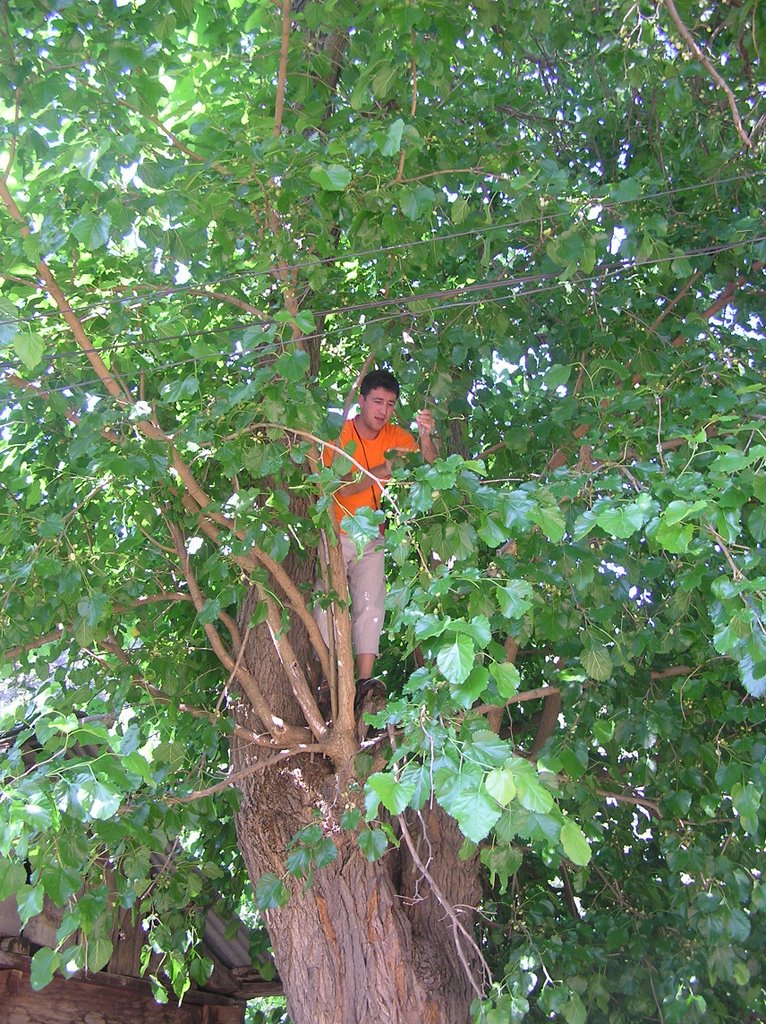 That morning, we drove up the trail past the village towards the Barhal church. Up until last year, it had served as a mosque and was currently closed pending restoration as a museum. The 10th or 11th century building was perhaps the best preserved of the three I visited, but the least prepossessing. This was due in part to it being wedged in on the side of a hill, with a grade school immediately adjacent, and trees closing in all around. There simply wasn't anywhere to stand back and get a perspective of the structure. I peered through the cracks in the doors--all the frescoes had received a thorough Islamic whitewashing years ago. It merely looked like a bland, deserted mosque. Before we left, my guide and friend, Turan, climbed a nearby mulberry tree and shook down plenty of delicious fruit for us.
Leaving Barhal church, we continued away from the village, further and further up the mountain valley. I kept thinking that we had reached the end of the road, but on and on it went, following close to a mountain stream. A single strand of electric wire paralleled the road and stream--sometime precariously--and sure enough, here and there, clumps of cottages and huts lay clustered along the hillsides. We passed 2 backpackers and stopped briefly to talk with them and give directions. They had a copy of a page out of the Lonely Planet guide, but were otherwise close to being quite lost. Turan was able to be of considerable assistance. We asked where they were from and they said "Chicago." They then seemed surprised to learn that I was an American as well. When we left, Turan assured me that they were not Americans, but Israelis trying to disguise their nationality. I tended to agree, they certainly did not seem American at all. Interesting, though. Later we passed a young woman herding a few head of cattle along the road. I'm afraid our vehicle scattered her charges. Eventually, our driver Belial, dropped Turan and I off at a bend in the road. We were to hike up and around the mountain and meet him at another crossing. Hiking the Kackars was a little more than I had bargained for.
 The steep climb certainly dispelled any lingering illusions about my youth and vitality. As we ascended, we found ourselves approaching a solitary cabin with unlimited vistas. A young woman worked the field in the foreground, as an adolescent boy performed chores around the house. The head of the family was on the roof, building a porch roof across one side of the cabin. He invited us to have tea. In short order the daughter of the household brought out a large wooden tray, the teapot, and the ubiquitous tulip-shaped glasses and sugar cubes for our tea break. We squatted on our haunches, drank the strong tea and smoked. Turan and the man talked at length. Later my friend was to relate the man's story to me. This was their home only during the spring and summer months. The snow forced them out during the winter. During those months, the family lived in an apartment in Yusefeli while the father would go to Istanbul to work as a day laborer. Theirs was a hard existence. He said the government was encouraging them to suppliment their income with activities such as beekeeping. This led to a story about "crazy honey." In some of the mountain valleys, the bees feed on the poppies that grow wild. Their honey is to be eaten with great moderation and in very limited qualities. The man had a friend who had helped trap a bear on the other side of the mountain. His payment was a spoonful of this honey. He was angry, believing that he had been taken advantage of. They warned him only to just taste it. The friend did not heed the warning, however, put the entire spoon in his mouth. Ten minutes later he started to feel a little groggy, and the next thing he remembers is waking up 2 days later. After 3 cups of tea, we thanked our host for his hospitality and trudged on up the hill. I tried not to let on, but I was forever thankful when Turan took the trail that began to descend the mountain! We trekked through one hillside village where the old lady laughed at Turan when he ran from her bees. I was exhausted by the time we caught up with Belial and our vehicle. I settled into the back seat for a long rest. Before reaching Barhal, we were stopped as a maintainer worked on the road--scraping away a recent rock slide. Interesting, a mini-van from Georgia was parked in front on us, of which more will be told later.
We arrived in Yusefeli a couple of hours later. This is a bustling little hub, the only place in these mountains for a town of any size. Yusefeli was a conservative town where all the women on the streets wore the headscarf. Men clustered around the cafes, drinking endless glasses of tea, and the women walked together and kept completely to theirselves. Yet, the town's main draw was tourism, so you could still get a beer in the riverside cafes. We bought a watermelon, some homemade cheese, homemade bread, some juices and water and headed for our next destination--Dort Kilisesi. In Turkish, that means "4 Churches." Only one was left, but it had never been a mosque and was one I particularly wanted to see. It lay probably 20 miles out from Yusefeli in the opposite direction than Barhal. But here again, the mountainous terrain was make it a 2-hour journey. All roads in this region follow the streams, and this was no exception. I was intriqued to see rice paddies between the road and water. At Tekkale we turned right, heading further up the mountain valley.
At long last we reached Dort Kilisesi. The church was not completely visible from the road, but sat on a high bluff, which an orchard falling down the hillside to the road. We sat on the ground in the orchard and ate our picnic feast (really, Turkish watermelons are the best in the world).
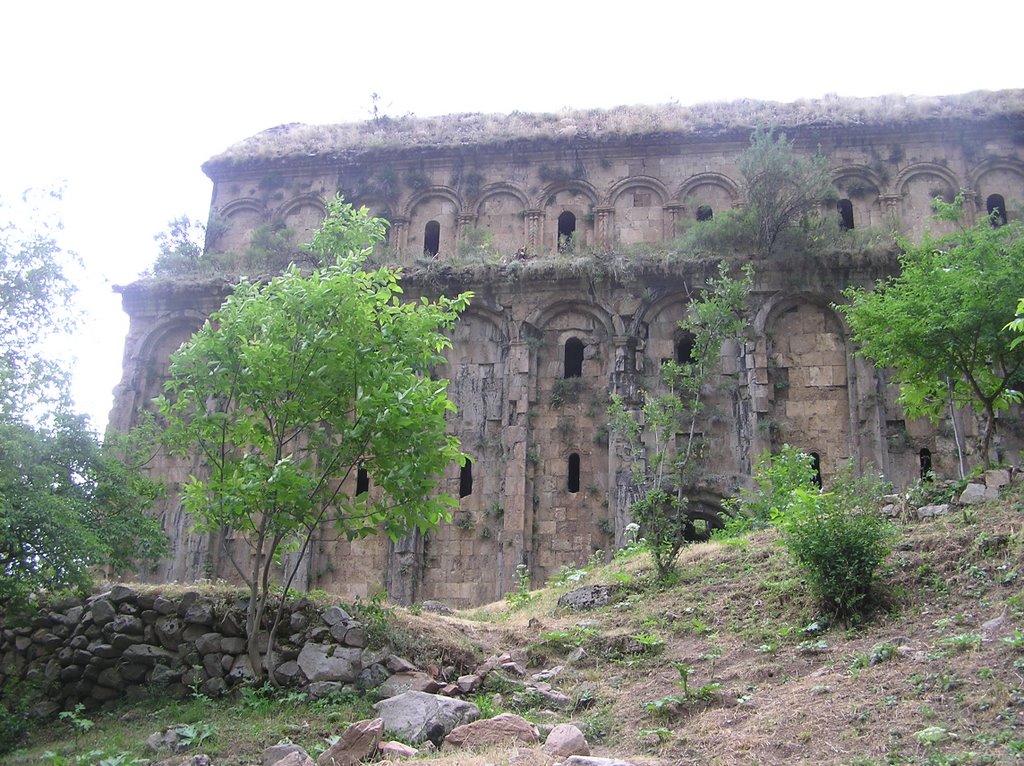 As it was threatening rain, I decided to go on up the hill alone. And perhaps Turan and Belial were tiring of my churches, as they chose to remain in the orchard. Dort Kilisesi sort of sneaks up on you. I was not prepared for the size of the structure. Simple in design, but immense. I entered into the cavernous interior. Dirt has silted up quite a bit on the floor, but the church is still solid, with roof completely intact. Rows of 4-story columns line the interior. The frescoes are fading fast, that, in fact being a major reason I chose to visit here. I took many snapshots, but other than Christ Pantocrator and angels, I was not generally not able to determine who they depicted. Sadly, the old church has also been an obvious and favorite site for teenage graffiti. I lingered for quite a while in the sanctuary, before stepping outside. Of the three churches I had visited in the region--Osk Vank, Barhal and Dort Kilisesi--this was my favorite by far.
 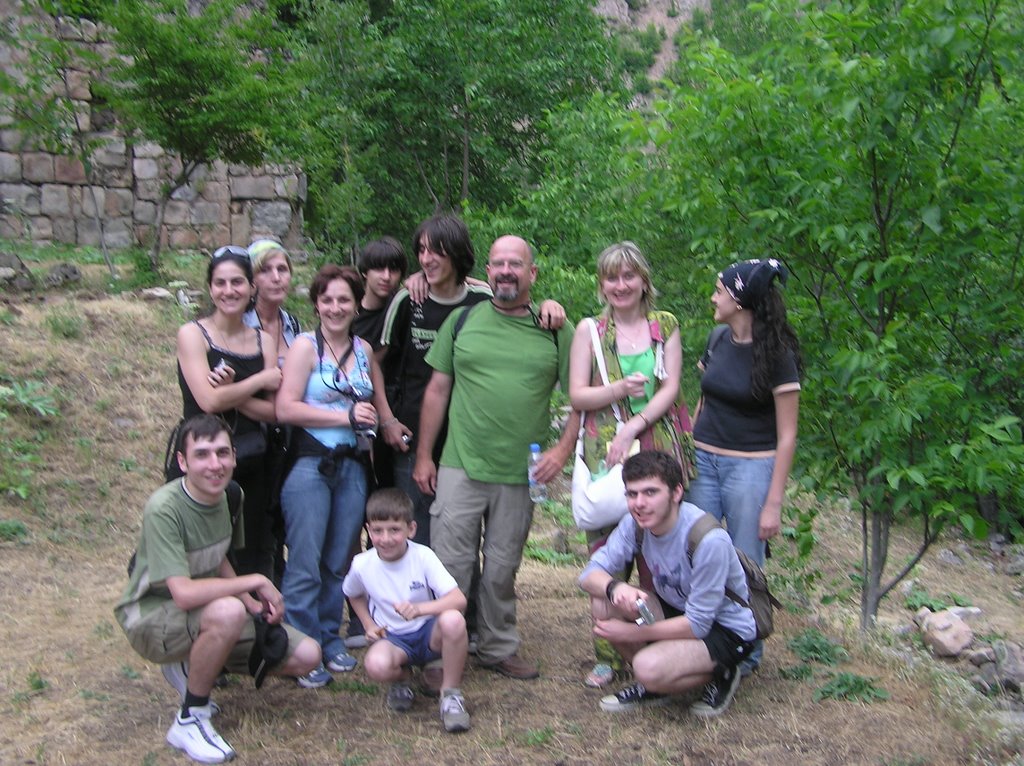 As I stood outside I heard a noise--lots of voices and commotion, in fact, coming from down the hill. I then saw a man approaching the church. I observed him as he slowly crossed himself three times in the unmistakable sweeping movement of the Georgians. My heart lept--the Georgians are here! I approached and tried to make him understand that I too, was Orthodox. I didn't think to show him my cross. Needless to say, we were having trouble communicating--the only word I knew was "madlapt" (sp.), Georgian for "thank you." But we eventually understood each other well enough and shook hands heartedly. The rest of his party had joined us by this time. It seems he was the driver of the minivan we were behind way back in Barhal. The group included 2 female teacher/chaperones and a gaggle of teenagers being taken on a cultural tour of their heritage in what is now Turkey. The young people seemed excited to be there and anxious to see the church and frescoes, once they had finished with their extensive greetings to me. Now I ask you, how many of our teenagers would submit to doing something like this, much less be excited about it? Not many, I fear. We posed for pictures and the one here says it all.
I said goodbye to my Georgian friends and brothers and walked back down the hill, and back into Turkey. I did not realize how much I had missed Georgian society in these 11 days. I do not want to engage in any cheap, simplistic Christian triumphalism. But, this incident brought home to me a great truth. We were only a few miles away (as the crow flies) from Georgia proper. But between there and here lay a deep, cultural chasm: the division between a Christian society and the Muslim world. I am still at something at a loss to express it adequately, but the sense of it is as real as anything I have ever experienced. The strictures of the Muslim world, the separation of men and women, and the very presuppositions from which they order their life may not be so obvious at first, until that is, they are contrasted with these curious, lively, noisy, loving, and sometimes untidy Christians. Thank God for the Georgians.
Wednesday, August 23, 2006
My Akdamar Poll

If you find yourself in far eastern Turkey, in the environs of the breathtakingly beautiful Lake Van, you are probably there to visit Akdamar Island. Such was the draw for me. Akdamar was the locus in this part of "Armenia" from the 900s until about 1918 or so, when the last of the local Christians were killed in the Armenian genocide. At one time, the island housed a royal palace complex and an extensive monastery, in addition to the cathedral church. The church served a comunity of over 140 area churches and 40 monasteries. Today, only the church is left, and it has stood vacant since the end of the First World War.
The church is currently undergoing a government-sponsored restoration, after decades of neglect. Admittedly, this may be cause for concern--the restoration of an ancient Armenian church by the Turkish authorities--but I will give them the benefit of a doubt. Ankara's aggressive PR campaign and overtures to join the EU undoubtedly play a part in this. That, and the dawning realization that there are tourist dollars in these crumbling Christian ruins. Day in, day out, three ferries continuously ply the 2 kilometers between shore and island. Our ferry carried 36 passengers--35 Turks and 1 Texan. I believe that this is a hopeful sign. Turkish nationals are apparently interested in visiting Akdamar and picnicking among the jumble of ancient Armenian tombstones with their huge, ornate crosses. The point is this: there is no way to "Turkify" Akdamar. It is wholly, completely, totally Armenian--and Christian.
My 35 Turkish fellow travelers broke down into 19 men and 16 women. In my journey throughout Turkey, I took to observing the number of women wearing headscarves. They have become common (and an issue) in Turkey only in recent years--tied to political and social conservatism, a "return to traditional values," if you will. I find the wearing of headscarves to be an obviously inexact, but not unreliable, measure of Islamist sentiment.
Lake Van lies in far eastern Turkey, in supposedly one of the most conservative regions of the country. Nevertheless, only 4 of the 16 women wore headscarves. Again, I find this hopeful, and is illustrative of the complex and changing nature of Turkish society.
The Islamist agenda, just as the practice of Islam itself, is somewhat different in Turkey. The Turks are both staunchly Muslim and secular at the same time. This dichotomy precludes making hard-and-fast conclusions about the culture. In fact, the only place I visited where all women wore headscarves was in Yusefeli, deep in the mountains of northeastern Turkey, although I am sure that is also the case in most rural villages, as well. I have been told that for many women, the wearing of the headscarf is more of a political statement than a show of religious fundamentalism. Throughout eastern Turkey, I could draw no firm conclusions--some women wore them, many did not.
There seemed to be no sifting-out between those who did and those who did not. Young women in headscarves--or even dressed "full burkha"--walked arm-in-arm with girls without the scarf who wore western-style blue jeans. My guide told me that each girl made the decision for herself, that there was no pressure one way or the other. I doubt seriously if this is the case in many rural areas, but otherwise I suspect it may be so. What is frowned-on, however, by all parties, is the wearing of short skirts. This is really just not done in Turkey.
I did not notice appreciably more headscarves in eastern Turkey than in Istanbul, as one might expect. In fact, Istanbul is such a cosmopolitan place that it is much like New York in that you are liable to see anything there. For example, the old Greek Phanar district has been largely taken over by poor, fundamentalist Muslims from eastern Turkey. The bearded men are in woolen skullcaps and the women in black burkhas--some with eyes and nose exposed, and some with only the eyes exposed. You might as well be in Kabul. (And believe me, this dress--and what is signifies--is as alarming to most Turks as it is to us). Yet, just across the Golden Horn, along the Istiklal Cadessi, I had to look, and look, and look to spot even one woman in headscarf among the crush of shoppers. As I sat in the sidewalk restaurant, observing, I eventually counted three.
Most of Istanbul falls between these two extremes. Many young Turkish women who opt for the headscarf also wear attractive white close-fitting tunic-style coats. Older women often wear the ubiquitous, shapeless floor-length overcoats endemic to Turkey. They come in two colors: gray and taupe, and they wear them regardless of how hot it is outside. Unfortunately, women who wear these seem cursed to assume their shape. On the other hand, young women in headscarves are often dressed elegantly from head to toe, with special attention to footwear.
I am trying not to obsess on this issue, but merely attempting to gauge the extent and direction of Islamism in the one Muslim country in which I have some limited experience. Blanket assumptions about the Middle and Near East can be ill-informed, and as we are finding out, dangerous. My gut feeling is that Turkey's westward orientation is irreversable; no matter how long it takes, they will eventually join Europe. But they will do so as a decidedly Muslim nation. And Europe, no longer Christian in any real sense, but retaining enough of a veneer of such in their collective memory to be alarmed, is scrambling to confront this dilemma. I am also convinced that if the West ever comes to an accomodation or truce with Islam--and clearly, I am not at all hopeful that such will ever, or should ever occur--it will have to be on the Turkish model.
Thursday, August 17, 2006
All or Nothing
I recommend most anything Theodore Dalrymple writes (and concerning Dalrymples, anthing William or Ian writes as well). He recently reviewed Efraim Karsh's Islamic Imperialism: A History. Dalrymple observes that:
The urge to domination is nearly a constant of human history. The specific (and baleful) contribution of Islam is that, by attributing sovereignty solely to God, and by pretending in a philosophically primitive way that God’s will is knowable independently of human interpretation, and therefore of human interest and desire—in short by allowing nothing to human as against divine nature—it tries to abolish politics. All compromises become mere truces; there is no virtue in compromise in itself. Thus Islam is inherently an unsettling and dangerous factor in world politics, independently of the actual conduct of many Muslims.
There's a lot of truth there. Read the entire essay here.
The urge to domination is nearly a constant of human history. The specific (and baleful) contribution of Islam is that, by attributing sovereignty solely to God, and by pretending in a philosophically primitive way that God’s will is knowable independently of human interpretation, and therefore of human interest and desire—in short by allowing nothing to human as against divine nature—it tries to abolish politics. All compromises become mere truces; there is no virtue in compromise in itself. Thus Islam is inherently an unsettling and dangerous factor in world politics, independently of the actual conduct of many Muslims.
There's a lot of truth there. Read the entire essay here.
Monday, August 14, 2006
You're known by the company you keep

This picture may add fuel to the speculation about Prince Charles being a wannabe and/or closet Orthodox. This picture hangs in the reception room at Mar Gabriel Monastery, in the Tur Abdin region of southeastern Turkey. Charles visited Turkey in 2004, Tur Abdin being his only stop outside of Istanbul.
My Akdamar Poll
If you find yourself in far eastern Turkey, in the environs of the breathtakingly beautiful Lake Van, you are probably there to visit Akdamar Island. Such was the draw for me. Akdamar was the locus in this part of "Armenia" from the 900s until about 1918 or so, when the last of the local Christians were killed in the Armenian genocide. At one time, the island housed a royal palace complex and an extensive monastery, in addition to the cathedral church. The church served a comunity of over 140 area churches and 40 monasteries. Today, only the church is left, and it has stood vacant since the end of the First World War.
The church is currently undergoing a government-sponsored restoration, after decades of neglect. Admittedly, this may be cause for concern--the restoration of an ancient Armenian church by the Turkish authorities--but I will give them the benefit of a doubt. Ankara's aggressive PR campaign and overtures to join the EU undoubtedly play a part in this. That, and the dawning realization that there are tourist dollars in these crumbling Christian ruins. Day in, day out, three ferries continuously ply the 2 kilometers between shore and island. Our ferry carried 36 passengers--35 Turks and 1 Texan. I believe that this is a hopeful sign. Turkish nationals are apparently interested in visiting Akdamar and picnicking among the jumble of ancient Armenian tombstones with their huge, ornate crosses. The point is this: there is no way to "Turkify" Akdamar. It is wholly, completely, totally Armenian--and Christian.
My 35 Turkish fellow travelers broke down into 19 men and 16 women. In my journey throughout Turkey, I took to observing the number of women wearing headscarves. They have become common (and an issue) in Turkey only in recent years--tied to political and social conservatism, a "return to traditional values," if you will. I find the wearing of headscarves to be an obviously inexact, but not unreliable, measure of Islamist sentiment.
Lake Van lies in far eastern Turkey, in supposedly one of the most conservative regions of the country. Nevertheless, only 4 of the 16 women wore headscarves. Again, I find this hopeful, and is illustrative of the complex and changing nature of Turkish society.
The Islamist agenda, just as the practice of Islam itself, is somewhat different in Turkey. The Turks are both staunchly Muslim and secular at the same time. This dichotomy precludes making hard-and-fast conclusions about the culture. In fact, the only place I visited where all women wore headscarves was in Yusefeli, deep in the mountains of northeastern Turkey, although I am sure that is also the case in most rural villages, as well. I have been told that for many women, the wearing of the headscarf is more of a political statement than a show of religious fundamentalism. Throughout eastern Turkey, I could draw no firm conclusions--some women wore them, many did not.
There seemed to be no sifting-out between those who did and those who did not. Young women in headscarves--or even dressed "full burkha"--walked arm-in-arm with girls without the scarf who wore western-style blue jeans. My guide told me that each girl made the decision for herself, that there was no pressure one way or the other. I doubt seriously if this is the case in many rural areas, but otherwise I suspect it may be so. What is frowned-on, however, by all parties, is the wearing of short skirts. This is really just not done in Turkey.
I did not notice appreciably more headscarves in eastern Turkey than in Istanbul, as one might expect. In fact, Istanbul is such a cosmopolitan place that it is much like New York in that you are liable to see anything there. For example, the old Greek Phanar district has been largely taken over by poor, fundamentalist Muslims from eastern Turkey. The bearded men are in woolen skullcaps and the women in black burkhas--some with eyes and nose exposed, and some with only the eyes exposed. You might as well be in Kabul. (And believe me, this dress--and what is signifies--is as alarming to most Turks as it is to us). Yet, just across the Golden Horn, along the Istiklal Cadessi, I had to look, and look, and look to spot even one woman in headscarf among the crush of shoppers. As I sat in the sidewalk restaurant, observing, I eventually counted three.
Most of Istanbul falls between these two extremes. Many young Turkish women who opt for the headscarf also wear attractive white close-fitting tunic-style coats. Older women often wear the ubiquitous, shapeless floor-length overcoats endemic to Turkey. They come in two colors: gray and taupe, and they wear them regardless of how hot it is outside. Unfortunately, women who wear these seem cursed to assume their shape. On the other hand, young women in headscarves are often dressed elegantly from head to toe, with special attention to footwear.
I am trying not to obsess on this issue, but merely trying to gauge the extent and direction of Islamism in the one Muslim country in which I have some limited experience. Blanket assumptions about the Middle and Near East can be ill-informed, and as we are finding out, dangerous. My gut feeling is that Turkey's westward orientation is irreversable; no matter how long it takes, they will eventually join Europe. But they will do so as a decidedly Muslim nation. And Europe, no longer Christian in any real sense, but retaining enough of a veneer of such in their collective memory to be alarmed, are scrambling to how to confront this dilemma. I am also convinced that if the West ever comes to an accomodation or truce with Islam--and clearly, I am not at all hopeful that such will ever, or should ever occur--it will have to be on the Turkish model.
Odds and Ends
When Bernard Lewis speaks about the Middle East, you had better listen. An excellent interview here.
President Bush has been in trouble lately over his studied use of the term "Islamic fascists." And while I have been none too charitable to our President in recent months, he is correct on this one. The term comes closer to recognizing reality--vastly superior to the nonsensical "war on terror." To separate the Islamic part of the equation from the terrorism, is to purposely miss-characterize what is actually happening. If anything, the term is still too tame. For fascists, to my understanding, were all about order--their order to be sure--but order, nonetheless. We've often heard the old line about how "Mussolini made the trains run on time," etc. I think "Islamic anarchists" is more descriptive.
The chairman of the Council on American-Islamic Relations (CAIR) predictably huffed that it "contributes to a rising level of hostility to Islam and the American Muslim community." Well, that is typical PCBS. Whether it engenders hostility or not, is immaterial. What is needed is an awareness that the current conflict is just the latest episode in the 1400 year-old struggle of Islam against the West. It has ebbed and flowed, but at present, it is flowing our way. One can make the point that the current terrorism is an aberrant and virulent strain of Islam, but the greater point is that it is a recurring strain in Islam. Calling it what it is is healthy.
I suspect everyone is tired of the whole Mel Gibson episode by now. Even so, lest we get into high dudgeon over it, Rod Dreher addresses the Mel in all of us. And in doing so, he invokes Flannery O'Connor--always a nice move. Read it here.
And finally, Maureen Freely has an excellent essay in Sunday's NYTimes about the trouble a Turkish novelist is in over her use of the "G" word. That's right--genocide, as in Armenian. Read it to believe it here. We occasionally read of a nutcase and/or Iranian President who denies the Jewish Holocaust. In Turkey, Armenian Genocide denial has been a matter of statute law. Truth will out, and the official line is becoming harder and harder to maintain, but the legal and military apparatus is still poised to pounce on any writer who dares to speak the truth.
President Bush has been in trouble lately over his studied use of the term "Islamic fascists." And while I have been none too charitable to our President in recent months, he is correct on this one. The term comes closer to recognizing reality--vastly superior to the nonsensical "war on terror." To separate the Islamic part of the equation from the terrorism, is to purposely miss-characterize what is actually happening. If anything, the term is still too tame. For fascists, to my understanding, were all about order--their order to be sure--but order, nonetheless. We've often heard the old line about how "Mussolini made the trains run on time," etc. I think "Islamic anarchists" is more descriptive.
The chairman of the Council on American-Islamic Relations (CAIR) predictably huffed that it "contributes to a rising level of hostility to Islam and the American Muslim community." Well, that is typical PCBS. Whether it engenders hostility or not, is immaterial. What is needed is an awareness that the current conflict is just the latest episode in the 1400 year-old struggle of Islam against the West. It has ebbed and flowed, but at present, it is flowing our way. One can make the point that the current terrorism is an aberrant and virulent strain of Islam, but the greater point is that it is a recurring strain in Islam. Calling it what it is is healthy.
I suspect everyone is tired of the whole Mel Gibson episode by now. Even so, lest we get into high dudgeon over it, Rod Dreher addresses the Mel in all of us. And in doing so, he invokes Flannery O'Connor--always a nice move. Read it here.
And finally, Maureen Freely has an excellent essay in Sunday's NYTimes about the trouble a Turkish novelist is in over her use of the "G" word. That's right--genocide, as in Armenian. Read it to believe it here. We occasionally read of a nutcase and/or Iranian President who denies the Jewish Holocaust. In Turkey, Armenian Genocide denial has been a matter of statute law. Truth will out, and the official line is becoming harder and harder to maintain, but the legal and military apparatus is still poised to pounce on any writer who dares to speak the truth.
Wednesday, August 02, 2006
Travels with St. Ephraim
I am a firm believer in traveling light. On my recent journey, I lived for 30 days out of a medium-sized backpack, mastering the fine art of washing and drying clothes in a shower stall. By the time I returned home, I had transited through 8 different airports a total of 14 times, so this philosophy served me well. I found it hard to avoid being a little smug watching tourists struggle with way, way too much luggage. (I was noticeably less smug on the return--trying to keep up with 3 bottles of wine, a bottle of homemade Georgian cognac and a 4x6 Turkish rug I had accumulated along the way). I extended this rule to my reading material, refusing to take any books, not even travel guides. I simply copied what information I needed from them and pasted it in my pocket journal. I made one exception: The Spiritual Psalter of St. Ephraim the Syrian.
I find myself returning again and again to this small treasure of a book. Over the course of the month, I intended to read through all 150 prayers, maintain my regular prayer discipline and spend considerable time in contemplation. Well, truth be told, I failed miserably! My reading from the psalter was sporadic. Worse yet, so were my regular prayers. I do not discount that I encountered much that affected me deeply, that caused me to contemplate spiritual matters. Yet, I realize that I neglected my prayer life. I had, shall we say, a large time, allowing the excitement of new places and adventures to push my intentions into the background. I realized that I spent more time in prayer and spiritual reading in my busy, work-a-day schedule than I did when I had 30 days without restrictions. So maybe there is a good lesson learned there.
Five days after leaving the Republic of Georgia, I found myself in the old city of Diyarbakir, in east-central Turkey. Let's just say that Diyarbakir does not see much in the way of tourists. Home to 1.5 million, the city is beset with problems. Back in the 1980s and 1990s, the Kurdish insurgency rocked eastern Turkey. Whole villages were abandoned as people sought refuge in the cities. Diyarbakir's population mushroomed with the Kurdish immigration. Despite impressive development in the city (and the old city is ringed by a quite modern new city), poverty is still acute and there are still far too few jobs to go around. Additionally, Kurdish nationalism still hangs on in Diyarbakir, and as a consequence, the Turkish military maintains a heavy presence there. A small riot occured, I believe, just the month before I arrived. The Turkish government and military are quite serious about stamping out remaining rebel activity, so the official response to any trouble is swift and heavy-handed. One hundred years ago, Diyarbakir was an ethnic melting pot with Turks, Kurds, Armenians and Syrian Orthodox. In fact, the city was fully 1/4 Armenian Christian. Not so today. The Turkish genocide of the Armenians in 1915-1918 took care of that element, and the Syrian Orthodox have been squeezed out in recent years. Today, the city is overwhelmingly Kurdish. Diyabakir boasts the longest continuous city walls in the world, but that is about all they can put on the tourist brochure. And to top it all off, Diyarbakir has an unsavory (but not undeserved) reputation. Unlike anywhere else in Turkey, gangs of young pickpockets prey on any unwary tourists.
So why would anyone even want to go to Diyarbakir? For me, I went for 1 reason--to see the Meryamana Kilisesi, the Church of the Virgin Mary. This Syrian Orthodox Church dates back to the late 300s, making it perhaps the oldest continuously operating church in the world. I had already visited a number of Suriani churches in Mardin and Midyat. They differ somewhat from the Orthodox churches I am used to, or have seen elsewhere in my travels. I realize, of course, that they are monophysite, like the Copts and Armenians. Beyond that, the altars are different, often more like elaborate niches, actually, with no iconostasis. (Altars in mosques are much the same, though Turks would never, ever admit that they copied this design from the early Christians!) The most noticeable difference, however, is in the iconography. Suriani churches are not covered in icons and frescoes. There may be a large icon or two, and perhaps some tapestries. Finally, the iconographic style is much simpler, almost child-like in some cases.
My guide, Turan, and I passed through the Byzantine walls into the old city. At first glance, it was no different from any number of Turkish streetscapes. We stopped at the Ulla Mosque, built with stones from the ancient cathedral at Diyarbakir. This is one of the oldest remaining Turkish mosques, perhaps 12th-century or so. I hate to be dismissive, but if you've seen one mosque, you've just about seen them all. There was a pleasant courtyard, however, and I took a few pictures so as to not offend my guide, who indeed by this time had become a good friend. From the courtyard, we prepared to venture out into the narrow labyrinth of alleyways leading to the Meryamana Kilisesi. We hid our cameras, and moved our backpacks to the front. The gangs here have the reputation of being able to strip a backpack before you know it. As we made our way towards the church, groups of these children seemed to take an inordinate interest in our progress, though Turan was able to keep them shoed away, for the most part. At one point, a man came out of a doorway and started walking with us. He gave Turan some warnings about what to watch out for, and then walked along with us, just to make sure we made it to the church without any trouble.
We reached the gate to the church compound, and rang the bell. In the East, you don't see much if you don't gain access to the courtyards. The beauty of their homes and lives is always hidden from public view. The caretaker admitted us and escorted us to the 4th-century church. The simple domed sanctuary was exquisite, though other than the altar, somewhat sparsely adorned. One large, bright reddish icon hung on the right wall. The caretaker explained that once the building could not hold all the worshippers. The Kurdish troubles, and the Turkish government's ambivalence to the plight of the Christians (sound familiar?) had forced most of the Suriani to flee in the 1980s. The church was now home to 3 Christian families. The priest ministered to these believers, as well as 2 families of Assyrian Catholics and and one Armenian remaining in the city.
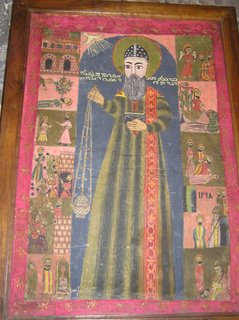
Shortly thereafter, the priest came in and began the vespers service. At first, the caretaker and I and my guide were the only ones there. One by one, 4 handsome young men, ranging in age from about 17 down to 10, came in and took their places around the priest, and assisted him in the chanting. The service was in Aramaic, but I was able to follow the caretaker's lead in prostrations and crossing myself. In a previous conversation with Turan, he was surprised to learn that we prostrated ourselves in worship. So now he had a demonstration of that truth. And I wondered if he realized that the Muslim practice of prostration, like so much of their religion, was not new to them, but borrowed from the early Christians. We eased out after about 15 minutes and worked our way back into the noisy city.
And one more thing. Before the service, I had Turan ask the caretaker who the icon portrayed. Mar Efram, he replied. St. Ephraim, of course.
I find myself returning again and again to this small treasure of a book. Over the course of the month, I intended to read through all 150 prayers, maintain my regular prayer discipline and spend considerable time in contemplation. Well, truth be told, I failed miserably! My reading from the psalter was sporadic. Worse yet, so were my regular prayers. I do not discount that I encountered much that affected me deeply, that caused me to contemplate spiritual matters. Yet, I realize that I neglected my prayer life. I had, shall we say, a large time, allowing the excitement of new places and adventures to push my intentions into the background. I realized that I spent more time in prayer and spiritual reading in my busy, work-a-day schedule than I did when I had 30 days without restrictions. So maybe there is a good lesson learned there.
Five days after leaving the Republic of Georgia, I found myself in the old city of Diyarbakir, in east-central Turkey. Let's just say that Diyarbakir does not see much in the way of tourists. Home to 1.5 million, the city is beset with problems. Back in the 1980s and 1990s, the Kurdish insurgency rocked eastern Turkey. Whole villages were abandoned as people sought refuge in the cities. Diyarbakir's population mushroomed with the Kurdish immigration. Despite impressive development in the city (and the old city is ringed by a quite modern new city), poverty is still acute and there are still far too few jobs to go around. Additionally, Kurdish nationalism still hangs on in Diyarbakir, and as a consequence, the Turkish military maintains a heavy presence there. A small riot occured, I believe, just the month before I arrived. The Turkish government and military are quite serious about stamping out remaining rebel activity, so the official response to any trouble is swift and heavy-handed. One hundred years ago, Diyarbakir was an ethnic melting pot with Turks, Kurds, Armenians and Syrian Orthodox. In fact, the city was fully 1/4 Armenian Christian. Not so today. The Turkish genocide of the Armenians in 1915-1918 took care of that element, and the Syrian Orthodox have been squeezed out in recent years. Today, the city is overwhelmingly Kurdish. Diyabakir boasts the longest continuous city walls in the world, but that is about all they can put on the tourist brochure. And to top it all off, Diyarbakir has an unsavory (but not undeserved) reputation. Unlike anywhere else in Turkey, gangs of young pickpockets prey on any unwary tourists.
So why would anyone even want to go to Diyarbakir? For me, I went for 1 reason--to see the Meryamana Kilisesi, the Church of the Virgin Mary. This Syrian Orthodox Church dates back to the late 300s, making it perhaps the oldest continuously operating church in the world. I had already visited a number of Suriani churches in Mardin and Midyat. They differ somewhat from the Orthodox churches I am used to, or have seen elsewhere in my travels. I realize, of course, that they are monophysite, like the Copts and Armenians. Beyond that, the altars are different, often more like elaborate niches, actually, with no iconostasis. (Altars in mosques are much the same, though Turks would never, ever admit that they copied this design from the early Christians!) The most noticeable difference, however, is in the iconography. Suriani churches are not covered in icons and frescoes. There may be a large icon or two, and perhaps some tapestries. Finally, the iconographic style is much simpler, almost child-like in some cases.
My guide, Turan, and I passed through the Byzantine walls into the old city. At first glance, it was no different from any number of Turkish streetscapes. We stopped at the Ulla Mosque, built with stones from the ancient cathedral at Diyarbakir. This is one of the oldest remaining Turkish mosques, perhaps 12th-century or so. I hate to be dismissive, but if you've seen one mosque, you've just about seen them all. There was a pleasant courtyard, however, and I took a few pictures so as to not offend my guide, who indeed by this time had become a good friend. From the courtyard, we prepared to venture out into the narrow labyrinth of alleyways leading to the Meryamana Kilisesi. We hid our cameras, and moved our backpacks to the front. The gangs here have the reputation of being able to strip a backpack before you know it. As we made our way towards the church, groups of these children seemed to take an inordinate interest in our progress, though Turan was able to keep them shoed away, for the most part. At one point, a man came out of a doorway and started walking with us. He gave Turan some warnings about what to watch out for, and then walked along with us, just to make sure we made it to the church without any trouble.
We reached the gate to the church compound, and rang the bell. In the East, you don't see much if you don't gain access to the courtyards. The beauty of their homes and lives is always hidden from public view. The caretaker admitted us and escorted us to the 4th-century church. The simple domed sanctuary was exquisite, though other than the altar, somewhat sparsely adorned. One large, bright reddish icon hung on the right wall. The caretaker explained that once the building could not hold all the worshippers. The Kurdish troubles, and the Turkish government's ambivalence to the plight of the Christians (sound familiar?) had forced most of the Suriani to flee in the 1980s. The church was now home to 3 Christian families. The priest ministered to these believers, as well as 2 families of Assyrian Catholics and and one Armenian remaining in the city.

Shortly thereafter, the priest came in and began the vespers service. At first, the caretaker and I and my guide were the only ones there. One by one, 4 handsome young men, ranging in age from about 17 down to 10, came in and took their places around the priest, and assisted him in the chanting. The service was in Aramaic, but I was able to follow the caretaker's lead in prostrations and crossing myself. In a previous conversation with Turan, he was surprised to learn that we prostrated ourselves in worship. So now he had a demonstration of that truth. And I wondered if he realized that the Muslim practice of prostration, like so much of their religion, was not new to them, but borrowed from the early Christians. We eased out after about 15 minutes and worked our way back into the noisy city.
And one more thing. Before the service, I had Turan ask the caretaker who the icon portrayed. Mar Efram, he replied. St. Ephraim, of course.
Sunday, July 30, 2006
At the Edge of Christendom
 One thing the scriptures make abundantly clear is that the essential nature of the Kingdom of God is spiritual, not physical. Any effort to draw geographical boundaries around it is not only futile, but is to miss the point altogether. But for the sake of illustration in this story, I will attempt to do that very thing. One of the best days I spent in the Republic of Georgia was at the Monasteries of Davit Gareja, located smack on the border of Christian Georgia and Muslim Azerbaijan.
St. Davit Gareja was a pivotal figure in Georgian history. He led a group of 13 Syrian Fathers to Georgia in the 6th Century, establishing a series of monasteries in the remote wilderness. A story connected with the beginning of the monastery relates that Davit, along with Lukiane and Dodo, were saved from starvation. Several does and fawns came up to them, gentle as sheep, and the does allowed themselves to be milked.
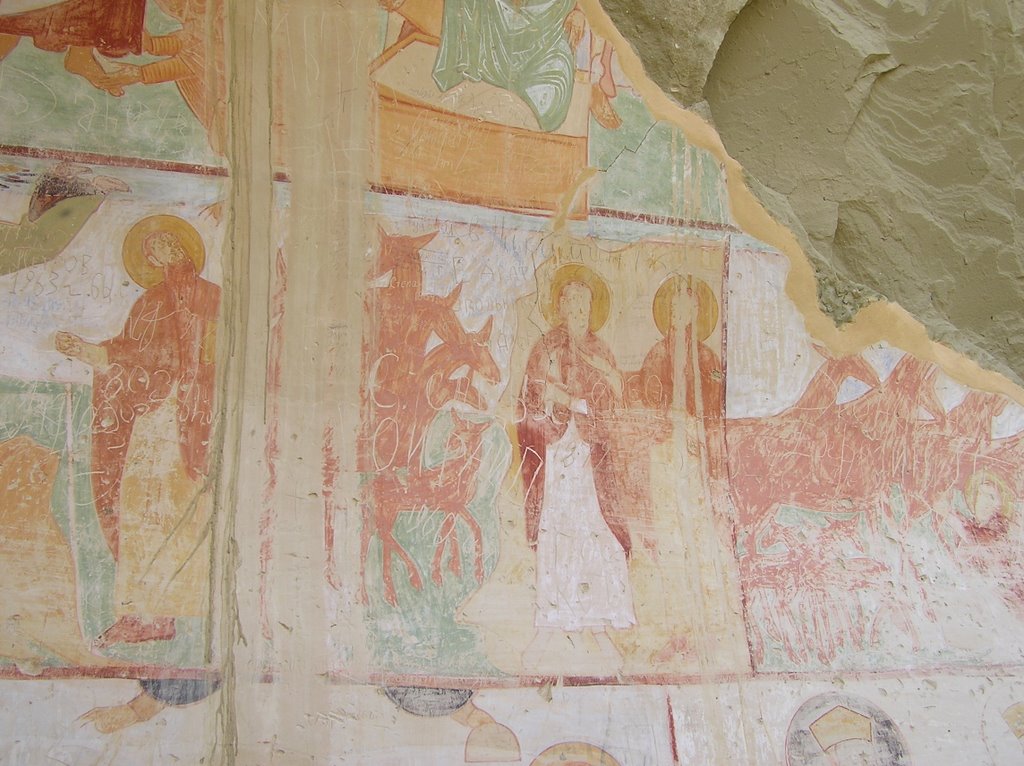
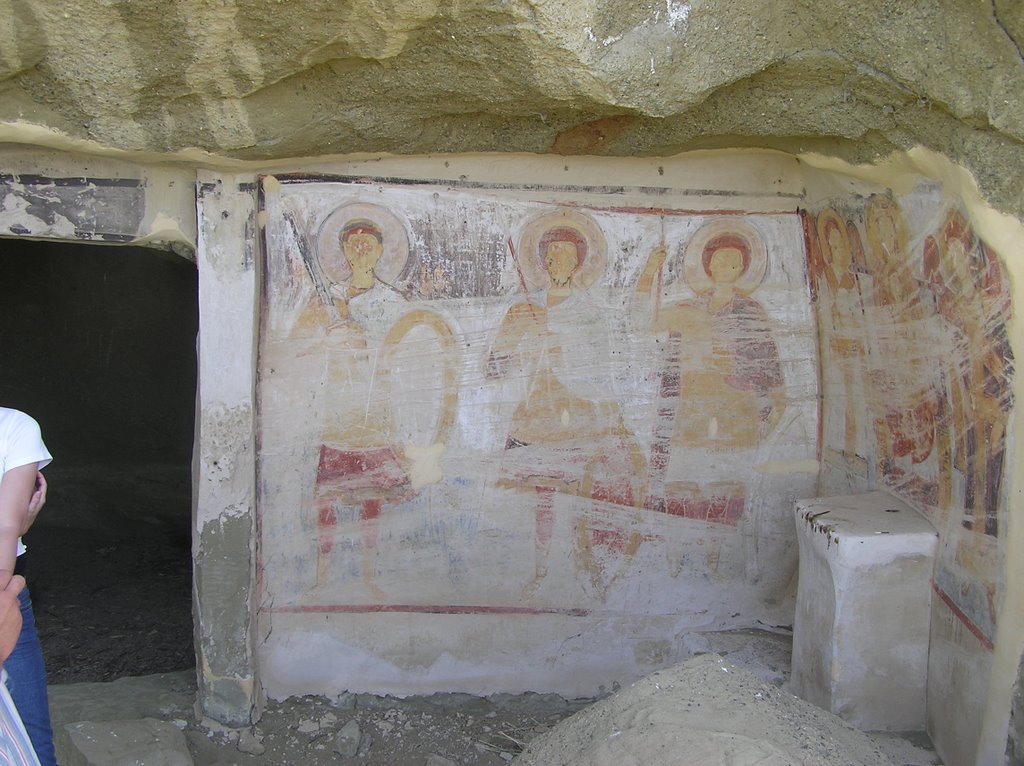
The monasteries flourished, and exerted significant influence in Georgia, being a center of fresco painting and manuscript copying and translation. The monks suffered tremendously during the invasion of the Mongols, and later Tamerlane. They persevered and regrouped each time. In 1615, however, the Shah of Persia massacred the entire colony of 6,000 monks and destroyed most of the treasures of the monastery. The monks were well hidden in the caves, but one of the Persians caught sight of a solitary candle flickering in a cave, betraying their position. The monasteries were closed again during the Soviet years. Now, the community of monks is flourishing once more at Davit Gareja.
Davit Gareja is located only 60 km. (36 miles) from Tbilisi, but it might as well be a half a world away. I stood on an outcropping of rock, surveying the wide windswept valley and the rolling, treeless hills, trying to come up with an appropriate description. My son said simply, "It's Rohan." Of course, that is exactly right. LOTR aficianados will know exactly what I am talking about. In the silence, I half expected to hear the thunder of hooves as the Rohirrim crested over the summit.

It is a 2 hour drive from Tbilisi to the monastery--an 18 mph average which gives you some idea of the quality of the roads. The city of Rustavi lies halfway between. A quintessential Soviet planned city, Rustavi had 150,000 inhabitants before communism's fall. A wide boulevard divides row upon row of bleak, despressing, crumbling apartment blocks. They could have been built anywhere from Vladivostock to East Berlin, as Soviet architects seemed to have only 1 set of blueprints. On the far side of the city, the vast, rusting industrial plants--stark, unsettling and soulless--now operate at 30% of their former capacity.
Yet even amid such sterility, the human yearning for God breaks through, like flowers pushing through cracks in the concrete. I noticed between some of the apartment blocks--in the common areas and playgrounds--some noticeably new construction. These small, traditional structures were invariably neat and attractive. They were, of course, minature chapels, all built in the ageless Georgian style. I doubt that the Soviet central planners would approve of this particular change in the layout!
I took no pictures of Rustavi. Our guide, Sophie, lived there and I did not want to embarrass her by taking special note of her decaying city. Later I learned my assumptions were offbase. Although she lived in Rustavi with her parents and brother, they resided in a nice home in the old part of town that predated the Communist era. In fact, their lot is spacious enough for her brother to plan another house on the site. In addition, they maintain a family home on the Black Sea coast.
Sophie explained that in the Georgian tradition, the son always inherits the house. Daughters have the right to live in the home as long as they like, however. This was not so much a matter of law, but simply a long-established custom. She assured me that a brother would never turn his sister out of the house. I am certainly not advocating this arrangement, but what impresses me is the stability and love within the Georgian family--the fact that extra-legal arrangements like this apparently work. I wonder how many American families--without legal safeguards--could pass a test like this.
Just past Rustavi lies a scraggly, hardscrabble village. There was nothing particularly unique about it, except for one noticeable building. At the edge of the village is a 6-story stone tower. For this is a village of Svans. Years earlier, an avalanche destroyed one of the Svanetian villages deep in the Caucasus Mountains. The government relocated them here, where some could engage in herding, and others could work in the Rustavi foundaries. I was incredulous that these fiercely independent mountain dwellers would be relocated here. And yet, the first thing they did was to build a traditional Svanetian tower, like the multitude that dot their Caucasian mountainsides. I saw the tower--and the adjoining church--as a testimony to the human spirit.
Soon, this village is left far behind, and nothing is left but miles of rolling hills and valleys. When we reach a small makeshift carpark, we are surprised to see the number of vehicles there. Packed marshrutkas from Tbilisi are unloading in front of us. We park and walk up the trail to Lavra Monastery--a compound of churches, cells and caves clustered around a central courtyard on three levels. There seemed to be a lot of activity around the courtyard, so we opt to visit the Udabno Monastery, a series of cave churches on the other side of the mountain. We follow a twisting trail past the watchtower that snakes up to the summit. Perhaps it was the altitude. Or perhaps I am just kidding myself about being in good physical shape. All I know is that going up the hill, I felt every one of the 15 lbs. I have put on in the last year. My dignity suffered further when a group of Italian seniors trotted past me on one of my many rest breaks.

At last I was able to join Sophie and my son on the summit, which afforded a breath-taking view south and east. The valley far below was Azerbaijan. So, in this sense, we were standing on the very edge of Christendom. In fact, much of the southern slope of the moutain was Azeri as well. The trail continued slightly down the hill and then eastward. A low iron railing ran for hundreds of feet near the path. Sometimes we were on one side, and sometimes the other. Only later did I learn that this demarcated the Georgian/Azerbaijan border. So I was able to "do" Azerbaijan on the cheap, without bothering with those tiresome border crossings. In the far distance, we heard an explosion, and then saw a plume of smoke lingering in the air. Sophie explained that the Azeris were exploding munitions. Okaaay.
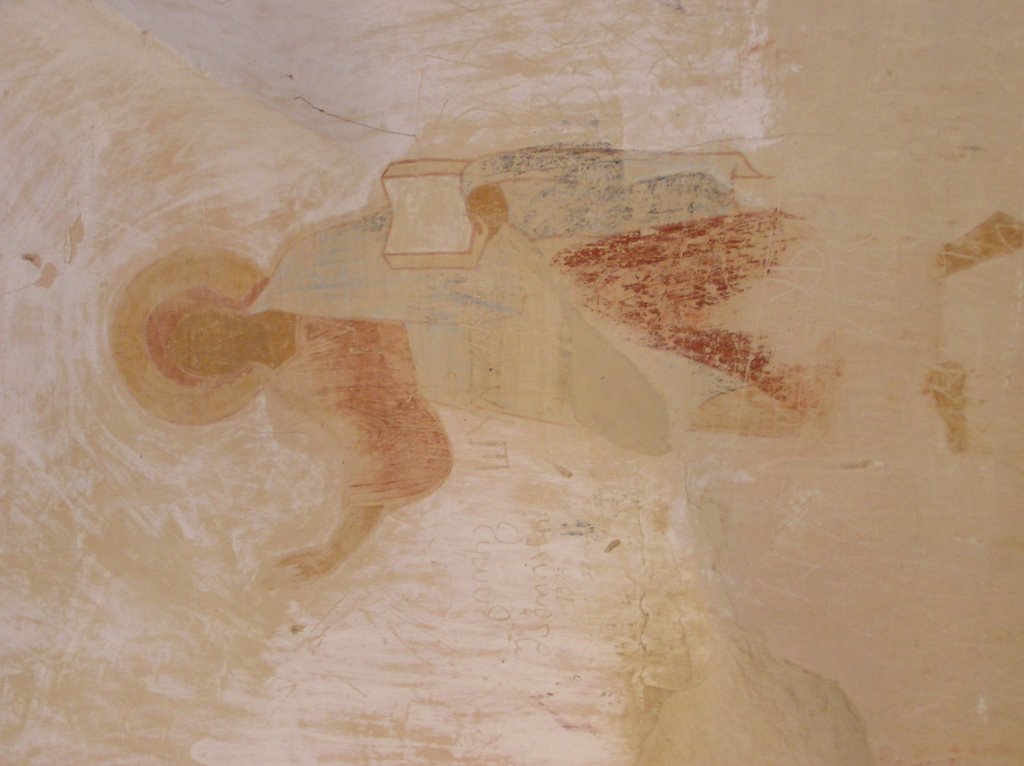
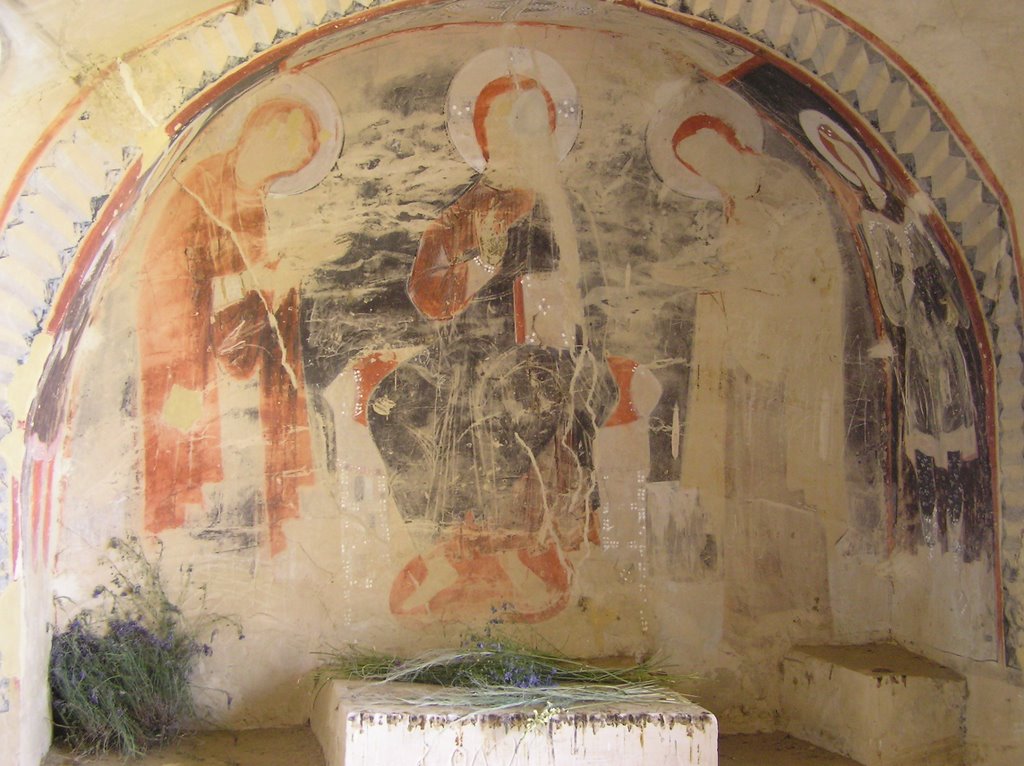
The Udabno monasteries are heartbreaking. During the 1980s, the Russians used the valley below as training ground for the troops being sent to Afghanistan. The explosions caused most of the cave fronts to collapse. Even so, a number of the cave churches still have beautiful, but fading frescoes. I have retained the image in my mind of one of the frescoes in particular, of Christ Pantocrator. This haunting and sublime icon is still distinct, but with the eyes gouged out. The desecration was done not by marauding Turks, Persians or Monguls of ages past, but by Communist Russian soldiers in the 1980s.
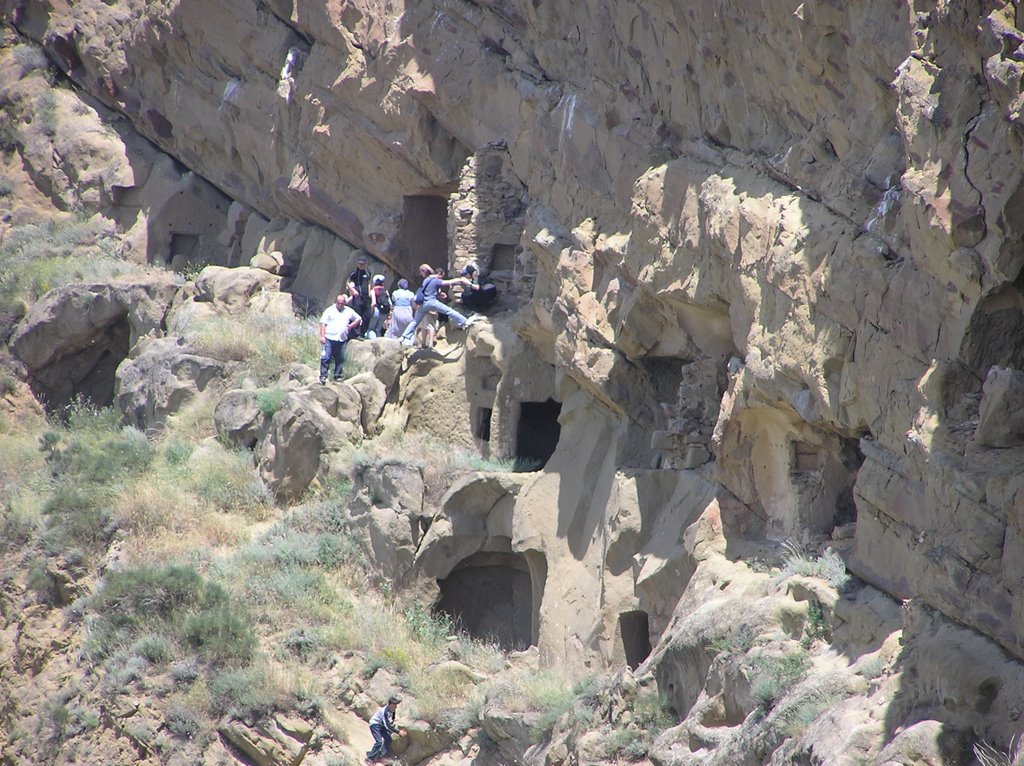
The trail continues past dozens of cave churches. Sophie explained that monks had installed doors on some of the Udabno caves and were now staying in the cells permanently. So, the monastic life is reborn once more in the caves of Udabno.
The trail leads to a promentory, the site of a reconstructed chapel. Sophie explained that a Tbilisi businessman funded the project. Workers and supplies were brought to the site by helicopter. While we sat on a bench and talked, Sophie learned that I was Orthodox. She was pleased, and not a little surprised. She wanted to know if there were many Orthodox in America. I told her there were not so many of us, but that I was hopeful of growth. A young Georgian man was there and heard us conversing in English. He spoke to Sophie. I learned that he wanted to make sure that she told me about the 6,000 martyrs.

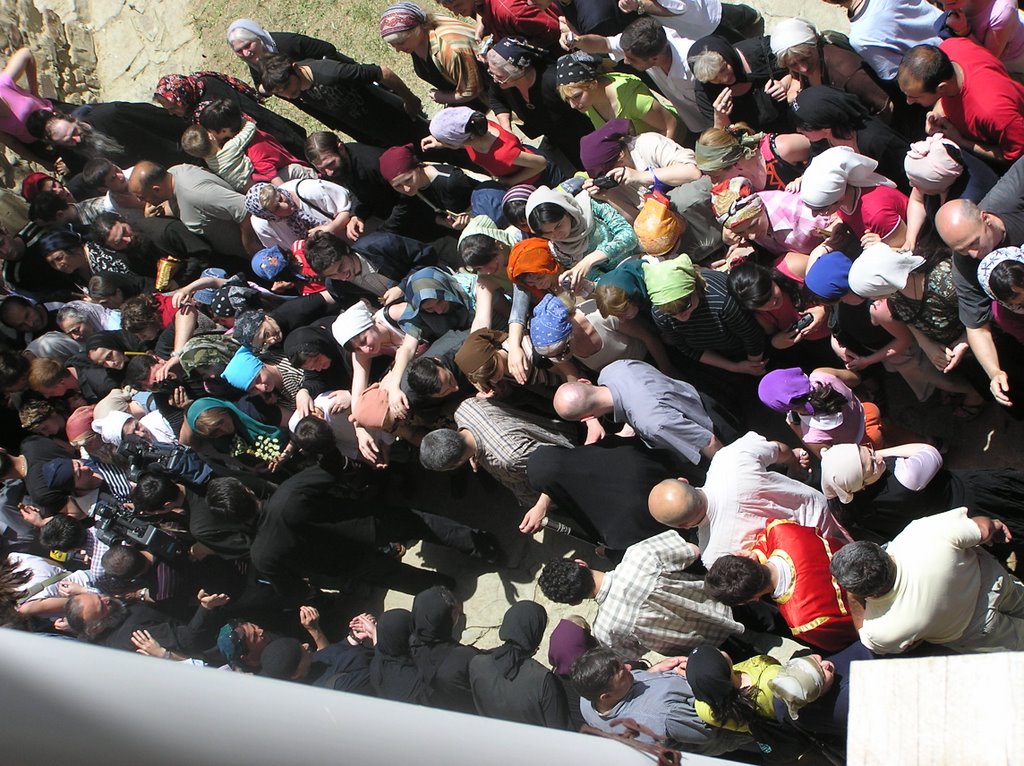
From here, the trail doubled back, down the north slope to Lavra Monastery. By the time we returned to the monastery we found even more people there than before. In fact, crowds covered the place. Sophie discovered that this was the feast day of St. Davit Gareja. This was the one time during the year when the Catholicos of the Georgian Orthodox Church, Ilya II, comes to this particular monastery and conducts the liturgy. The Church of the Transfiguration was packed, with the crowd spilling out into the courtyard. I took up a position on the 3rd floor gallery and waited. After a while, the worshippers, along with the monks and priests, and finally the Catholicos, filed out of the church, the crowds in the courtyard swarming around their shepherd.
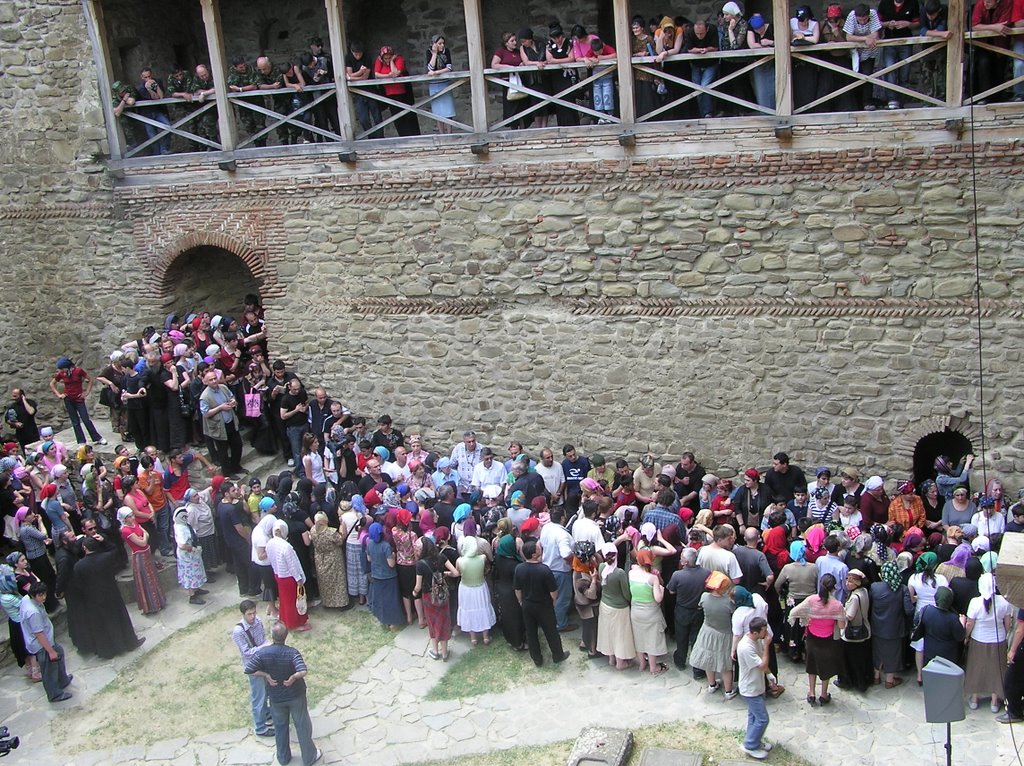
And so ended my journey to the monasteries of Davit Gareja. I retain a number of memories, not the least of which is the joy and simple faith I saw in the faces of the crowd that day. I also remember the story of the 6,000 martyrs. And the monks now returning to the caves. And perhaps more than anything, the now eyeless icon of Christ. And the ultimate utter futility of those who try to stamp out the message of He who sees all in all.
Thursday, July 20, 2006
Dark Grace
A week or so ago, Rod Dreher at Crunchy Con had a link to this excellent article on Flannery O'Connor. The writer laments the fact that the author is not more widely read these days. I agree. In my opinion, she is quite simply one of the greatest theologians of the 20th century, who masqueraded as the greatest American short story writer of the 20th century. The article observes that all of her stories are about grace, but not the kind we Americans would picture. We tend to think of grace as something warm and fuzzy and cuddly. The truth is, more often than not, it hits us like a Zidane head-butt. Go read the article.
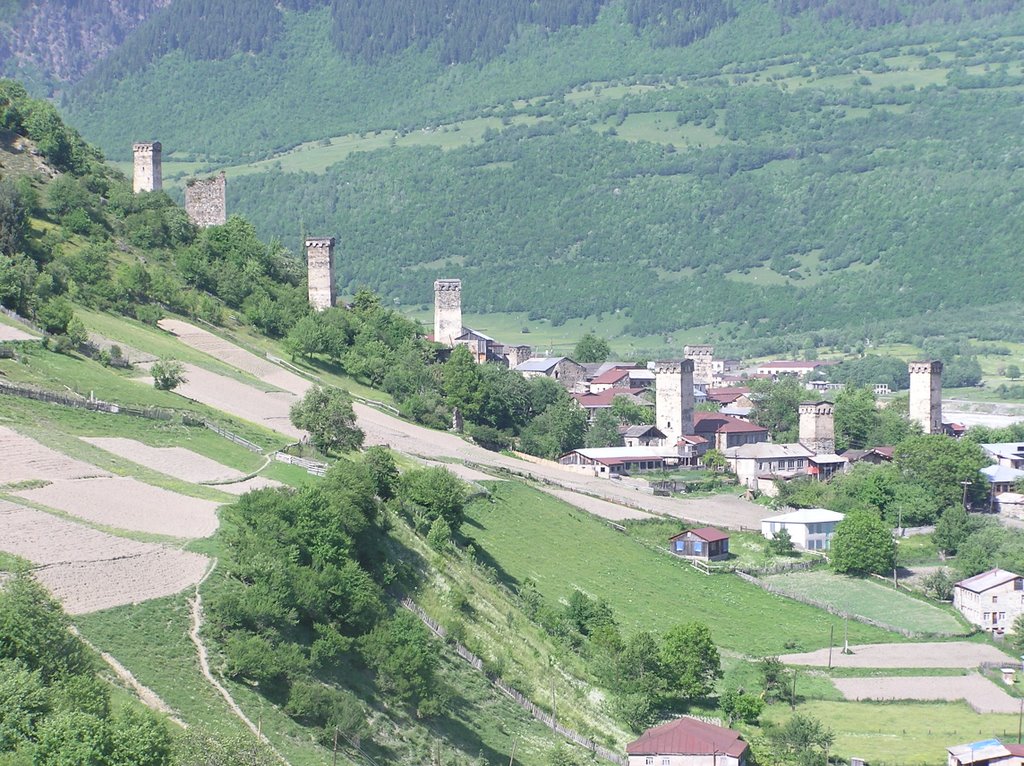
Views of Svaneti
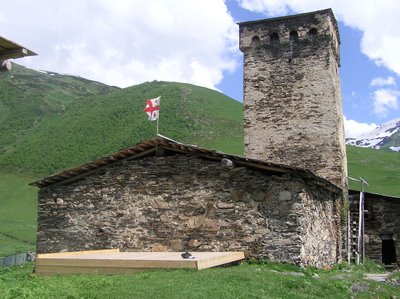
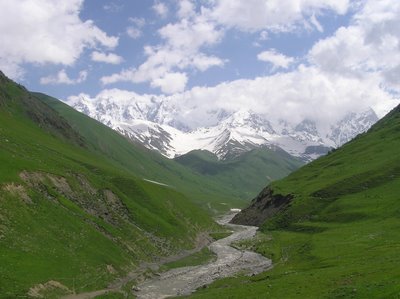
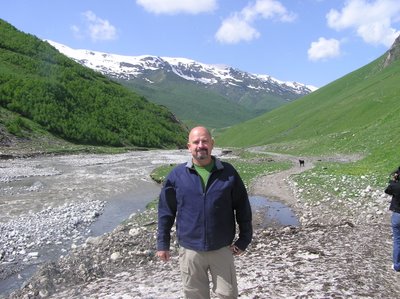
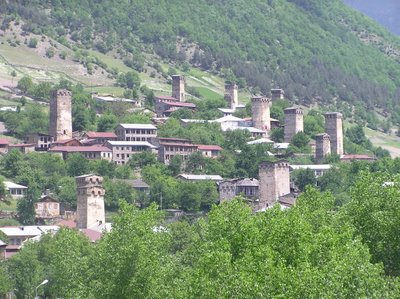
Blogspot has apparently fixed the photo upload problem, so here are a few views of Svaneti.




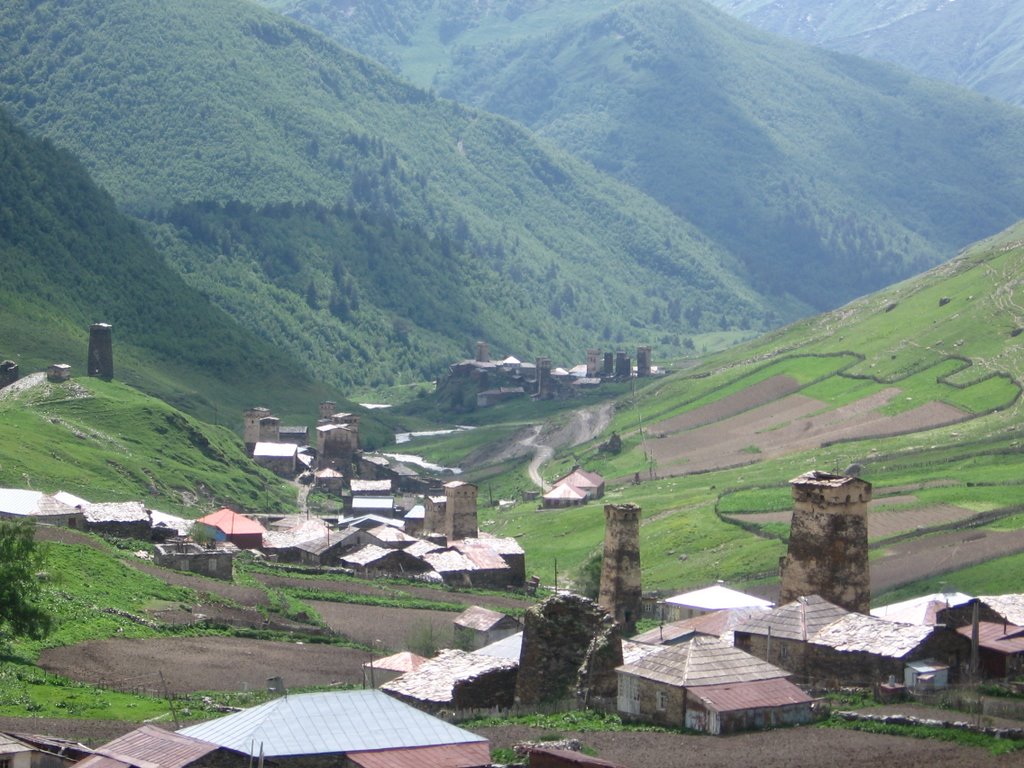

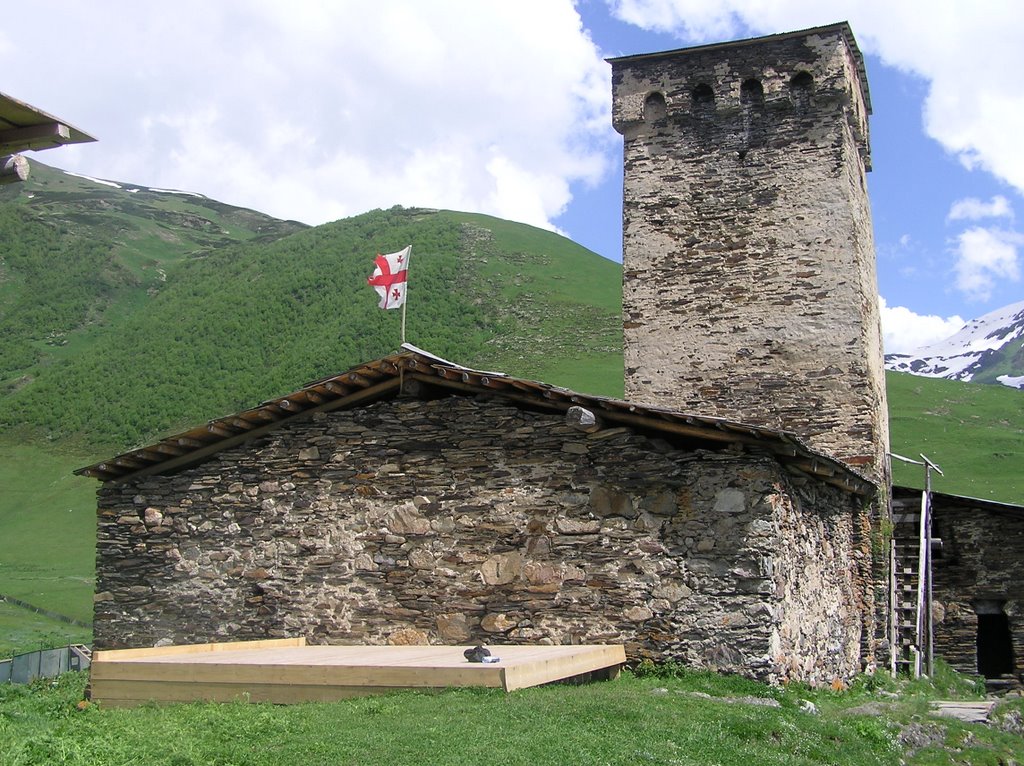
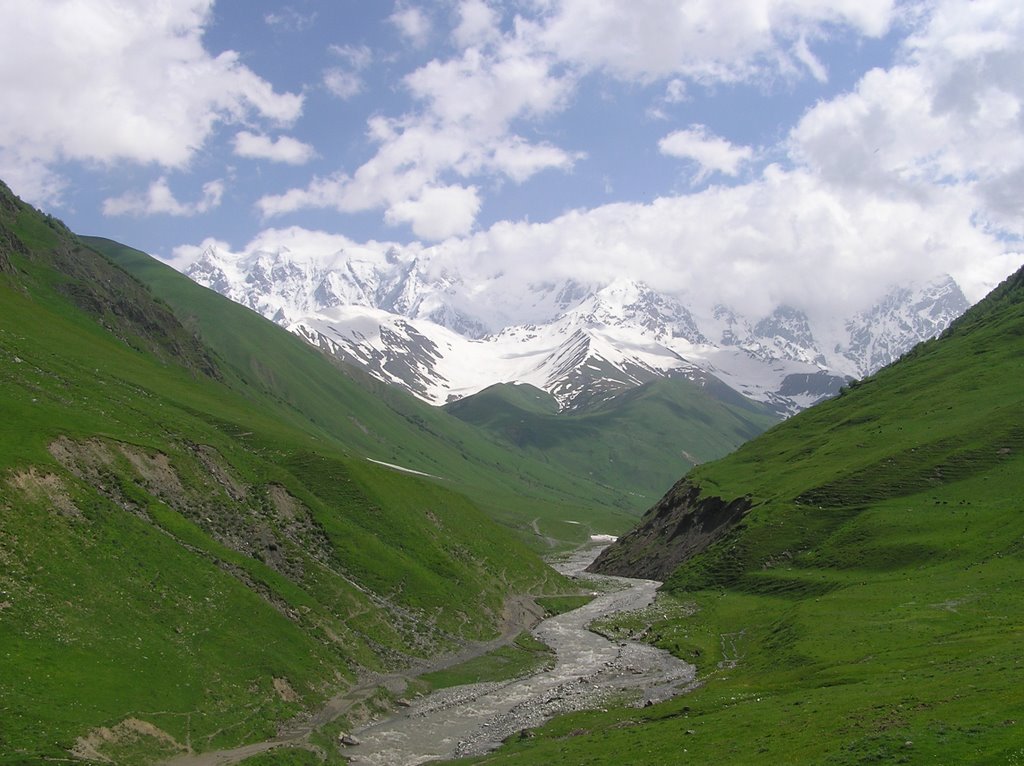

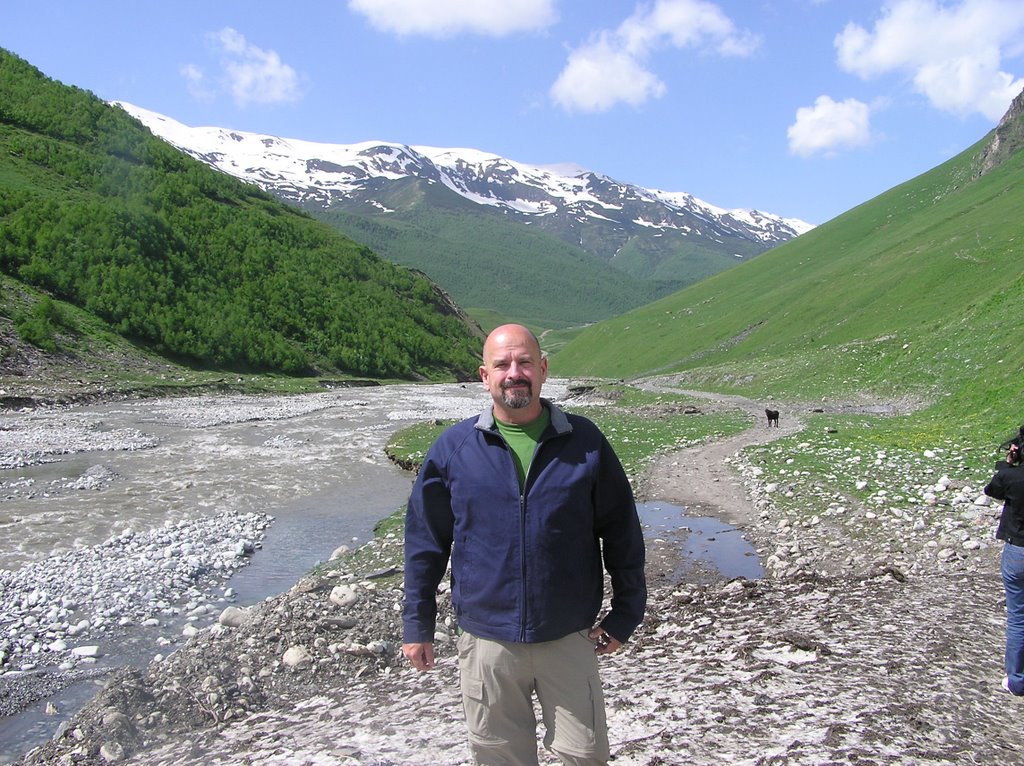

Wednesday, July 19, 2006
Situation Hopeless, But Not Serious
This comic line from a favorite movie--One, Two, Three with James Cagney--often comes to mind these days. Of course, I have reference to the situation in the Middle East. I am saddened, and alarmed by recent developments.
I hesitate to comment at all, for fear of being misunderstood. I am certainly no apologist for the ascendent radical Islam, or even Islam in general, and probably worry about it as much as anyone. And clearly, Israel has a right to defend itself against Hezbollah; no question about it. I don't believe they have a right to level Beirut and Lebanon in the process, however. As is always the case in the Jew vs. Muslim saga, the local Christians get caught in the crossfire. I wonder if the American evangelicals rooting so strongly for the Israeli offensive believe that the substantial Lebanese Christian community is somehow immune from these attacks? I really wonder if they even know they are there.
I am also not so naive as to believe that a resolution of the Israel question would suddenly solve our problems in the Middle East, or make radical Islam go away. It would not. But I do know that our polices of the last 60 years, by all administrations, have fed the growing, and now raging, discontent within Islam. We inherited an already flawed and discredited policy from the British after WWII. And we have stuck with it. We are joined to Israel at the hip (I would add for better or for worse, but there is no better). A friend of mine overheard former Secretary of State James Baker quip (off the record), "America has no foreign policy. Ariel Sharon has a foreign policy." All too true, I am afraid. The only out for us may lie in the growing alarm among Sunni Muslims (Saudi Arabia, Jordan, Egypt, Turkey, etc.) of their Shiite co-religionists (Iran, Iraq, Hezbollah, etc.). We'll see.
In the meantime, I have been following the on-going commentary. Douglas Ian, over at the Scrivener has some good things to say in 2 recent posts on the subject. Rod Dreher at Crunchy Con has linked two articles I consider to be "must reads:" one by George Will and the other by Spengler. I also recommend Jim's comments over at neepeople under "Catch Up," and the article regarding Robert Fisk here. Finally, Sand Monkey (an excellent, pro-Western Egyptian blogger) vents his frustation over the now-famous picture that is making the rounds; the one of the Israeli schoolgirls writing messages to Hezbollah on missiles. I did a little research, and the scene is somewhat contrived; but still, that is no excuse. It just shows how deep the sickness is on both sides. Check it out here, if you wish. He notes that "they [the Israelis]view us as if we were a headache. We view them as if they are a cancer. And this is why there will never really be any peace in the middle-east."
I hesitate to comment at all, for fear of being misunderstood. I am certainly no apologist for the ascendent radical Islam, or even Islam in general, and probably worry about it as much as anyone. And clearly, Israel has a right to defend itself against Hezbollah; no question about it. I don't believe they have a right to level Beirut and Lebanon in the process, however. As is always the case in the Jew vs. Muslim saga, the local Christians get caught in the crossfire. I wonder if the American evangelicals rooting so strongly for the Israeli offensive believe that the substantial Lebanese Christian community is somehow immune from these attacks? I really wonder if they even know they are there.
I am also not so naive as to believe that a resolution of the Israel question would suddenly solve our problems in the Middle East, or make radical Islam go away. It would not. But I do know that our polices of the last 60 years, by all administrations, have fed the growing, and now raging, discontent within Islam. We inherited an already flawed and discredited policy from the British after WWII. And we have stuck with it. We are joined to Israel at the hip (I would add for better or for worse, but there is no better). A friend of mine overheard former Secretary of State James Baker quip (off the record), "America has no foreign policy. Ariel Sharon has a foreign policy." All too true, I am afraid. The only out for us may lie in the growing alarm among Sunni Muslims (Saudi Arabia, Jordan, Egypt, Turkey, etc.) of their Shiite co-religionists (Iran, Iraq, Hezbollah, etc.). We'll see.
In the meantime, I have been following the on-going commentary. Douglas Ian, over at the Scrivener has some good things to say in 2 recent posts on the subject. Rod Dreher at Crunchy Con has linked two articles I consider to be "must reads:" one by George Will and the other by Spengler. I also recommend Jim's comments over at neepeople under "Catch Up," and the article regarding Robert Fisk here. Finally, Sand Monkey (an excellent, pro-Western Egyptian blogger) vents his frustation over the now-famous picture that is making the rounds; the one of the Israeli schoolgirls writing messages to Hezbollah on missiles. I did a little research, and the scene is somewhat contrived; but still, that is no excuse. It just shows how deep the sickness is on both sides. Check it out here, if you wish. He notes that "they [the Israelis]view us as if we were a headache. We view them as if they are a cancer. And this is why there will never really be any peace in the middle-east."
40 Martyrs of Sebaste

I saw this large icon of the 40 Martyrs of Sebaste in the Ethnographic Museum in Mestia, Svanetia, Georgia. It is 12th Century, painted in the Svanetian style, and one of my favorites.
Friday, July 14, 2006
Genora's House

Genora's "Guesthouse Nika" became my home-away-from-home in Tbilisi. The neighborhood was fairly typical for the city, but what we might call "transitional" over here. Grimy Soviet-style flats, sleek new high-rise apartments and overgrown, tumbledown lots made for an odd mix. Then there were the older homes, like Genora's, built prior to the Communist-era apartments. They were all 2-story, either brick or stuccoed, and were built flush with the sidewalk. As is typical in the east, whether Christian or Muslim, little is revealed streetside. The life of the family and the beauty of the home is always hidden in the courtyard behind the gate. Such was the case with Genora's home. The gate opened onto a small, pleasant courtyard with daylillies in bloom in one corner, and a grape arbor providing shade. A passageway led to a rear courtyard, which appeared overgrown at first glance. Actually, the family utilized the small area to its limit, but also with an eye for beauty, as apple, fig and pomegranate trees, grape arbors, roses and daylillies all vied for space.

This was the home of Genora's parents, and she had always lived here. Her father, an engineer, had built the house decades ago. Genora graduated from the university, trained as a classical pianist. In Soviet days, Georgia was perhaps the most affluent of the old republics, enjoying a relatively high standard of living. That all changed upon the fall of Communism and the regaining of independence. The market for Georgia's goods suddenly dried up. The security offered by the state was gone. And few had any real concept of what we call "business." Genora taught piano lessons (and still does at a local school), but this was not enough to survive. The family silver had to be sold, and then her piano. She said she was not going to sit around and wait for the government to provide for her. so, for the last 7 years she has operated a a pension in her home. While perhaps wistful for their former standard of living, she is not bitter and does not want to go back. She smiles, shrugs and says, "And so we live."
Genora's guesthouse is the unofficial headquarters for Peace Corps volunteers in Georgia, Armenia and Azerbaijan. The PC's office in nearby, and whenever the volunteers come into the city from their various postings, either on break, to take care of bookkeeping or to pick up their mail, they always stay at Genora's. It's a good arrangement on both sides--she speaks of them as "her children" and they view her house as a home-away-from-home.
I suppose my son and I--mere travelers and not connected with the PC--were something of oddity to the volunteers. No matter, they pulled us right in to their fellowship. I have never met a friendlier bunch of people, all eager to talk. And I might add, that I have rarely felt better about my own country that I did with these young people. Two years in a remote Georgian village is rarely seen as a savvy career move. And yet here they were. Graduate school and careers could wait. Right now, they were just trying to make a difference.

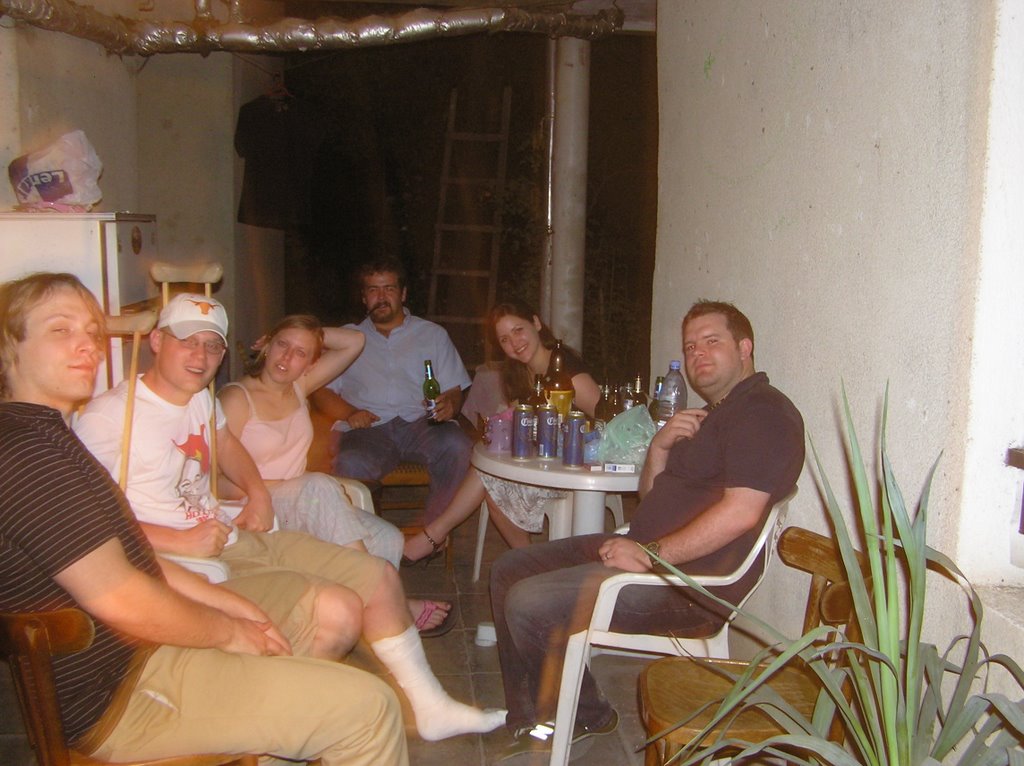
A covered patio connected the two courtyards. A cheap plastic table and chairs, coupled with an old refrigerator wedged in on the opposite wall made for a perfect hangout. I will never forget our first full night there. The two of us, and anywhere from 6 to 9 of our new PC friends, sat around shooting the bull, drinking Kazbegi beer and smoking too many cigarettes until 4:30 in the morning. One of the young men commented on my staying up with them. I told him I was delusional. He asked what I meant and I told him that I thought I was still young. He said he hoped he could be delusional one day. The next night, however, I was somewhat less delusional and had to give it up at 3:00 AM.
Anyway, these wide-ranging discussions touched on a number of subjects. I found their insight into the country invaluable, as they were eager to talk about Georgia and Georgians. I remember one anecodote,in particular. It seems in the old Soviet days, the other "republics" would simply do as Moscow dictated. The Georgians, however, would simply shrug, ask, "why?" and then go about doing as they wanted. I certainly saw evidence of this in my travels. But then Georgia has always been a dangerous neighborhood--a small country wedged between powerful ones. This attitude has less to do with obstinacy than it does with the preservation of Georgian culture in the face of a long history of invasions.

I have always been a little amused that when people sit around and drink, the subject of religion will often come into the conversation. We were no exception. First of all, I had an immediate connection with one of the older young men. He was out of the Peace Corps, but remained in Georgia, working for another humanitarian organization. He was from Texas and he had belonged to the same heritage church as mine. He was currently engaged to a Georgian Orthodox girl. And while he had left his old church far behind, he was not yet ready to cross the Bosphorus as I had. I believe he wanted to, but was looking for a narrower place to cross. He would go with her to the Orthodox Church, but was put off by some of the claims Orthodoxy makes for itself. She would accompany him to a "nondenominational" Bible study, but would become angry over their evangelical condescension--the idea that they were bringing "the gospel" to a country that, in fact, has a rich, 1700 year old Christian history. Anyway, in coming months, they are to have a Georgian wedding with a priest, and then a few months later, a Texas ceremony for his family. He and I shared a laugh over his mother's concern--whether the girl could be rebaptized and whether or not she could be "saved." Lord have mercy!
They were all intrigued when they discovered that I was Orthodox, which of course led the discussion into new areas. Many of these intelligent young people had been in Georgia for 2 years, working daily as members of Georgia society. It would be the heighth of presumption for me to lecture them about Georgians; for me to conclude that I had better insight into the culture after only a brief stay than they did. And yet, except for the one young man, I believe many of them had missed a key element of Georgian society. They were overlooking, or rather, dismissing the church. Partly this is due to the fact that they were Americans. We are still probably the most religiously observant folks around, statistically, but like the old saying goes, our American popular religion is 3,000 miles wide and 2 inches deep. Many, many Americans have only a superficial interest and/or understanding of matters of faith--of whatever stripe. And like our European kinsmen, it is becoming increasingly irrelevant to our society as a whole. Trained to help developing countries move into the modern world, I suspect that they failed to consider that a country's faith could/would/does continue to define the culture. For example, I had to explain to one of the young men from New England what I meant by the word "evangelical." He wasn't being obtuse, he actually didn't know.
I was assured that "Georgians didn't really go to church;" the impression being that they did not take it all that seriously. One young man related his experience at an Orthodox church. He observed that "the priest didn't even face the congregation. He has his back to them the whole time. It was like he was doing his own thing and wasn't even aware that the congregation was even there." Also, he saw a young man talking on his cell phone during the service. Oh, dear. Where to begin? I wondered how one could be trained for work in a traditional Orthodox country and not learn the bare rudiments of how they worship? How could one live there for 2 years and not pick up on this?
I quickly gathered that the problem was with their perception of "church." Broadly speaking, in America, church is a place where you fill up the parking lot on Sunday, go in and settle in to a comfortable pew, hear some nice uplifting songs and listen to an upbeat, feel-good sermon from the pastor and then go out to eat. And even if you are not a regular church-goer, you know that is what happens when Americans "go to church." Unknowingly, this was the prism through which they viewed Georgian religiosity. With this perception of "church," no wonder they dismissed Georgian spirituality. This is a shame, for in so doing, they missed a key, if not the very key, to understanding this people.

I began by addressing the experience of the one young man in the Orthodox church. I told him that, by and large, he was exactly right--the priest was not talking to the congregation. He was talking to God. I tried to explain how it differed from American Protestantism; how the "sermon" was not the thing at all; that an Orthodox church was not a place to go and hear a nice lesson. It was a temple; a place to pray; a place to experience God. Worshippers in an Orthodox church are not an audience, they are participants. I couldn't excuse the cell-phone guy, as Georgians seem more enamored with them than even we are, but I did try to convey that the Orthodox have a different conception of "church."
Admittedly, I am hardly an unbiased observer. Yet, over the course of my stay in Georgia, I suppose I was in at least 15 churches--from a mere 4 years old to 1500 years old--and found myself encouraged and edified by what I saw. Georgian churches are far from the museum pieces of western Europe. You might even say some literally churn with activity. As expected, people were coming in an out, lighting candles and praying before the icons. Yet they were not just the faithful old, the bow-legged old peasant women, as some mught presume. In fact, the demographics I saw tended towards the young, both women and men. The sight of young men, even soldiers, praying and crossing themselves before the icons is a healthy thing. For Orthodoxy is still a manly religion. At Sioni Cathedral I chanced upon a priest striding across the courtyard to the church. He was singing--bellowing actually--in a rich, strong bass. Yes, there's still plenty of room for men in Orthodoxy.
The spectacular new Sameba Cathedral dominates the Tbilisi skyline, billed as the third largest Orthodox church in the world. My PC friends told me that the building of this church generated some local controversy. Eyebrows were raised at such a lavish building in a struggling country. Others worried that it was erected largely from contributions of a businessman with questionable connections. Then part of the courtyard supposedly covered an old Armenian cemetery. So much for the naysayers. I found it magnificent and full of worshippers. I also witnessed 2 baptisms and 1 wedding in the short time I was there.
Taxi drivers in Tbilisi habitually cross themselves 3 times whenever they pass in sight of a church. Pedestrians stop on the pavement and do the same thing. Icon stores dot the city. New chapels and churches can be seen on the highway from Tbilisi to the coast--all in the beautiful Georgian style. Even in the bleak apartment flats of decaying Rustavi, chapels have been constructed next to the playgrounds in the common areas.
My PC friends complain that the Orthodox Church has been slow to build churches where the people are located. For example, my friend's fiancee lives in a neighborhood of 50,000 people, that until very recently, had no church. Perhaps this is true. But then convenience has never been a watchword in Orthodoxy. Georgians are much more likely to build a church on a rocky cragg overlooking all of God's creation than they are to erect it down on the crossroads.
I have to conclude that Orthodoxy in Georgia is vibrant, perhaps even resurgent. 80% of the populace identify themselves as Orthodox. Admittedly, some of this allegiance may be tilted more to their nationalistic identity as Georgians. But after 70 years of Communism, the re-emergence of Orthodox Christianity seems fresh and alive and invigorating.
Tuesday, July 11, 2006
The Treasure of Iperi
During my recent journey in the Republic of Georgia, I spent the better part of 4 days getting to, traversing across, and returning from the Province of Svaneti. In fact, I ventured as far as Ushguli, an almost surreal village nestled high in the Caucasus Mountains--the most remote village in the most remote province of a fairly remote country. It is quite literally the end of the road in Europe (that is if you play along with the Georgian insistence that that their country is in Europe). Svaneti's main draw for visitors--beyond its isolation--is its almost other-worldly look; an alpine terrain dotted with the unique 900 year-old defensive towers, 5 to 6 stories in heighth (see picture below on "Sabbatical" post).
Obviously, one doesn't go to Svaneti on the way to anywhere. From Zugdidi, a sometimes harrowing 5-hour jeep ride--on a twisting trail which hugs mountain ridges along the raging Enguri River far below--will eventually bring you as far as Mestia. The road is blocked by snow much of the year. And during the rest of the year, a road crew is clearing away the rock slides and bracing the road here and there to keep it from sluffing-off into the river.
The town of 2,300 is the provincial capital. We stayed with a nice lady named Nino, who is, in fact, the governor of the province. So, I guess you can say we boarded at the "Governor's Mansion." But before you go too far with that imagery, however, I might add that there was a clothes line in the front yard and the cows were stabled right below our bedroom window. But there were indoor "facilities." Nino and her husband were pilgrims to the Holy Land during Pascha and witnessed the Holy Fire. She set her laptop on the dining room table and we all gathered around and watched her home movie DVD of the miracle.
Svaneti, while Georgian, has always maintained a fierce independence. Among themselves, they continue to speak Svan and hold to the many of their old ways. While Orthodox Christian, many still hold to some pre-Christian traditions. On major feast days, some villagers will sacrifice a bull (but then prepare the meat for a feast). Remarkably, the towers are generally owned by the same families who built them 900 years earlier. In the bad old days of Communism, bureaucrats were shipped in to whip the region into line. Many simply never returned and the Svans went about their business as usual. Family feuds can still flare up from time to time, and the village elders are looked to for mediation. In fact, the defensive towers were as much a protection against adversarial clans as they were against foreign invaders and rockslides.
Good-natured banditry, while diminishing, can still be a problem. I say "good-natured," because the Svan highwaymen may relieve you of your money and your wine, but they are not going to hurt you. And they will probably share the wine with you, as well. On our journey there, my son and I traveled with a guide and a car and driver. Unbeknownst to us, the package price included an accompanying jeep with 3 commandos in camouflage gear and submachine guns. The tour company hired them as our protection, just in case. I appreciated them being there, even if their presence was a little off-putting. I retain an image of them, squatting on their haunches, eyeing us with curiosity, while pulling on a cigarette held between thumb and forefinger. I got the feeling that any one of them could have been on the other side, had that been where the money was.
This perception of Svaneti, however, can obscure the region's rich cultural heritage. During invasions, the Georgian monarchs of old would send their treasures there for safe-keeping. And at times, the mountain strongholds provided protection for the rulers themselves. When invaders, whether they be Turks, Persians or Communists would penetrate into the region, the villagers would take down the icons and other treasures and hide them in their homes. This has continued down to the present day, so much so that many Svanetians are still hesitant to relinquish them. Some have been gathered together and displayed in the excellent Ethnographic Museum in Mestia. Gospel books dating from the late 800s are on display, as well as beautiful icons from the 11th and 12th centuries. One of my favorites was a unique 12th Century Svanetian icon of the 40 Martyrs of Sebaste.
After Mestia, you leave the "good" road behind, and travel another 3 1/2 hours along the Enguri River to reach Ushguli. The first automobile only made it here in 1964. The road ends here. The small power line which provides sporadic electricity to the village ends here. The achingly beautiful Church of LaMaria crowns the last knoll in the valley. There, you are face to face with Mt. Shkhara, its summit hidden in clouds. On the other side--Russian Chechnya--which makes it an ideal place to turn around.
On the return journey, we stopped at the village of Iperi, about 1 1/2 hours from Ushguli and 2 hours from Mestia. Our guide, Sophie, wanted us to visit the Church of St. George there. We parked in front of the churchyard while she went to find the caretaker.
The church was unprepossessing from the outside, what I describe as the simple Georgian style with steep pitched roof, but without the soaring effect of the high Georgian style. A small village cemetery lay in front of the church. Georgians prefer black stones with the portraits of the deceased etched on the marble. So as I faced the church, the faces of the deceased village stared out at me! Americans would probably consider the graveyard an overgrown mess. Yet it was not neglected and a far cry from the sterile lawnscapes characteristic of modern American cemeteries. For the markers had bottles stacked around them. Families return to the graves periodically--and especially on the anniversary of the death--and drink toasts to the deceased. (Toasts are big in Georgia, by the way. In Ushguli, I survived 7 vodka toasts at supper...but that's another story.) The bottles are of water, soda, wine or vodka--but never beer--and the bottles are left there, for whatever reason. I see the practice as a hearty, earthy affirmation of belief in the victory over death through Christ. The separation with the deceased is not real, and at worst, is only temporary. Though totally foreign to my experience, I found the custom oddly comforting, and smiled when I speculated how some of my uptight Protestant forebears would react to a vodka toast being offered over their graves!
Eventually, Sophie returned with the caretaker. It seems that it was still one of the feast days for St. George and somewhere in the village they were boiling a bull. The caretaker unlocked the door and admitted us into the small sanctuary. There was little to see at first, as it took a while for my eyes to adjust to the darkness inside. There was one candlestand, and Sophie and I each lit a candle. Gradually, the panoply began to unfold before me.
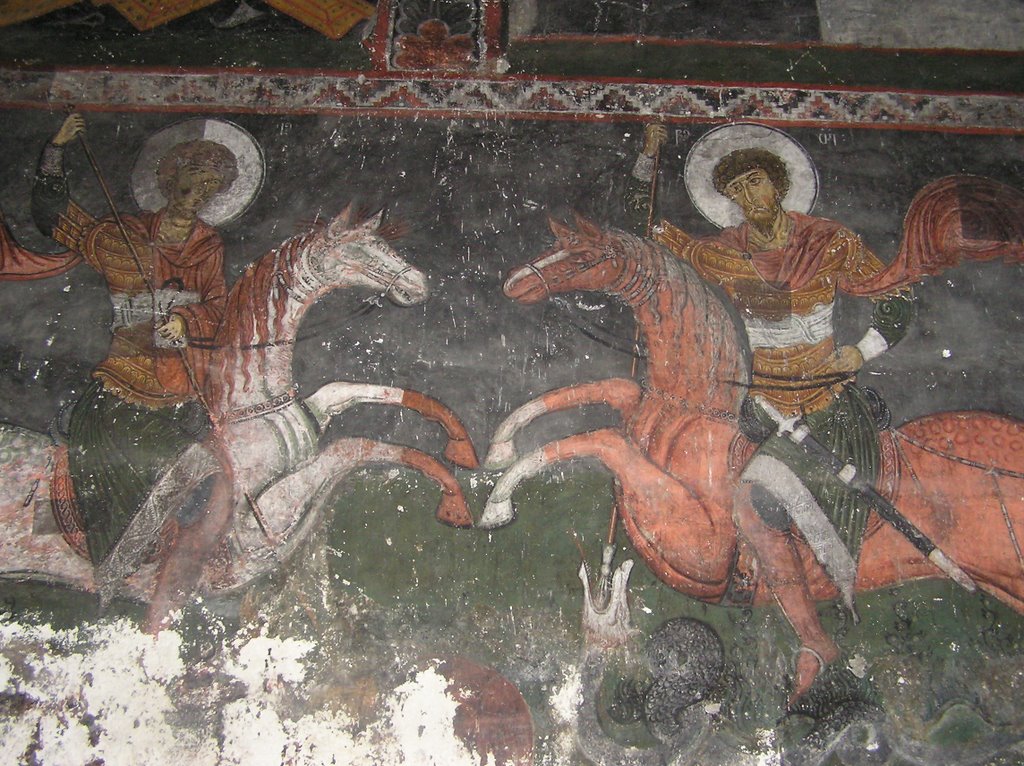
Meanwhile, the caretaker talked of his church. The building dated back to the 11th century. The frescoes inside were painted by the court painter of King David the Builder. King David is a Georgian saint, who along with his descendant, Queen Tamar, ruled during Georgia's glory days of the 10th throught 13th centuries. During the Soviet era, the local Communists commandeered the church as a stable, and defaced all the frescos on the lower level. But since Communism's fall, the church had been reconsecrated, and a priest conducts liturgies there from time to time. The caretaker said that there would be many baptisms whenever he came. He went on to explain that his nephew was a deacon in Tbilisi, and he had hopes of him returning to the village one day as a priest.
As my eyes adjusted to the dim light, I was bowled over by the beauty of the frescoes! Of course, Christ Pantocrator was seated above and behind the altar, with the Theotokos on the left and John the Baptist on the right. Scenes from the life of Christ filled-out the front of the church. Depictions of the life of St. George (and St. Theodore)lined the sides and rear of the sanctuary.
But I had not yet seen everything. A safe sat at the rear of the church. The caretaker carefully worked the combination and opened the door. An incredible silver icon of St. George sat on display on the the top shelf. The Svanetians often depict St. George spearing the Emperor Diocletian (as this one did), instead of a dragon. Of course, they know that St. George didn't really kill Diocletian, but by his martyrdom he symbolically slew the emperor and all that he stood for. The caretaker explained that this icon was hidden in the village during the long, dark years of Communism.

He pulled other treasures from the safe--ancient silver chain necklaces for both men and women. We held them in our hands and admired their weight and craftsmanship. He then extracted a golden bowl; not a gold-rimmed bowl, not a gold-plated bowl, but a golden bowl donated to the church by benefactors centuries earlier. As we stood there, holding this priceless golden bowl, the caretaker reached over to a table and picked up an unmarked (and open) bottle. He poured a clear liquid into the bowl. Not being real quick on the take, I looked at him questioningly. He said, "Wodka!" We smiled our approval. I put the bowl to my lips and took a long draught of vodka. I passed the bowl to my son, who finished it off. I briefly contemplated the strange, unfathomable providence and mercy of God--that would bring a formerly Protestant boy from East Texas to an obscure 11th Century Orthdox Church in the Caucasus Mountains, drinking vodka from a golden bowl.
The treasures were locked securely back in the safe, and began to exit the church. As I did, I was touched by what I glimpsed. Our hardened, young commandos were approaching--perhaps to see what we were up to--all the while, crossing themselves in the wide, sweeping Georgian manner as they neared the church. Western Protestants may pooh-pooh this as meaningless ritualism, but I am assured that it is not.
The caretaker charged a nominal fee to show the church, and a little more for picture-taking. It was really a pittance and we were glad to help support its maintenance. Through out guide and interpreter, I told him to keep the change as a contribution to the church. It amounted to, I believe, something like $14 more. The caretaker was overcome with emotion. He invited us to his home, to share a meal with his family. My "western" sensibilities took over. I didn't want to "impose," and then we did have something of an entourage--the 2 of us, our driver, our guide and our 3 rent-a-toughs. Then, of course, we did need to get on to Mestia. Anyway, I thanked him profusely, and I believe he understood. Before we left, he shook our hands firmly, bowed low to us, and then kissed us on each cheek. And so we left Iperi and its treasures behind, except of course for the one I was nurturing in my own heart.
Tech Help Needed
I am working on some travel stories to post. Unfortunately, Blogspot is not allowing me to upload pictures as before. Anyone ran into this problem before, or have any suggestions?
Friday, June 30, 2006
I Saw Dolphins
I spent the last few days of my journey in Istanbul before heading home on Monday. On Friday, I went out to the Princes Islands. The 4 inhabited islands--Kuniliada, Burgazada, Heybeliada and Buyukada--lie out into the Sea of Marmara, though within sight of the Asiatic side of İstanbul. They have a rich history. Back in the days of the East Roman Empire, the islands were used as a place of exıle (excuse my being pedantic here, but if you called a resident of old Costantinople a "Byzantine" they would not know what you were talking about. They considered themselves to be Romans.) Displaced royalty were dispatched here while the new emperor figured out what to do with them. Theologians out of favor at court also found their way to the islands. Frankly, there are worse things than being sentenced to these beautiful islands.
İn the last half of the 1800s, the islands began taking on a new character. The wealthy Greek and Armenian merchant class of Constantinople built expansive villas on the islands. And what villas they are!
As everyone knows, the Greek and Armenian presence in İstanbul is now little more than a memory. There are a few small cafes and shops clustered around the Ecumenical Patrıarchate (Church of St. George), but that is about all. Walking around the old Greek district--the Phanar--is a real eye-opener. The old Greek mansions and townhouses are now decrepit. An occasional one remains maintained and you wonder if it houses a Greek family behind the locked doors. But as the Greeks were pushed out, the area has been taken over by some of the poorest and most conservative Muslims immigrating from eastern Turkey. Frankly, this area reminds one of pictures of Afghanistan, as most women are in the black burka with only eyes and perhaps nose exposed, and the men with beards and woolen skullcaps. While this is NOT representative of İstanbul, it does describe what has happened to the old Greek district.
But the Christians have held on to the islands. Kuniliada is just a big Armenian social club. Burgazada is mostly Greek. Heybeliada is majority Turkish, but also contains the now-closed Greek Orthodox Theological Seminary (of much controversy) and several monasteries. Buyukada is supposed mostly Jewish, though it is hard to tell (Funny, the island doesn't look Jewish.)
Buyukada is the largest, and farthest away. As the ferry stops in turn at each of the islands, it takes a good hour and a half to reach Buyukada from the Eminonu docks. But İ enjoyed every minute of it. The sight of several pairs of dolphins along the way was a special treat.
An unique aspect of island life is the fact that vehicles are banned. You can walk. You can ride a bicycle. Or you can hire a horse-drawn carriage. These buggies are a big hit with the day-trippers from İstanbul who descend on the islands in droves during the summer. The pungent aroma of horse manure mingles with the fragrance of the lush, flowering shrubs Upon arrival, İ chose the cycling option and rented a bicycle in the Meydan (town square). My goal was the Monastery of St. George.
Buyukada has been rightly called the Turkish Hamptons. The homes are elegant and are usually surrounded by lush tropical landscaping. İ was unfamiliar with most of the flowering shrubs, save the hydrangeas. Whatever they were, they were all in full bloom. The residents were not easily spotted. İ suspect they like to sit on their back terraces which overlook their private beaches. But İ did catch glimpses of older non-Turkish men (whether Greek or Jewish) in sailing caps (think Thurston Howell, III) and henna-haired matrons in their garden chairs giving directions to the gardener, and of handsome young people who perhaps spend a little too much time laying around the pool. İ spotted several churches. Only saw one very small mosque with an aluminum mınaret. İt looked as out of place as you know what.
İ leasurely pedaled my way though these residential areas and on towards the monastery. The Church of St. George is located on the highest hill on the island. A cobbled road leads from the main road up to the summit. İ was already huffing and puffing by the time İ reached the monastery road. This was one steep hill! İ am not sure even Lance Armstrong could have ridden up it (Yeah, he could). Anyway, İ started pushing the bicycle up the hill. Actually, this worked out to my advantage as I was bent over double and used the bicycle seat to rest my head as I trudged along.
At long last, I reached the summit. The church was closed until 2:30, so I settled in and made myself at home on a park bench nearby. I carried a small backpack throughout my travels--ideal for my hat, water, camera, batteries and journal. For many years, I have kept a small journal on me when I travel. I make note of names and places and events, make observations, and draw small maps. I dug around around in the backpack and discovered that the journal was missing! I briefly panicked. Almost a month's worth of writing--gone! But then I remembered what I had written not many days before--about worry and fretting about things that could not be changed. So, I concluded that there were 3 options: 1. The journal had fallen out of my backpack when I was scrambling around in it for my water bottle. I would retrace my steps on the island and find it. 2. The journal had fallen out of my backpack. I would retrace my steps on the island and not find it. In such case, I would reconstruct my journal and this would be a good test of my memory--and a good test of my being able to "walk the walk" about not fretting over transitory things. 3. The journal was on the nightstand in my hotel room and I would find it that night. I took stock of where I was: I was at a monastery on the top of a mountain, with a cool breeze blowing, a view of sailboats bobbing in the harbor below, and I was worried about a damn journal! I took a deep breath, said a prayer and put it out of my mind.
Frankly, I was a little disappointed in the monastery church. There were no priests around (gee, shouldn't they be on hand to provide photo-ops for us tourists???); the church had no gift shop as I had been lead to believe; and no photographs were allowed inside. This may give you real insight into my spirituality that day! I guess I was a little tired and cranky by this time. I have to laugh at myself now, though.
The bicycle ride back into the town was a breeze, being mostly downhill this time. And what luck! There was a ferry right there on the dock preparing to leave. I jumped aboard for the ride back to Istanbul. Perceptive readers will here recognize a marked similarity between this scenario and my "wrong train out of Zurich scenario." The ferry was not going back to where I had come from. Just because a ferry brought me to Buyukada, did not mean that it was the only ferry stopping there. This ferry, I learned, was headed for a dock on the far southern end of Asiatic Istanbul. Well, it's still Istanbul, you say. With 14 million people, this would be similar to aiming for Washington DC and getting off in Baltimore. Some nice Greek tourists consulted a ferry schedule (which apparently everybody but me picked up when they first bought their tickets) and put me back on the ferry to Buyukada. So, once more, with the kindness of strangers, I backtracked and eventually made my way home.
The best part of the day? I saw dolphins.
Oh yeah, and the journal--I never found it. But I did reconstruct the whole thing.
İn the last half of the 1800s, the islands began taking on a new character. The wealthy Greek and Armenian merchant class of Constantinople built expansive villas on the islands. And what villas they are!
As everyone knows, the Greek and Armenian presence in İstanbul is now little more than a memory. There are a few small cafes and shops clustered around the Ecumenical Patrıarchate (Church of St. George), but that is about all. Walking around the old Greek district--the Phanar--is a real eye-opener. The old Greek mansions and townhouses are now decrepit. An occasional one remains maintained and you wonder if it houses a Greek family behind the locked doors. But as the Greeks were pushed out, the area has been taken over by some of the poorest and most conservative Muslims immigrating from eastern Turkey. Frankly, this area reminds one of pictures of Afghanistan, as most women are in the black burka with only eyes and perhaps nose exposed, and the men with beards and woolen skullcaps. While this is NOT representative of İstanbul, it does describe what has happened to the old Greek district.
But the Christians have held on to the islands. Kuniliada is just a big Armenian social club. Burgazada is mostly Greek. Heybeliada is majority Turkish, but also contains the now-closed Greek Orthodox Theological Seminary (of much controversy) and several monasteries. Buyukada is supposed mostly Jewish, though it is hard to tell (Funny, the island doesn't look Jewish.)
Buyukada is the largest, and farthest away. As the ferry stops in turn at each of the islands, it takes a good hour and a half to reach Buyukada from the Eminonu docks. But İ enjoyed every minute of it. The sight of several pairs of dolphins along the way was a special treat.
An unique aspect of island life is the fact that vehicles are banned. You can walk. You can ride a bicycle. Or you can hire a horse-drawn carriage. These buggies are a big hit with the day-trippers from İstanbul who descend on the islands in droves during the summer. The pungent aroma of horse manure mingles with the fragrance of the lush, flowering shrubs Upon arrival, İ chose the cycling option and rented a bicycle in the Meydan (town square). My goal was the Monastery of St. George.
Buyukada has been rightly called the Turkish Hamptons. The homes are elegant and are usually surrounded by lush tropical landscaping. İ was unfamiliar with most of the flowering shrubs, save the hydrangeas. Whatever they were, they were all in full bloom. The residents were not easily spotted. İ suspect they like to sit on their back terraces which overlook their private beaches. But İ did catch glimpses of older non-Turkish men (whether Greek or Jewish) in sailing caps (think Thurston Howell, III) and henna-haired matrons in their garden chairs giving directions to the gardener, and of handsome young people who perhaps spend a little too much time laying around the pool. İ spotted several churches. Only saw one very small mosque with an aluminum mınaret. İt looked as out of place as you know what.
İ leasurely pedaled my way though these residential areas and on towards the monastery. The Church of St. George is located on the highest hill on the island. A cobbled road leads from the main road up to the summit. İ was already huffing and puffing by the time İ reached the monastery road. This was one steep hill! İ am not sure even Lance Armstrong could have ridden up it (Yeah, he could). Anyway, İ started pushing the bicycle up the hill. Actually, this worked out to my advantage as I was bent over double and used the bicycle seat to rest my head as I trudged along.
At long last, I reached the summit. The church was closed until 2:30, so I settled in and made myself at home on a park bench nearby. I carried a small backpack throughout my travels--ideal for my hat, water, camera, batteries and journal. For many years, I have kept a small journal on me when I travel. I make note of names and places and events, make observations, and draw small maps. I dug around around in the backpack and discovered that the journal was missing! I briefly panicked. Almost a month's worth of writing--gone! But then I remembered what I had written not many days before--about worry and fretting about things that could not be changed. So, I concluded that there were 3 options: 1. The journal had fallen out of my backpack when I was scrambling around in it for my water bottle. I would retrace my steps on the island and find it. 2. The journal had fallen out of my backpack. I would retrace my steps on the island and not find it. In such case, I would reconstruct my journal and this would be a good test of my memory--and a good test of my being able to "walk the walk" about not fretting over transitory things. 3. The journal was on the nightstand in my hotel room and I would find it that night. I took stock of where I was: I was at a monastery on the top of a mountain, with a cool breeze blowing, a view of sailboats bobbing in the harbor below, and I was worried about a damn journal! I took a deep breath, said a prayer and put it out of my mind.
Frankly, I was a little disappointed in the monastery church. There were no priests around (gee, shouldn't they be on hand to provide photo-ops for us tourists???); the church had no gift shop as I had been lead to believe; and no photographs were allowed inside. This may give you real insight into my spirituality that day! I guess I was a little tired and cranky by this time. I have to laugh at myself now, though.
The bicycle ride back into the town was a breeze, being mostly downhill this time. And what luck! There was a ferry right there on the dock preparing to leave. I jumped aboard for the ride back to Istanbul. Perceptive readers will here recognize a marked similarity between this scenario and my "wrong train out of Zurich scenario." The ferry was not going back to where I had come from. Just because a ferry brought me to Buyukada, did not mean that it was the only ferry stopping there. This ferry, I learned, was headed for a dock on the far southern end of Asiatic Istanbul. Well, it's still Istanbul, you say. With 14 million people, this would be similar to aiming for Washington DC and getting off in Baltimore. Some nice Greek tourists consulted a ferry schedule (which apparently everybody but me picked up when they first bought their tickets) and put me back on the ferry to Buyukada. So, once more, with the kindness of strangers, I backtracked and eventually made my way home.
The best part of the day? I saw dolphins.
Oh yeah, and the journal--I never found it. But I did reconstruct the whole thing.
Monday, June 26, 2006
Traveling Stupid
İ like to fancy myself a sophistocated, informed and urbane citizen of the world--at ease in whatever continent İ happen to find myself. An unsettling number of incidents (5, actually) on my current journeying suggests a contrary conclusion. A standard daily prayer of mine is to beseech God to "humble, chastain and dscipline me; to keep me from pride, arrogance and greed." So why am İ still surprised when He does that very thing? İ offer these cautionary tales for your edification and amusement at my expense. Enjoy.
1. WRONG TRAİN OUT OF ZURİCH
İf you fly American Airlines to Eastern Europe or the Middle East, chances are good that you will have a day's layover in Zurich. İf the weather is nice and it is not a Sunday when all the shops are closed this is not such a bad thing at all. A train will whisk you from the airport to the center of the old city where one can stroll around and perhaps even take a dinner cruise on the Zurich Zee. Such was not the case for us on this cold, wet Sunday. Perhaps İ was not on top of my game due to lack of sleep. İ cannot sleep on flights, even with pills. With 45 minutes to an hour sleep under my belt İ was nevertheless ready to tackle Zurich at 8:30 that morning. We stashed our luggage and proceded to the train ticket booth.
İn line in front of us were Mr. and Mrs. American-Evangelical-in-Europe-for-the-first-tıme. Large build, flowery shirt, denim shorts, white sneakers and baseball cap--you get the picture. He hesitatingly asked the agent if she spoke English. (Meanwhile İ was trying to decide whether to just do it in English or whip out a "deux billet a' Zurich, s'il vous plait.") Anyway, she politely nodded yes and he exhaled loudly and exclaimed "Thank the Looorduh" in his best Trinity Broadcasting Network accent, as if to thank God for directing him to the one agent in this heathen land who could accomodate him in God's own English. İ am thinking "Good Lord! Yes she speaks English. And German. And French. And İtalian. And can probably make do in Portuguese or Serbo-Croatian if need be. This is Switzerland, for goodness sake!"
İ note this only because what happened next was undoubtedly pay-back for my arrogance and condescensıon. My son and İ took the flight of stairs down to the train landing. And what luck! There was a train just about to leave. We jumped aboard and settled in for the quick run into Zurich. Except this train was not going to Zurich. İn fact, it was heading in the opposite direction. For the airport train station does not just provide a commuter link into downtown, but rather is a major stop on the extensive Swiss railway system, with trains departing in every direction. Actually, I knew that. So why, like a doofus, did İ just assume this train would take us to Zurich? We rode the train until it stopped at a place called Winterthur. İ suppose İ can add this to my travel tips: When in Winterthur be sure and visit the charming railway station. We sheepishly bought new tickets back to the airport where we eventually boarded the right train. And yes, in the back of my mind, İ knew that the aforementioned couple from the ticket counter--wherever they were--were undoubtedly on the right train!
2. THE TBİLİSİ SULPHUR BATH İNCİDENT
All the Georgian travel guidebooks (actually, İ think there is only one) urge tourists to visit the Tbilisi sulphur baths. İn fact, that was the original reason for the city even being there. A bunch of medieval hedonists started hanging out around the warm mineral springs along the river and before long--Tbilisi! After spending a hot day walking all over the city, a nice long soak sounded like just the ticket.
You go into one of the establishments and pay for a private room. For just a little more money, a "massage man" will come in and work you over. I figure--why not? So İ go into my own private little ante-room and undress and change into the towel thing. İ then go into the main room containing my own private mineral bath and a marble slab to sit or lay on. İ swim around in the pool for a while and İ am beginning to feel very, very relaxed. Then the "massage man" comes in and does his thing. He scrubs me down and then beats on my back and shoulders. İt feels much better than it sounds! Anyway, by the time he was finished working on me, İ was feeling as relaxed as İ have ever felt. İ lay around and swam around a while longer and then tried to get dressed. İt was an effort.
When İ left the baths, fortune continued to shine on me, as there was a taxi waiting right in front (and not a scruffy little Lada but a late model Mercedes). İ jump in and we head off across town to Miskevitch Street. We had gone a little ways and İ began to have a strange uneasiness. Something just did not feel right. İ felt at my waist and there was an empty spot where my money belt was supposed to be. Oh crap! Apparently İ was so very relaxed getting dressed that İ did not even notice that my money belt (containing my passport and 2200 US dollars) had slipped off my belt. İ started gesturing wildly to the taxi driver to "Go Back! Go Back!" Eventually he understood and every second spent stalled in traffic was painful to me. When we reached the sulphur baths, İ jumped out and ran in, startling the little woman manning the front desk. İ went straight back to my room and thankfully they had not yet thought about cleaning up the room for another customer. There was my money belt laying on the floor. İ was so relieved, İ gave the lady a 20.
İ am a big one to preach to others that your passport stays on your body at ALL times when traveling overseas. There is a lesson in here somewhere, but İ am not sure what it is. İ do know that people that do things like this should not be allowed to cross the county line--much less go overseas--without a guardian!
3. ROBBERY BY İSTANBUL TAXİ DRİVER NO. 1
Let me just say upfront that İstanbul taxi drivers are the worst in the world. Their driving stinks, but İ am referring to their thievery. They have no equals. Despite their cheerful demeanor, whenever you get into the back of a İstanbul taxi, you have just hitched a ride with a modern-day Jesse James, but without the social conscıousness. Avoid them at all costs, but especially never, ever get a taxi anywhere near the main plaza in the Sultanhamet District. This İ knew. But like Dad used to say, "Well son, some people live and learn. Some people just live."
Actually, the day did not start out very propitiously. İt was Wednesday, June 15th and we were flying from Tbilisi to İstanbul. Outside of British Airways, all international flights arrive and depart Tbilisi in the wee hours of the morning. They seem fine with this crazy system. Our flight was to leave Tbilisi at 5:00 in the morning. This meant we left our pension at 3:00 in the morning, which of course meant that we did not go to bed that night. We thought that there would be few people on a 5:00 AM flight to İstanbul and we would use that 2 1/2 hours to catch up on our sleep. Such fools! Actually the flight was completely full, a large component consisting of an excited group of Georgian middle schoolers and their chaperones. Any hope of sleep soon faded. Once the plane was in the air, the Georgian schoolchidren being, well, Georgian, were all over the seats and in the aisles, chattering non-stop. The chaperones? Just as bad. Any hope that the little darlings would drift off to sleep was dashed when we realized that they were not running back to the rear of the plane to use the restroom, but rather to get little cups of black coffee. These kids were wired and ready to go! The young boy wearing the hat shaped like a soccer ball in the seat behind me was apparently practicing some athletic stretching exercizes with the back of my seat.
So we arrived in Istanbul somewhat "dazed and confused." Originally, we were to have a short 2-hour layover and then catch a flight directly to Sanliurfa. But after those arrangements were made, our airline went out of business and İ got word right before leaving Georgia that we would now fly Turkish Airways to Urfa. This was fine, except that our flight did not leave until 4:30 that afternoon. That is okay. I know what to do with a day in İstanbul. First stop, Apricot Hotel. The taxi drive from the airport was without incident--22 lira and a 3 lira tip (they never have change). He was happy. İ was happy. My friend Hakan owns the Apricot Hotel and in addition to running a great little establishment, serves up the best breakfast in İstanbul outside of the Pera Palace. We regrouped with a leasurely breakfast on the fifth-floor terrace overlooking the Sea of Marmara, savoring our real, brewed coffee (not that skanky Georgian Nescafe'). Then we strolled up the hill to the plaza between the Blue Mosque and the Haghia Sophia. Although early, the tour buses were already disgorging--and the hawkers were there ready. We waded through these hordes over to the far side and decided on a plan of action. İ wanted to view some of the lesser visited monuments from the Byzantine era. İ charted a sensible path, starting at the Aqueduct of Valens--located maybe a half to 3/4 mile away to the west. İn the interest of time, İ decided to catch a taxi. We were not going to Begolyu or the airport, just down the street a bit. What could go wrong?
İ hailed a cab and took out a map and pointed and said AQUEDUCT. He nodded and seemed to assure me he knew exactly where İ wanted to go. He started off traveling east. Okay, İ thought, he needs to turn around somewhere. But he never did. He kept on east until he came out on John F. Kennedy Blvd. just past the Galata bridge. İ am beginning to be concerned. At least he is heading west now on JFK Blvd. Any moment now İ am sure he will turn back north towards the Aqueduct. İn fact, İ pick out on the map the perfect street for him to do so. We pass that street. İ start trying to let him know that İ know where we are on the map. He is jabbering to me in Turkish--İ think that at one point he tells me there are 27 km. around the old city walls of Constantinople. And İ'm thinking, "yeah, but we don't have to drive them all!" Before long we are actually outside of the Theodosian walls! İ can only assume that our cab ride includes a mini-tour of Thrace. We head north on a major thoroughfare that follows the Theodosian walls. By this time, İ just put my head in my hands and take the Clayton Williams advice (Native Texans will know what İ am talking about. He was a candidate for governor who lost to Ann Richards due to an intemperate remark. İf you don't know, İ'm not about to tell it!) After a while he takes another street east, then one north and finally parks in front of the Aqueduct with a satisfied look on his face. İ give the bandit the 27 lira (18 dollars) and send him on his way to his next victim. Or after this run, maybe he just quit early for the day.
4. DOUBLE ROBBERY BY ISTANBUL TAXİ DRİVER NO. 2
İ am a persıstently optomistic person--even in the face of all evidence to the contrary. I refuse to let these minor annoyances ruin my day in İstanbul. We procede to carry out our plan. We walk west from the aqueduct up to the 4th hill of old Constantinople, dominated today by the Fetih Cami. İ have no particular interest in thıs big old barn of mosque. Frankly, they are all much the same. But it occupies the spot of one of the glories of Byzantium--the Church of the Holy Apostles, and the burial place for generations of emperors of the East Roman Empire. After the Muslim conquest, they tore it down and used the stones from the church to build the current mosque. From there, we walked east towards the 3rd hill and then on past towards the Suleymani mosque, the big daddy of all İstanbul mosques. Along the way, we visited a stunning 12th century church (now Zeyrik mosque), stopped and had tea, tagged the old Church of St. Theodore (now a mosque), saw 2 other Byzantine churches İ recognized from my Byzantine Monuments of İstanbul, looked in on the Suleymani mosque (ho-hum) and stopped for a leasurely smoke on a nargile.
We decided it was time to head back towards the airport. We work our way through the maze of narrow streets in old İstanbul. İ really do not know exactly where we are, but if we just keep walking down the hill we will eventually come out at the Golden Horn. My instincts for direction are better than İ imagine, as we come out at the Spice Bazaar. The SB is a major tourist trap, but at least İ knew exactly where we are. İt is starting to rain and there are a few taxis parked right in front. One man in particular seems very eager to take us to the cleaners (oops, I mean airport). The ride to the airport supposedly costs 34 lira (this being the same ride that cost 22 lira coming from the airport earlier that day). But the scam ıs only beginning. İ hand him some money and he starts saying, "No! No!" and then handed me back the money which is not enough for the ride. I am starting to get a little flustered. İ decide to hand him a 50 and get the change. He hands a 5 back to me and says "No. No. Not 5. 50." İ did not mean to give him a 5, so İ reach in my money belt and give him a 50. He gives me change and İ get free of this man as quickly as İ can. Standing on the curb I suddenly realize what just happened. Taking advantage of foreigner's unfamiliarity with Turkish currency (which all looks pretty much the same), he was taking the bill İ gave him and doing the old switcheroo with a smaller bill, claiming İ gave him the smaller bill. İ know because İ didn't have any 5s. He did it to me twice, and İ am still unsure of just how much he fleeced from me--at least 50 lira and probably much more, in addition to the inflated taxi fare. Also, in my change he gives me an old 250,000 lira note. Last year, Turkey lopped off the last 6 zeros in their currency. So, this was a note that was really no longer in cırculation. But it did have some value. Under the new currency it was worth .25 of a lira, or about 17 cents.
İ refuse to be defeated by this. İ fall back on my old "que sera, sera" attitude and say that if the scoundrel can live with it, İ can certainly live without it. The next day İ was relating the incident to my Turkish friend, Turan. He said they did the same thing to him at the airport. İt is a little comforting to realize that they put the screws to their own people just like they do visıtors. A little, but not much.
5. CELL PHONE SACRİFİCE
İ prided myself on the amount of planning and research İ did for this journey. İ even purchased a "global mobile" phone that would enable me, say, to call my friend Bill from the most remote village in the Caucasus Mountains or to call my nephew with the news of how İ survived a 7 vodka toast at the home of my Sventian hosts. And the phone served me well--what time İ had it.
Once İ was free from the taxi-thief, İ began to worry about our flight connections. The company İ was using to make my eastern Turkey arrangements had booked a flight to Ankara, with a 35 minute lay-over, and then a flight on to Urfa. A 35 mınute lay-over? There is no such thing in America. That just means you miss your connecting flight. So, İ was beginning to fret about that. İ envisioned an unscheduled night's stay in Ankara. The city is not exactly a tourist destination. The only thing to see there is Ataturk' Mauseleum. With his picture in every home, offıce and business and at least one stature in every town and his words inscribed with big white rocks on the sides of mountains, İ didn't feel particularly ınclined to visit his tomb.
And so İ fretted. And then our flight out of İstanbul was delayed 20 minutes. I fretted some more. We finally board and then İ fret all the way to Ankara. The Ankara airport is not as big as you might imagine. Actually, it is about the size of our little airport back home. There is one plane parked in front of the terminal. Hopefully it is our flight to Urfa and maybe, just maybe, we can make it. We make a mad dash through the airport and get to the security check. We know the drill. We unload everything and put them in the little baskets to go throw the scanner. İ walk through and set off the machine. I then remembered that İ had my cell phone in one of the side pockets of my cargo pants. So İ take it out and put it in a separate basket and send it through. (Perceptive readers can see where this is going). İ load everything back into my pockets, heft my backpack up and off we go again. We have to go down some stairs and through a few hallways before we come to another security check. We go through the same drill again. But finally we are at the waiting room for the Urfa flight, and it is still on the ground! İ start doing a check to make sure İ still have my passport, ımportant papers, etc. İ do not find my cell phone, but believe İ had put it in backpack. Anyway. our flight was boarding.
That night, İ realized that İ had not put my cellphone in my backpack. İn fact, İ had left it in the little basket at the first security check in Ankara. İ also remembered that on the last day in Tbilisi İ had added 100 dollars worth of minutes to it. Yikes! Also that night, my Turkish guide explained to me that these flights were what they called "connecting flights." İn other words, the Urfa flight wasn't going anywhere until the passengers from İstanbul disembarked and were processed and on board. İn other words, all of my worry was totally unwarranted.
The incident reminded me of something İ already knew, namely: most of the bad things we worry about never come to pass; and if they do, there was nothing we could have done about it anyway; and the bad things that come along while we are worrying about the other stuff can usually be survived as well. So, a little less fretting and a little more trust seem to be the order of the day. İ believe there is something to that effect in the Gospel of Matthew--something about "birds of the air" and "lillies of the field." İ think İ may need a refresher course.
Trabzon (Trebizond to you Greek hold-outs), Turkey 28 June 2006
1. WRONG TRAİN OUT OF ZURİCH
İf you fly American Airlines to Eastern Europe or the Middle East, chances are good that you will have a day's layover in Zurich. İf the weather is nice and it is not a Sunday when all the shops are closed this is not such a bad thing at all. A train will whisk you from the airport to the center of the old city where one can stroll around and perhaps even take a dinner cruise on the Zurich Zee. Such was not the case for us on this cold, wet Sunday. Perhaps İ was not on top of my game due to lack of sleep. İ cannot sleep on flights, even with pills. With 45 minutes to an hour sleep under my belt İ was nevertheless ready to tackle Zurich at 8:30 that morning. We stashed our luggage and proceded to the train ticket booth.
İn line in front of us were Mr. and Mrs. American-Evangelical-in-Europe-for-the-first-tıme. Large build, flowery shirt, denim shorts, white sneakers and baseball cap--you get the picture. He hesitatingly asked the agent if she spoke English. (Meanwhile İ was trying to decide whether to just do it in English or whip out a "deux billet a' Zurich, s'il vous plait.") Anyway, she politely nodded yes and he exhaled loudly and exclaimed "Thank the Looorduh" in his best Trinity Broadcasting Network accent, as if to thank God for directing him to the one agent in this heathen land who could accomodate him in God's own English. İ am thinking "Good Lord! Yes she speaks English. And German. And French. And İtalian. And can probably make do in Portuguese or Serbo-Croatian if need be. This is Switzerland, for goodness sake!"
İ note this only because what happened next was undoubtedly pay-back for my arrogance and condescensıon. My son and İ took the flight of stairs down to the train landing. And what luck! There was a train just about to leave. We jumped aboard and settled in for the quick run into Zurich. Except this train was not going to Zurich. İn fact, it was heading in the opposite direction. For the airport train station does not just provide a commuter link into downtown, but rather is a major stop on the extensive Swiss railway system, with trains departing in every direction. Actually, I knew that. So why, like a doofus, did İ just assume this train would take us to Zurich? We rode the train until it stopped at a place called Winterthur. İ suppose İ can add this to my travel tips: When in Winterthur be sure and visit the charming railway station. We sheepishly bought new tickets back to the airport where we eventually boarded the right train. And yes, in the back of my mind, İ knew that the aforementioned couple from the ticket counter--wherever they were--were undoubtedly on the right train!
2. THE TBİLİSİ SULPHUR BATH İNCİDENT
All the Georgian travel guidebooks (actually, İ think there is only one) urge tourists to visit the Tbilisi sulphur baths. İn fact, that was the original reason for the city even being there. A bunch of medieval hedonists started hanging out around the warm mineral springs along the river and before long--Tbilisi! After spending a hot day walking all over the city, a nice long soak sounded like just the ticket.
You go into one of the establishments and pay for a private room. For just a little more money, a "massage man" will come in and work you over. I figure--why not? So İ go into my own private little ante-room and undress and change into the towel thing. İ then go into the main room containing my own private mineral bath and a marble slab to sit or lay on. İ swim around in the pool for a while and İ am beginning to feel very, very relaxed. Then the "massage man" comes in and does his thing. He scrubs me down and then beats on my back and shoulders. İt feels much better than it sounds! Anyway, by the time he was finished working on me, İ was feeling as relaxed as İ have ever felt. İ lay around and swam around a while longer and then tried to get dressed. İt was an effort.
When İ left the baths, fortune continued to shine on me, as there was a taxi waiting right in front (and not a scruffy little Lada but a late model Mercedes). İ jump in and we head off across town to Miskevitch Street. We had gone a little ways and İ began to have a strange uneasiness. Something just did not feel right. İ felt at my waist and there was an empty spot where my money belt was supposed to be. Oh crap! Apparently İ was so very relaxed getting dressed that İ did not even notice that my money belt (containing my passport and 2200 US dollars) had slipped off my belt. İ started gesturing wildly to the taxi driver to "Go Back! Go Back!" Eventually he understood and every second spent stalled in traffic was painful to me. When we reached the sulphur baths, İ jumped out and ran in, startling the little woman manning the front desk. İ went straight back to my room and thankfully they had not yet thought about cleaning up the room for another customer. There was my money belt laying on the floor. İ was so relieved, İ gave the lady a 20.
İ am a big one to preach to others that your passport stays on your body at ALL times when traveling overseas. There is a lesson in here somewhere, but İ am not sure what it is. İ do know that people that do things like this should not be allowed to cross the county line--much less go overseas--without a guardian!
3. ROBBERY BY İSTANBUL TAXİ DRİVER NO. 1
Let me just say upfront that İstanbul taxi drivers are the worst in the world. Their driving stinks, but İ am referring to their thievery. They have no equals. Despite their cheerful demeanor, whenever you get into the back of a İstanbul taxi, you have just hitched a ride with a modern-day Jesse James, but without the social conscıousness. Avoid them at all costs, but especially never, ever get a taxi anywhere near the main plaza in the Sultanhamet District. This İ knew. But like Dad used to say, "Well son, some people live and learn. Some people just live."
Actually, the day did not start out very propitiously. İt was Wednesday, June 15th and we were flying from Tbilisi to İstanbul. Outside of British Airways, all international flights arrive and depart Tbilisi in the wee hours of the morning. They seem fine with this crazy system. Our flight was to leave Tbilisi at 5:00 in the morning. This meant we left our pension at 3:00 in the morning, which of course meant that we did not go to bed that night. We thought that there would be few people on a 5:00 AM flight to İstanbul and we would use that 2 1/2 hours to catch up on our sleep. Such fools! Actually the flight was completely full, a large component consisting of an excited group of Georgian middle schoolers and their chaperones. Any hope of sleep soon faded. Once the plane was in the air, the Georgian schoolchidren being, well, Georgian, were all over the seats and in the aisles, chattering non-stop. The chaperones? Just as bad. Any hope that the little darlings would drift off to sleep was dashed when we realized that they were not running back to the rear of the plane to use the restroom, but rather to get little cups of black coffee. These kids were wired and ready to go! The young boy wearing the hat shaped like a soccer ball in the seat behind me was apparently practicing some athletic stretching exercizes with the back of my seat.
So we arrived in Istanbul somewhat "dazed and confused." Originally, we were to have a short 2-hour layover and then catch a flight directly to Sanliurfa. But after those arrangements were made, our airline went out of business and İ got word right before leaving Georgia that we would now fly Turkish Airways to Urfa. This was fine, except that our flight did not leave until 4:30 that afternoon. That is okay. I know what to do with a day in İstanbul. First stop, Apricot Hotel. The taxi drive from the airport was without incident--22 lira and a 3 lira tip (they never have change). He was happy. İ was happy. My friend Hakan owns the Apricot Hotel and in addition to running a great little establishment, serves up the best breakfast in İstanbul outside of the Pera Palace. We regrouped with a leasurely breakfast on the fifth-floor terrace overlooking the Sea of Marmara, savoring our real, brewed coffee (not that skanky Georgian Nescafe'). Then we strolled up the hill to the plaza between the Blue Mosque and the Haghia Sophia. Although early, the tour buses were already disgorging--and the hawkers were there ready. We waded through these hordes over to the far side and decided on a plan of action. İ wanted to view some of the lesser visited monuments from the Byzantine era. İ charted a sensible path, starting at the Aqueduct of Valens--located maybe a half to 3/4 mile away to the west. İn the interest of time, İ decided to catch a taxi. We were not going to Begolyu or the airport, just down the street a bit. What could go wrong?
İ hailed a cab and took out a map and pointed and said AQUEDUCT. He nodded and seemed to assure me he knew exactly where İ wanted to go. He started off traveling east. Okay, İ thought, he needs to turn around somewhere. But he never did. He kept on east until he came out on John F. Kennedy Blvd. just past the Galata bridge. İ am beginning to be concerned. At least he is heading west now on JFK Blvd. Any moment now İ am sure he will turn back north towards the Aqueduct. İn fact, İ pick out on the map the perfect street for him to do so. We pass that street. İ start trying to let him know that İ know where we are on the map. He is jabbering to me in Turkish--İ think that at one point he tells me there are 27 km. around the old city walls of Constantinople. And İ'm thinking, "yeah, but we don't have to drive them all!" Before long we are actually outside of the Theodosian walls! İ can only assume that our cab ride includes a mini-tour of Thrace. We head north on a major thoroughfare that follows the Theodosian walls. By this time, İ just put my head in my hands and take the Clayton Williams advice (Native Texans will know what İ am talking about. He was a candidate for governor who lost to Ann Richards due to an intemperate remark. İf you don't know, İ'm not about to tell it!) After a while he takes another street east, then one north and finally parks in front of the Aqueduct with a satisfied look on his face. İ give the bandit the 27 lira (18 dollars) and send him on his way to his next victim. Or after this run, maybe he just quit early for the day.
4. DOUBLE ROBBERY BY ISTANBUL TAXİ DRİVER NO. 2
İ am a persıstently optomistic person--even in the face of all evidence to the contrary. I refuse to let these minor annoyances ruin my day in İstanbul. We procede to carry out our plan. We walk west from the aqueduct up to the 4th hill of old Constantinople, dominated today by the Fetih Cami. İ have no particular interest in thıs big old barn of mosque. Frankly, they are all much the same. But it occupies the spot of one of the glories of Byzantium--the Church of the Holy Apostles, and the burial place for generations of emperors of the East Roman Empire. After the Muslim conquest, they tore it down and used the stones from the church to build the current mosque. From there, we walked east towards the 3rd hill and then on past towards the Suleymani mosque, the big daddy of all İstanbul mosques. Along the way, we visited a stunning 12th century church (now Zeyrik mosque), stopped and had tea, tagged the old Church of St. Theodore (now a mosque), saw 2 other Byzantine churches İ recognized from my Byzantine Monuments of İstanbul, looked in on the Suleymani mosque (ho-hum) and stopped for a leasurely smoke on a nargile.
We decided it was time to head back towards the airport. We work our way through the maze of narrow streets in old İstanbul. İ really do not know exactly where we are, but if we just keep walking down the hill we will eventually come out at the Golden Horn. My instincts for direction are better than İ imagine, as we come out at the Spice Bazaar. The SB is a major tourist trap, but at least İ knew exactly where we are. İt is starting to rain and there are a few taxis parked right in front. One man in particular seems very eager to take us to the cleaners (oops, I mean airport). The ride to the airport supposedly costs 34 lira (this being the same ride that cost 22 lira coming from the airport earlier that day). But the scam ıs only beginning. İ hand him some money and he starts saying, "No! No!" and then handed me back the money which is not enough for the ride. I am starting to get a little flustered. İ decide to hand him a 50 and get the change. He hands a 5 back to me and says "No. No. Not 5. 50." İ did not mean to give him a 5, so İ reach in my money belt and give him a 50. He gives me change and İ get free of this man as quickly as İ can. Standing on the curb I suddenly realize what just happened. Taking advantage of foreigner's unfamiliarity with Turkish currency (which all looks pretty much the same), he was taking the bill İ gave him and doing the old switcheroo with a smaller bill, claiming İ gave him the smaller bill. İ know because İ didn't have any 5s. He did it to me twice, and İ am still unsure of just how much he fleeced from me--at least 50 lira and probably much more, in addition to the inflated taxi fare. Also, in my change he gives me an old 250,000 lira note. Last year, Turkey lopped off the last 6 zeros in their currency. So, this was a note that was really no longer in cırculation. But it did have some value. Under the new currency it was worth .25 of a lira, or about 17 cents.
İ refuse to be defeated by this. İ fall back on my old "que sera, sera" attitude and say that if the scoundrel can live with it, İ can certainly live without it. The next day İ was relating the incident to my Turkish friend, Turan. He said they did the same thing to him at the airport. İt is a little comforting to realize that they put the screws to their own people just like they do visıtors. A little, but not much.
5. CELL PHONE SACRİFİCE
İ prided myself on the amount of planning and research İ did for this journey. İ even purchased a "global mobile" phone that would enable me, say, to call my friend Bill from the most remote village in the Caucasus Mountains or to call my nephew with the news of how İ survived a 7 vodka toast at the home of my Sventian hosts. And the phone served me well--what time İ had it.
Once İ was free from the taxi-thief, İ began to worry about our flight connections. The company İ was using to make my eastern Turkey arrangements had booked a flight to Ankara, with a 35 minute lay-over, and then a flight on to Urfa. A 35 mınute lay-over? There is no such thing in America. That just means you miss your connecting flight. So, İ was beginning to fret about that. İ envisioned an unscheduled night's stay in Ankara. The city is not exactly a tourist destination. The only thing to see there is Ataturk' Mauseleum. With his picture in every home, offıce and business and at least one stature in every town and his words inscribed with big white rocks on the sides of mountains, İ didn't feel particularly ınclined to visit his tomb.
And so İ fretted. And then our flight out of İstanbul was delayed 20 minutes. I fretted some more. We finally board and then İ fret all the way to Ankara. The Ankara airport is not as big as you might imagine. Actually, it is about the size of our little airport back home. There is one plane parked in front of the terminal. Hopefully it is our flight to Urfa and maybe, just maybe, we can make it. We make a mad dash through the airport and get to the security check. We know the drill. We unload everything and put them in the little baskets to go throw the scanner. İ walk through and set off the machine. I then remembered that İ had my cell phone in one of the side pockets of my cargo pants. So İ take it out and put it in a separate basket and send it through. (Perceptive readers can see where this is going). İ load everything back into my pockets, heft my backpack up and off we go again. We have to go down some stairs and through a few hallways before we come to another security check. We go through the same drill again. But finally we are at the waiting room for the Urfa flight, and it is still on the ground! İ start doing a check to make sure İ still have my passport, ımportant papers, etc. İ do not find my cell phone, but believe İ had put it in backpack. Anyway. our flight was boarding.
That night, İ realized that İ had not put my cellphone in my backpack. İn fact, İ had left it in the little basket at the first security check in Ankara. İ also remembered that on the last day in Tbilisi İ had added 100 dollars worth of minutes to it. Yikes! Also that night, my Turkish guide explained to me that these flights were what they called "connecting flights." İn other words, the Urfa flight wasn't going anywhere until the passengers from İstanbul disembarked and were processed and on board. İn other words, all of my worry was totally unwarranted.
The incident reminded me of something İ already knew, namely: most of the bad things we worry about never come to pass; and if they do, there was nothing we could have done about it anyway; and the bad things that come along while we are worrying about the other stuff can usually be survived as well. So, a little less fretting and a little more trust seem to be the order of the day. İ believe there is something to that effect in the Gospel of Matthew--something about "birds of the air" and "lillies of the field." İ think İ may need a refresher course.
Trabzon (Trebizond to you Greek hold-outs), Turkey 28 June 2006
Subscribe to:
Posts (Atom)