The Travel Section in last Sunday's NY Times was entitled "Where to Go in 2006." I was intrigued to see that one answer is, apparently, eastern Europe.
ESTONIA--The new "hot spot" is Tallinn, the capital, which they bill as "Vegas on the Baltic." Cheap alcohol attracts hordes of nearby Finns on "booze cruises," and now many Brits on packaged bachelor-party junkets. Gee, they make it sound sooo enticing. I believe I will pass.
LATVIA--They are now being billed as the "next Czech Republic." If Riga is the "new Prague," can Minsk be far behind as the "new Riga?" ;)
LITHUANIA--Not wanting to be left behind by its Baltic neighbors, Lithuania is capitalizing on its Soviet past. A theme park near Grutas is known as "Stalin World," and is "styled after a Siberian labor camp, with statues of Marx, Stalin and other Communist icons..." Okaaaay.
MONTENEGRO--Yes, Montenegro, which they say is poised for a major comeback and is the "fastest growing travel and tourism economy in the world." The article shows a picture of a tiny island in the Adriatric, capped with terra-cotta cottages and villas behind its medieval wall. But they note that the European glitterati have already been spotted on its cobblestone streets, which means, of course, that it is too late for the rest of us.
BULGARIA--I was glad to see some notice finally taken of one of my favorite places. They touted Bulgaria as offering "vistors a rare chance to see Europe as it once was--before the euro, before World War II, before electricity." Ouch. That's a little harsh, I think. They do give credit to bustling Sofia, but note that Bulgaria "is a nation that can celebrate a refreshing lack of progress." The writer is quite enthusiastic about visiting Bulgarian monasteries and their growing interest as a tourist destination, which he equates to "casle-hopping in Tuscany." I do believe this is happening. When I visited Rila Monastery in 2003, it was a life-changing experience. When I returned in 2004, I shared the experience with a busload of Japanese tourists. But with much of Bulgaria, you have it pretty much to yourself. For a while, anyway.
And now, a little further afield:
ETHIOPIA--I was intrigued by the picture of the royal palace at the old city of Gonder, which is known as "Africa's Camelot." They also reference the historic churches at Axum, where the Church of St. Mary supposedly contains the Ark of the Covenant. Ethiopia is one of the few places in Africa that I want to visit someday.
BODRUM, TURKEY--The Times touts this town on the Aegean coast as the "next St.-Tropez." I have been to Bodrum, briefly. When my Turkish tourist agent botched my ferry reservations to Samos and then on to Patmos, I had to make a midnight dash to Bodrum to try and catch the hydrofoil to Cos, from which I could make connections to Patmos. Bodrum is appealling--an idyllic setting nestled between the bay and an old crusader fortress. It could just as well be on the Cote d'Azur. The ubiquitous call to worship which blares from the minarets 5 times a day, however, reminds you that you are in Turkey, not the South of France. Sadly, given demographic trends in
western Europe, and the general wishy-washiness of many, it may not be long until this call to worship is a familiar sound there, as well.
KABUL--This piece, describing the opening of the 5-Star Serena Hotel in downtown Kabul, is my favorite. The writer observes that "the hotel is surrounded by a perimeter wall, and, at the entrance, an obstacle course of barriers--wide metal tubes filled in with concrete--leads to a thick steel gate garded by three men with Kalashnikovs." If you book a room at the Serena Hotel, you might want to consider spending the day in the bar, as "explorations on foot in the area are considered risky, according to the hotel guards." All this for only $230 a night.
Finally, this quote from Simon Doonan, creative director, Barneys New York:
I'm longing to go to a place, preferably by a warm ocean, where nobody is fashionable or groovy or hip or has as iPod or a pierced tongue. This place would have no trendy shops, only dusty old emporiums with out-of-date dead-stock merchandise through which I could rummage unhindered. The local cuisine would be plain and uncomplicated, and the indigenous people would be neither friendly nor hostile. In other words, I am looking for a place that has not been tainted by people like myself.
If you find it, Simon, please let me know. I promise I won't tell anyone else :)
Friday, January 27, 2006


Wednesday, January 25, 2006
Welcome!
To my local friends/family who have recently stumbled across this blog--you know who you are :)--and are wondering what in the Sam Hill is going on, I say--welcome! Don't be alarmed. I am still the same person I have always been, on the same journey I've always been on. Of course, if that was a problem before, then I guess it still is!
Tuesday, January 24, 2006
Evangelical is Not Enough
Three or four years ago, I read Evangelical is Not Enough by Thomas Howard, a Catholic convert from evangelical Protestantism. A small book, but a powerful read. A few selections follow:
The worship of God, surely, should be the place where men, angels, and devils may see human flesh once more set free into all that it was created to be. To restrict that worship to sitting in pews and listening to words spoken is to narrow things down in a manner strange to the gospel. We are creatures who are made to bow, not just spiritually . . . but with kneebones and neck muscles... (page 37)
To anyone who was swept away by the great cathedrals I would have pointed out crisply that Jesus built no such edifices. In so doing, I would have ignored the overwhelming fact that, while He built no such edifices, He spoke words of such power and glory that they burned into the hearts of men and kindled all the skill and creativeness that was in them. His words did not spread a frost over human potential. They roused and vivified us and set us free to do all of our work for the glory of God, whether that work meant cups of cold water, prayers, building, baking or typing. The Word became flesh. The word always becomes flesh. What is true in a man's heart will take on the mantle of good works, or of stone, or of gilded illuminating around the border of a manuscript, or of well-baked bread.
(page 64)
One's coming to God has nothing to do with how one feels . . . . you do it because that is what the people of God do. Moreover, in so doing, you discover that, far from being mere drab duty, it orders your life and undergirds it and gives it a rhythm . . . if he has learned to look on prayer as a plain habit, he will find that it is not so much of a struggle. (page 70)
The Bible is not a handbook for everything. It opens up the vision of God for us mortals, and this vision comes upon our mortal life and redeems it and transfigures it and glorifies it, so that all that we are springs into new vigor. Far from quelling our human potentialities and yearnings and capacities, it redeems them and sets them free . . . . To prohibit ceremony, or even to distrust it, and to reduce the worship of God Himself to the meager resources available to verbalism, is surely to have dealt Christendom a dolorous blow.
(page 100)
The worship of God, surely, should be the place where men, angels, and devils may see human flesh once more set free into all that it was created to be. To restrict that worship to sitting in pews and listening to words spoken is to narrow things down in a manner strange to the gospel. We are creatures who are made to bow, not just spiritually . . . but with kneebones and neck muscles... (page 37)
To anyone who was swept away by the great cathedrals I would have pointed out crisply that Jesus built no such edifices. In so doing, I would have ignored the overwhelming fact that, while He built no such edifices, He spoke words of such power and glory that they burned into the hearts of men and kindled all the skill and creativeness that was in them. His words did not spread a frost over human potential. They roused and vivified us and set us free to do all of our work for the glory of God, whether that work meant cups of cold water, prayers, building, baking or typing. The Word became flesh. The word always becomes flesh. What is true in a man's heart will take on the mantle of good works, or of stone, or of gilded illuminating around the border of a manuscript, or of well-baked bread.
(page 64)
One's coming to God has nothing to do with how one feels . . . . you do it because that is what the people of God do. Moreover, in so doing, you discover that, far from being mere drab duty, it orders your life and undergirds it and gives it a rhythm . . . if he has learned to look on prayer as a plain habit, he will find that it is not so much of a struggle. (page 70)
The Bible is not a handbook for everything. It opens up the vision of God for us mortals, and this vision comes upon our mortal life and redeems it and transfigures it and glorifies it, so that all that we are springs into new vigor. Far from quelling our human potentialities and yearnings and capacities, it redeems them and sets them free . . . . To prohibit ceremony, or even to distrust it, and to reduce the worship of God Himself to the meager resources available to verbalism, is surely to have dealt Christendom a dolorous blow.
(page 100)
The Way
How good and kind our Lord Jesus Christ is, and how great is His love! In what different ways He draws sinners to Himself. With what wisdom He uses things of little importance to lead us on to great things."
The Way of a Pilgrim, page 126
The Way of a Pilgrim, page 126
The Middle of the Road
The following is a quote from my common-place book from 1996. I still like it.
[He] was the true incarnation of the obvious and natural young man, and it was far better to be exactly like that, to walk and skip down the very middle of the road, than peer and sidle away into the shadowed margin....Wasn't it rather this host of perfectly normal people, who had by their sheer weight kept back all chance of enlightenment? There they all marched along in the middle of the road, singing "Onward, Christian Soldiers" without any notion of what Christianity or fighting meant, except that you were kind and bluff and hearty and taught the village boys to resist the temptations to which you had yourself succumbed. But anyone who imagined that there were strange little-known districts in the hinterland of the human spirit, who ventured on the dubious and secluded places, was to them an object of slightly contemptuous pity. They were quite certain of themselves: they knew that there were no shy wild beasts which lived in the forests, just as they knew that there were no unicorns....
E. F. Benson, The Inheritor, page 56-57
[He] was the true incarnation of the obvious and natural young man, and it was far better to be exactly like that, to walk and skip down the very middle of the road, than peer and sidle away into the shadowed margin....Wasn't it rather this host of perfectly normal people, who had by their sheer weight kept back all chance of enlightenment? There they all marched along in the middle of the road, singing "Onward, Christian Soldiers" without any notion of what Christianity or fighting meant, except that you were kind and bluff and hearty and taught the village boys to resist the temptations to which you had yourself succumbed. But anyone who imagined that there were strange little-known districts in the hinterland of the human spirit, who ventured on the dubious and secluded places, was to them an object of slightly contemptuous pity. They were quite certain of themselves: they knew that there were no shy wild beasts which lived in the forests, just as they knew that there were no unicorns....
E. F. Benson, The Inheritor, page 56-57
A Good Start for the Day
On my drive into work this morning, I was searching for something to listen to on the radio. I paused at my local classical music station just in time to hear the long version of the Polovtsian Dances from Borodin's Prince Igor. Man, what a rush!
Saturday, January 21, 2006
C. S. LEWIS "QUOTE OF THE WEEK"
There is one vice of which no man in the world is free; which every one in the world loathes when he sees it in someone else; and of which hardly any people, except Christians, ever imagine that they are guilty themselves....
The essential vice, the utmost evil, is Pride. Unchastity, anger, greed, drukenness, and all that, are mere fleabites in comparison: it was through Pride that the devil became the devil: Pride leads to every other vice: it is the complete anti-God state of mind....
As long as you are proud you cannot know God. A proud man is always looking down on things and people: and, of course, as long as you are looking down, you cannot see something that is above you....
The real test of being in the presence of God is that you either forget about yourself altogether or see yourself as a small, dirty object. It is better to forget about yourself altogether.
C. S. Lewis, Mere Christianity, bk 3, ch. 8
The essential vice, the utmost evil, is Pride. Unchastity, anger, greed, drukenness, and all that, are mere fleabites in comparison: it was through Pride that the devil became the devil: Pride leads to every other vice: it is the complete anti-God state of mind....
As long as you are proud you cannot know God. A proud man is always looking down on things and people: and, of course, as long as you are looking down, you cannot see something that is above you....
The real test of being in the presence of God is that you either forget about yourself altogether or see yourself as a small, dirty object. It is better to forget about yourself altogether.
C. S. Lewis, Mere Christianity, bk 3, ch. 8
Thursday, January 12, 2006
From the Monastery of the Archangel Michael
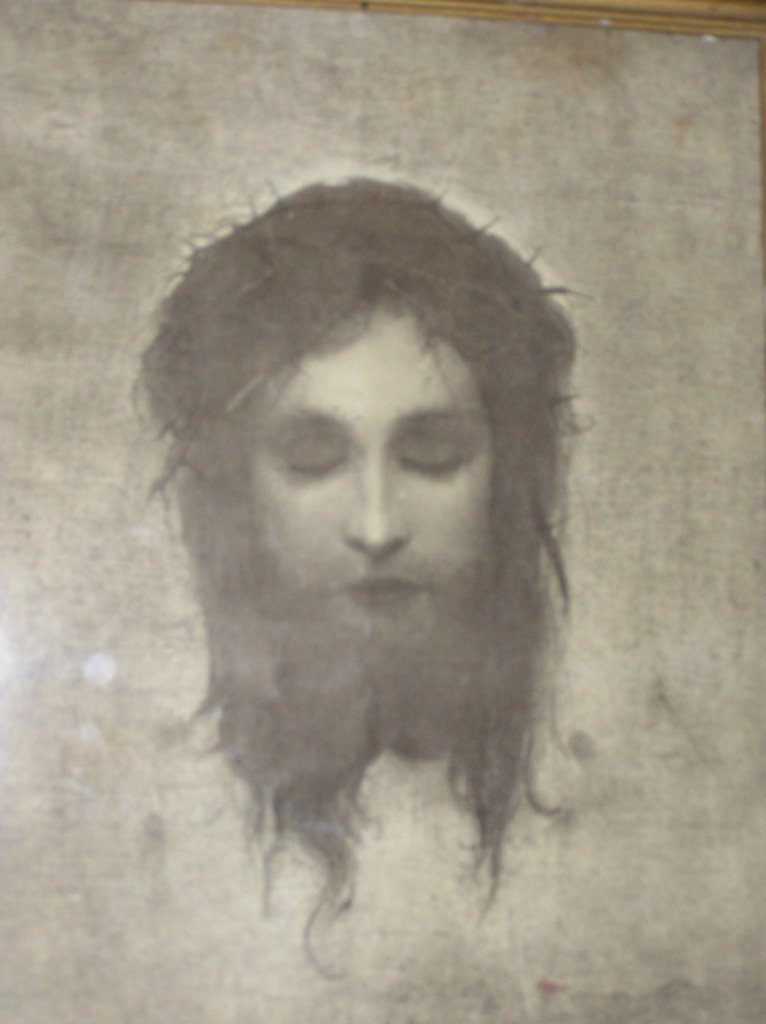
The Monastery of the Archangel Michael is located near the village of Prissovo, south of Veliko Turnovo in north-central Bulgaria. Isolated and difficult to find, the monastery was at one time much larger--all that now remains is the church and a few outbuildings. On our first trip here, two monks were gathering hay by hand and putting it into large bedsheets to carry to the barn. The older monk invited us to his room where he shared a cup of cold coffee with us. The church contains a beautiful iconostasis and one of the most eerie icons (?) I have ever seen (see picture). It looks as real as a photograph. I wasn't sure whether to call it an icon or not, but it was on the wall amidst the more traditional icons. Has anyone ever seen one like this, or have any insight into this?
Wednesday, January 11, 2006
Grass Partakes of Fire
From lips defiled and a vile heart,
from an impure tongue and a soul defiled,
receive my prayer, O my Christ,
and do not despise my words,
my appearance,
nor my shamelessness.
Grant me boldness, my Christ,
to say what I desire.
Even more, teach me
what to do and say.
I have sinned more than the harlot
who, on learning where Thou wast,
bought myrrh and came boldly to anoint Thy feet,
my God, my Master and my Christ.
As Thou didst not turn her away
when she came with her heart,
so, O Word, turn me not away,
but give me Thy feet to hold, to kiss,
and to anoint bodily with a stream of tears
as with a precious ointment.
Wash me with my tears, O Word,
and cleanse me with them!
Remit my transgressions
and grant me forgiveness.
Thou knowest the multitude of my evil;
Thou knowest also my wounds!
Thou seest my scars;
Thou knowest also my faith!
Thou seest my intentions
and hearest my sighs.
Nothing is hidden from Thee,
my God, my Maker, my Redeemer,
not even a teardrop,
or part of that drop.
Thine eyes have seen
that which I have not yet done.
Thou hast inscribed in Thy book
things yet to happen.
See my humility!
See each of my labors
and all of my sins!
Forgive me, O God of all,
that with a pure heart,
trembling thoughts, and a contrite soul
I may partake of Thine undefiled
and most Heavenly Mysteries
which enliven and deify
all who partake of them with a pure heart.
Thou hast said, O Master:
"Whoever eateth My Body
and drinketh My Blood
abideth in Me and I in him!"
True is every word
of my Master and God!
When I partake of Thy divine and deifying grace,
I am no longer alone --
I am with Thee, my Christ,
the Light of the Triple Sun
-- Which enlighteneth the world.
May I not remain alone,
without Thee, O Lifegiver, my Breath,
my Life, and my Joy,
the Salvation of the world.
I approach Thee, therefore, with tears,
as Thou seest,
-- and a contrite soul.
I beg to receive
deliverance from my sins.
May I partake uncondemned
of Thy life-giving and spotless Mysteries,
that Thou mayest abide,
as Thou hast said,
-- with me, the thrice-wretched.
May the tempter not find me
with Thy grace
and seize me deceitfully
and lead me, deceived,
-- from Thy deifying words.
Therefore, I shall fall down before Thee
and fervently cry:
"As Thou didst receive the prodigal
and the harlot who came to Thee,
O Gracious One,
receive me, prodigal and defiled."
With a contrite soul I approach Thee now:
I know, O Savior,
that no one hath sinned against Thee
as I have,
-- nor done the deeds that I have done.
But I also know
that neither the greatness of my transgressions
nor the multitude of my sins
surpasseth the great patience of my God
-- and His extreme love for man.
Through Thy merciful compassion
Thou dost cleanse and brighten
those who repent with fervor,
making them partakers of Light
-- and full communicants of Thy Divinity.
To the astonishment of angels
and human minds,
Thou dost converse with them often
as with Thy true friends.
This maketh me bold, my Christ;
this giveth me wings!
Emboldened by the wealth
of Thy generosity towards us,
with both joy and trepidation,
I who am grass partake of fire.
O strange wonder!
I am sprinkled with dew
and am not burned,
as the bush burned of old
-- without being consumed.
With grateful thoughts
and a grateful heart,
with my grateful members,
my soul and my body,
I now fall down
and worship and glorify Thee, my God,
for blessed art Thou,
now and for ever.
-- St Simeon the New Theologian, Sixth Prayer before receiving the Immaculate Mysteries. Taken from "Daily Prayer for Orthodox Christians," St Mary of Egypt Orthodox Church, Norcross, Georgia, 1995.
from an impure tongue and a soul defiled,
receive my prayer, O my Christ,
and do not despise my words,
my appearance,
nor my shamelessness.
Grant me boldness, my Christ,
to say what I desire.
Even more, teach me
what to do and say.
I have sinned more than the harlot
who, on learning where Thou wast,
bought myrrh and came boldly to anoint Thy feet,
my God, my Master and my Christ.
As Thou didst not turn her away
when she came with her heart,
so, O Word, turn me not away,
but give me Thy feet to hold, to kiss,
and to anoint bodily with a stream of tears
as with a precious ointment.
Wash me with my tears, O Word,
and cleanse me with them!
Remit my transgressions
and grant me forgiveness.
Thou knowest the multitude of my evil;
Thou knowest also my wounds!
Thou seest my scars;
Thou knowest also my faith!
Thou seest my intentions
and hearest my sighs.
Nothing is hidden from Thee,
my God, my Maker, my Redeemer,
not even a teardrop,
or part of that drop.
Thine eyes have seen
that which I have not yet done.
Thou hast inscribed in Thy book
things yet to happen.
See my humility!
See each of my labors
and all of my sins!
Forgive me, O God of all,
that with a pure heart,
trembling thoughts, and a contrite soul
I may partake of Thine undefiled
and most Heavenly Mysteries
which enliven and deify
all who partake of them with a pure heart.
Thou hast said, O Master:
"Whoever eateth My Body
and drinketh My Blood
abideth in Me and I in him!"
True is every word
of my Master and God!
When I partake of Thy divine and deifying grace,
I am no longer alone --
I am with Thee, my Christ,
the Light of the Triple Sun
-- Which enlighteneth the world.
May I not remain alone,
without Thee, O Lifegiver, my Breath,
my Life, and my Joy,
the Salvation of the world.
I approach Thee, therefore, with tears,
as Thou seest,
-- and a contrite soul.
I beg to receive
deliverance from my sins.
May I partake uncondemned
of Thy life-giving and spotless Mysteries,
that Thou mayest abide,
as Thou hast said,
-- with me, the thrice-wretched.
May the tempter not find me
with Thy grace
and seize me deceitfully
and lead me, deceived,
-- from Thy deifying words.
Therefore, I shall fall down before Thee
and fervently cry:
"As Thou didst receive the prodigal
and the harlot who came to Thee,
O Gracious One,
receive me, prodigal and defiled."
With a contrite soul I approach Thee now:
I know, O Savior,
that no one hath sinned against Thee
as I have,
-- nor done the deeds that I have done.
But I also know
that neither the greatness of my transgressions
nor the multitude of my sins
surpasseth the great patience of my God
-- and His extreme love for man.
Through Thy merciful compassion
Thou dost cleanse and brighten
those who repent with fervor,
making them partakers of Light
-- and full communicants of Thy Divinity.
To the astonishment of angels
and human minds,
Thou dost converse with them often
as with Thy true friends.
This maketh me bold, my Christ;
this giveth me wings!
Emboldened by the wealth
of Thy generosity towards us,
with both joy and trepidation,
I who am grass partake of fire.
O strange wonder!
I am sprinkled with dew
and am not burned,
as the bush burned of old
-- without being consumed.
With grateful thoughts
and a grateful heart,
with my grateful members,
my soul and my body,
I now fall down
and worship and glorify Thee, my God,
for blessed art Thou,
now and for ever.
-- St Simeon the New Theologian, Sixth Prayer before receiving the Immaculate Mysteries. Taken from "Daily Prayer for Orthodox Christians," St Mary of Egypt Orthodox Church, Norcross, Georgia, 1995.
Sunday, January 08, 2006
Some Comparisons
"Well, if its a symbol, to hell with it."
(Flannery O'Connor responding to Mary McCarthy regarding the Eucharist)
Flannery O'Connor and the Christ-Haunted South, Ralph Wood, p. 23.
In recent months, I have been making the transition from evangelical Protestantism to Orthodox Christianity. While the journey has been exciting and exhilirating, I realize that I need to curb my enthusiasm somewhat and resist the urge to pontificate on matters I am only just beginning to grasp. This goes against my nature, but I probably need to just be quiet, listen and learn. I also need to resist the natural impulse to disparage my former religious affiliation. A more productive course would be to recall my many years there and remember that the seeds that found fruition in Orthodoxy were planted in this very same church.
All that being said [my friends will recognize here that this is my cue that I'm going to go ahead and pontificate anyway!], I have recently had occasion to compare the worship in each. As I live over 100 miles from an Orthodox church, and my wife remains a faithful Protestant Christian, attendance can be a difficult proposition at times. For example, I recently attended the Feast of Theophany at my Orthodox church. Then on a recent Sunday, I found myself at the large, progressive Protestant church that I attend with my wife. The contrast could not be more striking. And it is here that I believe a few cautious observations are in order.
First, I'm still learning about the Liturgy--and know that I will be from now on. Also, the fact that about half the service is in Greek sometimes leaves me fumbling through my liturgy book. But despite this, there is no doubt in my mind what I am doing (worshipping). There is no doubt in my mind whom I am doing it with (the Body of Christ). The object of our worship is never in doubt (the triune God). I find the Divine Liturgy to always be fresh and exciting. If we were given to much sitting, you could even say that I would be on the edge of my seat :) Everything builds toward Holy Communion. As that time comes, I approach the altar, in the midst of the whole church, with a mixture of humility, joy and palpable excitement. And at that moment, time indeed seems to stand still. These are a few of my early impressions as an Orthodox Christian.
Now that brings me to my Sunday experience at our familiar evangelical church. Truth be told, this church is warm, welcoming and caring. I suppose though, as I become more and more Orthodox in my sensibilites, the more foreign this type of worship seems. The song service was actually well-done, though it now strikes me as sing-songy, sentimental and lacking in substance. We viewed a video presentation in which several of the teenagers spoke to how meaningful the youth group was to their lives. Then a couple of men gave testimonials about how a particular class or ministry had impacted their lives.
In due course, it was time for the communion service. This church is based in the Restoration Movement, so communion is faithfully observed every Sunday. The general practice is as follows: some men of the congregation come to the front, pray over the bread and the grape juice (which are viewed as only symbols) and then pass the trays up and down the pews as each individual partakes individually while supposedly thinking on the crucifixion. This particular morning, the speaker praying over the symbols also gave a short devotional beforehand. He compared what we were doing to a football scrimmage. That's correct--football. The fact that I despise our football culture and refuse to watch it made this particularly hard to stomach. The analogy had something to do with the fact that what we were doing in the "worship center" was just a scrimmage, whereas the real game would be when we left the building and started evangelizing. Our leaders were cast as coaches, and just like in a real football game, they would not be on the field with us. Incredibly, the football terminology and analogies continued into the prayers over the bread and grape juice, with some language about the Lord giving us strength to play the roles that He had set out for us. And this was my Protestant communion service.
I was dumbstruck. I'm sure the preacher had something warm and fuzzy and encouraging to say in the sermon afterwards. But frankly, I was so rattled by the communion travesty that I didn't hear any of it. In fairness, this is not usual, but next week it could be something completely different, in the never-ending effort to keep things new and interesting. That's the rub actually. There's no end to this sort of thing. Always seeking to be timely and "relevant," a church in fact loses what is timeless and ultimately become irrelevant. O'Connor's exasperated statement rings true.
(Flannery O'Connor responding to Mary McCarthy regarding the Eucharist)
Flannery O'Connor and the Christ-Haunted South, Ralph Wood, p. 23.
In recent months, I have been making the transition from evangelical Protestantism to Orthodox Christianity. While the journey has been exciting and exhilirating, I realize that I need to curb my enthusiasm somewhat and resist the urge to pontificate on matters I am only just beginning to grasp. This goes against my nature, but I probably need to just be quiet, listen and learn. I also need to resist the natural impulse to disparage my former religious affiliation. A more productive course would be to recall my many years there and remember that the seeds that found fruition in Orthodoxy were planted in this very same church.
All that being said [my friends will recognize here that this is my cue that I'm going to go ahead and pontificate anyway!], I have recently had occasion to compare the worship in each. As I live over 100 miles from an Orthodox church, and my wife remains a faithful Protestant Christian, attendance can be a difficult proposition at times. For example, I recently attended the Feast of Theophany at my Orthodox church. Then on a recent Sunday, I found myself at the large, progressive Protestant church that I attend with my wife. The contrast could not be more striking. And it is here that I believe a few cautious observations are in order.
First, I'm still learning about the Liturgy--and know that I will be from now on. Also, the fact that about half the service is in Greek sometimes leaves me fumbling through my liturgy book. But despite this, there is no doubt in my mind what I am doing (worshipping). There is no doubt in my mind whom I am doing it with (the Body of Christ). The object of our worship is never in doubt (the triune God). I find the Divine Liturgy to always be fresh and exciting. If we were given to much sitting, you could even say that I would be on the edge of my seat :) Everything builds toward Holy Communion. As that time comes, I approach the altar, in the midst of the whole church, with a mixture of humility, joy and palpable excitement. And at that moment, time indeed seems to stand still. These are a few of my early impressions as an Orthodox Christian.
Now that brings me to my Sunday experience at our familiar evangelical church. Truth be told, this church is warm, welcoming and caring. I suppose though, as I become more and more Orthodox in my sensibilites, the more foreign this type of worship seems. The song service was actually well-done, though it now strikes me as sing-songy, sentimental and lacking in substance. We viewed a video presentation in which several of the teenagers spoke to how meaningful the youth group was to their lives. Then a couple of men gave testimonials about how a particular class or ministry had impacted their lives.
In due course, it was time for the communion service. This church is based in the Restoration Movement, so communion is faithfully observed every Sunday. The general practice is as follows: some men of the congregation come to the front, pray over the bread and the grape juice (which are viewed as only symbols) and then pass the trays up and down the pews as each individual partakes individually while supposedly thinking on the crucifixion. This particular morning, the speaker praying over the symbols also gave a short devotional beforehand. He compared what we were doing to a football scrimmage. That's correct--football. The fact that I despise our football culture and refuse to watch it made this particularly hard to stomach. The analogy had something to do with the fact that what we were doing in the "worship center" was just a scrimmage, whereas the real game would be when we left the building and started evangelizing. Our leaders were cast as coaches, and just like in a real football game, they would not be on the field with us. Incredibly, the football terminology and analogies continued into the prayers over the bread and grape juice, with some language about the Lord giving us strength to play the roles that He had set out for us. And this was my Protestant communion service.
I was dumbstruck. I'm sure the preacher had something warm and fuzzy and encouraging to say in the sermon afterwards. But frankly, I was so rattled by the communion travesty that I didn't hear any of it. In fairness, this is not usual, but next week it could be something completely different, in the never-ending effort to keep things new and interesting. That's the rub actually. There's no end to this sort of thing. Always seeking to be timely and "relevant," a church in fact loses what is timeless and ultimately become irrelevant. O'Connor's exasperated statement rings true.
Sunday, January 01, 2006
A Plan for the New Year
I have been unable to upload a Calvin and Hobbes strip for some insightful New Year's commentary.
Soooo, try to imagine the following scene:
Calvin and Hobbes are walking in the snow....
First Frame:
Hobbes: ARE YOU MAKING ANY RESOLUTIONS FOR THE NEW YEAR?
Second Frame:
Calvin: YEAH. I'M RESOLVING TO JUST WING IT AND SEE WHAT HAPPENS.
Third Frame:
Hobbes: SO YOU'RE STAYING THE COURSE?
Calvin: I STICK TO MY STRENGTHS.
Soooo, try to imagine the following scene:
Calvin and Hobbes are walking in the snow....
First Frame:
Hobbes: ARE YOU MAKING ANY RESOLUTIONS FOR THE NEW YEAR?
Second Frame:
Calvin: YEAH. I'M RESOLVING TO JUST WING IT AND SEE WHAT HAPPENS.
Third Frame:
Hobbes: SO YOU'RE STAYING THE COURSE?
Calvin: I STICK TO MY STRENGTHS.
Thursday, December 29, 2005
Brokeback Mountain Reconsidered
I have watched and read with some interest the hype in recent weeks surrounding the release of the movie, Brokeback Mountain. I don't have a decided opinion one way or the other about it--haven't seen it and I really doubt it will ever show in my little burg. Both proponents and opponents of the film have been staking out their expected, and predictable positions.
One of the most thoughtful insights I've read, however, comes from Rod Dreher, a conservative Catholic commentator. He concludes that the real message of the film is not so much about tolerance and acceptance of homosexuality--as many lauding the movie would have you believe--but rather, the tragedy of the human condition, and the mess we humans invariably make of things. I appreciate Dreher's quoting from Flannery O'Connor in his article, as she is one of my favorites. To paraphrase O'Connor: once you realize that we are made out of dust, you shouldn't be surprised if things get a little dusty from time to time. Dreher's column, below, is from last Thursday's Dallas Morning News.
One of the most thoughtful insights I've read, however, comes from Rod Dreher, a conservative Catholic commentator. He concludes that the real message of the film is not so much about tolerance and acceptance of homosexuality--as many lauding the movie would have you believe--but rather, the tragedy of the human condition, and the mess we humans invariably make of things. I appreciate Dreher's quoting from Flannery O'Connor in his article, as she is one of my favorites. To paraphrase O'Connor: once you realize that we are made out of dust, you shouldn't be surprised if things get a little dusty from time to time. Dreher's column, below, is from last Thursday's Dallas Morning News.
Rod Dreher:
The real message in Brokeback
The movie is so much more than a story about two gay cowboys
05:52 AM CST on Thursday, December 29, 2005
Seen the gay cowboy movie yet? I have, though I hadn't planned to because the rapturous reviews made Brokeback Mountain sound like a film that delivered yet another fierce left hook across the jaw of homophobic America. Ho hum.
I'm not interested in propaganda, whether pro-gay or anti-gay, and I get tired of the way the news and entertainment media find it difficult to discuss homosexuality without propagandizing. And some of the loudest conservative voices on gay issues are just about as bad.
What gets lost in the culture-war blitzkrieg over homosexuality are the complex and ambiguous truths that real people live and struggle with. Art that reduces messy humanity to slogans and arguments is not art at all, but sentimentality, kitsch, anti-art – in a word, propaganda.
My friend Victor Morton turned me around. On his "Right-Wing Film Geek" blog (www.cinecon.blogspot.com), Victor wrote a long, impassioned post that said, in effect, Don't believe the 'Brokeback' hype, from either side! The film is good, not great, Victor argued, but what makes it worthwhile is its fidelity to the tragic truth of its characters, not its usefulness to anybody's cause.
Intrigued, I found on the Internet a link to the Annie Proulx short story on which the movie is based and was shocked by how good it was, especially at embodying the "concrete details of life that make actual the mystery of our position here on earth" – Catholic writer Flannery O'Connor's description of what true artistry does. Though director Ang Lee's tranquil style fails to capture the daemonic wildness of Ms. Proulx's version, I came away from the film thinking, this is not for everybody, but it really is a work of art.
Brokeback Mountain is the story of two young cowboys, Ennis Del Mar and Jack Twist, who meet in a 1960s summer job tending sheep on the mountain. They fall in love, then upon returning to the world, go their separate ways, marry and start families. A few years later, they resume their intensely sexual affair – visually, this is a rather chaste film – but with terrible consequences for themselves and the wives and children they deceive. The film climaxes violently and tragically, and it's this that has the critics lauding it as a cinematic cri du coeur for tolerance and acceptance of homosexuality.
But Brokeback is not nearly that tidy. True, the men begin their doomed affair in a time and place where homosexuality was viciously suppressed, and so they suffer from social constrictions that make it difficult to master their own fates. But it is also true that both men are overgrown boys who waste their lives searching for something they've lost, and which might be irrecoverable. They are boys who refuse to become men, or to be more precise, do not, for various reasons, have the wherewithal to understand how to become men in their bleak situation.
It is impossible to watch this movie and think that all would be well with Jack and Ennis if only we'd legalize gay marriage. It is also impossible to watch this movie and not grieve for them in their suffering, even while raging over the suffering that these poor country kids who grew up unloved cause for their families. As the film grapples with Ennis' pain, confusion and cruelty, different levels of meaning unspool – social, moral, spiritual and erotic. In the end, Brokeback Mountain is not about the need to normalize homosexuality, or "about" anything other than the tragic human condition.
Ms. O'Connor once wrote that you don't have to have an educated mind to understand good fiction, but you do have to have "at all times the kind of mind that is willing to have its sense of mystery deepened by contact with reality, and its sense of reality deepened by contact with mystery." The mystery of the human personality can never be fully plumbed, only explored. To the frustration of ideologues, artists like Annie Proulx and Ang Lee undertake a journey to those depths and return to tell the truth about what they've seen – which is not necessarily what any of us wants to hear.
As Ms. O'Connor taught, "Fiction is about everything human and we are made out of dust, and if you scorn getting yourself dusty, then you shouldn't try to write fiction."
Or read it. Or watch it.
C. S. LEWIS "QUOTE OF THE WEEK"
I used to think it was a 'cruel' doctrine to say that troubles and sorrows were 'punishments'. But I find in practice that when you are in trouble, the moment you regard it as a 'punishment', it becomes easier to bear. If you think of this world as a place intended simply for our happiness, you find it quite intolerable; think of it as a place of training and correction and it's not so bad.
C. S. Lewis, Answers to Questions on Christianity
We Americans would do well to ponder what Lewis is saying here. We are all about being "happy." Shoot, it's even inscribed in the foundational document of our society--that whole "pursuit of happiness" thing. And yet, I suspect that despite our dogged pursuit of it, we find it less and less.
Darrin McMahon wrote an interesting article on this phenomenon, found here
http://www.nytimes.com/2005/12/29/opinion/29McMaMahon.html
McMahon's observations are timely and astute. I was particularly intrigued by his documentation of the actual historical development of a culture of "happiness." Excerpts below:
C. S. Lewis, Answers to Questions on Christianity
We Americans would do well to ponder what Lewis is saying here. We are all about being "happy." Shoot, it's even inscribed in the foundational document of our society--that whole "pursuit of happiness" thing. And yet, I suspect that despite our dogged pursuit of it, we find it less and less.
Darrin McMahon wrote an interesting article on this phenomenon, found here
http://www.nytimes.com/2005/12/29/opinion/29McMaMahon.html
McMahon's observations are timely and astute. I was particularly intrigued by his documentation of the actual historical development of a culture of "happiness." Excerpts below:
HAPPY New Year!" We seldom think of those words as an order. But in some respects that is what they are.
Doesn't every American want to be happy? And don't most Americans yearn, deep down, to be happy all of the time? The right laid out in our nation's Declaration of Independence - to pursue happiness to our hearts' content - is nowhere on better display than in the rites of the holiday season. With glad tidings and good cheer, we seek to bring one year to its natural happy conclusion, while preparing to usher in a happy new year and many happy returns.
Like the cycle of the seasons, our emphasis on mirth may seem timeless, as though human beings have always made merry from beginning to end. But in fact this preoccupation with perpetual happiness is relatively recent. As Thomas Carlyle observed in 1843, " 'Happiness our being's end and aim' is at bottom, if we will count well, not yet two centuries old in the world."
Carlyle's arithmetic was essentially sound, for changes in both religious and secular culture since the 17th century made "happiness," in the form of pleasure or good feeling, not only morally acceptable but commendable in and of itself. While many discounted religious notions that consigned life in this world to misery and sin, others discovered signs of God's providence in earthly satisfaction. The result was at once to weaken and transpose the ideal of heavenly felicity, in effect bringing it to earth. Suffering was not our natural state. Happy was the way we were meant to be.
That shift was monumental, and its implications far reaching. Among other things, it was behind the transformation of the holiday season from a time of pious remembrance into one of unadulterated bliss. Yet the effects were greater than that. As Carlyle complained, "Every pitifulest whipster that walks within a skin has had his head filled with the notion that he is, shall be, or by all human and divine laws ought to be, 'happy.' "
Carlyle was notoriously cranky, but his central insight - that the new doctrine of happiness tended to raise expectations that could never possibly be fulfilled - remains as relevant today as it was in 1843. Despite enjoying far better living standards and more avenues for pleasure than before, human beings are arguably no happier now than they've ever been.
Sociologists like to point out that the percentage of those describing themselves as "happy" or "very happy" has remained virtually unchanged in Europe and the United States since such surveys were first conducted in the 1950's. And yet, this January, like last year and next, the self-help industry will pour forth books promising to make us happier than we are today. The very demand for such books is a strong indication that they aren't working.
... we might do well to reflect on the darker side of holiday cheer: those mysterious blues that are apt to set in while the streamers stream and the corks pop; the little voice that even in the best of souls is sometimes moved to say, "Bah, humbug." As Carlyle put it, "The prophets preach to us, 'Thou shalt be happy; thou shalt love pleasant things.' " But as he well knew, the very commandment tended to undermine its fulfillment, even to make us sad.
Carlyle's sometime friend and long-time rival, the philosopher John Stuart Mill, came to a similar conclusion...."Ask yourself whether you are happy, and you cease to be so," Mill concluded after recovering from a serious bout of depression. Rather than resign himself to gloom, however, Mill vowed instead to look for happiness in another way.
"Those only are happy," he came to believe, "who have their minds fixed on some object other than their own happiness; on the happiness of others, on the improvement of mankind, even on some art or pursuit, followed not as a means, but as itself an ideal end. Aiming thus at something else, they find happiness by the way." For our own culture, steeped as it is in the relentless pursuit of personal pleasure and endless cheer, that message is worth heeding.
So in these last days of 2005 I say to you, "Don't have a happy new year!" Have dinner with your family or walk in the park with friends. If you're so inclined, put in some good hours at the office or at your favorite charity, temple or church. Work on your jump shot or your child's model trains. With luck, you'll find happiness by the by. If not, your time won't be wasted. You may even bring a little joy to the world.
Saturday, December 17, 2005
Diyarbakir
Diyarbakir is not one of your better known tourist destinations. This city of near 2 million people lies in far eastern Turkey and is not really on the way to anywhere, unless of course you are going to Iraq or Iran. The area is overwhelmingly Kurdish and was at the epicenter of the PKK guerilla war with Turkey in the 1980s and early 1990s.
Things are calmer and safer now, though travel there can still be a little dicey. This didn't stop intrepid travelers Rich and Wendy, though. Check out their excellent travelogues at http://groups.msn.com/RichWendysAwayFromHomePage/ Diyarbakir is not without its attractions. Over 3000 years old, the city is the repository of layer after layer of varied civilizations. Until the 1920s, Diyarbakir had a vibrant Armenian and Syrian Orthodox Christian community. Before 1920, the city was one quarter Armenian. The Christians, as is often the case in this part of the world , got caught between the feuding Turks and Kurds, and have been effectively squeezed out. Yet behind its Byzantine walls, a handful of churches and Orthodox Christians struggle on. Rich and Wendy relate an interesting experience among the Diyarbakir Christian community:
Does this story make you as uncomfortable as it does me? The Meryamana Kilisesi (Church of the Virgin Mary) was built in the 3rd century. Not only have they kept things going for oh, say 1800 years or so, but they are even still worshipping in the language that Jesus spoke! I find this remarkable. These Christians have withstood invasions of Arabs, Persians, Mongols, Kurds and Turks. They have suffered persecution and martyrdom, and now struggle to survive in a culture than can quickly turn hostile. Notice especially Rich and Wendy's description of the church: "this venerable edifice with its rich rites so closely connected with their object."
Now let's inject American Protestant evangelicals into the cultural mix. What do they do? They build a "brand new building" directly across from the ancient church. One almost imagines a metal building with a bright, white steeple. Such perception!
But of course, this is the American way, is it not? We build the Baptist Church next to the Methodist Church which is across from the Church of Christ which is around the corner from the Bible Church which shares a parking lot with the Believers Outreach Victory Chapel Community of Faith Church or some such--all enticing choices in the cafeteria of American religious pluralism.
Don't get me wrong, I humbly commend anyone who attempts to take the message of Christ to the Islamic world. But before it was an Islamic world, it was a very Christian world. And pockets of these Christians are still holding on. Pray for them. Respect and honor their witness. Perhaps evangelicals should consider this before they set up shop in the neighborhood, with buckets of American dollars, and seek to "compete" with the beleaugered locals. All I am saying is that a little less hubris and a little more perceptiveness to the witness of the apostolic faith seems to be in order here.
I found it ironic that their teenage Kurdish guide moved comfortably within the 3rd century church, but was spooked by American-style Pentacostalism across the street. You got it, kid.
Things are calmer and safer now, though travel there can still be a little dicey. This didn't stop intrepid travelers Rich and Wendy, though. Check out their excellent travelogues at http://groups.msn.com/RichWendysAwayFromHomePage/ Diyarbakir is not without its attractions. Over 3000 years old, the city is the repository of layer after layer of varied civilizations. Until the 1920s, Diyarbakir had a vibrant Armenian and Syrian Orthodox Christian community. Before 1920, the city was one quarter Armenian. The Christians, as is often the case in this part of the world , got caught between the feuding Turks and Kurds, and have been effectively squeezed out. Yet behind its Byzantine walls, a handful of churches and Orthodox Christians struggle on. Rich and Wendy relate an interesting experience among the Diyarbakir Christian community:
"On to Meryamana Kilisesi, its tiny congregation just as beleaguered as Keldani's but retaining far more dignity, as befitted one of the oldest functioning churches in the world--- it had been built in the 3rd century. Services there were still conducted in Aramaic, the language Jesus spoke. The fierce-eyed, black-bearded Syrian Orthodox priest met us and pointed out details of the small domed nave. Directly across the narrow street from this venerable edifice with its rich rites so closely connected with their object, stood a brand new building. A friendly young man beckoned us in, and the moment he opened the inner door I knew where I was. The small room was packed with people praying--- in the arm-waving ecstatic style of American Pentecostals. Our teenage guide was very uncomfortable, so we backed out after a minute or so. An unsmiling young American woman in the hall explained to me that the church had been founded by Assembly of God missionaries 10 years before. For our guide's sake we soon left."
Does this story make you as uncomfortable as it does me? The Meryamana Kilisesi (Church of the Virgin Mary) was built in the 3rd century. Not only have they kept things going for oh, say 1800 years or so, but they are even still worshipping in the language that Jesus spoke! I find this remarkable. These Christians have withstood invasions of Arabs, Persians, Mongols, Kurds and Turks. They have suffered persecution and martyrdom, and now struggle to survive in a culture than can quickly turn hostile. Notice especially Rich and Wendy's description of the church: "this venerable edifice with its rich rites so closely connected with their object."
Now let's inject American Protestant evangelicals into the cultural mix. What do they do? They build a "brand new building" directly across from the ancient church. One almost imagines a metal building with a bright, white steeple. Such perception!
But of course, this is the American way, is it not? We build the Baptist Church next to the Methodist Church which is across from the Church of Christ which is around the corner from the Bible Church which shares a parking lot with the Believers Outreach Victory Chapel Community of Faith Church or some such--all enticing choices in the cafeteria of American religious pluralism.
Don't get me wrong, I humbly commend anyone who attempts to take the message of Christ to the Islamic world. But before it was an Islamic world, it was a very Christian world. And pockets of these Christians are still holding on. Pray for them. Respect and honor their witness. Perhaps evangelicals should consider this before they set up shop in the neighborhood, with buckets of American dollars, and seek to "compete" with the beleaugered locals. All I am saying is that a little less hubris and a little more perceptiveness to the witness of the apostolic faith seems to be in order here.
I found it ironic that their teenage Kurdish guide moved comfortably within the 3rd century church, but was spooked by American-style Pentacostalism across the street. You got it, kid.
Thursday, December 15, 2005
Emergent What, Exactly?
You might be interested to know what the Emergent Church folks are thinking these days. Admittedly, that may be hard to pin down, as it seems they are anything and everything.
In recent days, Clifton Healy has engaged the movement head-on in This is Life! blog (http://www.chattablogs.com/aionioszoe/) (see his posts on Dec. 12-14). Clifton confronts the Emergents from an Orthodox perspective, and as is usually the case, he goes deep. The discussion is well worth reading.
I certainly can't add much to the discussion, but it seems to me that emergents have forgotten that you can't just say anything, believe anything, open everything up for discussion with multiple options, pick and choose among the traditions of your choice and at the end of the day remain a Christian. Fr. Al Kimel, in a comment to Clifton's posts, made an astute observation about the Emergent Church Movement. He observed their own perceived self-importance and the very American nature of the movement. Exactly so.
Finally, the following story is an excellent little tale by Douglas over at Prochoros (http://prochoros.blogspot.com/), which has much to say about the Emergent churches, and schism in general. Thanks, Douglas.
In recent days, Clifton Healy has engaged the movement head-on in This is Life! blog (http://www.chattablogs.com/aionioszoe/) (see his posts on Dec. 12-14). Clifton confronts the Emergents from an Orthodox perspective, and as is usually the case, he goes deep. The discussion is well worth reading.
I certainly can't add much to the discussion, but it seems to me that emergents have forgotten that you can't just say anything, believe anything, open everything up for discussion with multiple options, pick and choose among the traditions of your choice and at the end of the day remain a Christian. Fr. Al Kimel, in a comment to Clifton's posts, made an astute observation about the Emergent Church Movement. He observed their own perceived self-importance and the very American nature of the movement. Exactly so.
Finally, the following story is an excellent little tale by Douglas over at Prochoros (http://prochoros.blogspot.com/), which has much to say about the Emergent churches, and schism in general. Thanks, Douglas.
God built a mountain and called a people to share in His work. They came from far and wide to live on the mountain. They worked with God to make the mountain strong and to defend it against enemies that would try to tear it down. The mountain was a place of strength, of refuge, of nourishment, and of healing - and the people prospered on its slopes.
Though there were often differences among the people of the mountain, these were like the differences between the members of a family, because they knew that they were all the people of God’s mountain. But eventually some of the people of the mountain rose up in dispute against their brothers and these left the mountain and descended into the plains. They claimed that they took the real life of the mountain with them and that those who continued to live on the mountain were, in fact, no longer the true people of the mountain.
These settled in view of the mountain on the plains and grew into a great nation in the world. Eventually, some of these rose up in revolt against their leaders as well, saying that they had lied to them about what it meant to be the people of the mountain. But instead of returning to the mountain itself, they moved off further into the plains. They split into tribes and generation by generation they spread into the far reaches of the world.
But though they had long ago lost all sight of the mountain, they continued to think of themselves as the people of the mountain, and to preserve the ways of the people of the mountain as best they could. And yet they were split into camps that fought one with another about what the mountain was, what it looked like, how its people lived, and about what it really meant to be the people of the mountain. The tribes split into clans, and the clans into families and single vagabonds, roaming the world.
Eventually they began to deny that a real mountain ever existed. Some insisted it was a theoretical mountain only, a symbol of something, some said the mountain was evil, or just a story told to children. And they stopped telling the story to their children, and eventually the mountain was completely forgotten.
Finally some of these began to talk to one another, and insist: “If we are called the people of the mountain, then there ought to be a mountain!” They gathered together in new clans and tribes and brought handfuls of sand from near and far and set out to build little hills of their own.
Iraqi Elections
Early reports from Iraq indicate that the election is going smoothly (or at least by Iraqi standards). With absolutely no real experience with true representative government, this effort to fashion a rough constitutional democracy out of whole cloth, so to speak, is noteworthy indeed. While disaster still lurks on every side, there is room for at least guarded hope. Let's just not be surprised, however, if this nascent "democracy" takes root and brings forth fruit not exactly to our liking.
The mess in Iraq, like so many others, has it roots in the divvying-up of the old orders after World War I. Mark Steyn, a gifted Canadian writer, had these thoughts on Veterans Day, 2002, which are still appropriate today:
On the 11th hour of the 11th day of the 11th month the guns fell silent. But peace is more than the absence of war. for the last decade, the world has been preoccupied with the messy unfinished business of the Great War, the "war to end all wars"--first in Yugoslavia, the prototype multi-ethnic utopia, which fell apart along the old Hapsburg/Ottoman fault line as if the last 80 years had never happened; and then in "the Middle East," an Anglo-French construct cooked up in the years after 1918. After decades of coveting Araby, by the time they got their hands on the place both powers were too exhausted to do little more than draw lines in the sand and call them "Syria," "Iraq," "Saudi Arabia." The most toxic states of the 21st Century are the progeny of whimsical Colonial Office cartographers of 1922.
Mark Steyn, National Post, 21 November 2002
The mess in Iraq, like so many others, has it roots in the divvying-up of the old orders after World War I. Mark Steyn, a gifted Canadian writer, had these thoughts on Veterans Day, 2002, which are still appropriate today:
On the 11th hour of the 11th day of the 11th month the guns fell silent. But peace is more than the absence of war. for the last decade, the world has been preoccupied with the messy unfinished business of the Great War, the "war to end all wars"--first in Yugoslavia, the prototype multi-ethnic utopia, which fell apart along the old Hapsburg/Ottoman fault line as if the last 80 years had never happened; and then in "the Middle East," an Anglo-French construct cooked up in the years after 1918. After decades of coveting Araby, by the time they got their hands on the place both powers were too exhausted to do little more than draw lines in the sand and call them "Syria," "Iraq," "Saudi Arabia." The most toxic states of the 21st Century are the progeny of whimsical Colonial Office cartographers of 1922.
Mark Steyn, National Post, 21 November 2002
C. S. LEWIS "Quote of the Week"
The dangers of apparent self-sufficiency explain why Our Lord regards the vices of the feckless and dissipated so much more leniently than the vices that lead to worldly success. Prostitutes are in no danger of finding their present life so satisfactory that they cannont turn to God: the proud, the avaricious, the self-righteous, are in that danger.
C. S. Lewis, The Problem of Pain, chapter 6
C. S. Lewis, The Problem of Pain, chapter 6
Monday, December 12, 2005

ON THE ROAD, Part 2
Occasional thoughts on my spiritual journey
Life in Christ
Christ be with me, Christ within me,
Christ behind me, Christ before me,
Christ beside me, Christ to win me,
Christ to comfort and restore me,
Christ beneath me, Christ above me,
Christ in quiet, Christ in danger,
Christ in hearts of all that love me,
Christ in mouth of friend and stranger.
St. Patrick (5th-Century Ireland)
It is Christ who gives us the power to walk,
And he is himself the way;
He is the lodging where we stay for the night,
As well as our final destination.
St. Nicolas Cabasilas (14th-Century Constantinople)
In Part 1, I began this examination of my spiritual journey by looking at the church through the eyes of a historian. My concern was the historical witness and continuity of the church, or rather the lack of it I experienced in my own religious heritage. I hope those observations were not too polemic in nature, as I am trying to curb the worst excesses of my “convertitis.”
The historical witness is indeed of vital importance. In every step of my journey, it has served as confirmation of the truths I have been absorbing. Yet, this is perhaps not the greatest concern, or at least it wasn't with me. Rather, the determining factor in my journey thus far has been what I like to simply call “Life in Christ.” This is an admittedly expansive term that encompasses much. But I suppose what I intend in this regard is something fairly tangible and measurable: my own transformation. That, it seems, has been what has been nagging me for years—my complete lack of growth, the lack of real closeness and communion with Christ, the lack of true spiritual fervor. I could put on a good show of it, but I always knew nothing much had changed inside. The person I presented to the world was not my true self as I actually was, and was certainly not the person God had created me to be--as Thomas Merton would say, a "false self."
I suppose what I was looking for was authenticity. I like the connotation of the word "authenticity," and I will probably overuse it horribly in coming posts. In John 17, Jesus prayed to His Father that we would all be one, as He was in us and the Father was in Him. St. Paul taught much about being "in Christ:"
to the Corinthians--“do you know know yourselves, that Jesus Christ is in you?”
to the Galatians--“Christ lives in me”;
to the Colossians--“your life is hidden with Christ in God,” and
“Christ is our life," and
“Christ is all and in all”
to the Phillipians--“to live is Christ.”
All these scriptures and dozens more speak to the need to live a life that is truly "in Christ." I quess I was seeking a faith that was as Christocentric as the one Jesus prayed for and the one Paul described.
I have found that kind of faith in Holy Orthodoxy. But what I am trying to describe is my passage from evangelical Protestant (albeit of the Restorationist slant) to Orthodox. To be critical of what I have now left would be neither difficult nor noteworthy. The fact that I have left, in and of itself, already speaks to my dissatisfaction with what I once was. So, I should be cautious in what I say, not judging the spirituality of anyone, or the authenticity (there's that word again) of their faith.
That being said, I have always been dubious of cheap sentimentality. The Protestant world of my background seems awash in it, or if not in cheap, then certainly easy sentimentality. Here in the South, what passes for Christocentricity often seems to be just an endless variation on the old evangelical mantra of "all you've got to do is just accept Jesus Christ into your heart as your personal Lord and Savior." Just??? The mystery of our reconciliation to God through Christ--just??? Anyway, you get my point.
This easy sentimentality lends itself to a more subjective view of "life in Christ." Though I am admittedly painting with a broad brush here, life in Christ in popular Evangelicalism is at its root, more juridical than experential. Everything revolves your status--are you "saved" or not? You are "saved" because you have accepted the mantra (above) and since you "feel it in your heart," it must be true, right? Confirmation of "life in Christ" is exhibited by the warm fuzzy feeling you get during a praise service, or how many times you can say the word "Jesus" in the chorus of a "praise song."
Now it is easy for me to be a little sarcastic in all this, as my own heritage church traditionally took the opposite approach. They shunned runaway emotionalism and did consider salvific issues more objectively. Yet, status was still all-important, just with a slightly different set of entrance requirements. We spoked in terms of "obeying the Gospel." "Life in Christ" often just translated into knowing more things about Christ, willing yourself to follow Him more closely, memorizing more proof texts and running yourself ragged in the busyness of the "work of the church." Somehow this approach didn't seem to be quite while St. Paul was talking about either.
Thinking back now, it is almost amusing to remember that in my Protestant evangelical/fundamentalist heritage church, we could never, ever, in any bible study or class, have quoted from the two sources at the top of this post. The words of either St. Patrick or St. Nicolas Cabasilas would have been highly suspect and undoubted brought down a rebuke from a self-appointed guardian of Church of Christ orthodoxy. The reasoning goes that since the church supposed “fell away” soon after AD 100, nothing was noteworthy, and everything was suspect until our guys got around to “restoring” the church some 200 years ago. Gentle readers, I am not making this stuff up!
Occasionally, “trouble-makers” like me would sneak in quotes such as these, always dropping the “St.” to cover ourselves! But seriously, what I hear in these two quotes-separated as they are by a thousand years—is a continuity of the same Christocentricity expressed by Paul and the other Apostles. That was the life and authenticity I was looking for and had not found in my evangelical heritage.
Life in Christ
Christ be with me, Christ within me,
Christ behind me, Christ before me,
Christ beside me, Christ to win me,
Christ to comfort and restore me,
Christ beneath me, Christ above me,
Christ in quiet, Christ in danger,
Christ in hearts of all that love me,
Christ in mouth of friend and stranger.
St. Patrick (5th-Century Ireland)
It is Christ who gives us the power to walk,
And he is himself the way;
He is the lodging where we stay for the night,
As well as our final destination.
St. Nicolas Cabasilas (14th-Century Constantinople)
In Part 1, I began this examination of my spiritual journey by looking at the church through the eyes of a historian. My concern was the historical witness and continuity of the church, or rather the lack of it I experienced in my own religious heritage. I hope those observations were not too polemic in nature, as I am trying to curb the worst excesses of my “convertitis.”
The historical witness is indeed of vital importance. In every step of my journey, it has served as confirmation of the truths I have been absorbing. Yet, this is perhaps not the greatest concern, or at least it wasn't with me. Rather, the determining factor in my journey thus far has been what I like to simply call “Life in Christ.” This is an admittedly expansive term that encompasses much. But I suppose what I intend in this regard is something fairly tangible and measurable: my own transformation. That, it seems, has been what has been nagging me for years—my complete lack of growth, the lack of real closeness and communion with Christ, the lack of true spiritual fervor. I could put on a good show of it, but I always knew nothing much had changed inside. The person I presented to the world was not my true self as I actually was, and was certainly not the person God had created me to be--as Thomas Merton would say, a "false self."
I suppose what I was looking for was authenticity. I like the connotation of the word "authenticity," and I will probably overuse it horribly in coming posts. In John 17, Jesus prayed to His Father that we would all be one, as He was in us and the Father was in Him. St. Paul taught much about being "in Christ:"
to the Corinthians--“do you know know yourselves, that Jesus Christ is in you?”
to the Galatians--“Christ lives in me”;
to the Colossians--“your life is hidden with Christ in God,” and
“Christ is our life," and
“Christ is all and in all”
to the Phillipians--“to live is Christ.”
All these scriptures and dozens more speak to the need to live a life that is truly "in Christ." I quess I was seeking a faith that was as Christocentric as the one Jesus prayed for and the one Paul described.
I have found that kind of faith in Holy Orthodoxy. But what I am trying to describe is my passage from evangelical Protestant (albeit of the Restorationist slant) to Orthodox. To be critical of what I have now left would be neither difficult nor noteworthy. The fact that I have left, in and of itself, already speaks to my dissatisfaction with what I once was. So, I should be cautious in what I say, not judging the spirituality of anyone, or the authenticity (there's that word again) of their faith.
That being said, I have always been dubious of cheap sentimentality. The Protestant world of my background seems awash in it, or if not in cheap, then certainly easy sentimentality. Here in the South, what passes for Christocentricity often seems to be just an endless variation on the old evangelical mantra of "all you've got to do is just accept Jesus Christ into your heart as your personal Lord and Savior." Just??? The mystery of our reconciliation to God through Christ--just??? Anyway, you get my point.
This easy sentimentality lends itself to a more subjective view of "life in Christ." Though I am admittedly painting with a broad brush here, life in Christ in popular Evangelicalism is at its root, more juridical than experential. Everything revolves your status--are you "saved" or not? You are "saved" because you have accepted the mantra (above) and since you "feel it in your heart," it must be true, right? Confirmation of "life in Christ" is exhibited by the warm fuzzy feeling you get during a praise service, or how many times you can say the word "Jesus" in the chorus of a "praise song."
Now it is easy for me to be a little sarcastic in all this, as my own heritage church traditionally took the opposite approach. They shunned runaway emotionalism and did consider salvific issues more objectively. Yet, status was still all-important, just with a slightly different set of entrance requirements. We spoked in terms of "obeying the Gospel." "Life in Christ" often just translated into knowing more things about Christ, willing yourself to follow Him more closely, memorizing more proof texts and running yourself ragged in the busyness of the "work of the church." Somehow this approach didn't seem to be quite while St. Paul was talking about either.
Thinking back now, it is almost amusing to remember that in my Protestant evangelical/fundamentalist heritage church, we could never, ever, in any bible study or class, have quoted from the two sources at the top of this post. The words of either St. Patrick or St. Nicolas Cabasilas would have been highly suspect and undoubted brought down a rebuke from a self-appointed guardian of Church of Christ orthodoxy. The reasoning goes that since the church supposed “fell away” soon after AD 100, nothing was noteworthy, and everything was suspect until our guys got around to “restoring” the church some 200 years ago. Gentle readers, I am not making this stuff up!
Occasionally, “trouble-makers” like me would sneak in quotes such as these, always dropping the “St.” to cover ourselves! But seriously, what I hear in these two quotes-separated as they are by a thousand years—is a continuity of the same Christocentricity expressed by Paul and the other Apostles. That was the life and authenticity I was looking for and had not found in my evangelical heritage.
Thursday, December 08, 2005
A Favorite Picture

This is a picture of an elderly monk at the Monastery of the Transfiguration, outside of Veliko Turnovo in Bulgaria. One of my favorites.
Subscribe to:
Posts (Atom)