Thursday, August 03, 2017

First Day in the U.K.: And Six Graves Along the Way

My first day overseas is always the roughest. I cannot sleep on the flight over, and I slept only 2 and 3 hours on the nights leading up to the flight. A delay at JFK put me on the M40 later than I planned. Driving on the left doesn't throw me; in fact I kind of like the roundabout approach to traffic flow. What does give me problems are the narrow roadways with hard curbs, even on many country lanes. It takes a while to judge the distance to the curb. Once you are going at a certain speed, bumping the curb that first time will probably not do much harm; nor the second time. But the third time is usually the charm. Sure enough, I had a flat. I pulled down a little lane and parked in front of a nice home with acreage. This was not the first time I've had to change a tire overseas; or the second, or the third. I open the boot of the car to get the spare and jack and found that it was empty. I called Europecar and discovered that they don't provide spares anymore--they would call a service that would find me and change the tire. Well, okay then.

So, I settled in to wait. The owner of the house drove out in a black Range Rover to suggest I park somewhere else, but I explained my predicament and he left me alone. I could see my itinerary for the day slipping away. Truth be told, it was overly ambitious anyway. I had planned to tag Churn Knob where the preaching of St. Birinus converted the pagan Saxon king Cynegils in 637, the shrine of St. Birinus in Dorchester Abbey, the Church of St. Margaret and the Holy Well of St. Frideswide at Binsey (also the inspiration for the “Birnsey Poplars,” the poem by Gerard Manley Hopkins), Hailes Abbey and the adjoining church with the incredible wall murals, St. Kenelm’s Holy Well, St. Kenelm’s Church in Romsey, Wightwick Manor (home of collection of Pre-Raphaelite art and William Morris decorative arts), and Much Wenlock and the Shrine of St. Milburga. This may also illustrate why I travel alone so much of time; I tend to wear-out traveling companions. But none of that was to be, and it was raining of course.

My rescuer arrived within an hour of my call. He turned out to be a bright-eyed young man with a thick accent. He said I could wait in the car while he changed the tire, but I answered I would stand out there with him. I asked if he were Russian, or from the Balkans. Poland, he said. His name was Pavel, and he has been in the U.K. for about 5 years, just returning from a holiday at a beach near Cardiff with his wife and daughter. He told me his dream was to go to America, but that visas were non-existent. Once he had obtained his British passport, however, he hoped to travel to the U.S. on holiday. He wanted to spend a month in our country, seeing New York City, the Big Canyon, and Detroit. I questioned his choice of Detroit, and he replied that it was his wife's idea, that she wanted to visit the home town of Eminem. I suggested that Chicago might have more to offer. I gave him my card and told him if he ever makes it to the U.S., to contact me and I would show him Texas. He promised he would do that. I told him that the number in my email address was the year of my birth. He looked at me funny, and said he would not have thought me older than age 45. Such intelligent,perceptive people, these Poles.

So, I was soon on my way again. I would like to say that I didn't bump any more curbs, but that would be a lie. And I didn't give my altered plans a second thought. What I was meant to do was talk with this young Polish immigrant, not check off sites on an over-planned itinerary.

I was able, however, to visit a few churchyards along the way, where I paid my respects to six individuals. That is an old fashioned habit of mine.  I show honor to the deceased by visiting their places of burial.  The current popularity of cremations dismays me, or at least in those cases when the ashes are not subsequently buried.  Apart from being unmoored from history, tradition and theology, uninterred cremations give one no place where one can honor the deceased.  I understand this is not absolutely true in all cases, but I still believe it is a consideration often overlooked today.  I would have liked to have visited the graves of Edith Sitwell, Christopher Dawson, and Steven Runciman, among others, but these sites simply were too far removed to be practical. I did, however, stop by Shepherd's Lane Cemetery in Beaconsfield, All Saints Churchyard in Sutton Courtenay, and Wolvercote Cemetery outside of Oxford where I paid my respects to the following disparate individuals:
G. K. Chesterton monument, carved by Eric Gill.


G. K. Chesterton:  Chesterton is an obvious choice for me.  One can easily find fault with something he wrote, considering the breadth of his writing.  His blatant militarism during the Great War, for example, is jarring.  But he certainly wasn’t alone in that, and faced with the sheer volume of his writings, I find myself largely in agreement.  Chesterton had no time or sympathy for the English aristocracy and class system.  He took a dim view of capitalism.  Although he is so closely identified with Catholic polemics, the fact is that it took him a long time to come around, and most of his work was written prior to his conversion.  Chesterton wrote with such clarity and good humor.  In contrast, I respect but never warmed up to C. S. Lewis.  I could easily visit his grave on this itinerary, but it is not at all compelling for me to do so.  Chesterton, on the other hand, is one of the most likable of authors, regardless of what you think of his positions.  
George Orwell's grave


Eric Arthur Blair:  George Orwell was undoubtedly one of the most consequential writers of the twentieth century.  And I think most would agree that his works have stood the test of time, being as popular and instructive now as they ever were.  After the November election, people started reaching for their Orwell.  I was not surprised to see cheap paperbacks of “Nineteen Eighty-Four” popping up in airport newsstands.  Orwell wrote with consistent moral clarity and authority.  And like Chesterton, he had little use for Great Britain’s entrenched class system, though recognizing how it had colored everything.  He died early, in 1949, and is known mostly for “Animal House,” and “Nineteen Eighty-Four,” though these works came near the end of his career.  He wrote much, much more.  My son’s favorite it “The Road to Wigan Pier,” from which he can quote selections.  From that book, Orwell mused that he hoped for a civilization in which ‘progress’ meant something more than “making the world safe for little fat men.”  So do I.  Memory Eternal, Eric Arthur Blair.


Lady “Margot’ Asquith:  Lady Asquith seems an odd choice, coming on the heels of Chesterton and Orwell.  She was the second wife of Lord Asquith, the British Prime Minister in the years leading up to the Great War.  Margot Asquith was, however,  a formidable personage in her own right.  Even so, I never knew of her before studying the life of Stephen Runciman.  


Even a superficial reading into the literature of the interwar period of English history leaves one with the distinct impression that the same people were all at the same cocktail parties, all lounging about the same drawing rooms, all at the same country house fortnights, all sneaking a bit of sex with the same other people’s wives, etc.  Margot Asquith offers about as much insight into this incestuous and self-perpetuating web of connections, power and influence as anyone.  
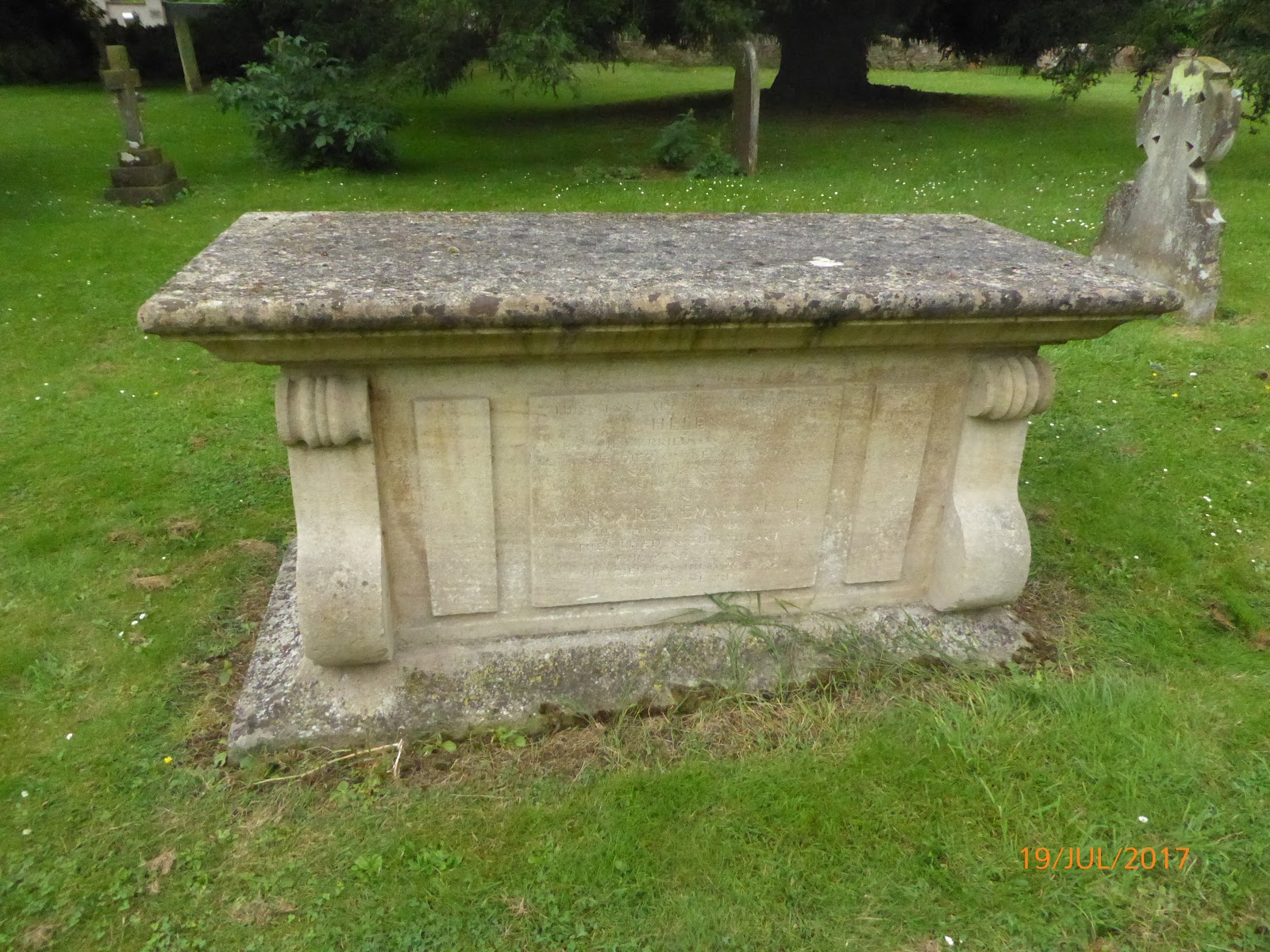
The relatively modest tomb of Lord Asquith and wives


I enjoy playing Six Degrees of Separation with these people, but usually takes no more than three degrees.   Margot’s stepson died a war hero and lies buried in France.  He had married Katherine Horner of Mells, Somerset, daughter of a simple country squire of ancient lineage and the former Frances Graham, also Margot’s great friend.  Frances Graham was the hauntingly beautiful model of Edward Burne-Jones, and other Pre-Raphaelite painters, as well.  Burne-Jones was the uncle of Rudyard Kipling (fun, isn’t it?)  


Margot was aunt to Stephen Tennant, noted aesthete and the “brightest of the Bright Young People.”  She was stepmother to Lady Helena Bonham Carter, the grandmother of the actress of the same name from all those Merchant Ivory adaptations of E. M. Forster.  The Asquith’s daughter, Elizabeth, married Romanian diplomat and aristocrat, Antoine Bibesco, also kinsman to the husband of author Marthe Bisbeco, which brings us back to Steven Runciman.


Both Runciman’s parents were Liberal Party politicians, immensely loyal to the Asquiths.  The good-humored historian was not a snob in the conventional sense of the word.  He used his lower-runged upper class status to open doors to archives, private collections and useful informants, rather than to social ascendancy.  Margot Asquith first enlisted Runciman to help nudge along her nephew.  Although the earnest and discreet Runciman shared the same inclinations as the flamboyant Stephen, he was repelled by Tennant’s indolence.  Later the young man would find a more congenial partner in Siegried Sassoon, and they were, in fact, a couple for a number of years.  Runciman parlayed his Asquith-Bibesco ties first to an interlude with Edith Wharton in France, and later into the Romanian aristocracy; the Bibescos, the Mavrocordatas, and the Cantacuzenes.  Similar doors opened for him in Bulgaria and Greece, and before long the young man had established himself firmly in Balkan and Byzantine studies.  To his credit, Runciman fully appreciated the advantages of his birth and connections.  As his grave in the Scottish lowlands is outside the scope of this itinerary, I will have to just note this bit player, you might say, in the life of Steven Runciman.
Luthien and Beren (the Tolkiens)


J. R. R. Tolkien:  If I made no others, this is one pilgrimage I was determined to make.  And concerning him, I will say the least, for there is simply no need to do so.  His life’s work speaks for itself.  One quote:  We have come from God and inevitably the myths woven by us though they contain error, will also reflect a splintered fragment of the true light, the eternal truth that is with God.  Indeed, only by myth-making, only by becoming a “sub-creator” and inventing stories, can Man ascribe to the state of perfection that he knew before the fall.


Prince Dmitri Obolensky: He was born into one of the wealthiest families in Russia, but that accounted for nothing as the Revolution broke out when he was just one year old.  The family made its way first to Malta and then to England.  Obolensky became a protegee of the older Steven Runciman, and the two formed a close and long-lasting academic bond.  Obolensky established an enviable reputation in Byzantine Studies.  I have two of his books, some of my earliest acquisitions as I was building a Byzantine collection.   
Grave of Dmitri Obolensky and Mary Tolstoy


Hamo Thornycroft:  Though largely unknown today, Thornycroft was the most noted British sculptor in the late Victorian and Edwardian eras.  The Thornycrofts were an artistic family all around, in both painting and sculpture.  I learned of Hamo through the autobiography of his nephew, Siegfried Sassoon.  Some of his best known works include the famous statue of Alfred the Great in the roundabout at Winchester, “The Mower” at Kew Garden, and a bit closer to home, the statue of Teucer at the Art Institute of Chicago.  Thornycroft was a strappingly handsome man.  British authors Edmund Gosse and John Addington Symonds were both besotted with Hamo, apparently after skinny-dipping excursions in Goring Creek.  Thornycroft, however, was not given to that sort of thing, so their affections remained unrequited.
Tomb of Hamo Thornycroft


Monday, July 03, 2017

Some Thoughts on Patriotism this Fourth

Some Thoughts on Patriotism this Fourth

Wendell Berry had much to say about the nature of true patriotism.  The following quote is but a small sampling:

For a nation to be, in the truest sense, patriotic, its citizens must love their land with a knowing, intelligent, sustaining, and protective love. They must not, for any price, destroy its health, its beauty, or its productivity. And they must not allow their patriotism to be degraded to a mere loyalty to symbols or any present set of officials.

On July 4th, I often think back to a conversation I overheard as a young boy.  My mother and her brother-in-law, my favorite uncle, were drinking coffee in the kitchen of our old house.  My uncle was a career Navy man who fought in three wars, circumnavigated the globe four times, and was, to my great pleasure, the fount of endless stories.  His life revolved around commitment, duty, honor and service.  It must’ve been around the Fourth and he was expounding on such themes.  When he referenced the flag, my mother replied, matter-of-factly, that “it was just a piece of cloth.”  She was blunt and plain-spoken, without an ounce of artifice to her.  I suppose one of her virtues was that she said exactly what she thought. But it was also her vice.  This flabbergasted my uncle and left him almost sputtering for a response.  Truth be told, he was a little put out with her.  And so was I, for although I loved my mother, of course, I idolized my uncle.

We were not patriotic in the generally accepted sense of the word.  We never flew the flag.  We didn’t pop fireworks (a waste of money).  We didn’t pontificate about “freedom,” or “liberty” or  “democracy” or such things.  The Fourth of July was a day off from work (unless we had hay on the ground and it was threatening rain).  My mother would fix quite a spread:  fried chicken, mashed potatoes, corn on the cob, her special rolls, fresh tomatoes, okra, peas, etc., and a selection of desserts.  My dad and I would be in the carport, taking turns with the ice cream freezer.  My sister and her family and my brother and his children would pile in.  My dad would be in an expansive mood and would tell the old familiar stories from his youth.  As often as not, neighbors or extended family stopped by for dessert and coffee.  That was what the Fourth of July meant to us:  our place, our family, our neighborhood and extended connections.  We would have been uneasy had anyone tried to make more out it than that.

I have come to realize that both my mother and my uncle were each right and wrong.  She wouldn’t have know Wendell Berry from Adam, but she would have agreed with the sentiments he expressed.  My mother’s stark literalism, however, can leave one with a cramped view of the world and our place in it.  Material objects may very well have meaning beyond their mere materiality.  Their symbolism, however, cannot be in the abstract, but must be rooted in the particular.

Like my mother, I am naturally suspicious and wary whenever anyone speaks of patriotism by way of freedom, liberty, or democracy.  Frankly those terms have been so mangled and abused, stretched here and there to cover most anything, that they are now largely without any real meaning.  Patriotism to me is simply settled love and affection;  love of place, love of family, love of friends and neighbors.  We can stop it right there, particularly if we understand, as we are instructed, who is our neighbor.  The rest will take care of itself.     

Friday, February 24, 2017

Fun With Modern Day Heretic Detectors

This is fun.

Back in the early days (1837-1842) of the American Restoration Movement, now dubbed the Stone-Campbell Movement, there was a brotherhood journal named "The Heretic Detector." Their name tells you all you need to know about them. They flared out, and others took their place, but none with as nifty a moniker as "Heretic Detector." But their intellectual descendants yet survive.

Here’s the setup:  A Baptist seminary in Louisville, Ky recently held their annual lecture series.  I know nothing about the college or the lectures (other than they are named after a wealthy Louisville family to which I am distantly related, and who were not at all Baptist.)  One of their speakers was none other than Rod Dreher, an author and writer for The American Conservative.  But Dreher (whom I know) is a fairly public Orthodox Christian, and his talk concerned “The Benedict Option,” also the title of his forthcoming book.  This was apparently too much for some Baptists (though I suspect my subject is a fringe group).

A self-described Calvinist Reformed Baptist pastor, JD Hall, runs a site called Polemics Report.  In his most recent post, he took the Baptist seminary to task for inviting Dreher to speak, calling him out as a non-Christian.  I would consider Dreher to be a fairly innocuous choice, but I have half-forgotten how this mindset works.  We had such groups--plenty of them--back when I was in the Church of Christ.  A non-Church of Christ speaker would never be invited to speak at one of our Lectureships. Having been away for a dozen years, I don’t know if that is still the case--but it may not matter, for the lectureships themselves seem to be fading away from lack of interest.  I do remember my son being called down after a Wednesday night devotional for citing C. S. Lewis.  The preacher asked him, “You do know that C. S. Lewis was not a member of the Lord’s Church?”  Duh.  We were also told that his books should be burned.  That same spirit apparently animates Pastor Hall.

I don’t imagine that he has much sway in Baptist circles at large (and I don’t keep up that much).  In fact, my impression is that some Baptist leaders (Albert Mohler, Russell Moore, etc.) have a clear understanding of what is happening in the larger culture.  The Great Sluffing-Away has reached their ranks, with Baptist numbers actually declining in recent years.  Oh, there’s no danger of them going away anytime soon.   But still, some leaders realize that their coziness with our materialistic, consumer culture has transformed them, rather than the world; that a faith that survives is one that has a bit of substance to it, that their allegiance to the GOP has been a disappointing dead-end, and perhaps that they need to be something more than the Republican Party at Prayer, something maybe, well, a bit more Christian.  

Pastor Hall’s circle-the-wagons polemic seems almost like old times for me. (In my former church’s language, this was called “keeping to the old paths.”  Unfortunately, those paths only led back to the 1920s or so.)  Four times in the article, Hall drives home the point that Dreher is non-Christian.  His wording indicates that he is only superficially aware of the beliefs of Christian Orthodoxy.  He refers to it only as “Greek Orthodoxy” and he takes Dreher to task for finding inspiration in Dante, rather than Scripture.  And sometimes, he’s unintentionally funny--calling Dreher a “crunch-con,“ when he no doubt meant “Crunchy-Con,” his first book.  But here are his basic accusations against us (cleaned up a little for clarity):

  1. We deny Sola Fide
  2. We believe in the perpetual virginity and veneration of the Mother of God
  3. We venerate icons (he puts “icons” in italics--ha!)
  4. We pray for the dead
  5. Chrism for the reception of the Holy Spirit
  6. Baptismal regeneration and the baptism of infants
  7. We deny justification by faith alone, which puts us “outside the bounds of Biblical Christianity.”
  8. We deny penal substitionary atonement, which puts us “squarely outside Christianity”

Hoo-boy. What do you say to that? "Guilty as charged," I suppose.

Actually, I don’t really resent this at all.  I even feel a little sorry for Hall.  Calvinism does that to me; it makes me sad. But I much prefer this sort of in-your-face opposition rather than the usual broad-church-foyer smile in person followed by vicious ripping-into you when your back is turned.

A kinsman of sorts once remarked that he'd rather I'd become an Agnostic than Orthodox. No doubt Pastor Hall would agree. Sorry to disappoint.

Monday, December 26, 2016

Three Biographies


Over the last week or two, I’ve finished three biographies:  Steven Runciman, the historian; Edward Burne-Jones, the artist; and Francis Thompson, the poet.  There’s nothing particularly that unites these men together, though there is a slight overlap in the supporting cast of characters in the Burne-Jones narrative and Runciman’s story.  They were all English (despite Runciman’s Scottish affectations) and they were all middle-class in background.  The only real connectedness between the three, however, had to be their love of beauty.

The Runciman biography is Outlandish Knight:  The Byzantine Life of Steven Runciman by Minoo Dinshaw.  The book weighs-in with 640 pages of text, plus copious notes.  Frankly, I would have been just as satisfied with 200 fewer pages.  But no matter, the book is detailed, and Runciman lived 97 years.  That takes a bit of telling.  I consider Runciman to be one of the greatest historians, of our age or any other.  Contemporary historians are prone to dismiss him because of the biases he supposedly harbored.  The fact that some historians think they write without bias is funny in and of itself.  Rather, Runciman’s biases were of a different sort than the ones popularly employed today.  He didn’t fret much over such criticism, just as he dismissed the thinly disguised jealousy of peers who questioned his methodology.  To one he replied, “but you must understand that I am writing literature.”  And by this he certainly did not mean fiction.  In the future, people will be reading Runciman for the same reason they still read Gibbon:  each was a masterful story-teller (and it is not without irony that much of what Runciman wrote was to correct Gibbon’s mis-tellings, in his eyes.)  Runciman recognized the role of chance and circumstance in the history of families and nations.  As a consequence, he remained skeptical of purely ideological interpretations or deterministic grand theories of history.  Once William Dalrymple (another much-admired writer) asked Runciman what he thought of the French Annalistes School, and more particularly their most famous adherent, Fernand Braudel, and his “The Mediterranean.”  Runciman said that he had tried to read it, but three pages in he realized that the author didn’t know what a dromedary was--this was the famous racing camel of the the southern Mediterranean world.  Not knowing this basic fact of life in the region, Runciman saw little need to proceed any further with the ponderous tome.  Broadly speaking, Runciman probably did more than anyone to shift the focus of European historiography south and east and away from the English Channel.

Of course, Runciman made a name for himself in his three volume treatment of the Crusades.  But his real love--and the focus of much of his scholarship--was the Balkans.  He developed a lifelong respect for the peoples and histories of Greece, Bulgaria and Romania.  He maintained warm relations there to the end of his long life.  In connection with this, he developed an abiding respect for the Orthodox Church.  He was raised in a teetotalling Calvinist environment, and Runciman reacted as one would hope and expect a young man of intellect to do.  He largely rejected it, but perhaps because of it, retained a lifelong skepticism of both Anglicanism and Roman Catholicism.  But he took to Orthodoxy like a duck to water--the friend and confidante of priests, monks and patriarchs.  He actually held the title of Grand Orator to the Patriarch of Constantinople.  Late in life he won the Onassis Award, which came with a $300,000 cash prize.  Runciman immediately turned over the proceeds to the monks of Mount Athos, but with a specific purpose in mind.  He funded the restoration of a tower at Vatopedi Monastery to house their priceless manuscripts and icons.  At age 97, the then wheelchair-bound Runciman was airlifted onto Mount Athos by helicopter for the ceremony--certainly something of a first.  And while Orthodoxy had no greater friend, he never converted, and was buried in the rites of the Church of Scotland.         

If one didn’t know better, one might dismiss Runciman as an effete aristocrat, a bored 20’s-era Bright Young Thing of the sort that one encounters in Evelyn Waugh novels.  He did move in those circles.  In fact, it sometimes seemed that most every name between the wars in England attended the same cocktail parties and could be found at the same country house weekends.  His parents were both prominent Liberal politicians, very much in the camp of Lord and Lady Asquith.  This association--and particularly with Margot Asquith and her Tennant and Wyndham connections and by extension even the Bibescu and Cantecuzene families of Romania--opened doors for the youthful Runciman which never seemed to close.  But for Runciman, these connections were never an end in themselves, but pathways to get to the people he needed to see, to ask the questions that needed asking.  

Since he was British, it goes without saying that he could be snobbish if the situation required it--to the unwanted visitor such as the gushing professor from Idaho, for example.  But this was the exception.  He had a very real sense of who he was--certainly not as “British,” or some faux Scottish affectation, but who he was as a Runciman, a family of Scots whom he described as coming south “to see what kind of money they could make off of the English.”  A family member thinks that his deep sense of family was a defense mechanism against the family’s creeping embourgeoisement.  Runciman’s grandfather had come up from a hardscrabble existence to forge a small shipping empire.  This funded his father’s career in Liberal politics and was, as Runciman always remembered, the source of all their good fortune.  But he was one of many grandchildren, and while Runciman was comfortable, he was never flush.  He lived frugally and without ostentation.  He took jobs for the same reason the rest of us do--because he needed the money.  During the 1920s and 30s, he was frankly disgusted by the aimlessness of many of the real upper classes.  Perhaps harkening back to his low-church Calvinism, Runciman set out to live a purposeful and useful life.  And he did just that.  In his late 50s, Runciman received a knighthood.  And while he didn’t reject it, he certainly took a jaundiced view of the matter.  When the Queen Mother asked him how he felt about it, he replied that for the first time in his life he knew what it meant to be both middle-aged and middle-class.  In his eyes, the honor could certainly be useful to him in his career, but as far as it being anything in and of itself, no.  For he was already a Runciman.

Runciman’s homosexuality was widely known in Great Britain.  There was no ambiguity about it at all, and he was certainly forthright among close friends in private settings.  But in an age when homosexual behavior was a crime, Runciman was fiercely protective of his privacy, which was never subject to publicity or scandal.  Runciman formed no lasting emotional attachments with his partners.  Again, this was done purposely on his part, and without regret, apparently.  From an early age, he accepted that his would be a solitary existence, though played out in the midst of a company of many.  That said, and without salaciousness, the author notes that Runciman lived a life of discreet but aggressive sexual adventurism, across many continents and throughout many decades.  Late in life he published “A Traveler’s Alphabet,” a book which takes each letter of the alphabet as the starting point for a short remembrance of a particular place.  Runciman confided to an associate that he could have done the same thing with his sexual partners, if only he hadn’t rebuffed the advances of Quentin C**** (and yes, there was an “X,” a young Greek named Xenophon.)

Runciman’s life crossed paths with another favored writer of mine--Patrick Leigh Fermor.  By the time he made it to Bulgaria, in 1933, in his now famous trek across Europe, Paddy looked more the part of a young, dashing desperado, rather than the teenaged English lad he was underneath.  And as the English do things, he had obtained a letter of introduction somewhere along the way--Hungary, I think--which would allow him entry into the front door of the British Embassy in Sofia.  A cocktail reception was underway, and the young vagabond was ushered into its midst.  Among the other guests was the young historian, Steven Runciman.  The two made a connection with they nurtured for the rest of their long lives (most notably in Greece during and after the war).  The book ends with a visit by Fermor and a female companion to the 97-year old Runciman’s home in Dumfriesshire.  After a night of reminiscences, Fermor and his guest start home.  This is how he remembers it:

“As we motored through the Cumbrian dusk, we imagined him helping to plot the circumference of the dome of St. Sophia, before a late supper with the Empress Theodora, or--he had a soft spot for crowned heads--or advising Princess Anna about the accuracy of the Alexiad.  In other scenes, he was shaking his head over the wilder tenets of the Bogomils and persuading a team of iconoclasts to drop their hammers, or calming rebellious prelates at the Council of Ephesus.  In yet other scenes, he was reasoning with Bohemond at Antioch or counseling Richard Coeur de Lion about his policy at Acre; or playing chess with Saladin, in his tent; then, a bit later, rallying Bessarion for accepting the filioque clause at the same time as a cardinal’s hat; consoling the eastern Comnenes for the loss of Trebizond; or, under Mount Taygetus, exchanging syllogisms with Gemistros Plethon as they strolled along the future Runciman Street.  Later on still, we imagined him hobnobbing with Phanariot hospodars in the snows beyond the Danube...It was hard to stop.”    

The next biography is The Last Pre-Raphaelite:  Edward Burne-Jones and the Victorian Imagination by Fiona MacCarthy.  Like the Runciman book, this one is overly long, and I took to skimming passages--which I did not do with the former.  For some time now, I have been trying to become more knowledgeable and appreciative of art and art history, as long as that history stops before Modernism and/or Abstract Art.  I was vaguely family with Burne-Jones, having seen a couple of his paintings at the Met, but I was never particularly obsessed with the Pre-Raphaelites.  I’ve written about this before, but several years ago I stumbled across a Georgian Orthodox Church in a remote village in Samtskhe.  The Church of Alexander Nevsky is not at all ancient--funded in the 1890s by the Tsar’s brother, George, living in a nearby hunting lodge.  He commissioned Mikhail Nesterov for the iconography, and the finished product--I can only describe it as ethereal--is unlike anything I have ever seen, in any church, anywhere.  Art scholars might differ, but I connected it with what I imagined Pre-Raphaelite art to be.  And so, since that time, I have been more interested in these particular painters.  I will say this, however:  Pre-Raphaelite art is best appreciated in moderation.  

Burne-Jones came from the struggling middle class--not destitute, but not at all secure either.  His path was not easy, but in time he developed supporters and patrons who encouraged his efforts.  I don’t find myself drawn as much to Burne-Jones as I did Runciman.  The artist had a long-suffering wife at home, whom he frankly didn’t deserve.  He exhibited a predictable and bad habit of forming (or attempting) love affairs with all of his models.  And Burne-Jones has a pattern of running off on extended junkets to Italy for “inspiration.”   

As in the Runciman book, part of the charm of Burne-Jones’ story is the wide cast of supporting characters.  Seemingly every writer, poet or artist of note in mid to late Victorian England found their way to his studio.  One of his more interesting associates was Simeon Solomon--a wild and audacious young Jewish artist of the Pre-Raphaelite school.  And before there was Oscar Wilde, there was Simeon Solomon.  In the late 1870s, he was caught in the act, so to speak, with a stable hand in a public restroom.  In a mockery of equal justice, the other man received 18 months of hard labor while Solomon only paid a fine.  But the notoriety ruined his career, nonetheless.  Commissions were cancelled, patrons dropped him, and his peers abandoned him--that is, except for Burne-Jones.  He was the only one who stood with Solomon throughout this ordeal.  I find that to be his finest hour.  Solomon, however, was in a downward spiral, eking out an existence as an alcoholic street-artist in his remaining years.

The final biography is:  Strange Harp, Strange Symphony:  The Life of Francis Thompson, by John Walsh.  Unlike Runciman and Burne-Jones, I knew nothing of Thompson until a few months ago.  I stumbled across a short essay on Thompson by Joseph Pearce which whetted my appetite.  I then followed through and found a copy of his most famous poem, “The Hound of Heaven.”   I was hooked.  

Thompson’s life was a sad one, as he was an opium addict from a young age.  He was sensitive and well-liked, but it became increasing clear that he would never be able to conform to late Victorian norms.  And the more he struggled, the more dependent he became on opium.  Throughout it all, Thompson remained a devout Catholic.  Indeed, one of the more interesting aspects of the book is its depiction of the close-knit, insular world of English Catholicism.  In fact, his story is also the story of one English Catholic family--his rescuers, the Meynells.  Before they came along, Thompson had been abandoned by his family (who thought him beyond hope) and was living on the streets, eking out enough money for his habit, occasionally being taken in by a kind prostitute.  The Meynells gave him the family support he needed, and encouraged his writing, and through their publishing connections, saw that it reached a wide audience.  Even during this time, his demons did not retreat, however, and he spent extended rehabilitations in Catholic monasteries in Surrey and Gwynd.  Thompson was able to stay more or less straight for a period of five to six years, and produced some of his most extraordinary work, including “The Hound of Heaven.”  But he was not to win his battles--at least not in this life--and he died too soon.  Put simply, the story of Francis Thompson and the Meynells has much to teach us about the nature of struggle and repentance and compassion.  I am memorizing “The Hound of Heaven.”  As it is a long one, I’ll be at it a while.  Knowing his story better makes the poem all the more meaningful.     
           

Thursday, November 10, 2016

The Portuguese Parrot


My Aunt Sis died yesterday, November 9th, at age 93.  She was the last of her generation, having outlived all her siblings and cousins.  With her passing, I lost my last living link with a world that now exists only in my mind.

Stuck away in the mountains of northern Arkansas, for many years it has been my habit to make an annual trek to visit Aunt Sis.  Kind, gracious, and hospitable to a fault, we would sit around the kitchen table, drinking coffee and sharing the old stories.  She kept her mind until the end.  She became forgetful, and prone to repeat herself, to be sure.  But this was the little stuff.  On the big items, her mind remained clear.  She always knew exactly who she was, who you were, and where she was.  On my last visit, she recognized me immediately, and we became teary-eyed before any words were spoken.  Towards the end, her mind become more focused on the times of her youth, with events 80 years past more real to her than the events of the day.  I believe that to be a great blessing.

On this last visit, she shared a new story, and I think I heard it a half dozen times before I left.  For some reason, her memory had focused in on an incident from over 75 years ago, involving her uncle and a parrot that “spoke” Portuguese.  A little background is necessary.

My grandfather and his two sisters--all born within 4 years of one another--were always close.  The sisters called him Brother.   Due to advantageous family connections, all three were able to attend Wedemeyer’s Academy in Bell County, Texas.  The girls went on to graduate from Mary Hardin Baylor College.  The sisters were true Edwardian ladies--prim, proper, and polite.  They were easily scandalized, and my good-natured granddad took especial pleasure in shocking them, to which they would gasp, “Oh, Brother!”

The sisters lived their entire lives in tandem.  They went to college together, became teachers and taught together, and eventually married brothers.  The older aunt married last, and even after marriage maintained much of the air of an old maid about her.  The two couples lived just outside of Fort Worth.

After the great tragedy that befell my grandparent’s family, the aunts stepped in to help as they could.  The older aunt offered to adopt my youngest uncle, then an infant.  My grandfather, a proud man, refused.  (I wonder how my uncle’s life would have been different, had he grown up in this aunt’s stable environment.  But while his path might have been easier in life, he might not have become the quirky, funny, happy-go-lucky man we loved so much).   Aunt Sis and her baby brother, nevertheless, did spend extended periods of time living with their aunts.


When they moved out to Lake Worth, the youngest aunt and her husband purchased their place from an elderly Portuguese immigrant.  They bought the place, lock, stock, and parrot.  The old man’s bird “spoke” in Portuguese.  Up until the last two years, my Aunt Sis could, remarkably, remember and repeat what the parrot would say, though she had no idea of what it meant.  The large parrot and its cage was her responsibility.  

Her aunt’s husband would sometime tease the parrot.  Once he even gave Polly a cigarette.  The bird bided its time.  Finally one day, as my uncle was walking through the house, the parrot flew onto his back and clawed little vees into the back of his shirt.  He hollered for Aunt Sis to get that bird off his back.  She found a handy broomstick and lifted the parrot off of him.

What happened next is the thing that stuck in her mind.  The parrot got down on the floor and on its side, squawking and twisting in circles.  In Aunt Sis’s eyes, the bird exacted its revenge and was now laughing at our flustered uncle.  My aunt described in great detail how the parrot’s eyes looked, and how they pivoted around.


Our memories are funny things.  At the end of a long and well-lived life, it fills me with wonder that it was this little thing that filled her consciousness, the eyes of a happy parrot from almost 80 years ago.       

Monday, November 07, 2016

A Melancholy Tuesday

A Melancholy Tuesday

As things stand now, Tuesdays are my “day off.”  I plan to make good use of it.  If the weather permits, I will cut some wood.  If not, I can immerse myself in genealogy, or some other form of escapism, such as re-reading something from Trollope.  This may keep my mind off the events of the day.  For at the end of it, the American people will have elected either Hillary Clinton or Donald Trump as President.  That does not say anything particularly uplifting about our nation.

I have always taken a keep interest in current events, and I do not expect that to change.  Normally, election days are characterized by high-flown and self-congratulatory rhetoric about freedom, democracy, the American Way, etc., and it is easy to get swept up in all that.  This year, however, I’m just not feeling it.  Frankly, I am exhausted from the eternal campaigning, but more so by the hyper partisanship and the general craziness, of the bat-sh*t variety.  I would be better served to step away from Facebook, but I’m not going to do that any more than you are.

For example, I recently suggested to someone on Facebook that their projection of Trump carrying all the swing states plus PA, MI, NH and ME might display a bit of hopeful thinking on his part.  He told me I was rude, to “scram,” and then blocked me.  And I thought I was thin-skinned.  But this is typical of what passes for political discourse these days.

My own particular political beliefs do not fit into the boxes we’ve been assigned.  The terms liberal and conservative, as currently understood in the American context, have little real meaning anymore, and I would resist being labeled as either one.  I am most comfortable with the designation of “traditionalist.”  I value order, stability, peace through humility, continuity, conservation, and preservation.  I have no faith in, or love for, unfettered free market capitalism.  In recent years the real evolution of my thinking has been the growing awareness of just how destructive this has been to the human condition.  At the same time, doctrinaire socialism leaves me cold, as well.  I am mostly attracted to Distributism, to the extent that I understand it.  It will never have a chance here, however, unless of course, after we start over.  

I have conservative friends who still believe, I suppose, in Movement Conservatism, who believe that there are political solutions to our problems, and that only one political option exists for right-thinking Christians to support.  For these people, my ideas are so around-the-bend that they characterize me as a wild-eyed Leftist.   I get a chuckle out of this, for I have friends who are truly Leftists and they know me well enough to know that, while sympathetic, I am not totally in their camp.  I have no stomach for storming the barricades and burning everything down.  Revolutions always destroy much more than they intend to do, and the ends never justify the means.  

I have tried to be even-handed in my criticisms this election cycle.  Not being a supporter of either major party candidate, my interest has largely been analytical--charting the polls and their accuracy.  Also, whenever I have dumped on Trump, I feel compelled to post an article criticizing Clinton.  I have learned that you get no credit for this, however.  In our hyper-partisan age, any criticism of Trump is seen as an endorsement of Clinton, and visa-versa.  Apparently the only thing that matters is your partisan slant.

So here, the day before the election, I want to come clean about the major candidates.  First, Trump.  The man is a colossal fraud, on nearly every level.  He lies--not stealthily like Clinton, but compulsively and pathologically.  He is a narcissist, seeing every issue and every subject as being ultimately about himself.  He is petty, refusing to let anything go.  He is bombastic, speaking almost totally in exaggeration and hyperbole.  He is uninformed, and the worst of it is that he is proudly so.  And finally, he is a dangerous demagogue, one like we’ve not seen since Huey Long.  I can’t say that I oppose him on policies, because he has none.  All is going to be Great, just trust him.   We have elected little, petty men to the Oval Office before.  But in every case, I believe they recognized that they had ascended to something greater than themselves, and set about to make themselves worthy of the honor.  With Trump, I don’t believe he understands that there is anything greater than himself.

I tend to agree with a recent article by Damon Linker, who suggested a small part of him would take a perverse satisfaction if Trump were elected.  He lists 4 reasons:
  1. To destroy the knowingness of the poll-watchers (not unlike myself)
  2. To teach Progressives that “history is not on their side” (yes,yes, yes!)
  3. To humble the smugness of the Establishment Republicans
  4. To humiliate hubristic Democratic elites
I have to admit that while this would be deeply satisfying, is that enough reason to vote for Trump?  No, no, a thousand times no!

Clearly Trump has tapped-into the legitimate concerns, fears and anger (if unfocused) of a significant segment of Americans.  But again, his skillful exploitation of these issues does not warrant a vote for him.  In fact, the only reason I can see that anyone would want to do so would be if they believe Hillary Rodham Clinton is far worse.  I lived through the 90s and voted both for and against them along the way.  I have never really understood the visceral hatred they engender among the GOP.  It has been my observation that the Republicans lose every time they go up against her.  I believe that it is because they always run against the Witch Woman of Chappaqua, rather than against Clinton the political animal.  Believe me, there is enough ammunition to use on the latter without resorting to portraying her as a cartoon villain.  Two examples:  when it comes to “Benghazi,” or the emails, Republicans ought to be screaming to high heaven about Judgment.  Instead, they go for Criminality, with chants of “Lock her up,” or questioning how she could even be allowed to run.  These narratives are reinforced by the Epistemic Bubble of the Right’s social media, from which Republicans refuse to venture outside.  They will believe anything and everything, no matter how outrageous.  Congressional Republicans have signaled that they are ready to start impeachment proceedings now, as well as declaring that they will refuse to consider any of her Supreme Court appointments.  This explains why they always lose up against her.  Like the Bourbons of old, they have forgotten nothing, and they have learned nothing.

So, would all this suggest a vote for Clinton?  Well, not for me, at least.  We have multiple avenues to not vote for Trump that do not require voting for Clinton.   For let’s face it, she represents nearly everything that is wrong with our system, as well as everything that people despise about our governing elites.  After being in the political arena for so long, it is almost sad that her main selling point is that she is NOT Donald Trump.  She may well get us into a war with Russia.  But if she does, it will be because of her ideological worldview, one who remains wedded to a dangerous, confrontive, and increasingly outdated and discredited foreign policy.  But Trump could just as easily get us in a war with Russia, as well.  All Putin would have to do is to publicly repeat the comment many have made before--that Trump’s hair looks like a wolverine crawled up on top of his head and died.  Again, with Trump everything is personal.  I would prefer to take my chances with the first scenario.


If Trump were to win, I believe things would start to come apart, probably starting with a stock market crash.  That would not be good.  If Clinton wins, things will stay as they are.  And that is not very good, either.  To look beyond this particular election, our Great Experiment may be winding down.  Winston Churchill, I believe, once quipped that democracy was the worst system of government in the world....except for all the others.  The applicability of this axiom may be nearing the end of its lifespan.  

Tuesday, October 11, 2016

In Praise of Declinism

I consider myself a thorough-going declinist, which is easier than saying hell-in-a-handbasketist.  And I am quite comfortable in that worldview. To be clear, this is not at all the same thing as doom-and-gloom pessimism.  For us, the situation is hopeless, but not serious.  For them, everything is forever hopeless and serious.  The cramped and self-pitying view of these dour and sour pessimists is not for me.  Avoid such people at parties, if you can.  Dispassion and/or realism in the face of the overall fallenness of our world does not fit neatly into a binary choice between optimism and pessimism.  It does not take a particularly perceptive person to note the weariness in our sagging old Western civilization.  In the meanwhile, small kindnesses abound.  If not exactly happiness, then certainly joy can be had, which is, anyway, far better and more lasting.  Laughter, food and drink can still be shared and enjoyed around the table.  Think “Love in the Ruins.”    
The confused bright-and-sunny optimists miss out on all of this, doomed as they are to live lives of perpetual disappointment.  The declinist is rarely disappointed, and certainly not when things go amiss.  He is, however, pleasantly appreciative when events (often) do not turn out as grim as was expected.  And he savors this experience to the fullest, knowing it will not last long.  
The realist generally looks to the peripheral edges of both Leftist and Rightist thought for support.  We look askance at all utopian schemes--the progressive technological/capitalist fantasies of the Right, as well as the progressive social constructions on the Left.  A pox on both their houses.  The very idea of “decline” is anathema to American progressives, whether liberal or conservative, for the Left and the Right both worship at the altar of Progress; just on different days and observing different liturgies.
The Left usually rejects declinism out of hand, and when the Right does engage our civilizational collapse, it is usually some variation of the “We are Rome” argument, or the apocalyptical histrionics of the “God and Country” crowd.  Both fall far short of any meaningful assessment of our situation.
I’ve heard the “We are Rome” argument for decades, but I never really bought into the “we are just like Rome” argument.  Sure, some broad comparisons can be made between the breakdown of society in the West during late antiquity, and the fraying of Western civilization in late modernity.  Decadence is not hard to spot.  But as a historian, I was always aware of the vast dissimilarities between Rome and America.  And then again, Rome did not really “fall” in 476 A.D. did it?  As one who now often approaches things from a Byzantine perspective, I know that “Rome” lived on and prospered for almost another 1,000 years.   
Maureen Mullarkey has an interesting take on this in a recent article here.  She too warns about the danger of reading ourselves into the past.  The quote sometimes attributed to Albert Schweitzer is appropriate here--”looking into the well of history and seeing only ourselves in the reflection.”  Mullarkey warns that to say “that conditions today are ‘shockingly similar’ to those in Rome at the advent of Christianity is to confuse symptoms with causes."  Nor, she says, should we “bend history to fit homiletics.”  Her conclusion is well worth noting.  Mullarkey posits that pagan Rome was, in fact, deeply religious, committed to ritual, if not dogma.  “The pagan temperament was not nihilist.  By contrast, modern man has put God out of mind...What we face today is not paganism.  It is the desolate freedom of the nihilist.”  

The “God and Country” crowd erroneously believe they own the “decline” argument.  Their solutions are nostalgically simple, usually involving decisions made at the ballot box or on the battlefield: If only we could go back to the Reagan years; If only we could elect a President who will appoint conservative judges; If only we could reverse Roe v. Wade.  If only. These arguments are often cast in apocalyptical terms, with the U.S. cast in the role of God's chosen people, who will face His judgment raining down on us, as in Sodom and Gomorrah, if we do not repent.  This forlorn hope, a nostalgic, nationalistic fantasized idealization of a recent past, is not realism at all, but simply utopianism of the conservative stripe.
Michael del Sapio, in a recent article has something interesting things to say about our decline.  I took note of the article because of his reference to Jacob Burckhardt, a historian I first read twenty-five years ago. Burckhardt:
I have no hope at all for the future.  I am tired of the modern world. I want to escape them all, the radicals, the communists, the industrialists, the overeducated, the fastidious…the -ists and -ers of every kind.
The author notes that “a sick, worn-out mood dominated intellectuals at the turn of the twentieth century, a feeling that the Western cultural tradition was going to seed. This is in contradiction to our often rosy view of the nineteenth century as a time of progress, relative peace, and self-confidence.”  He sees several explanations of the West’s cultural atrophy:  loss of a spiritual core, simple exhaustion from striving after progress and change--in time, “all the possibilities are exhausted,” and creativity being drained away by material comfort and opulence.  
The main point of del Sapio’s article is that our decline has been in place for far longer than those who see only recent developments. And I would add that the roots of decay run so deep that they transcend traditional political remedies.

Since the late nineteenth century, each generation has managed to put enough gas in the vehicle of Western culture to keep it going. But in any decline, one eventually reaches rock bottom. The question facing us is, have we now reached it? The jadedness, ennui, and mind-numbed distraction of many modern people—a tableau of decadence mimicking The Romans of the Decadence—seems to suggest that we have. The only response to such a situation is what Jacob Burckhardt did: rediscover, hoard, and cherish the cultural treasures of our past.
As John Lukacs observed, living at the end of an age is not such a bad thing, if you are aware of it.