At our church services tonight, we had Small Compline with the "Akathist of Thanksgiving." I found this akathist to be incredibly beautiful and moving. These lines, in particular, hit home:
Kontakion 10
No one can put together what has crumbed into dust, but Thou canst restore a conscience turned to ashes. Thou canst restore to its former beauty a soul lost and without hope. With Thee, there is nothing that cannot be redeemed. Thou art love; thou art Creator and Redeemer. We praise Thee, singing: Alleluia!
Wednesday, November 26, 2008


Frank Schaeffer and some things that need saying
Frank Schaeffer is not for every one's taste. He can sometimes be, I suppose, a bit polarizing. But then, can't we all? Schaeffer is generally not one who needs any encouragement when it comes to speaking his mind. I respect that. His Dancing Alone was one of the first books I read when I began my investigation into Orthodoxy. For someone of my background, and at that initial stage of the journey, the book made quite an impression. You might say it jolted me out of my complacency. Not everyone needs that, but I did. So, I owe Schaeffer a debt of gratitude.
He is now an occasional contributor to The Huffington Post. The following recent article, copied in its entirety, falls in the category of "Things That Need to be Said." Enjoy.
Changing the Failed Strategy of the Religious Right Into a Winning Formula That Helps Heal Our Country
Along with my late evangelical leader father Francis Schaeffer for a time in the 1970s and early eighties (long before I became a "secular left wing back-sliding" novelist) I was an instigator, propagator and founder of the anti-abortion hard right of the Religious Right. Today I am one of President-elect Obama's most enthusiastic supporters and wrote dozens of articles, blogs and opinion pieces supporting his candidacy. As a result I'm getting a daily dose of hate mail from the same people who used to regard my family as royalty within evangelical subculture.
Long after I left that evangelical/hard right subculture I converted to the Greek Orthodox Church (in 1990) and so I'm also getting to a few "how can you support the abortionist Obama" hate e-mails from some of the more right wing and politicized members of the Orthodox community. (Most of them are converts who brought their former evangelical and/or Roman Catholic right wing politics into their new church.)
All the hate e-mails have one thing in common: a disdain for President-elect Obama (some with vile overt racist overtones) and all refer to him as "an abortionist," or "in favor of infanticide," or "wanting to force gay marriage on America," etc., etc., etc.
Every single one of these hate e-mails assumes a basic premise: President-elect Obama has -- through some nefarious underhanded means -- tricked our "Christian nation" into following him so that he can secularize our God fearing people, impose "anti-Christian" laws, and generally drive the goodhearted, moral and Christian American people over a cliff of socialized sexual decadence.
Aside from the absurd inaccuracy of this oddly paranoid vision, stoked by the likes of talk radio's village idiots, half-truths, exaggeration and outright "he's a Muslim isn't he?" lies, there's an even more basic problem: the evangelical right wing, Roman Catholic right wing and their Orthodox, and Mormon counterparts circulating these hate emails don't seem to have noticed that--
A), We live in a pluralistic democracy that never was a Christian nation, in the sense that, say, Byzantium was when ruled by an Orthodox emperor in league with the Orthodox Church hierarchy of Constantinople, or that the papal states were in the Middle Ages, or even the way that the Massachusetts Bay State colony was under Puritan rule.
And...
B) Have any of these folks noticed that today they are in a distinct ideological numerical minority now whatever our historical American beginnings were?
America is a country with Hindus, Muslims, tens of thousands of splinter group Protestant denominations all over the map, both theologically and politically, a Roman Catholic Church split when it comes to politics, where some Catholics love Vatican II and want further liberation, and others regard the Middle Ages as a golden age. Then there are the Jews, divided into dozens of subsets, and many non-believers and on and on it goes. Whatever the argument about America's "Christian heritage" was there's no argument about the fact that today we are a polyglot, diverse society.
Let's suppose for a nutty moment that the evangelical/Mormon/conservative Roman Catholic/ultra-Orthodox Jewish and Muslim view of such issues as abortion, homosexuality, marriage (gay or otherwise) is correct. For one crazy instant let's even assume that God wants everyone in America to live as if all the injunctions of the Old Testament, New Testament, and Koran, when it comes to sexual moral behavior or not eating shellfish, are to be practiced literally, up and to including the stoning to death of homosexuals. How then to best get back to some sort of Promised Land of rectitude and God-pleasing ways?
Clearly the election of our new the pro-choice, tolerant, progressive President-elect, represents the sweeping aside of the Republican majority in Congress and their triumphal neoconservative American exceptionalism. It is also an utter repudiation of the evangelical right and their fellow travelers.
The Republican/evangelical right's world view has been replaced by a battered, it's-the-economy-stupid!, state of mind. Economic collapse and perhaps worse awaits us. We are losing one war, and the other war was clearly a mistake. And the fools who got us into this mess need not apply for any post higher than dog catcher for years to come. Most American know all this.
This knowledge signals not just a loss for the Religious right but a resounding and permanent defeat. It also signals (to anyone sane) that even if you except the Religious right's view that, for instance, all abortion is murder, gay marriage an affront to God's natural law and so forth, a change of tactics is in order. Obviously no one is getting convinced, but rather the culture is moving in the other direction. In fact the Religious Right has made its case so badly that with friends like them the right's causes need no enemies.
What might a change of tactics be? How to effect change at the same time as practicing love for one's neighbor without which love -- by Christ's standard anyway -- everything else becomes mere sound and fury signifying nothing?
Here's the answer. (Yes, I said the answer.) First, admit that the traditionalist view of matters sexual, reproductive and moral is now the minority view. Statistics on teenage sexuality and pregnancy, divorce, single parenthood, polls on how Americans view gays, statistics on premarital sex, multiple serial monogamy "marriages," the number of children being raised by stepparents (including in many so-called conservative evangelical homes), all point to the fact that trying to close the "barn door" on these issues through legislation is futile.
Take abortion. Polls show that most Americans feel that abortion should be legal but somewhat more restricted, in comparison to the permissive license for all abortions at any time and for any reason provided by Roe v. Wade. Therefore if Roe was ever overturned by the Supreme Court (which has been the stated aim of the 30-year futile pro-life effort), every serious student of this matter says that abortion would remain legal, if somewhat slightly more restricted in most states. That doesn't even account for the availability of abortion through the abortion pill.
Fact: abortion is going to remain available in America, with or without new appointments to the Supreme Court by President-elect Obama.
Fact: It doesn't matter one way or the other what any president says or does "about" abortion. It is here to stay, unless the population has a change of heart. So it boils down to changing hearts and minds, not laws.
The same goes for laws related to easy "no-fault" divorce.
The same goes for legal rights for gay men and women, whether those rights are called "marriage" or something else.
The horse is long fled, the barn door permanently open. There are no short cuts to change. It boils down to each heart and mind.
Religious conservatives should stop pretending that they are living in 13th century Rome, or 11th Century Byzantium, or 21st-century Saudi Arabia. Where conservatives, and especially religiously conservative people, are actually living is in the American version of Babylon, or, for that matter, on Jefferson's Monticello estate while he's busy with a pair of nail scissors cutting out the bits of the New Testament he doesn't like.
Deal with it!
That being the case what strategy can people who wish to change their culture to a more traditional one employ? Is it to, for instance, spend millions of dollars on California's Proposition 8 to outlaw gay marriage? Will this win long term when the whole of society is becoming more and more tolerant of gays? Or is that just a good way to make most Americans disdain and/or fear the Mormon Church and other conservative religious people and to make the gay community hate them and everything they stand for forever?
Note to my old friends on the American Religious Right:
Your new winning strategy begins by you acknowledging where you are living. Do you want to just talk to yourselves or change America? This is not the Bay State in the1600! Therefore writing the kind of political screeds that might have passed into law in 17th-century New England, is a dead end. All Prop 8-type overtures will eventually loose. Trying to overturn Roe, or roll back the acceptance of gay marriage by the force of law is futile. What makes sense is an entirely positive campaign of hope rather than negativity.
Rather than telling lies about your fellow believers, such as President-elect Obama - that he's a " secret Muslim," a "Manchurian candidate," a "Communist," a "child molesting, sex pervert," "that he will ban talk radio..." and so on and on, how about telling the truth? The truth is that President-elect Obama is a born-again Christian (just like you evangelicals are) but with progressive social views on certain social issues that you conservative Christians (Mormons) and other religious folks disagree with. However Obama has shown that he is sensitive to those who disagree with him, for instance on abortion, by saying that there ought to be government programs to help women and babies in a way that makes abortion far less frequent. Do you want that to happen or not? If so get on board.
Having once told the truth about those with whom you disagree you evangelical right wingers, and all your fellow travelers, should concentrate on providing both the inspiration for, and the means for, positive change of heart. You could do this in a way that would actually advertise religious faith as an attractive alternative to secularism, rather than making it seem that you are the sort of ignorant rubes who are about to pull a hood over your heads and burn a cross on somebody's lawn.
Positive action could change the dynamic of the American political debate. Instead of being labeled as professional haters you on the Religious Right would be seen as agents of compassion, consistent with what you say you believe.
What if right wing Christians, Mormons and others volunteered to work with the Obama administration in helping to set up programs to provide women with the means to have and keep their children? How about evangelicals leading the cheering section for Obama's health care reform? What if those same Christians set up programs to make sure that gay men and women in their communities are not discriminated against and protect them if they are? What if these same Christians work to welcome, care for and protect immigrants, instead as portraying them to as enemies and the "other?" What if instead of being against gay marriage you were for keeping all marriages together and worked to reduce the numbers of evangelicals getting divorced?
If the fight for the rights of the unborn became a positive effort to hold President-elect Obama to his word when it comes to health and welfare programs for mothers and babies, if the fight against gay marriage took the form of outdoing all other groups when it comes to fighting for the rights of gay men and women to be treated with dignity, and for all married people to find ways to make their relationships work, if the fight against illegal immigration took the form of reaching out to the immigrant community, both legal and illegal, with compassion care and love, educational programs and with the welcome Jesus commands us to have for the stranger in our midst... the entire enterprise of the Religious Right would turn from a bitter hate-inspiring (and now massively politically losing) effort, into what has always been the actual business of the best of Christian faith from time immemorial: missionary outreach to "the least of these" in the name of the Christ who, according to the Scriptures, "desires the salvation of all humankind."
I have a question: if your idea of fighting for moral change via political means is so great, how is it working out so far? Roe was 30 years ago. Closer to overturning it our we? Did the nation fly to Sarah Palin? How many abortions have you stopped since W. took office? How many gay men and women love Jesus more because they met your groups? And, by the way, why did you all give us 8 years of the worst presidency in our history, being that without your votes W. would be running a ball club now instead of running America into the ground.
Your born-again president has bankrupted our country, destroyed the Christian community in Iraq, and killed tens of thousands of innocent people, including over 4000 of our men and women? If you don't learn from these failures what will you learn from? Do you think America will ever trust your judgment again unless you change? And now you are putting yourselves on the wrong side of Obama, a man who is going to be one of our great presidents.
Conclusion
Members of the Religious Right wouldn't have to give up one iota of their principles, moral or otherwise if they took the advice set forth above. But rather than relying on the political and legislative process to force other people to comply with the right's American version of Sharia'h Law, their effort could be to make converts through generosity and love.
Frank Schaeffer is the author of CRAZY FOR GOD-How I Grew Up As One Of The Elect, Helped Found The Religious Right, And Lived To Take All (Or Almost All) Of It Back. Now in paperback.
The link can be found, here.
He is now an occasional contributor to The Huffington Post. The following recent article, copied in its entirety, falls in the category of "Things That Need to be Said." Enjoy.
Changing the Failed Strategy of the Religious Right Into a Winning Formula That Helps Heal Our Country
Along with my late evangelical leader father Francis Schaeffer for a time in the 1970s and early eighties (long before I became a "secular left wing back-sliding" novelist) I was an instigator, propagator and founder of the anti-abortion hard right of the Religious Right. Today I am one of President-elect Obama's most enthusiastic supporters and wrote dozens of articles, blogs and opinion pieces supporting his candidacy. As a result I'm getting a daily dose of hate mail from the same people who used to regard my family as royalty within evangelical subculture.
Long after I left that evangelical/hard right subculture I converted to the Greek Orthodox Church (in 1990) and so I'm also getting to a few "how can you support the abortionist Obama" hate e-mails from some of the more right wing and politicized members of the Orthodox community. (Most of them are converts who brought their former evangelical and/or Roman Catholic right wing politics into their new church.)
All the hate e-mails have one thing in common: a disdain for President-elect Obama (some with vile overt racist overtones) and all refer to him as "an abortionist," or "in favor of infanticide," or "wanting to force gay marriage on America," etc., etc., etc.
Every single one of these hate e-mails assumes a basic premise: President-elect Obama has -- through some nefarious underhanded means -- tricked our "Christian nation" into following him so that he can secularize our God fearing people, impose "anti-Christian" laws, and generally drive the goodhearted, moral and Christian American people over a cliff of socialized sexual decadence.
Aside from the absurd inaccuracy of this oddly paranoid vision, stoked by the likes of talk radio's village idiots, half-truths, exaggeration and outright "he's a Muslim isn't he?" lies, there's an even more basic problem: the evangelical right wing, Roman Catholic right wing and their Orthodox, and Mormon counterparts circulating these hate emails don't seem to have noticed that--
A), We live in a pluralistic democracy that never was a Christian nation, in the sense that, say, Byzantium was when ruled by an Orthodox emperor in league with the Orthodox Church hierarchy of Constantinople, or that the papal states were in the Middle Ages, or even the way that the Massachusetts Bay State colony was under Puritan rule.
And...
B) Have any of these folks noticed that today they are in a distinct ideological numerical minority now whatever our historical American beginnings were?
America is a country with Hindus, Muslims, tens of thousands of splinter group Protestant denominations all over the map, both theologically and politically, a Roman Catholic Church split when it comes to politics, where some Catholics love Vatican II and want further liberation, and others regard the Middle Ages as a golden age. Then there are the Jews, divided into dozens of subsets, and many non-believers and on and on it goes. Whatever the argument about America's "Christian heritage" was there's no argument about the fact that today we are a polyglot, diverse society.
Let's suppose for a nutty moment that the evangelical/Mormon/conservative Roman Catholic/ultra-Orthodox Jewish and Muslim view of such issues as abortion, homosexuality, marriage (gay or otherwise) is correct. For one crazy instant let's even assume that God wants everyone in America to live as if all the injunctions of the Old Testament, New Testament, and Koran, when it comes to sexual moral behavior or not eating shellfish, are to be practiced literally, up and to including the stoning to death of homosexuals. How then to best get back to some sort of Promised Land of rectitude and God-pleasing ways?
Clearly the election of our new the pro-choice, tolerant, progressive President-elect, represents the sweeping aside of the Republican majority in Congress and their triumphal neoconservative American exceptionalism. It is also an utter repudiation of the evangelical right and their fellow travelers.
The Republican/evangelical right's world view has been replaced by a battered, it's-the-economy-stupid!, state of mind. Economic collapse and perhaps worse awaits us. We are losing one war, and the other war was clearly a mistake. And the fools who got us into this mess need not apply for any post higher than dog catcher for years to come. Most American know all this.
This knowledge signals not just a loss for the Religious right but a resounding and permanent defeat. It also signals (to anyone sane) that even if you except the Religious right's view that, for instance, all abortion is murder, gay marriage an affront to God's natural law and so forth, a change of tactics is in order. Obviously no one is getting convinced, but rather the culture is moving in the other direction. In fact the Religious Right has made its case so badly that with friends like them the right's causes need no enemies.
What might a change of tactics be? How to effect change at the same time as practicing love for one's neighbor without which love -- by Christ's standard anyway -- everything else becomes mere sound and fury signifying nothing?
Here's the answer. (Yes, I said the answer.) First, admit that the traditionalist view of matters sexual, reproductive and moral is now the minority view. Statistics on teenage sexuality and pregnancy, divorce, single parenthood, polls on how Americans view gays, statistics on premarital sex, multiple serial monogamy "marriages," the number of children being raised by stepparents (including in many so-called conservative evangelical homes), all point to the fact that trying to close the "barn door" on these issues through legislation is futile.
Take abortion. Polls show that most Americans feel that abortion should be legal but somewhat more restricted, in comparison to the permissive license for all abortions at any time and for any reason provided by Roe v. Wade. Therefore if Roe was ever overturned by the Supreme Court (which has been the stated aim of the 30-year futile pro-life effort), every serious student of this matter says that abortion would remain legal, if somewhat slightly more restricted in most states. That doesn't even account for the availability of abortion through the abortion pill.
Fact: abortion is going to remain available in America, with or without new appointments to the Supreme Court by President-elect Obama.
Fact: It doesn't matter one way or the other what any president says or does "about" abortion. It is here to stay, unless the population has a change of heart. So it boils down to changing hearts and minds, not laws.
The same goes for laws related to easy "no-fault" divorce.
The same goes for legal rights for gay men and women, whether those rights are called "marriage" or something else.
The horse is long fled, the barn door permanently open. There are no short cuts to change. It boils down to each heart and mind.
Religious conservatives should stop pretending that they are living in 13th century Rome, or 11th Century Byzantium, or 21st-century Saudi Arabia. Where conservatives, and especially religiously conservative people, are actually living is in the American version of Babylon, or, for that matter, on Jefferson's Monticello estate while he's busy with a pair of nail scissors cutting out the bits of the New Testament he doesn't like.
Deal with it!
That being the case what strategy can people who wish to change their culture to a more traditional one employ? Is it to, for instance, spend millions of dollars on California's Proposition 8 to outlaw gay marriage? Will this win long term when the whole of society is becoming more and more tolerant of gays? Or is that just a good way to make most Americans disdain and/or fear the Mormon Church and other conservative religious people and to make the gay community hate them and everything they stand for forever?
Note to my old friends on the American Religious Right:
Your new winning strategy begins by you acknowledging where you are living. Do you want to just talk to yourselves or change America? This is not the Bay State in the1600! Therefore writing the kind of political screeds that might have passed into law in 17th-century New England, is a dead end. All Prop 8-type overtures will eventually loose. Trying to overturn Roe, or roll back the acceptance of gay marriage by the force of law is futile. What makes sense is an entirely positive campaign of hope rather than negativity.
Rather than telling lies about your fellow believers, such as President-elect Obama - that he's a " secret Muslim," a "Manchurian candidate," a "Communist," a "child molesting, sex pervert," "that he will ban talk radio..." and so on and on, how about telling the truth? The truth is that President-elect Obama is a born-again Christian (just like you evangelicals are) but with progressive social views on certain social issues that you conservative Christians (Mormons) and other religious folks disagree with. However Obama has shown that he is sensitive to those who disagree with him, for instance on abortion, by saying that there ought to be government programs to help women and babies in a way that makes abortion far less frequent. Do you want that to happen or not? If so get on board.
Having once told the truth about those with whom you disagree you evangelical right wingers, and all your fellow travelers, should concentrate on providing both the inspiration for, and the means for, positive change of heart. You could do this in a way that would actually advertise religious faith as an attractive alternative to secularism, rather than making it seem that you are the sort of ignorant rubes who are about to pull a hood over your heads and burn a cross on somebody's lawn.
Positive action could change the dynamic of the American political debate. Instead of being labeled as professional haters you on the Religious Right would be seen as agents of compassion, consistent with what you say you believe.
What if right wing Christians, Mormons and others volunteered to work with the Obama administration in helping to set up programs to provide women with the means to have and keep their children? How about evangelicals leading the cheering section for Obama's health care reform? What if those same Christians set up programs to make sure that gay men and women in their communities are not discriminated against and protect them if they are? What if these same Christians work to welcome, care for and protect immigrants, instead as portraying them to as enemies and the "other?" What if instead of being against gay marriage you were for keeping all marriages together and worked to reduce the numbers of evangelicals getting divorced?
If the fight for the rights of the unborn became a positive effort to hold President-elect Obama to his word when it comes to health and welfare programs for mothers and babies, if the fight against gay marriage took the form of outdoing all other groups when it comes to fighting for the rights of gay men and women to be treated with dignity, and for all married people to find ways to make their relationships work, if the fight against illegal immigration took the form of reaching out to the immigrant community, both legal and illegal, with compassion care and love, educational programs and with the welcome Jesus commands us to have for the stranger in our midst... the entire enterprise of the Religious Right would turn from a bitter hate-inspiring (and now massively politically losing) effort, into what has always been the actual business of the best of Christian faith from time immemorial: missionary outreach to "the least of these" in the name of the Christ who, according to the Scriptures, "desires the salvation of all humankind."
I have a question: if your idea of fighting for moral change via political means is so great, how is it working out so far? Roe was 30 years ago. Closer to overturning it our we? Did the nation fly to Sarah Palin? How many abortions have you stopped since W. took office? How many gay men and women love Jesus more because they met your groups? And, by the way, why did you all give us 8 years of the worst presidency in our history, being that without your votes W. would be running a ball club now instead of running America into the ground.
Your born-again president has bankrupted our country, destroyed the Christian community in Iraq, and killed tens of thousands of innocent people, including over 4000 of our men and women? If you don't learn from these failures what will you learn from? Do you think America will ever trust your judgment again unless you change? And now you are putting yourselves on the wrong side of Obama, a man who is going to be one of our great presidents.
Conclusion
Members of the Religious Right wouldn't have to give up one iota of their principles, moral or otherwise if they took the advice set forth above. But rather than relying on the political and legislative process to force other people to comply with the right's American version of Sharia'h Law, their effort could be to make converts through generosity and love.
Frank Schaeffer is the author of CRAZY FOR GOD-How I Grew Up As One Of The Elect, Helped Found The Religious Right, And Lived To Take All (Or Almost All) Of It Back. Now in paperback.
The link can be found, here.
Sunday, November 23, 2008
What it Means to Lead
It is not often that the Orthodox Church makes the Sunday op-ed page of a major newspaper (and that is a good thing, actually.) But in today's Dallas Morning News, editorial columnist and Orthodox Christian Rod Dreher comments on the recent election of Bishop Jonah Paffhausen as Metropolitan of the Orthodox Church in America. Dreher commends Met. Jonah and quotes from his remarkable Tuesday night speech at the All-American Council. He then applies Met. Jonah's admonitions to the current crisis within American society as a whole.
Dreher writes:
Moreover, leaders must understand that they and their institutions serve a mission more important than anyone in it. Mistrustful followers must know that holding tight to cynicism is an abdication of their responsibility to care for the common cause. At every level, only active love – that is, selfless stewardship – can restore what has been broken.
The column, found here, is well worth reading.
Dreher writes:
Moreover, leaders must understand that they and their institutions serve a mission more important than anyone in it. Mistrustful followers must know that holding tight to cynicism is an abdication of their responsibility to care for the common cause. At every level, only active love – that is, selfless stewardship – can restore what has been broken.
The column, found here, is well worth reading.
Wednesday, November 19, 2008
Three Years
A glance at the calender today reminded me that it was exactly 3 years ago tonight that I was received into the Holy Orthodox Church. What a blessed journey it has been so far--3 years on the way to my own "Many Years!"
Those Wacko 'Love Thy Neighbor' Christians
I may be a Christian, but it's not like I'm one of those wacko "love your neighbor as yourself " types.
Funny stuff, this. Read it here.
More on Metropolitan Jonah
Those following the recent selection of Bishop Jonah as the Metropolitan of the Orthodox Church in America will be interested in a collection of his articles published in Divine Ascent, found here. They are excellent, and also show why he was such an obvious choice (after Tuesday night's speech) at the All-American Council.
Monday, November 17, 2008
Rudderless Christianity
I could be wrong, but I suspect the bloom is off the rose, so to speak, on the mega church movement. Seems to me it is time again for The.Next.Big.Thing in American religiosity. In a recent Touchstone article, S. M. Hutchins comments on the implications of Willow Creek Community Church's recent and exhaustive self-analyzation. The findings are published in "Reveal." Some of the conclusions are not at all what the WCCC marketers were expecting, and their willingness to publish anyway is to be commended. What they may find troubling, I find encouraging. Unfortunately, Hutchins' article is not available online. I have copied it in its entirety (emphasis mine.)
Up A Creek: S. M. Hutchins on the Dangerous Success of Rudderless Christianity
The most disturbing and widely publicized finding of "Reveal," Willow Creek Community Church's years-long exercise in consultant-directed self-analysis, was that a significant percentage of the members who have profited most from its ministry, have moved forward along its continuum of measurement for spiritual growth (tithing, serving, and evangelizing), are dissatisfied and thinking of leaving.
A more amenable result to the church, of course, would be that the dissatisfied are the less rather than the more mature Christians, but Willow Creek has discovered that the more advanced a person becomes by its own measures of spirituality, the more likely it is he is thinking of going elsewhere.
This finding not only shook the church's leadership, but caused significant disturbance in the larger Evangelical world, since the model provided by the huge congregation in the Chicago suburb has in the last generation become almost paradigmatic for the movement of which it is a part.
The principal mission of Evangelicalism being to evangelize, the methods used by Willow Creek, representing the most advanced and sophisticated applications of market analysis and Church Growth technique, have been so successful that they have not only formed the basis for a large connection of churches, but are widely studied and imitated among Evangelicals as the best modern example of what they are in the world to do.
Since the criteria used by Willow Creek to measure spiritual growth are by and large the same as those used by other Evangelical churches, if this study is valid the entire movement has been confronted with the question of whether the deeper one ventures into the Christian faith--the better he knows his Bible, the more faithful he is in the service of Christ, the more concerned he is for the welfare and mission of the Church--the less of a modern Evangelical he must perforce become. I have not heard it articulated this way, but think the conclusions inescapable.
Willow Creek's ministry deserves praise for two important virtues. Its critics, I believe, should allow that if its more advanced members can become dissatisfied with the form of Christianity they have found, it is more than likely they have been there provided with criteria against which to measure it. (This, I am bound to say, is one of the well-recognized dangers of turning people loose with their Bibles: There is nothing, as a famous English Chancellor once correctly observed, more apt to alienate them from their churches.)
While, if this book represents it well, its leadership's attitude toward the Church appears to be self-referential, still something has been learned at Willow Creek that allows the most advanced member to understand he is in a spiritual nursery and can no longer live satisfactorily on its lactations. This means, however, that there must have been a competence of nourishment to begin with, with all this implies about the effectiveness of its ministry of the gospel as far as it goes--and this is no small thing.
The second commendation is of its willingness to look seriously at itself, both naming and making public findings that not only reflect faults in its ministry, but tend to cast doubt upon the validity of the entire project. If the more mature members, whose normal task is to lead the church into a more perfect faith, are instead finding that their church cannot accommodate it, this cast the character of the whole into serious question.
It appears to me that this church, while professing a high regard for Jesus, does not think nearly as well of the apostolic ministry which formed, supposedly under his direction, the Church of the New Testament, knowledge of which is a principal part of what long-standing members of Willow Creek are expected to gain from the teaching of their church and their private devotions. Its enthusiastic adoption of the egalitarian heresy is the most notable sign of this deficiency.
I do not see evidence here (although perhaps it may be found elsewhere) of the conviction that any of these problems are due to sins that need to be forsaken. Rather, they are treated as ineffectiveness, the result of ignorance from which the church claims to desire relief.
Since the story whose beginnings are chronicled in "Reveal" is not yet over, this writer is not willing to write Ichabod over the portals, but must note the lack of promise in the mixed message of its concluding parts: While on one hand, it desires the aid of others to make the necessary corrections and improvements, on the other, one senses the probability that whatever advice it receives, to be found useful, must be domesticated to the small corner of Christendom where it lodges, a place dominated more by marketing experts who ask people what they want than by Christian leaders who tell them, with the authority of apostolic teaching and tradition, what the Church believes and does.
Willow Creek seems to be cheerfully maintaining and listening to its business-school pastors while losing--not cheerfully, to be sure--those who may be beginning to understand what the Church is all about.
Up A Creek: S. M. Hutchins on the Dangerous Success of Rudderless Christianity
The most disturbing and widely publicized finding of "Reveal," Willow Creek Community Church's years-long exercise in consultant-directed self-analysis, was that a significant percentage of the members who have profited most from its ministry, have moved forward along its continuum of measurement for spiritual growth (tithing, serving, and evangelizing), are dissatisfied and thinking of leaving.
A more amenable result to the church, of course, would be that the dissatisfied are the less rather than the more mature Christians, but Willow Creek has discovered that the more advanced a person becomes by its own measures of spirituality, the more likely it is he is thinking of going elsewhere.
This finding not only shook the church's leadership, but caused significant disturbance in the larger Evangelical world, since the model provided by the huge congregation in the Chicago suburb has in the last generation become almost paradigmatic for the movement of which it is a part.
The principal mission of Evangelicalism being to evangelize, the methods used by Willow Creek, representing the most advanced and sophisticated applications of market analysis and Church Growth technique, have been so successful that they have not only formed the basis for a large connection of churches, but are widely studied and imitated among Evangelicals as the best modern example of what they are in the world to do.
Since the criteria used by Willow Creek to measure spiritual growth are by and large the same as those used by other Evangelical churches, if this study is valid the entire movement has been confronted with the question of whether the deeper one ventures into the Christian faith--the better he knows his Bible, the more faithful he is in the service of Christ, the more concerned he is for the welfare and mission of the Church--the less of a modern Evangelical he must perforce become. I have not heard it articulated this way, but think the conclusions inescapable.
Willow Creek's ministry deserves praise for two important virtues. Its critics, I believe, should allow that if its more advanced members can become dissatisfied with the form of Christianity they have found, it is more than likely they have been there provided with criteria against which to measure it. (This, I am bound to say, is one of the well-recognized dangers of turning people loose with their Bibles: There is nothing, as a famous English Chancellor once correctly observed, more apt to alienate them from their churches.)
While, if this book represents it well, its leadership's attitude toward the Church appears to be self-referential, still something has been learned at Willow Creek that allows the most advanced member to understand he is in a spiritual nursery and can no longer live satisfactorily on its lactations. This means, however, that there must have been a competence of nourishment to begin with, with all this implies about the effectiveness of its ministry of the gospel as far as it goes--and this is no small thing.
The second commendation is of its willingness to look seriously at itself, both naming and making public findings that not only reflect faults in its ministry, but tend to cast doubt upon the validity of the entire project. If the more mature members, whose normal task is to lead the church into a more perfect faith, are instead finding that their church cannot accommodate it, this cast the character of the whole into serious question.
It appears to me that this church, while professing a high regard for Jesus, does not think nearly as well of the apostolic ministry which formed, supposedly under his direction, the Church of the New Testament, knowledge of which is a principal part of what long-standing members of Willow Creek are expected to gain from the teaching of their church and their private devotions. Its enthusiastic adoption of the egalitarian heresy is the most notable sign of this deficiency.
I do not see evidence here (although perhaps it may be found elsewhere) of the conviction that any of these problems are due to sins that need to be forsaken. Rather, they are treated as ineffectiveness, the result of ignorance from which the church claims to desire relief.
Since the story whose beginnings are chronicled in "Reveal" is not yet over, this writer is not willing to write Ichabod over the portals, but must note the lack of promise in the mixed message of its concluding parts: While on one hand, it desires the aid of others to make the necessary corrections and improvements, on the other, one senses the probability that whatever advice it receives, to be found useful, must be domesticated to the small corner of Christendom where it lodges, a place dominated more by marketing experts who ask people what they want than by Christian leaders who tell them, with the authority of apostolic teaching and tradition, what the Church believes and does.
Willow Creek seems to be cheerfully maintaining and listening to its business-school pastors while losing--not cheerfully, to be sure--those who may be beginning to understand what the Church is all about.
Friday, November 14, 2008
Back from 15th All-American Council

I returned last night from 4 days in Pittsburgh, as a lay delegate to the 15th All-American Council of the Orthodox Church in America. I will not soon forget the events that transpired there. Without going into specifics, suffice to say that the last few years have been trying ones for the OCA. Members and others who follow this sort of thing will know what I am referencing. Consequently, this council always had the potential to be a bit dicey. And yet, the gathering took an altogether different course, in ways both mysterious and wonderful. Fr. John, our parish priest, described the experience much better than I:
It is safe to say that, while some perhaps foresaw that anything could or might happen at this Council, no one could have predicted this. And yet it all happened in the most spiritual and natural of ways. We all went to Pittsburgh with some fear and trepidation, hoping for a spirit of healing and relief from the burden of the financial scandal of the past several years; fearing the release of pent up anger amongst many. We also came with hope that Our Lord would bring about a new day for the OCA and allow us to move forward in our mission for the Gospel of Jesus Christ, unburdened and empowered by Grace. This is what we got. On Monday night and the whole of Tuesday the Council plenary sessions dealt forthrightly and openly with the scandal. We heard reports, had floor discussions, and penned questions for the Hierarchs (bishops) to consider. One thing became very clear from the outset - our Hierarchs were participating in the Council to a much greater degree than they had at previous Councils, and in general seemed more expressive. As Tuesday went on there were some tense moments as people asked difficult questions, and while nothing got out of hand it was clear that to most that many questions and a spirit of doubt and distrust continued to hang in the air. There was a general temptation to read anything and everything in the context of the scandal. Towards the end of Tuesday disappointment was expressed that the Holy Synod had yet to formally address questions that were collected from the delegates and that could be on any subject. Their silence on this was purely a procedural matter - they had not received the full questions and had not had time to consider them. It was decided that they would be addressed on Wednesday, but it was at that moment that it was announced that Bishop Jonah would speak for a few minutes after the end of the plenary session. This was not planned - it was a spontaneous decision. I am sure I was not the only one thinking that the junior bishop of the synod who was not involved in any way in the scandal faced a measure of peril in speaking to such a topic. But as he began to speak, everything began to change. For the first time a Hierarch stood and spoke with spiritual authority and pastoral compassion to a gathered body of the OCA. He spoke very openly, almost too openly, on certain aspects of the scandal. But he also made it clear that our spiritual task involved laying down our anger as a spiritual cancer, and abandoning any negative energy or feelings we still bore to the whole subject, and begin to look at tomorrow. You can listen to this speech here: http://ancientfaith.com/specials/podup/oca15aac/bishop_jonah_addresses_questions At the end of the speech, which was frequently broken by applause and standing ovations, the whole gathering exploded in applause. It was a truly significant moment, and far beyond the actual words used, it was the sense of a spiritual father speaking to spiritual children with genuine, God given spiritual authority. I have never heard anything like it on that scale, and it was clear that ten days of being a bishop meant little - Bishop Jonah bore a standing all his own - a Grace of the Holy Spirit, and no doubt the fruit of a genuine monastic life removed from the world of ecclesial politics and compromise. Only he could have made that speech.
The next day we began the process of electing a Metropolitan. Delegates are not supposed to talk about potential choices. It is an entirely open process and any name meeting the minimum canonical requirements (a celibate male member of the Orthodox Church) can be voted for. Bishop Jonah led the first ballot over Archbishop Job by a few votes. On the second ballot that lead grew. The Holy Synod took those two names into the altar for consideration. They had the freedom to choose either one or even someone entirely different. It still seemed unlikely that Bishop Jonah could rise so fast to the responsibility of Metropolitan. But as the synod came out and Archbishop Dmitri spoke, "It seems good to the Holy Spirit and to us..." it suddenly became clear. The announcement of his name again brought thunderous applause and realization that in one fell swoop so much about the OCA suddenly changed. That night, after a beautiful address from our chancellor Fr. Alexander Garklavs, His Beatitude again addressed the banquet, http://ancientfaith.com/specials/podup/oca15aac/a_vision_for_the_future_-_metropolitan_jonah and again a spirit of euphoria and joy swept the room as he laid out his vision - again one that was not unique in many senses, but he just said everything that so many had been waiting a long time to hear. He was connected to the Grace filled future of our autocephalous OCA in a way that no other hierarch seemed to be. He was truly our Metropolitan.
The next day we began the process of electing a Metropolitan. Delegates are not supposed to talk about potential choices. It is an entirely open process and any name meeting the minimum canonical requirements (a celibate male member of the Orthodox Church) can be voted for. Bishop Jonah led the first ballot over Archbishop Job by a few votes. On the second ballot that lead grew. The Holy Synod took those two names into the altar for consideration. They had the freedom to choose either one or even someone entirely different. It still seemed unlikely that Bishop Jonah could rise so fast to the responsibility of Metropolitan. But as the synod came out and Archbishop Dmitri spoke, "It seems good to the Holy Spirit and to us..." it suddenly became clear. The announcement of his name again brought thunderous applause and realization that in one fell swoop so much about the OCA suddenly changed. That night, after a beautiful address from our chancellor Fr. Alexander Garklavs, His Beatitude again addressed the banquet, http://ancientfaith.com/specials/podup/oca15aac/a_vision_for_the_future_-_metropolitan_jonah and again a spirit of euphoria and joy swept the room as he laid out his vision - again one that was not unique in many senses, but he just said everything that so many had been waiting a long time to hear. He was connected to the Grace filled future of our autocephalous OCA in a way that no other hierarch seemed to be. He was truly our Metropolitan.
The official OCA announcement can be found, here.
Ancient Faith Radio has links to all the major addresses, here. I particularly recommend any of the talks by now Metropolitan JONAH. The Banquet Address of Fr. Alexander Garklavs is very good, as well.

While we were busy at the Council from 7:00 AM until late at night, I was still able to squeeze in a bit of Pittsburgh sightseeing, here and there. I was favorably impressed with the the city, actually--friendly people, interesting neighborhoods and significant, classic architecture. Approximately 400 priests at a downtown hotel made for an interesting street scene in central Pittsburgh--for OCA priests always wear their cassocks. At any given time--and particularly around dinner--one might see a couple of dozen Orthodox priests, monks and hieromonks on the sidewalks of downtown Pittsburgh. As they've seen it all in Pittsburgh, everyone seemed to take it in stride. I'm afraid the sight would have been a traffic-stopper in Dallas. The first night there, several of us ended up at a small Greek joint nearby for a gyro (and I might add, the best rice pudding I've ever had). There were probably 6 to 8 priests in there at time. A policeman came in and joked with the priests--pretending he was calling in reinforcements because the cafe had been swarmed by Orthodox priests. Another short side-trip involved walking down "the Strip," a few blocks of fish markets, sausage markets, macaroni markets, etc. and Wholey's Supermarket. Wholey's is, shall we say, unique. They also have a talking cow--a fuzzy, mounted cow head that talks to you as you walk by, welcoming you to Wholeys. The talking cow sounded a bit too much like Marty Moose to me--cheesy as all get-out, but a lot of fun, nonetheless.

Wednesday, November 05, 2008
The Day After: What the World is Saying

Houston Chronicle
The Independent
The Telegraph
Financial Times
Le Monde
Der Spiegel
Pravda
Jerusalem Post
Turkish Daily News
Asia Times
Sydney Australian
The Times of India
China Daily
Johannesburg Mail & Guardian
Toronto Star
(from the above, my favorite article is the one in Pravda!)
The Independent
The Telegraph
Financial Times
Le Monde
Der Spiegel
Pravda
Jerusalem Post
Turkish Daily News
Asia Times
Sydney Australian
The Times of India
China Daily
Johannesburg Mail & Guardian
Toronto Star
(from the above, my favorite article is the one in Pravda!)
Monday, November 03, 2008
Markus Urek's "Letters from old Civilizations"
Mustafa Akyol is a young Turkish journalist who writes for the English language Turkish Daily News. I have found his observations to be some of the most reliable on the situation there. His blog, White Path, is linked here. In a recent story in the TDN, Akyol references a series of articles penned by Markus Urek, a Turkish citizen, currently a Fulbright scholar in the New School of New York. Of more significance, in my view, is the fact that Urek is Suriani, an Oriental Orthodox Christian from southeastern Turkey. The TDN published 7 installments of Urek's observations from recent travels in Syria, Jordan and Kurdish Iraq. His unique background gives him an interesting slant. He has quite a bit to say about Turkey's evolving relationship with it's neighbors, democracy and/or secularism in the Near East, and the status of the indigenous Christian communities within these 4 countries. I quote at length from his last installment, but the entire series, linked below, is well worth reading.
The taxi left me in Ankawa, which is the most modern vicinity of the town. In everywhere in Ankawa, all kinds of drinks from Turkey and from all over the world are sold and are consumed by the pools in a great enjoyment.
At night I sat with two people from Ankawa by the pool and we had steak and Turkish Efes Pilsen beer to drink and started to speak about the life in Iraq. They were curious about the life in America and Turkey, but I was bombarding them with my questions about Iraq. As everyone there these two young men too wanted to go to America or Europe. I said your situation is very good. Look you have BMW cars, whereas I cannot use this car in the U.S.
“Yes, I own a BMW,” says one of them. “But we don't see the future. We cannot have a serious enterprise. There is no proper legal system. There is no proper education. Everything is bound by the words of the leaders. If one goes out and gets murdered, who can you go to to enquire about the murder? No one you can ask to enquire about it. That means you will die for nothing. This is not so in the U.S. and Europe. I don't know because I haven't lived there at all, but I think it is so there,” he continues to say.
The younger man was curious about the life in Turkey, especially in reference to the Turkish women who appear in the tabloid news. He asks whether that is the real life there. “Yes, it is true but that should not mislead you, it is not so all over Turkey. Look, the ruling party and the main opposition party in Turkey have divided the country into two groups – the believers and unbelievers – i.e. those from us and those from them. Both sides do not trust one another; this is why politics in Turkey is sensitive,” I said.
The BMW owner was not satisfied with the answer I gave, and said, “There is at least democracy there; there are efforts for the EU membership.” Agreeing with him I drank a bit of my Efes beer to cool myself from the enormous summer heat there.
Leaving the place after we had our meals, two villas that were protected by armored vehicles and barriers drew my attention. I asked the people there about who owned them and why they need so much protection. The answer I received surprised me: The houses were owned by American diplomats and businessmen. Wondering about this I asked a passerby why would the Americans built their villas in the Christian vicinity rather than Kurdish vicinity. The answer I received was as I guessed: “They are afraid to live in the Kurdish vicinity,” said the passerby.
Here I recalled the words in my fourth letter by the American commander who said we have come here for the Kurds not for the Christians. Even though they may have come for the Iraqi Kurds, they still could not live among them. Whereas the Iraqi Assyrian Christians are being threatened and murdered just because the Americans who although have no relations with them are considered to be co-religious and co-operatives. This has forced hundreds of thousands of Iraqi Assyrians to flee Iraq.
Part 1
Part 2
Part 3
Part 4
Part 5
Part 6
Part 7
The taxi left me in Ankawa, which is the most modern vicinity of the town. In everywhere in Ankawa, all kinds of drinks from Turkey and from all over the world are sold and are consumed by the pools in a great enjoyment.
At night I sat with two people from Ankawa by the pool and we had steak and Turkish Efes Pilsen beer to drink and started to speak about the life in Iraq. They were curious about the life in America and Turkey, but I was bombarding them with my questions about Iraq. As everyone there these two young men too wanted to go to America or Europe. I said your situation is very good. Look you have BMW cars, whereas I cannot use this car in the U.S.
“Yes, I own a BMW,” says one of them. “But we don't see the future. We cannot have a serious enterprise. There is no proper legal system. There is no proper education. Everything is bound by the words of the leaders. If one goes out and gets murdered, who can you go to to enquire about the murder? No one you can ask to enquire about it. That means you will die for nothing. This is not so in the U.S. and Europe. I don't know because I haven't lived there at all, but I think it is so there,” he continues to say.
The younger man was curious about the life in Turkey, especially in reference to the Turkish women who appear in the tabloid news. He asks whether that is the real life there. “Yes, it is true but that should not mislead you, it is not so all over Turkey. Look, the ruling party and the main opposition party in Turkey have divided the country into two groups – the believers and unbelievers – i.e. those from us and those from them. Both sides do not trust one another; this is why politics in Turkey is sensitive,” I said.
The BMW owner was not satisfied with the answer I gave, and said, “There is at least democracy there; there are efforts for the EU membership.” Agreeing with him I drank a bit of my Efes beer to cool myself from the enormous summer heat there.
Leaving the place after we had our meals, two villas that were protected by armored vehicles and barriers drew my attention. I asked the people there about who owned them and why they need so much protection. The answer I received surprised me: The houses were owned by American diplomats and businessmen. Wondering about this I asked a passerby why would the Americans built their villas in the Christian vicinity rather than Kurdish vicinity. The answer I received was as I guessed: “They are afraid to live in the Kurdish vicinity,” said the passerby.
Here I recalled the words in my fourth letter by the American commander who said we have come here for the Kurds not for the Christians. Even though they may have come for the Iraqi Kurds, they still could not live among them. Whereas the Iraqi Assyrian Christians are being threatened and murdered just because the Americans who although have no relations with them are considered to be co-religious and co-operatives. This has forced hundreds of thousands of Iraqi Assyrians to flee Iraq.
Part 1
Part 2
Part 3
Part 4
Part 5
Part 6
Part 7
Wednesday, October 22, 2008
A Crack in the Tea-Cup
And the crack in the tea-cup opens
A lane to the land of the dead
Rod Dreher quotes this from W. H. Auden in an excellent article, here, on our on-going financial meltdown. Of course, its really much more than that, with the Wall Street disaster being merely a symptom of a societal, if not civilizational, illness.
Some good observations from Dreher, below:
We are not a people distinguished by a sense of history and the claims the past has on us. We are the original progressive nation, an Enlightenment people destined to create a new order of the ages. Philosophically and dispositionally, Americans are pragmatic, optimistic and unrooted, hence our dynamism, expansionism and dedication to individualism.
...a country corrupted by materialism and hedonism and the illusion that, in America, one has the freedom to escape the human condition.
...a false ideal of the good life. It's a life that measures happiness by material wealth and personal liberty – which is to say by the absence of the constraints imposed by poverty and duty, which has forever been the lot of the vast majority of humankind.
Perhaps the cracking of our collective confidence in the wealth-generating system will be a salutary reckoning. Our riches and the liberties they purchased were not based on reality, but on putting full faith and credit in the false hope of the Everlasting Now.
Where has that put us? Broke, with a socialist Republican administration borrowing unimaginably vast sums to prevent the debt-based implosion of our national Potemkin suburb, where the stoplights are always green.
Mad men? Deranged, the lot of us, for we thought it would last forever. So now, pass the gin, and brace for interesting times. Brother, can you spare a lime?
(I particularly enjoy this turn of phrase: "our national Potemkin suburb, where the stoplights are always green.")
A lane to the land of the dead
Rod Dreher quotes this from W. H. Auden in an excellent article, here, on our on-going financial meltdown. Of course, its really much more than that, with the Wall Street disaster being merely a symptom of a societal, if not civilizational, illness.
Some good observations from Dreher, below:
We are not a people distinguished by a sense of history and the claims the past has on us. We are the original progressive nation, an Enlightenment people destined to create a new order of the ages. Philosophically and dispositionally, Americans are pragmatic, optimistic and unrooted, hence our dynamism, expansionism and dedication to individualism.
...a country corrupted by materialism and hedonism and the illusion that, in America, one has the freedom to escape the human condition.
...a false ideal of the good life. It's a life that measures happiness by material wealth and personal liberty – which is to say by the absence of the constraints imposed by poverty and duty, which has forever been the lot of the vast majority of humankind.
Perhaps the cracking of our collective confidence in the wealth-generating system will be a salutary reckoning. Our riches and the liberties they purchased were not based on reality, but on putting full faith and credit in the false hope of the Everlasting Now.
Where has that put us? Broke, with a socialist Republican administration borrowing unimaginably vast sums to prevent the debt-based implosion of our national Potemkin suburb, where the stoplights are always green.
Mad men? Deranged, the lot of us, for we thought it would last forever. So now, pass the gin, and brace for interesting times. Brother, can you spare a lime?
(I particularly enjoy this turn of phrase: "our national Potemkin suburb, where the stoplights are always green.")
Thursday, October 02, 2008
An Obsession
I have a strong distaste for clowns, circuses, rodeos, traveling-shows and hucksters. And yet, every 4 years I succumb to the biggest and most transparent sideshow around--the U.S. Presidential election. I know better, I really do. And yet, I am drawn to it, as one would be to a forest fire, tornado, flood or other unfolding disaster. In light of this affliction, I remain resolute in my determination NOT to blog on 2008 politics until after the election. But I find myself distracted by all the political noise and have difficulty writing of anything else. Time is the only cure. In another month and 2 days, I should start the recovery process, and regular blogging should resume. In the meantime, I had better start getting ready for tonight's Vice-Presidential debate.
Thursday, September 25, 2008
A Minor Detail
The Iraqi Parliament has finally passed a crucial election law, once they decided not to decide on the Kurdish question just yet. The new law is said to be "crucial for the nation to heal its deep-running political and religious fissures and also to shore up the fragile security gains that have been achieved in recent months."
But, there are a few troubling details:
The question of how to settle a fierce dispute over control of the ethnically mixed and oil-rich northern city of Kirkuk, however, was given to a committee for further study.
And an article in an earlier version of the law that provided a limited number of provincial council seats for Iraq’s Christians and other minorities was eliminated from the new bill, stirring outrage among the groups.
The new law eliminates an article that, in an earlier version, had provided 13 seats in six provinces for Iraqi Christians, Yazidis and other minorities — a move that Younadim Kanna, head of the Assyrian Democratic Movement and the only Christian member of Parliament said was “a very, very bad sign.
“We really were disappointed,” Mr. Kanna said, adding that he could “sense disaster” in the Parliament’s action.
“It seems they are confiscating the free will of the minorities and trying to impose their own puppets to represent” them, he said.
In a news conference held on Wednesday, Staffan de Mistura, the United Nations’ special representative to Iraq, called the passage of the election law “a good day for Iraq, a day for democracy,” but he added that the minority issue was a “dark cloud.”
Full article, here.
Who knows what Iraq will become once our troops leave (though one can safely bet that it will not be the western-oriented liberal democracy fantasized by the American right). What is clear is that Iraq will be less safe and less secure for the Christian remnant holding out there.
But, there are a few troubling details:
The question of how to settle a fierce dispute over control of the ethnically mixed and oil-rich northern city of Kirkuk, however, was given to a committee for further study.
And an article in an earlier version of the law that provided a limited number of provincial council seats for Iraq’s Christians and other minorities was eliminated from the new bill, stirring outrage among the groups.
The new law eliminates an article that, in an earlier version, had provided 13 seats in six provinces for Iraqi Christians, Yazidis and other minorities — a move that Younadim Kanna, head of the Assyrian Democratic Movement and the only Christian member of Parliament said was “a very, very bad sign.
“We really were disappointed,” Mr. Kanna said, adding that he could “sense disaster” in the Parliament’s action.
“It seems they are confiscating the free will of the minorities and trying to impose their own puppets to represent” them, he said.
In a news conference held on Wednesday, Staffan de Mistura, the United Nations’ special representative to Iraq, called the passage of the election law “a good day for Iraq, a day for democracy,” but he added that the minority issue was a “dark cloud.”
Full article, here.
Who knows what Iraq will become once our troops leave (though one can safely bet that it will not be the western-oriented liberal democracy fantasized by the American right). What is clear is that Iraq will be less safe and less secure for the Christian remnant holding out there.
Monday, September 22, 2008
GPS

One of the most thoughtful news shows around is Fareed Zakaria's GPS on CNN. I usually catch it on the radio, on my way home from church. This Sunday I caught his interview with Lee Kuan Yew, the founder and former president of Singapore. There's much wisdom here, on both sides of the table. Part 1. Part 2.
Sunday, September 14, 2008
The Man Who Walked

As I reach a certain age, I seem to have accumulated quite a list of books that have "changed my life." But the place of William Dalrymple's From the Holy Mountain is secure. I was pleased to read an interview he conducted with his own inspiration, now 93-year old Patrick Leigh Fermor. Years ago, I read Fermor's first travelogue, A Time for Gifts. For travel writing enthusiasts, this interview is as good as it gets. An excerpt, below:
One of the books he chanced across was The Station, Robert Byron’s newly published book about his travels through the monasteries of Mount Athos. A subsequent meeting with Byron in a ‘blurred and saxophone-haunted nightclub’ made Leigh Fermor, aged 18, ache to follow in the author’s footsteps and visit ’serpent-haunted dragon-green Byzantium’. He had also read George Orwell’s Down and Out in Paris and London, published in 1933. With nothing to keep him in Britain he set off, having first borrowed a knapsack that had accompanied Byron to Athos, aiming to walk to that living fragment of Byzantium while living as cheaply as Orwell: ‘I loved the idea of roughing it.’
On the wet afternoon of December 9, 1933, the year that Hitler came to power, as ‘a thousand glistening umbrellas were tilted over a thousand bowler hats’, Leigh Fermor left London, boarding a Dutch steamer at Irongate Wharf. His rucksack contained pencils, drawing pads, notebooks, The Oxford Book of English Verse and a volume of Horace. He would not lay eyes on Britain again until January 1937, when he returned ‘for better or for worse, utterly changed by my travels’.
‘I thought I’d keep a diary and turn it into a book, which of course is what I did,’ he said. ‘Except I am still writing that book more than 70 years later.’ It was not just that the journey gave Leigh Fermor the subject for his lifework, it ‘broadened my mind, taught me history, literature and languages. It opened everything up: the world, civilisation and Europe. It also gave me a capacity for solitude and a sense of purpose. It taught me to read and to look at things. It was a great education. I didn’t go to university, I went travelling instead.’
For the full interview, read here, and thanks to Andrew Cusack.
Monday, September 01, 2008
Convention Schedule
This year's GOP convention has been more or less cancelled, in light of the greater political expediancy to show compassion and hopefully, competence in the face of Hurricane Gustav. This may be something of a blessing in disguise for the GOP, as both Presidents Bush and Cheney have cancelled their speaking engagements there. Before all that was decided, however, Christopher Buckley was kind enough to provide us with a schedule of convention events, found here. I just wish he had done the same for the Dems. Enjoy.
Friday, August 29, 2008
Of Reunions, Restaurants and Road Signs

As the summer is drawing to a close, I thought I would briefly comment on a few recent road trips in the American South. The accounts may not be as exotic as my Syrian travels, but then again, maybe they are even more so. As visitors to this blog can attest, a favorite pasttime of mine is observing the churches I pass on my journeys. Hopefully, this is more than just an opportunity to poke fun and wax sarcastic. I acknowledge my own droll sense of humor, and try to keep a rein on it, but I do believe many of my targets offer some insight into the state of American religiousity. Perhaps I am too critical (my wife certainly thinks so) and perhaps the weirdness is all on my end of things. That said, three recent excursions have supplied me with plenty of ammuniton.
In mid May, I made a mad dash through eastern Oklahoma and up to far northwestern Arkansas. I have one aunt still living. She and her husband retired from St. Louis 30+ years ago to a corner of the Ozarks remote even by Arkansas standards. They are now in their mid 80s, living alone, though assisted by my wonderful cousin who moved nearby. I felt strongly that I needed to see them, and soon. Happily, they were in fine health, and I look forward to future visits. I am not a big fan of Arkansas, frankly. I proposed to drive north through eastern Oklahoma and then cut over east only when it became absolutely necessary.
As I was approaching Idabel, Oklahoma, I noticed a billboard, proclaiming:
JESUS CHRIST IS THE

OVER IDABEL
Now I know what these civic-minded folks were trying to say. I get it. But my first impression was the literal one: "Jesus Christ is the light bulb over Idabel." And I suspect that there may be some dim bulbs passing this way whose understanding never goes beyond that.
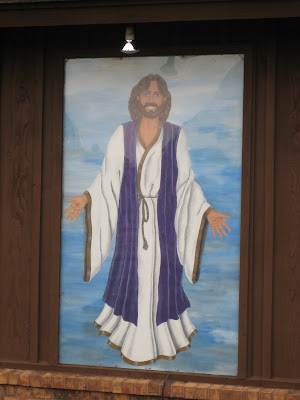
My path took me through Fort Smith, Arkansas. In the 1850s, my ancestors (the family of my surname, in fact) settled in a valley about 20 miles south of the city. The region is more reminiscent of nearby Oklahoma than the general perception of mountainous Arkansas. The hills are only rolling, with farms boasting real, substantial pastures in the spreading valleys. The Civil War disrupted things in this valley before my people could get settled good. They, and a clutch of neighboring families, were Unionists. Killings were not unheard of, with the father-in-law of one of my uncles being shot down. An aunt was caught alone in the fields by Rebel bushwackers and apparently raped (though this sort of thing just wasn't talked openly). She was never the same afterwards, and died sometime later, unmarried. A couple of uncles slipped across the the border into Indian Territory and joined up with Union forces. My particular ancestor, who had a young family, could not easily do so. He and a brother-in-law were drafted into the Confederate Army, but on Christmas leave, gathered up their families and fled to Indian Territory. They made it to Texas in early 1863, the last of my tribe to arrive. The rest of the family rode out the war and remained in Arkansas. Every time I am close by, I stop at the graveyard where they lie buried. The cemetery grew around the churchyard of the Coop Prairie Cumberland Presbyterian Church, an historic church dating to 1848 and the church of my ancestors. In that sense, the church had meaning to me. But no more. The church building has been modernized, and apparently the word "Presbyterian" was a little too restrictive for post-modern sensibilities. But then, even the word "church" is considered too dogmatic. For now, it is simply the Coop Prairie Fellowship, or something like that--honestly, I can't remember exactly, for they all run together. But what did get my attention was the large painting of Jesus on the outside of the church. From here on out, my ancestors lie buried in the shadow of the Happy Hippie Jesus Church. Oh well.
My second excursion took my wife and I to Jackson, Mississippi to attend an annual family reunion, on my mother's side. In 1776, a young German boy with a funny name enlisted in the British Army to fight in America. Once here, he decided the better course would be to fight against the British instead. So, from 1779, he served in the colonial army. At war's end, he married a North Carolina girl and began raising a large family, first there, and later in Georgia. When he died in 1816, he was a substantial farmer, a Primitive Baptist preacher and a Justice of the Peace, though still speaking with something of a thick German accent. For the last 29 years, representatives of his innumerable descendants have gathered for a reunion in some Southern locale. None of us are closely related to one another, but we treasure these yearly gatherings.
To speak of Southern eccentricities is to repeat oneself. At one point, I found myself chatting with a group of cousins that consisted of a NASCAR driver, a Mobile society doyenne and a Holiness preacher. The NASCAR driver created the most splash this year, arriving in his candy-apple red, vintage 1966 Corvette, with pictures of the plantation he had just purchased (1832 mansion house with columns and the whole bit).
My path took me through Fort Smith, Arkansas. In the 1850s, my ancestors (the family of my surname, in fact) settled in a valley about 20 miles south of the city. The region is more reminiscent of nearby Oklahoma than the general perception of mountainous Arkansas. The hills are only rolling, with farms boasting real, substantial pastures in the spreading valleys. The Civil War disrupted things in this valley before my people could get settled good. They, and a clutch of neighboring families, were Unionists. Killings were not unheard of, with the father-in-law of one of my uncles being shot down. An aunt was caught alone in the fields by Rebel bushwackers and apparently raped (though this sort of thing just wasn't talked openly). She was never the same afterwards, and died sometime later, unmarried. A couple of uncles slipped across the the border into Indian Territory and joined up with Union forces. My particular ancestor, who had a young family, could not easily do so. He and a brother-in-law were drafted into the Confederate Army, but on Christmas leave, gathered up their families and fled to Indian Territory. They made it to Texas in early 1863, the last of my tribe to arrive. The rest of the family rode out the war and remained in Arkansas. Every time I am close by, I stop at the graveyard where they lie buried. The cemetery grew around the churchyard of the Coop Prairie Cumberland Presbyterian Church, an historic church dating to 1848 and the church of my ancestors. In that sense, the church had meaning to me. But no more. The church building has been modernized, and apparently the word "Presbyterian" was a little too restrictive for post-modern sensibilities. But then, even the word "church" is considered too dogmatic. For now, it is simply the Coop Prairie Fellowship, or something like that--honestly, I can't remember exactly, for they all run together. But what did get my attention was the large painting of Jesus on the outside of the church. From here on out, my ancestors lie buried in the shadow of the Happy Hippie Jesus Church. Oh well.

My second excursion took my wife and I to Jackson, Mississippi to attend an annual family reunion, on my mother's side. In 1776, a young German boy with a funny name enlisted in the British Army to fight in America. Once here, he decided the better course would be to fight against the British instead. So, from 1779, he served in the colonial army. At war's end, he married a North Carolina girl and began raising a large family, first there, and later in Georgia. When he died in 1816, he was a substantial farmer, a Primitive Baptist preacher and a Justice of the Peace, though still speaking with something of a thick German accent. For the last 29 years, representatives of his innumerable descendants have gathered for a reunion in some Southern locale. None of us are closely related to one another, but we treasure these yearly gatherings.
To speak of Southern eccentricities is to repeat oneself. At one point, I found myself chatting with a group of cousins that consisted of a NASCAR driver, a Mobile society doyenne and a Holiness preacher. The NASCAR driver created the most splash this year, arriving in his candy-apple red, vintage 1966 Corvette, with pictures of the plantation he had just purchased (1832 mansion house with columns and the whole bit).
One of the cousins of my generation is a Mobile attorney. Each year, she invariably ends up as the source of some memorable anecdote or incident. This year was no exception. We rented a restaurant for our Saturday night banquet and meeting. By the time we all left, the staff was anxious to close up. Halfway back to the hotel, my cousin remembered she had left her jacket at the restaurant. So she and her 85-year old aunt circled back to the restaurant to retrieve the jacket. Upon return, they found the establishment to be closed and locked up tight. Sure enough, the jacket was hanging on the hat rack, just inside the door. My cousin left a note on the door with her name and address and instructions for mailing the jacket back to Mobile. But before leaving, she noticed that the lock was just the normal residential variety. She jiggled the knob, and was able to push the door open. This, of course, set off the alarm system. With the siren blaring, she turned to her aunt and yelled "Get in the car, Aunt Mae! Get in the car!" 85-year old Aunt Mae took off running across the parking lot, as my cousin reached in, grabbed her jacket, pulled the door shut and ripped off the note with her name and number. They peeled out the parking lot and made their way safely back to the hotel.
Jackson is favorite of ours. We always drive by Eudora Welty's house. We always spend an hour in Lemuria, one of the best Southern bookstores. And Jackson is a good city for eating out. Dennery's is still in business--the haunt of Miss Welty. But this year, we stopped at another favorite of mine, the Elite Restaurant downtown. The same Greek family has operated the establishment since 1947. Interestingly, they are of the same family that founded the noted Texas eatery of the same name even earlier.

Once the reunion was over, we looped up through the Delta, turning a 5-hour return trip into 8 hours. This is sort of thing I enjoy and my wife patiently endures. But there is method to this madness, for we were able to stop in Greenwood for Sunday dinner (often referred to as "lunch" elsewhere). There were joined the local Episcopacracy at Giardina's, going strong since 1936, next door to the elegant Alluvian Hotel.
 From there, we turned West, heading for the Greenville bridge. Along the way we passed the Jim Henson Muppet Museum in Leland (just look for the giant frog). Who knew?
At Greenville, I wanted to visit the kneeling knight in the Percy family plot there. Time constraints and a failure to locate the cemetery dictated that I postpone this to another trip (Ask directions? Never!) The impressive new bridge over the Mississippi at Greenville is nearing completion. From there, we angled across southeastern Arkansas, into Monroe, Louisiana, which put us within 3 hours of home on the interstate.

I saw some of my most memorable church signs on this Delta loop. One thing I noticed was perhaps a new trend--the mix-and-match of traditonal evangelical denominational names. The New Bethany Assembly for Christ is supposed to be somehow different, I suppose, from just the run-on-the mill Assemby of God. Then there was the Charismatic Holiness Church of Christ, which will make about as much sense to any Southerner as say, Ralph Nader Republicans. In Greenwood, a storefront church caught my eye: The Endtimes Encounter Church, with Pastor and Apostle Sherry _________. At least we don't have to wonder what they are all about. But the church that gave me pause was the Emanuel Baptist Church in Leland, near the Muppet Museum. Their sign on the highway outlined their plea:
Acceptance, Purpose, Family and FUN!
I can grudginly grant them the first three, even though they would be way down on my list if I was coming up with that sort of thing. Seems like humility, love, patience ought to be in there somewhere. But fun? And not just fun, but FUN! Why must everything in this country be fun? Can't some things simply by their very nature be deadly serious? The sign bothered me much more than any of the evangelical charistmatic church configurations I noted. Church--the Body of Christ--is serious business. And if we have to market it differently, then to quote Flannery O'Connor, "to hell with it."
But what really got my attention was a little church on the outskirts of Bonita, Louisiana, just north of Mer Rouge. The chuch was named--and you can't make this stuff up--"The Holy Ghost Disturbed Church." To me, this is right out of Flannery O'Connor. I think I know what they are referring to--the stirring-up of the waters at the pool of Siloam. Somehow I can just image a church member being asked their religious affiliation and replying, "Oh, I'm a Disturbed Christian." So am I, so am I.

Finally, my wife and I took a long weekend trip to Galveston. We are not at all beach people. Galveston has always had the reputation of being the most cosmopolitan and well, least Texan of our cities. It has been years and years since I've been there. Practically the entire city is the "historical district." We planned to meet friends there and attend the premier of Jaston Williams' and Joe Sears' latest play at the Grand Opera House. Afterwards, we had a memorable meal at Di Bella's, a old-time neighborhood Italian diner. In approaching Galvestion, one should avoid Houston at all costs. We turned off to the east of the city, driving through some pleasant rural areas located surprisingly close to Houston. Two churches along this stretch of road caught my attention. One was the "Melchizidek Divine Church." I just have no idea. Melchizidekians??? The next church down the road was "The Changing Lifestyles Fellowship." This name may actually imply something they probably didn't intend. And then finally, there was the appropriately brief and to-the-point "Happy Church."
Thursday, August 28, 2008
A Little Nation-Building

Russian recognition of the (in)dependence of Abkhazia and South Ossetia is now official. No surprise here, as this was their end game all along. These nations now have a place at the table next to Ruritania, Grand Fenwick, Lower Slobbavia, and of course, Kosovo. Can Transdniestra be far behind?

Last year in Tbilisi, I visited the 6th-century Anchiskhati Church for Saturday Vespers. The church was packed, with services delayed due to a memorial service going on on one side and a baptism underway on the other--the whole Orthodox circle of life under one roof. I went outside for some air, and as it was raining, I shared the shelter of the portico with a beggar lady. Our conversation was limited--obviously--but I was able to determine that she was a Georgian refugee from Abkhazia, one of several hundred thousand uprooted by Russian "peacekeepers." I do not remember what I gave her, but now I wish I have given her more. I suppose she will now have to make room for the influx of Georgians from South Ossetia.
And now I hear that Dick Cheney is on his way to Georgia.
Good Lord, no.
As I have stated before, there is enough blame to go around for this mess. But to the extent that American foreign policy is culpable--and it is--you might say our Kosovo chickens have come home to roost. Srdja Trifkovic's column, here, is essential reading, in this regard.
Tuesday, August 19, 2008
Brideshead Re-Revisited

In recent weeks I have read several reviews of the remake of Evelyn Waugh's Brideshead Revisited. From what I can tell, the movie itself is sumptuous and visually stunning, but totally misses the point Waugh was making, if not, in fact, drawing the exact opposite conclusion. I will probably see the movie anyway...perhaps.
I first read the book about 25 years ago, and I missed the point as well. I suppose I was not ready for it at the time. I viewed it as just another English country house drama--complete with an eccentric, disintegrating, dysfunctional old family, out of step with changing times between the wars. I just lapped-up that sort of thing back then. Brideshead Revisited, while enjoyable and well-done, was not even the best among this extensive genre, in my view.

I have recently revisited Brideshead. Upon second reading, I can say that I now have a little more insight into what escaped me earlier on. The book's acclaim is well-deserved. I would place it among the essential works of 20th century literature. As Waugh himself later observed, the point of the book was “to trace the divine purpose in a pagan world.” In Charles' last conversation with Cordelia, she reminded him of an evening at Brideshead. A drunken Sebastian interrupted Lady Marchmain's reading from Chesterton's Father Brown. Cordelia remembered a line from the book: "'I caught him’ [the thief] with an unseen hook and an invisible line which is long enough to let him wander to the ends of the world and still bring him back with a twitch upon the thread.” That is the point of Brideshead: grace, mercy and redemption--a few lost fishes hauled in from the sea.
Charles is slow to acknowledge the source of the inspiration he finds at Brideshead. I particularly like the following exchange he had with Sebastian (p. 65):
'Oh dear, it's very difficult being a Catholic.'
'Does it make much difference to you?'
'Of course. All the time.'
'Well, I can't say I've noticed it. Are you struggling against temptation? You don't seem much more virtuous than me.'
'I'm very, very much wickeder,' said Sebastian indignantly....
'I suppose they try and make you believe an awful lot of nonsense?'
'Is it nonsense? I wish it were. It sometimes sounds terribly sensible to me.'
'But my dear Sebastian, you can't seriously believe it all.'
'Can't I?'
'I mean about Christmas and the star and the three kings and the ox and the ass.'
"Oh yes, I believe that. It's a lovely idea.'
'But you can't believe things because they're a lovely idea.'
'But I do. That's how I believe.'

In time, Charles became increasingly exasperated with the Flyte's use of faith as a touchstone for most everything in their lives. In a conversation with Sebastian's brother (p. 113):
'My mother believes Sebastian is a confirmed drunkard. Is he?'
'He's in danger of becoming one.'
'I believe God prefers drunkards to a lot of respectable people.'
'For God's sake,' I said, for I was near to tears that morning, 'why bring God into everything?'
'I'm sorry. I forgot. But you know that's an extremely funny question.'
'Is it?'
'To me. Not to you.'
'No, not to me. It seems to me that without your religion Sebastian would have the chance to be a happy and healthy man.'
'It's arguable,' said Brideshead. 'Do you think he will need this elephant's foot again?'
Charles acknowledged his own emptiness, but resisted recognizing the source of the hollowness.
"I remained unchanged, still a small part of myself pretending to be whole...." (p.179) and "How often, it seemed to me, I was brought up short, like a horse in full stride suddenly refusing an obstacle, backing against the spurs, too shy even to put his nose at it and look at the thing." (p. 246)
Eventually, Charles began to realize that holiness was something altogether different than morality, or at least as it was conventionally understood. Sebastian ended up in Morocco, rejected from the monastery (for a time), living and caring for Kurt--a German of somewhat disreputable background--and drinking by turns. Cordelia, in relating this, observed that the Superior of the monastery recognized the holiness in Sebastian. By this time, Charles offered no rebuttal.
I have always been more a fan of Waugh's contemporary, Anthony Powell, than I was of Waugh himself. Powell is more subtle and nuanced, and a better writer in many ways. But in so many important ways, Waugh's writing is the more significant. Powell described himself as non-croyant. He always seemed a bit baffled by Waugh's seeming religious obsession (a similar relationship, I have learned, to that of Eudora Welty and Flannery O'Connor). Powell's characters are often just as hollow and empty as Waugh's--the modern malady of "pretending to be whole." And while they may occasionally acknowledge the condition, somewhat bemusedly, there is never any recognition of its source, or more importantly, its cure. With Waugh, this awareness leads to belated, faltering, but quite purposeful steps toward healing.

Three Books I Plan to Read
Bill Moyers recently interviewed Andrew Bacevich, author of The Limits of Power: The End of American Exceptionalism. A few excerpts, as follows:
Well, I've been troubled by the course of U.S. foreign policy for a long, long time. And I wrote the book in order to sort out my own thinking about where our basic problems lay. And I really reached the conclusion that our biggest problems are within. I think there's a tendency on the part of policy makers and probably a tendency on the part of many Americans to think that the problems we face are problems that are out there somewhere, beyond our borders. And that if we can fix those problems, then we'll be able to continue the American way of life as it has long existed. I think it's fundamentally wrong. Our major problems are at home.
The pursuit of freedom, as defined in an age of consumerism, has induced a condition of dependence on imported goods, on imported oil, and on credit. The chief desire of the American people...is that nothing should disrupt their access to these goods, that oil, and that credit. The chief aim of the U.S. government is to satisfy that desire, which it does in part of through the distribution of largesse here at home, and in part through the pursuit of imperial ambitions abroad.
What will not go away, is a yawning disparity between what Americans expect, and what they're willing or able to pay....I think one of the ways we avoid confronting our refusal to balance the books is to rely increasingly on the projection of American military power around the world to try to maintain this dysfunctional system, or set of arrangements that have evolved over the last 30 or 40 years. But, it's not the American people who are deploying around the world. It is a very specific subset of our people, this professional army. We like to call it an all-volunteer force--but the truth is, it's a professional army, and when we think about where we send that army, it's really an imperial army. I mean, if as Americans, we could simply step back a little bit, and contemplate the significance of the fact that Americans today are fighting in Iraq and Afghanistan, and ask ourselves, how did it come to be that organizing places like Iraq and Afghanistan should have come to seem to be critical to the well-being of the United States of America.
There is nothing in the preamble to the Constitution which defines the purpose of the United States of America as remaking the world in our image, which I view as a fool's errand. There is nothing in the preamble of the Constitution that ever imagined that we would embark upon an effort, as President Bush has defined it, to transform the Greater Middle East. This region of the world that incorporates something in order of 1.4 billion people. I believe that the framers of the Constitution were primarily concerned with focusing on the way we live here, the way we order our affairs. To try to ensure that as individuals, we can have an opportunity to pursue our, perhaps, differing definitions of freedom, but also so that, as a community, we could live together in some kind of harmony. And that future generations would also be able to share in those same opportunities.
I think that the Bush Administration's response to 9/11 in constructing this paradigm of a global war on terror, in promulgating the so called, Bush Doctrine of Preventive War, in plunging into Iraq - utterly unnecessary war - will go down in our history as a record of recklessness that will be probably unmatched by any other administration.
There are many people who say they support the troops, and they really mean it. But when it comes, really, down to understanding what does it mean to support the troops? It needs to mean more than putting a sticker on the back of your car. I don't think we actually support the troops. We the people. What we the people do is we contract out the business of national security to approximately 0.5 percent of the population. About a million and a half people that are on active duty. And then we really turn away. We don't want to look when they go back for two or three or four or five combat tours. That's not supporting the troops. That's an abdication of civic responsibility. And I do think it - there's something fundamentally immoral about that. Again, as I tried to say, I think the global war on terror, as a framework of thinking about policy, is deeply defective. But if one believes in the global war on terror, then why isn't the country actually supporting it? In a meaningful substantive sense?
Yep, this is a book I plan to read. The full interview, here.
Another book on my to-read list is Michael Scheuer's Marching Toward Hell: America and Islam After Iraq. Scheuer is the ex-CIA operative who authored Imperial Hubris a couple of years back. The man knows what he is talking about.
Finally, there is Tony Judt's Reappraisals: Reflections on the Forgotten Twentieth Century. Peregrine Worthorne, in a review in the American Conservative, had this to say:
For Americans, victory in the Cold War was more than a terrestrial victory. It was also a celestial victory for which the U.S. had been prepared to risk destroying not only their own and the Russian peoples--who could be presumed to have given their consent--but the peoples of the rest of the world whose permission was never asked. Henceforth all things were going to be fundamentally transformed--in a word, reborn. As Judt puts it,
...with too much confidence and too little reflection we put the 20th century behind us and strode boldly into its successor swaddled in self-serving half truths: triumph of the West, the end of history, the uni-polar American moment, the ineluctable march of globalization and the free market
In other words, as one evil empire fell, a utopian empire--equally dangerous--took its place.
a
Well, I've been troubled by the course of U.S. foreign policy for a long, long time. And I wrote the book in order to sort out my own thinking about where our basic problems lay. And I really reached the conclusion that our biggest problems are within. I think there's a tendency on the part of policy makers and probably a tendency on the part of many Americans to think that the problems we face are problems that are out there somewhere, beyond our borders. And that if we can fix those problems, then we'll be able to continue the American way of life as it has long existed. I think it's fundamentally wrong. Our major problems are at home.
The pursuit of freedom, as defined in an age of consumerism, has induced a condition of dependence on imported goods, on imported oil, and on credit. The chief desire of the American people...is that nothing should disrupt their access to these goods, that oil, and that credit. The chief aim of the U.S. government is to satisfy that desire, which it does in part of through the distribution of largesse here at home, and in part through the pursuit of imperial ambitions abroad.
What will not go away, is a yawning disparity between what Americans expect, and what they're willing or able to pay....I think one of the ways we avoid confronting our refusal to balance the books is to rely increasingly on the projection of American military power around the world to try to maintain this dysfunctional system, or set of arrangements that have evolved over the last 30 or 40 years. But, it's not the American people who are deploying around the world. It is a very specific subset of our people, this professional army. We like to call it an all-volunteer force--but the truth is, it's a professional army, and when we think about where we send that army, it's really an imperial army. I mean, if as Americans, we could simply step back a little bit, and contemplate the significance of the fact that Americans today are fighting in Iraq and Afghanistan, and ask ourselves, how did it come to be that organizing places like Iraq and Afghanistan should have come to seem to be critical to the well-being of the United States of America.
There is nothing in the preamble to the Constitution which defines the purpose of the United States of America as remaking the world in our image, which I view as a fool's errand. There is nothing in the preamble of the Constitution that ever imagined that we would embark upon an effort, as President Bush has defined it, to transform the Greater Middle East. This region of the world that incorporates something in order of 1.4 billion people. I believe that the framers of the Constitution were primarily concerned with focusing on the way we live here, the way we order our affairs. To try to ensure that as individuals, we can have an opportunity to pursue our, perhaps, differing definitions of freedom, but also so that, as a community, we could live together in some kind of harmony. And that future generations would also be able to share in those same opportunities.
I think that the Bush Administration's response to 9/11 in constructing this paradigm of a global war on terror, in promulgating the so called, Bush Doctrine of Preventive War, in plunging into Iraq - utterly unnecessary war - will go down in our history as a record of recklessness that will be probably unmatched by any other administration.
There are many people who say they support the troops, and they really mean it. But when it comes, really, down to understanding what does it mean to support the troops? It needs to mean more than putting a sticker on the back of your car. I don't think we actually support the troops. We the people. What we the people do is we contract out the business of national security to approximately 0.5 percent of the population. About a million and a half people that are on active duty. And then we really turn away. We don't want to look when they go back for two or three or four or five combat tours. That's not supporting the troops. That's an abdication of civic responsibility. And I do think it - there's something fundamentally immoral about that. Again, as I tried to say, I think the global war on terror, as a framework of thinking about policy, is deeply defective. But if one believes in the global war on terror, then why isn't the country actually supporting it? In a meaningful substantive sense?
Yep, this is a book I plan to read. The full interview, here.
Another book on my to-read list is Michael Scheuer's Marching Toward Hell: America and Islam After Iraq. Scheuer is the ex-CIA operative who authored Imperial Hubris a couple of years back. The man knows what he is talking about.
Finally, there is Tony Judt's Reappraisals: Reflections on the Forgotten Twentieth Century. Peregrine Worthorne, in a review in the American Conservative, had this to say:
For Americans, victory in the Cold War was more than a terrestrial victory. It was also a celestial victory for which the U.S. had been prepared to risk destroying not only their own and the Russian peoples--who could be presumed to have given their consent--but the peoples of the rest of the world whose permission was never asked. Henceforth all things were going to be fundamentally transformed--in a word, reborn. As Judt puts it,
...with too much confidence and too little reflection we put the 20th century behind us and strode boldly into its successor swaddled in self-serving half truths: triumph of the West, the end of history, the uni-polar American moment, the ineluctable march of globalization and the free market
In other words, as one evil empire fell, a utopian empire--equally dangerous--took its place.
a
Subscribe to:
Posts (Atom)