Wednesday, October 25, 2006

Trick Dogs

Down here in Evangeland, it is the Fall Festival season. This is the time of year when many of our churches, being oh-so-careful not to use the "H" word, trot out their annual "Fall Festival" extravaganzas. Two goals seem to be in play. One is to provide a safe, secure venue for children to dress up, have fun, play games and indulge in some serious sugar highs. This is noble and laudable. The secondary motive is evangelical in nature--to entice families into the church through the children. The thinking is that if the children come, the parents can't be far behind. Frankly, I've never seen this really work, but of course, I could be wrong.

And I have absolutely no beef with any of this at all. What amuses me, however, is the fierce competition among churches within the "Fall Festival" market. A case in point: in my morning drive into the city, I passed a small surburban non-denominational community church (something with "Grace" in the name) that had obviously chunked out a great deal of money on a new, state-of-the-art sign, with bright red streaming video. And this morning, they were advertising their Fall Festival.

PUPPETS!!!! CANDY!!!! TRICK DOGS!!!!

Trick Dogs??? That's it! This church has inadvertantly stumbled upon what has been missing in American evangelicalism all along--trick dogs. Look for it soon in your neighborhood!

Friday, October 20, 2006

Let's Talk About Real Persecution

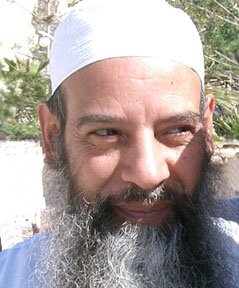
This is Bahaa El Din Al Akkad, a former muslim sheikh in Egypt. He has spent the last 18 months languishing in an Egyptian prison. His crime? Leaving Islam and converting to Christianity, of course. Or as the charges read, "insulting a heavenly religion." Thanks to Sand Monkey, who is, in my view, one of the best news sources in the Middle East. Read his account and Bahaa El Din Al Akkad's story here. By all means, READ HIS STORY.

Two thoughts come to mind. First, this is why I want to gag whenever I hear American Christians talk about being "persecuted" for their beliefs. Such talk trivializes faith and demeans the suffering of the truly persecuted church throughout the world. And second, I am ashamed that it is our billions which prop up this regime. (I know, I know. What replaces it will surely be much worse. But still....)

Sunday, October 15, 2006

No Relief in Sight

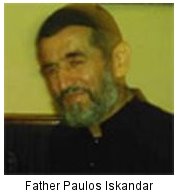
The news from Iraq remains unremittingly bleak. Syrian Orthodox Priet Fr. Paulos Iskander (Paul Alexander) was recently kidnapped and beheaded by unknown terrorists. Read here. The most comprehensive report is from Al Jazeera News, found here, and a related story here.

And today's paper is just chock-full of news from the abyss, such "Shiite town erupts in revenge killings after bodies found." Shiite villagers attacked a neighboring Sunni village, killing at least 26, this in retaliation for the beheading of 14 local Shiite construction workers the day before. And this story: "Iraqis' faith in premier fading fast." The story notes that to date, some 400 committees have been formed to investigate the myriad problems facing Iraq. So far, only 1 has brought its findings to Parliament. Meanwhile, since the government's formation, daily killings in Baghdad have risen from 65 to 100. At least one bureau of the new government is doing a landmark business--the passport office. Passports are being issued at the rate of 15,000 a week. Anyone who can afford to get out is getting out while they can.

These stories just set the stage for the cringe-inducing interview with Samir Sumaidaie, the Iraqi Ambassador to the U.S. He states:

...I want to make the distinction between what's going on in Iraq and all-out civil war. What's going on in Iraq is a campaign of violence waged by extremists on both sides, extremist Sunnis and extremist Shiites. There is no widespread conflict between the communities. The communities live quietly, peacefully and agreeably with each other, and have done so for thousands of years.


Unbelievable.

Sunday, October 08, 2006

Sunday Quotes

Sunday Paper Misc.

Georgie Ann Geyer on Immigration:

She quotes from film producer Ron Maxwell, who says

"the world is divided into two kinds of people. Those that live in three diminsions live simultaneously in the past, present and future. Those of us who live in this present are trustees to hand the past over to the future so the dead and the unborn are as alive as we are. But those who live only in the present think it's fine to pave over a battlefield or destroy a Buddha."

and John Tanton, founder of FAIR, who asked

"when did we begin to see man in America as only an economic animal?"

Good question, that.

Nick Gillespie, in article on Chris Anderson, editor of Wired and author of The Long Tail: Why the Future of Business is Selling Less of More:

We are turning "from a mass market," he argues, "into a niche nation" in which we can find exactly what we want in clothes, art, music and food. And, quite possibly, politics, personal identity, lifestyle and more.

And I suspect our American religiosity falls firmly within the "more."

Finally, in a review of Claire Messud's The Emperor's Children, an excellent quote from Edith Wharton:

"There are lots of ways to be miserable, but there's only one way of being comfortable, and that's to stop running around after happiness."

I like Edith Wharton.

Friday, October 06, 2006

Staring Down History

Igdir is a rather nondescript, if not unpleasant, modern city in far eastern Turkey, close on to the Armenian border. The region is noted throughout Turkey for its apricots. I can attest to the fact that they are indeed heavenly--juicy and the size of peaches. The region's shame, however, is this monstrosity. For this is the monument to the "Turkish Genocide." That's right; not the Armenian Genocide, but the Turkish Genocide. Turkey, in the face of all evidence to the contrary, maintains that there was no systematic genocide against the Armenians between 1915 and 1918, that while some Armenians did die during the "troubles," it was nowhere near the 1 to 1.5 million figure usually cited, that this part of Turkey was never primarily ethnic Armenian and that as many innocent Turks died as did Armenians. This monument, with museum underneath, is meant to perpetuate and validate this lie. Supposedly, the monument was built in such a location that, on a clear day, it could be seen in Yerevan, the Armenian capital.

My hosts wanted me to see this. The museum contained several rooms with official statements from Turkish historical conferences, old photographs showing Armenian "guerrilla" fighters (with guns!), and pictures from the 1990s unearthing of Turkish graveyards, supposedly showing the victims of the Armenians. The musuem sought to hammer through 3 points:

1. the Armenians "had it good" under the Ottomans
2. the Armenians were armed
3. that Turkish deaths equalled, if not exceeded those of the Armenians

The first point does have some merit. In many ways, Ottoman Armenians functioned in the same way as Jews did in many European societies. This appeared to be more of a Constantinople phenomenon, however. The fact that there were some armed Armenian freedom fighters is not news. So what? The museum's implication is that all were. Their panaramas depicting Armenian priests urging bloodthirsty hordes against the "innocent" Turks were particularly revolting. The third point is their Big Lie. Certainly, some innocent Turks lost their lives in this era. No one denies that. But Turkey resolutely denies the magnitude of Armenian deaths, or that there was any aspect of systematic "ethnic cleansing."

My host and I had a somewhat spirited discussion later on. He observed that many of the Armenians were not killed by the Ottoman troops, but rather, died of disease. "Like starvation," I asked? He excitedly replied, "Yes! Yes!" My sarcasm was lost on him. In other words, the only deaths that counted were those Armenians actually shot, stabbed, drowned or clubbed to death; not those who died of starvation.

I can understand Armenian anger towards Turkey. But this illogical Turkish animosity against Armenia baffles me. Would they not stay in line as they were being executed? Apparently, the fact that Armenians refuse to concede the point on what happened, and that the Armenian diaspora keeps the issue alive, infuriates many Turks. My host even thought tiny Armenia had designs on this part of Turkey, which would be comparable, I suppose, to Paraguay having designs on Brazil.

In my view, this is the main obstacle to Turkey joining the EU, or indeed, Turkey taking its rightful place on the world stage. By this, I do not mean the fact that they are Muslim, for frankly, they wear that very lightly. No, it is rather their infuriating nationalism, xenophobia, historical amnesia, and simple Turkocentric view of everything.

I love Turkey. I have friends there. I've traveled there three times, and hope to return. But this attitude becomes really, really hard to take at times. Much of it could be dismissed as mere silliness, were it not for the fact that it is believed, just as they largely believe 9-11 to be a U.S. government conspiracy. For example, I learned that: the Great Wall of China was built to keep out the Turks; that a Turk probably discovered America before Columbus (I suppose he will have to get in line behind the Norse, the Chinese, and according to Mormon theology--the lost tribe of Israel); that the American Indians are actually a Turkic people (could be); and on and on it goes. The 5 raised swords of the Igdir monument depict various stages of Turkish history, with a bas relief below each. One depicts a fierce Turkish soldier underneath a double eagle ensignia. I pointed this out to my host and said, "that's a Byzantine symbol!" He replied, "no, it's Turkish." I said, "no, I know a little about this sort of thing. That is definitely the Byzantine double eagle." "They got it from the Turks," he confidently replied. End of discussion.

I readily agree that the Ottoman Empire worked better in the Middle East than anything that has come along since. Think about it. But no, Turkey is not ready. And it will never be unless it honestly engages its own history.

A Ride with the Queen

On Fox News tonight, I listened to an interview with former Secretary of State, James Baker. Baker related an anecdote about President Reagan's state visit to Great Britain. Queen Elizabeth II hosted the Reagans at Windsor Castle. As both were avid horse-people, aides arranged a short, private ride. Far removed from reporters, the riders trotted up a nearby hill. Queen Elizabeth's horse, shall we say, was suffering from gas and emitted several short bursts, as only horses can do. The Queen turned to President Reagan and said, "Oh, I'm so sorry!" The President never batted an eye and replied, "that's quite alright, Your Majesty. I thought it was the horse."

Tuesday, October 03, 2006

History Matters (Still)


Rod Dreher at Crunchy Con has a number of excellent and timely articles posted today. The most intriguing, to me, is "History Matters," and his link to Daniel Larison.

Larison is a Ph.D student in Byzantine History at the University of Chicago. His post, entitled "History Matters, Even For Those Who Think It Has Ended," can be found here.

Larison begins by quoting Paul Schroeder from The American Conservative, whose full article is well worth reading and can be found here. Schroeder notes that the main intellectual defect in current American foreign policy is the lack of any sense of history...a trained intuitive sense of the way things do not happen. (How they actually happen depends on the evidence.) America’s leaders and their advisers, including some so-called historians and political scientists, not only are ignorant of history and insensitive to it, they despise and repudiate it.

Larison's commentary is impressive.

History teaches the attentive student the tragic sense of life, which most Americans cannot grasp at all, and an awareness that some problems are not meant to be solved but are to be endured.

and masterfully (and also quoted in to Dreher post):

History does not repeat itself, of course, but it does provide cautionary lessons to those who would take heed of them. Among them are these basic truths: that great powers sow in the exercise of their own dominance the seeds of their collapse; that no victory is complete, no cause is ever truly vindicated by force of arms, and no defeat is final so long as people retain memory of it; that concentrated power is the ruin of a nation; that natural affinities and attachments to kith and kin are more enduring and powerful than almost any idea or belief known to man; that man has a deep need to worship and find meaning beyond himself, whether in the divine or the demonic; that man is impractical and irrational and will ensnare himself in fetters to acquire what he desires; that most men, if given the chance, will betray themselves and all they hold dear for the acquisition of power.

Untold volumes have been written, either trying to explain or explain away what Larison sums up in a paragraph. His site is well worth visiting and exploring.
Thanks Rod, and Daniel, and Dr. Schroeder.

Sunday, September 24, 2006

Give Me That Rodeo Religion

In the last few days, I had opportunity to travel around a bit in this weird state of mind called Texas. Obstensibly, I was to attend a one-day continuing education seminar west of San Antonio, but you might say I took the long way there. A freakish accident, resulting in a broken ankle, scotched my seminar attendance and sent me limping home a day early (but that is another story).

I enjoy driving the backroads, savoring the small towns and the occasional cafe where the waitress might still call you "Hon." In these places, you catch glimpses of the unique, the off-beat, and sometimes, the downright bizarre.

Somewhat in that context, I always pay special attention to the churches I pass along the way: their archetecture (or lack thereof), their sloganeering, and especially their names. The Jesus Christ is the Answer, Inc. Church, painted in large red letters on the church roof is hard to miss, or forget. Somehow I suspect someone didn't really think this one through...."Hi, I'm with the Jesus Christ is the Answer, Inc. Church and I'd like to tell you that Jesus Christ is the Answer"....it just doesn't flow. I found the Little Zion Jerusalem Baptist Church, an odd juxtaposition, but then I found the Mother Zion Missionary Baptist Church completely baffling. I am familiar, of course, with the biblical usage of the word "Zion," but what is meant by "Mother Zion?" I don't get it.

But outside of these colorful varieties and the traditional Baptist/Methodist/ Church of Christ matrix, most everything else was of the "new" variety. By this I mean some variation of the phrase "New Life," "New Beginnings," "New Covenant," etc. or something or the other. In fact, 90% of these churches are some jumble of the following phrases:

New Life
New Beginning
New Covenant
Faith
Family
Fellowship
Praise
Community
Outreach Center


Just mix and match to come up with a jazzy name, find a metal building, and you are in business. Interestingly, many tend to avoid the word "church," thinking, I suppose, that if you don't call it a church, then people will come. So you end up with things like New Life Outreach Center, or New Beginnings Family Fellowship, or New Covenant Fellowship Center. A variation in a nearby county is Driven Life Outreach Center. Driven life? Excuse me. I don't mean to put too fine a point on it, but Muslims are driven. Christians are led. Bottom line: more often than not, new is not better.

I take all this in stride, but for some reason, I am baffled and a little disturbed by the phenomenon of the "cowboy churches." Those of you who don't live in the South or West may be puzzled by what I mean. These are churches specifically designed for "cowboys," where they can wear their boots and jeans and whatever else (hats?) and be comfortable and not feel out of place. Invariably, they meet in a large metal building that perhaps once was, or could still double as, a barn. Usually there is a roping arena out back, where the congregation can "rope," I suppose, after church.


What got me to thinking about this was the particular cowboy church I passed down in Central Texas--the All Around Cowboy Church. Now I understand that this is a rodeo term, but it just struck me as funny. If you are a part-time cowboy, or what we used to call a drug-store cowboy, then podner, you'd better jest mosey on down the trail, for this church is for "all around" cowboys.

And therein lies the heart of what bothers me about all this, and why it is just another example, par excellence, of the dissipation of Protestantism. The cowboy church philosophy, I gather, is to create a worship environment that is inviting to the "cowboy." I am speaking only for my part of the state, but real cowboys are pretty scare around here. There are folks who may have a few cows and who may occasionally ride a horse, but by and large it is merely an affectation, a stance, in many cases a mere fashion statement--a preference for wranglers and Tony Lama boots. (Now some truth in advertising here: I am not one, have never been one and have never aspired to be one. But my dad was--a real, old-time cowboy. He did other things, for sure, but at heart he was a cowboy, from cowboy country. So I do know the genuine article when I see it.) So, in effect, what we have here is a denomination created in large part for people who want to dress a certain way. I suppose it is no different than having Surfer Dude Churches in California and Hawaii, where you can carry your surfboard to worship. The raison d'etre of the cowboy churches is their particular hobby, or fashion preference. In my mind, this has trivialized Christianity down to the point where it cannot go much further.

Two final points and I'll stop "beating this dead horse." American religious groups of all stripes have long adopted casual dress in worship. (I have no problem with this, up to a point, because what bothers me more than casualness is pretense.) I never heard of anyone being turned away from any Protestant church around here for showing up in boots and jeans. It just wasn't an issue. So there was no real need for any separate churches. And I wonder what my reception would be at the All Around Cowboy Church if I showed up in khakis and loafers? It's just the same old thing. Finally, the image of the cowboy in American culture is one of lonely, rugged, individualistic, self-reliance. While these traits may serve you well in taming the frontier, I don't see a single one that should be a characteristic of Life in Christ.

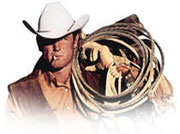
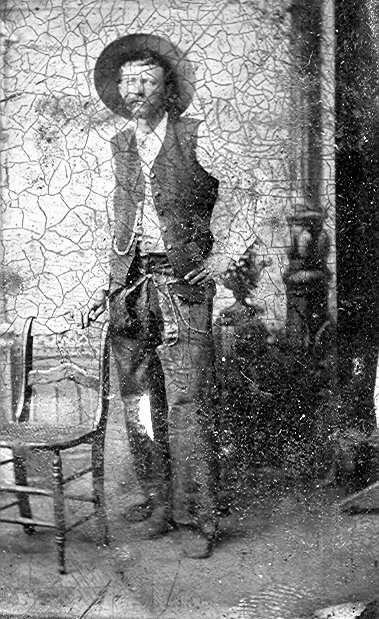
By the way, the first picture is our cowboy of American myth. The second picture is the real thing, my g-g-uncle Henry who went up the Chisholm Trail in the late 1870s.

Wednesday, September 20, 2006

Obsessed

Okay, I'll admit it. I recognize that I have become tee-totally obsessed with this whole Pope Benedict mess. I'm still stirred up about it and the thoughts that follow are far from a measured, calm response to the controversy.

My state of mind was not helped by yesterday's Dallas Morning News. The editorial headline read: "Pope was careless, but reaction is out of line." Although they did bemoan the disproportionate Islamic response, they saved plenty of advice for the pontiff, as well. The editor advised that Benedict should have "chosen a better example for a recent talk that has launched an international furor," and that "wisdom prescribed care and clarity in speaking of sensitive religious matters," concluding that "the current pope cannot afford another blunder like this one."

Careless? Blunder? What pure, unadulterated, pandering crap this is! As I have stated here and elsewhere, I am convinced that Pope Benedict's words were carefully chosen and he said exactly what he intended to say. I do not know his exact reasons for doing so, but they were no careless blunder. Ochlophobist has some fascinating speculation as to his motivations.

And then over at Dreher's Crunchy Con, I found a link to this about the planned "Day of Rage" this coming Friday, in which Muslims will vent their outrage over Pope Benedict's remarks. Oh, so you mean, the last week of rage hasn't been enough? I would suggest a counter "Day" in the West. I'm not sure what we should call it. Maybe "Day of Get-over-it-already" or maybe "Day of Grow-up!" or perhaps "Day of You-Call-That-A-Religion?" I don't know.

And yet, there are hopeful signs of dawning awareness in the West; perhaps a belated recognition of the adversary we face. By this I mean that some of the secular Left, who in former days would counsel "dialogue" and "understanding" and "sensitivity," now view this as the insipid pandering that it often is. Case in point (and a hat tip to my friend Milton) is Sam Harris, a left-leaning atheist whose latest book was entitled The End of Faith. He writes:

But my correspondence with liberals has convinced me that liberalism has grown dangerously out of touch with the realities of our world — specifically with what devout Muslims actually believe about the West, about paradise and about the ultimate ascendance of their faith. On questions of national security, I am now as wary of my fellow liberals as I am of the religious demagogues on the Christian right. This may seem like frank acquiescence to the charge that "liberals are soft on terrorism." It is, and they are. A cult of death is forming in the Muslim world — for reasons that are perfectly explicable in terms of the Islamic doctrines of martyrdom and jihad. The truth is that we are not fighting a "war on terror." We are fighting a pestilential theology and a longing for paradise. Unfortunately, such religious extremism is not as fringe a phenomenon as we might hope....Such an astonishing eruption of masochistic unreason could well mark the decline of liberalism, if not the decline of Western civilization. The truth is that there is every reason to believe that a terrifying number of the world's Muslims now view all political and moral questions in terms of their affiliation with Islam. This leads them to rally to the cause of other Muslims no matter how sociopathic their behavior. This benighted religious solidarity may be the greatest problem facing civilization and yet it is regularly misconstrued, ignored or obfuscated by liberals....We are entering an age of unchecked nuclear proliferation and, it seems likely, nuclear terrorism. There is, therefore, no future in which aspiring martyrs will make good neighbors for us. Unless liberals realize that there are tens of millions of people in the Muslim world who are far scarier than Dick Cheney, they will be unable to protect civilization from its genuine enemies....To say that this does not bode well for liberalism is an understatement: It does not bode well for the future of civilization. For the full story, read here.

And then there is Anne Applebaum, writing in the Washington Post:

Western politicians, writers, thinkers and speakers should stop apologizing -- and start uniting. By this, I don't mean that we all need to rush to defend or to analyze this particular sermon; I leave that to experts on Byzantine theology. But we can all unite in our support for freedom of speech -- surely the pope is allowed to quote from medieval texts -- and of the press. And we can also unite, loudly, in our condemnation of violent, unprovoked attacks on churches, embassies and elderly nuns. By "we" I mean here the White House, the Vatican, the German Greens, the French Foreign Ministry, NATO, Greenpeace, Le Monde and Fox News -- Western institutions of the left, the right and everything in between. True, these principles sound pretty elementary -- "we're pro-free speech and anti-gratuitous violence" -- but in the days since the pope's sermon, I don't feel that I've heard them defended in anything like a unanimous chorus. A lot more time has been spent analyzing what the pontiff meant to say, or should have said, or might have said if he had been given better advice. All of which is simply beside the point, since nothing the pope has ever said comes even close to matching the vitriol, extremism and hatred that pour out of the mouths of radical imams and fanatical clerics every day, all across Europe and the Muslim world, almost none of which ever provokes any Western response at all. And maybe it's time that it should…

Indeed. Read the full article here.

And finally, Lord Carey, the former Archbishop of Canterbury adds his voice:

The former Archbishop of Canterbury...has issued his own challenge to “violent” Islam in a lecture in which he defends the Pope’s “extraordinarily effective and lucid” speech. Lord Carey said that Muslims must address “with great urgency” their religion’s association with violence. He made it clear that he believed the “clash of civilisations” endangering the world was not between Islamist extremists and the West, but with Islam as a whole. “We are living in dangerous and potentially cataclysmic times,” he said. “There will be no significant material and economic progress [in Muslim communities] until the Muslim mind is allowed to challenge the status quo of Muslim conventions and even their most cherished shibboleths.” ...
Arguing that [Samuel] Huntington’s thesis has some “validity”, Lord Carey quoted him as saying: “Islam’s borders are bloody and so are its innards. The fundamental problem for the West is not Islamic fundamentalism. It is Islam, a different civilisation whose people are convinced of the superiority of their culture and are obsessed with the inferiority of their power.” He said ... it was the “moral relativism of the West” that has outraged Muslim society. Most Muslims believe firmly that the invasion of Iraq is 2004 was solely about oil, he said. He went on to defend the Pope’s fundamental thesis, that reason and religious faith can be compatible. “The actual essay is an extraordinarily effective and lucid thesis exploring the weakness of secularism and the way that faith and reason go hand in hand,” he said. He said he agreed with his Muslim friends who claimed that true Islam is not a violent religion, but he wanted to know why Islam today had become associated with violence. “The Muslim world must address this matter with great urgency,” he said.


Read here for entire article.

End of rant.

Monday, September 18, 2006

We Are All Paleologi Now

The furor over Pope Benedict's remarks continued unabated over the weekend, following what is now a predictable and depressingly familiar pattern. Only two sentences from an academic speech by this former academician have apparently offended the whole of Islam. The silliness and absurdity of the protests rival that of the Danish cartoon "scandal." For Islam, this may be another Emperor-has-no-clothes moment.

But protests in the Muslim street appear to be the order of the day. In the face of their own homegrown poverty, endemic and institutionalized corruption and near hopeless economies--all legitimate reasons for protest--many riot over this obscure quotation of a 14th-century Byzantine emperor by a German Pope. The indignation is not confined to the "streets." Muslim political leaders compare Pope Benedict to Hitler and recall their ambassadors from the Vatican. Official apologies are demanded across the board, but it is doubtful any will be sufficient to assuage the tender sensibilities of the professionally agrieved. Meanwhile Palestinian churches are indiscriminately torched, with Orthodox and Anglican churches suffering alongside Catholic. (Proof, if any were needed, that despite the distinctions we ourselves make, we are all very much in the same foxhole.) And apparently, elderly Catholic nuns are now to be shot in the back, as evidenced by the tragedy in Mogadishu.

That is the world we live in now. Of course, the irony here is that this reaction in the Muslim world only validates and reinforces those very sentiments--expressed by Manuel II some 600 years ago--that the protestors find so reprehensible today.

Victor Davis Hanson has some insightful comments here, and including this absolutely spot-on summation:

... by quoting from the emperor rhetorician Manuel Paleologus—whose desperate efforts at strengthening the Morea and the Isthmus at Corinth a generation before that awful Tuesday, May 29, 1453 all came to naught—the Pope failed to grasp that under the tenets of radical Islam of the modern age, context means little, intent nothing, learning less than zero. If a sentence, indeed a mere phrase can be taken out of context, twisted, manipulated to show an absence of deference to Islam, furor ensues, death threats follow, assassins load their belts—even as the New York Times or the Guardian issues its sanctimonious apologies in the hope that the crocodile will eat them last.

Rod Dreher has a good discussion here, with a link to Michelle Malkin here, who in turn has a link to a must-read article that puts the original 14th-century remarks of Manuel II Paleologus in their proper context, here.

Dreher thinks something about the reaction to Benedict's speech seems to have pushed Christians...over the line, concluding that if any good is to come out of this mess that began with Pope Benedict's speech, it will be that fewer and fewer ordinary people will be gulled by political correctness, and will start to understand exactly what we're all up against.

One can hope.

Finally, Dreher notes "in any case, Benedict's speech will go down as a defining moment in this conflict."

Saturday, September 16, 2006

Remembering Oriana Fallaci

Oriana Fallaci is dead. After battling cancer for 10 years, she returned to her native Florence to die. A take-no-prisoners journalist, Fallaci had bested the likes of Arafat, Kissinger and Khomeini in her day, as well as being shot 3 times and left for dead at the Mexico City Olympics of 1968. Always controversial, she was perhaps never more so than in the post 9/11 years.

I came to appreciate her rather late. A New York Times review of her The Rage and the Pride in September 2002 was my first introduction. I ordered the book, read it overnight in one sitting, and then promptly ordered 5 copies to give as gifts. It is neither a well-written nor even a well-reasoned book, but it is quite simply the most passionate book I have ever read. It is a cry of truth, and truth is often an inconvenient and uncomfortable thing. An extended passage from her The Rage and the Pride follows:

Good Lord, I don't deny anybody the right to have fear. A thousand times I have written that whoever claims not to know fear is either a liar or an idiot or both. But in Life and in History there are moments when fear is not permitted. Moments when fear is immoral and uncivilized. And those who out of weakness or stupidity (or the habit of keeping one foot in two shoes) avoid the obligations imposed by this war, are not only cowards: they are masochists.

Masochists, yes, masochists. And on this subject let's finally speak of what you call Contrast-Between-the-Two-Cultures. The two?!? If you really want to know, I feel uncomfortable even when you pronounce the words "two cultures." That is, when you put them on the same level as if they were two parallel entities. Two realities of equal weight and value. Don't be so humble, my dear. Because behind our culture there is Homer, there is Pheidias, there is Socrates, there is Plato, there is Aristotle, there is Archimedes. There is Ancient Greece with its divine sculpture and architecture and poetry and philosophy, with its principle of democracy. There is Ancient Rome with all its grandeur, its universality, its concept of the Law, its literature, its palaces, its amphitheaters, its aqueducts, its bridges, its streets built all over the then know world...There is a revolutionary called Jesus who died on the cross to teach us the concept of love and justice. (And so much the worse for us if we didn't learn it). There is a Church that...gave a tremendous contribution to the History of Thought, and after the Inquisition began to change. Not even an anti-clerical like me can deny it. Then there is the cultural awakening that started and flourished in Florence, in Tuscany, to replace Man at the center of the Universe and [re]concile his need of freedom with his need of God. I mean the Renaissance....There is also the heritage left by Erasmus from Rotterdam and Montaigne and Thomas More and Cartesius. There is also the Enlightenment....There is also the music of Mozart and Bach and Beethoven and Rossini and Donizetti up to Verdi and Puccini and company....Finally, there is our Science, by God. And the technology that derives from it....Enough with bullshit, my dear: Copernicus, Galileo, Newton, Darwin, Pasteur, Einstein were not followers of the Prophet. Were they? The motor, the telegraph, the light-bulb, I mean the use of electricity, the photograph, the telephone, the radio, the television, have not been invented by some mullahs or some ayatollahs. Have they? The train, the automobile, the airplane, the helicopter, (that Leonardo da Vinci fancied and designed), the spacecrafts with which we have gone to the Moon and to Mars and will so go to God knows where, the same. Right? The heart and liver and eyes and lungs' transplant, the cures for cancer, the genome's disclosure, as well. Wrong? And let us not forget the standard of life that Western culture has achieved at every level of society. In the West we don't any longer die of starvation and curable diseases as they do in the Moslem countries. Right or wrong? But even if all these were unimportant achievements, (which I doubt), tell me: what are the conquests of the other culture, the culture of the bigots with the beard and the chador and the burkah?

Look and search, search and look. I can only find the Prophet with his sacred book that sounds preposterous even when it plagiarizes the Bible and the Gospels and the Torah and the Hellenistic thinkers. I only find Averroe with his indisputable merits of scholar...Omar Khayyam with his fine poetry, plus a few beautiful mosques. No other achievement in the field of art and in the garden of Thought. No accomplishment in the domain of science, of technology, of welfare...When I mention this truth, some object with the word mathematics....Mathematics was invented more or less simultaneously by the Arabs, the Indians, the Greeks, the Mayans, the Mesopotamians. Go and check. Nor did your ancestors invent numbers. They simply invented a new way of writing them. The way that we Unfaithful have adopted, thus facilitating and speeding the discoveries you never made. That invention is highly commendable, I agree. Undoubtedly meritorious. But it is also insufficient to define Islamic culture superior to Western culture. As a consequence, I feel fully authorized to affirm that, apart from Averroe and some poets and some mosques and the way of writing the numbers, your ancestors have substantially left a book and that's all. I mean that Koran which for a thousand and four hundred years has tormented humanity even more than the Bible or the Gospels and the Torah together...


As you see, Fallaci pulls no punches. I would like to think that Fallaci was becoming uncomfortable with the atheism she professed throughout her career. Some of the best writing in the book is her defense of the churches in Florence and her indignation and rage over their desecration by Somali Muslims. The Somalis, protesting the hesitancy of the Italian government to renew their visas, erected a tent city in central Florence. Taped recordings of "calls to prayer" by a muezzin drowned out the bells of the churches. Some Somalis used the bapistry of the Santa Maria del Fiore Cathedral as a urinal and defecated in front of the 9th-century Church of San Salvatore al Vescovo. Fallaci complained to the newspaper, then the Mayor of Florence and finally the Minister of Foreign Affairs. All were sympathetic, but no action was taken. Finally, in desperation, she called the chief of police. She informed him that if he did not see to the dismantling of the tent city, that she would burn it down and "that not even a regiment of soldiers could prevent it." Furthermore, that she fully expected to be arrested, handcuffed and locked in jail, and that the newspapers and TV stations would report that "Fallaci has been incarcerated in her own city for defending her own city. And this will throw shit on all of you." The tent city promptly came down, but as she states, it was a Phyrric victory. The government quickly and quietly re-issued all the visas.

I know she respected the new Pope, and even had an audience with him within the last year. I would like to think that she was informed of his comments earlier this week that have ignited such a furor. I think she would have been pleased. What a woman!

Obituaries here and here, and a book review from earlier this year here.

Memory Eternal.

Wednesday, September 13, 2006

Pope Benedict's Byzantine Moment

It is always noteworthy when a 21st-century Pope quotes a 14th-century Byzantine. Pope Benedict XVI did just that at a speech given at Regensburg University.

Benedict addressed the issue of Islamic holy war, noting that it was "against God's nature." He quoted, interestingly, a 14th-century Byzantine Emperor, Manuel II Paleologos.

Show me just what Muhammad brought that was new, and there you will find things only evil and inhuman , such as his command to spread by the sword the faith he preached.

Benedict went on to explain the emperor's repudiation of, and unreasonableness of, the use of violence in spreading faith.

One spectator was impressed, noting that "Muslims aren't going to take us seriously until we become conscious of our own values."

Exactly so. Read here.

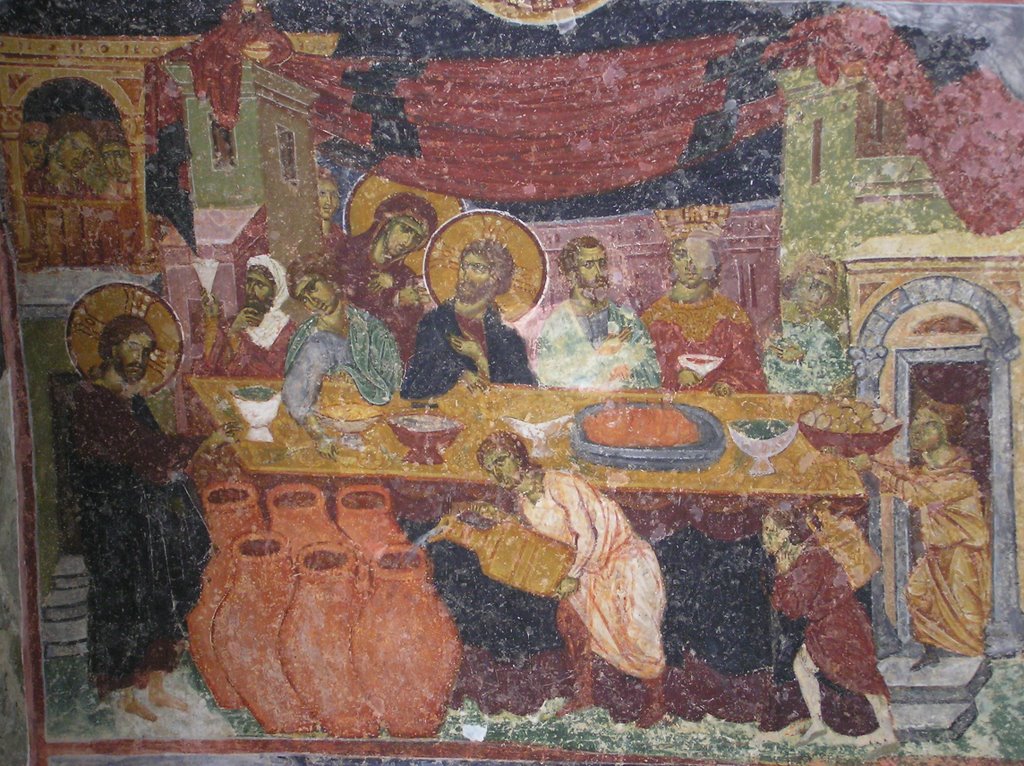
Wedding Feast at Cana


No commentary, just a beautiful fresco.

Haghia Sophia Church, Trabzon (Trebizond), Turkey; 13th Century.

Monday, September 04, 2006

A Belated Plug

I want to take opportunity to put in a good word for good man--Steven Robinson. As most visitors here already know, he is the co-host of "Our Life in Christ." His audio archives are an incredible resource--whether you are just inquiring into Orthodoxy, have already become so and need help with Protestant friends and family, or are a lifelong Orthodox looking to deepen your faith. If you don't already have it bookmarked, do so NOW.

Steve is devoted to pastoral work and is to be commended for his recent article in the Spring 2006 issue of AGAIN magazine: "I Am Not My Sin: An Orthodox Pastoral Approach to Same-Sex Attraction." Unfortunately, this article is not online. You can subscribe to the magazine (and purchase back issues, I suppose) on the Conciliar Press website.

Finally, Steve is a man with a wicked, wicked sense of humor. If you don't believe me, check out "poor little Billy's" plight on his blog.

Thanks, Steve, for everything.

Monday, August 28, 2006

The Middle East, As Always

Rod Dreher takes on President Bush's recent speech before the American Legion. He observes:

Lord have mercy, will he not observe that to more than a few people in the Muslim world, freedom does not mean the same thing it does to Americans. Freedom means freedom to live as they believe God has commanded them to live. Democracy means electing people who will implement God's law, as they understand it. This crazy hubris, believing that everybody in the world wants the same thing as Americans, is wrecking us.

For the full article, read.

In last weekend's Dallas Morning News Dreher writes about Suyyid Qutb, founder of the Muslim Brotherhood and the "philosopher of Islamic terror." His conclusions are worth reading. Go here.

William J. Abraham is a Professor at Southern Methodist University's Perkins School of Theololgy. In spite of that, he hits the nail on the head, here.

And finally, common sense and reality from, of all places, The Boston Globe, here.

Travel Journal--26 June 2006

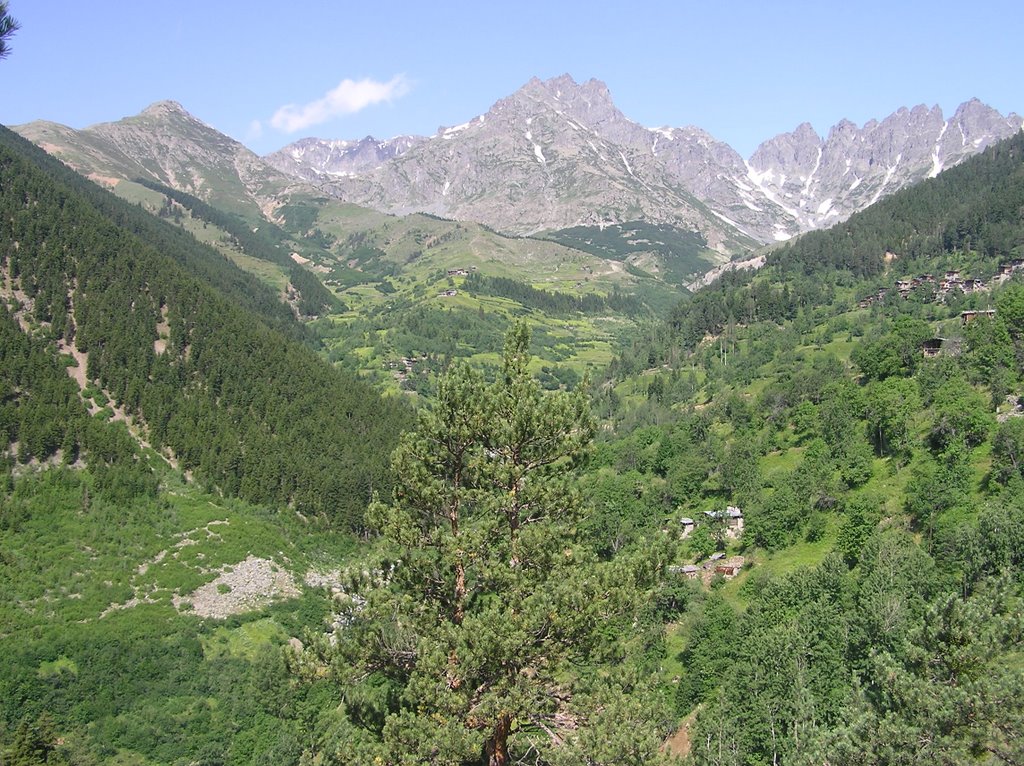
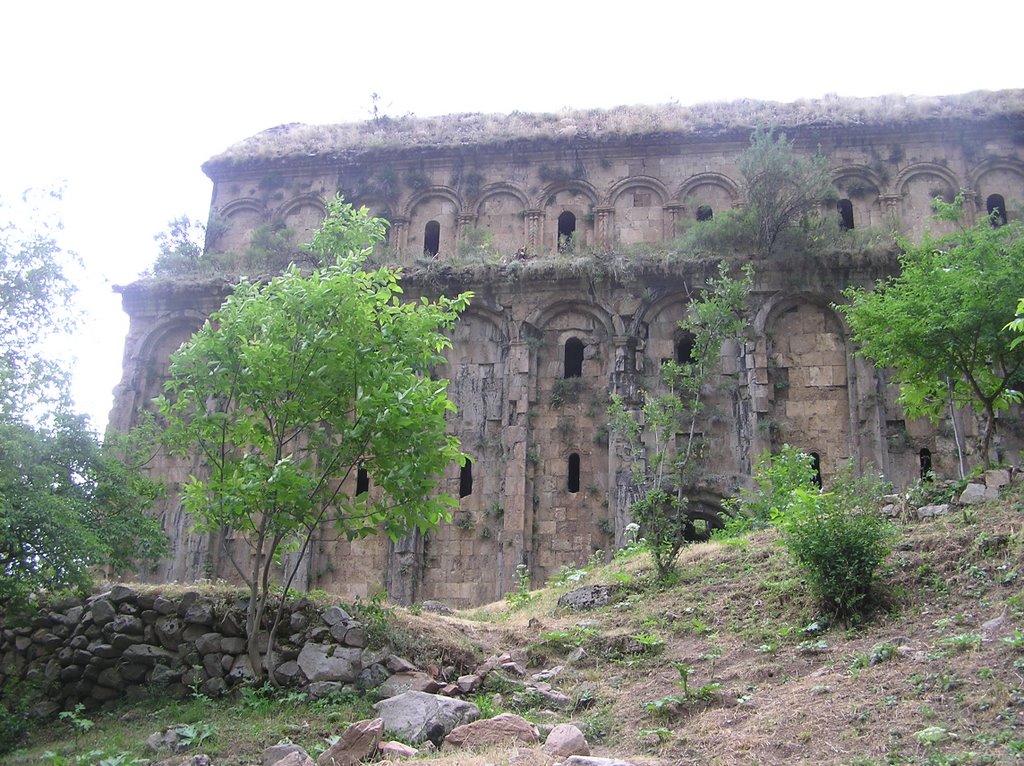
I awoke on the morning of June 26, 2006 in a Swiss-style chalet high in the Kackar Mountains of northeastern Turkey. I had left the Republic of Georgia 11 days earlier. This area of Turkey is known in the travel guidebooks as the Georgian Church country. The region was once part of Georgia, both ethnically and politically and a few ruined, soaring Georgian-style Orthodox churches from the 10th-12th century remain. Even so, they are quite a draw. I had hoped to visit four. While this appeared to be easily managable looking on the map, the reality of the mountainous terrain and twisting dirt roads defeated this goal. We managed to visit three, and by that time I was ready to come down out of the mountains.

Our pension was in Barhal, a small village wedged between the base of a mountain at the confluence of 2 rushing streams, 19 miles and 1 hour and 20 minutes up a torturous dirt road from Yusefeli. If you are looking to get away from it all, Barhal is a likely spot. A dolmus or two make the run up from Yusefeli, but the village doesn't see much traffic beyond that. My bed and board, including supper and breakfast cost $25. The only other tourists there consisted of a party of Swiss mountaineers. Incredibly fit, they all seemed about 6'2", wore hiking shorts and boots, and looked liked they could be extras from any old Nazi propaganda film. I had to wonder--if you are Swiss trying to decide where to go on holiday, wouldn't you rather go to the beach than the mountains?
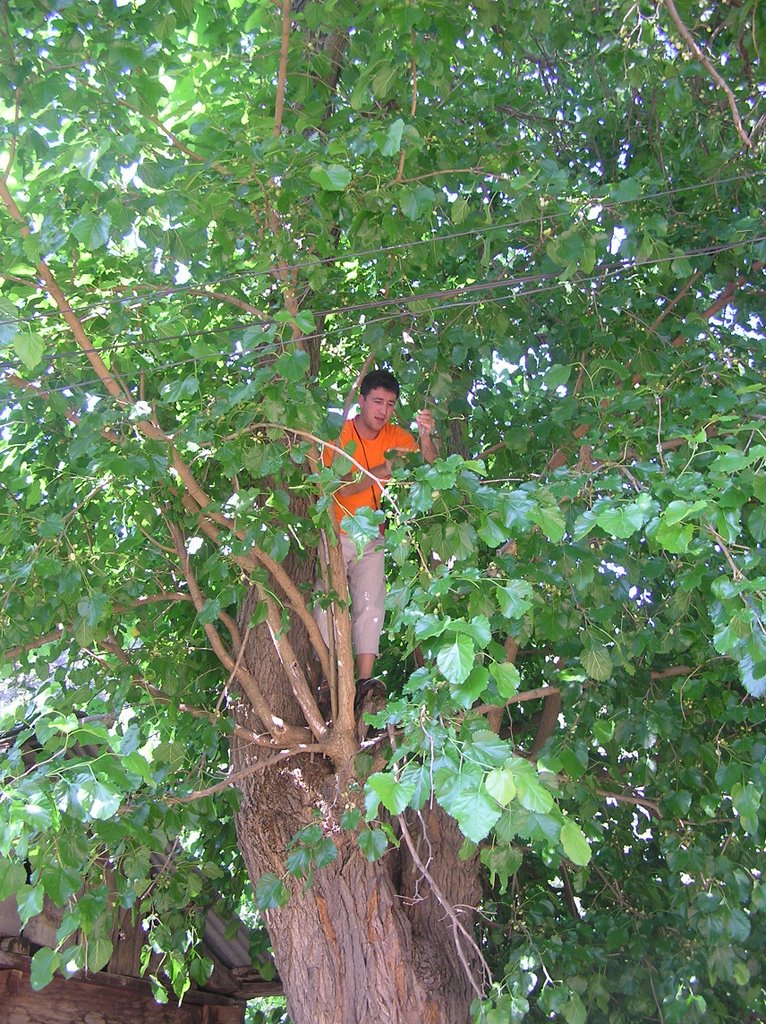
That morning, we drove up the trail past the village towards the Barhal church. Up until last year, it had served as a mosque and was currently closed pending restoration as a museum. The 10th or 11th century building was perhaps the best preserved of the three I visited, but the least prepossessing. This was due in part to it being wedged in on the side of a hill, with a grade school immediately adjacent, and trees closing in all around. There simply wasn't anywhere to stand back and get a perspective of the structure. I peered through the cracks in the doors--all the frescoes had received a thorough Islamic whitewashing years ago. It merely looked like a bland, deserted mosque. Before we left, my guide and friend, Turan, climbed a nearby mulberry tree and shook down plenty of delicious fruit for us.

Leaving Barhal church, we continued away from the village, further and further up the mountain valley. I kept thinking that we had reached the end of the road, but on and on it went, following close to a mountain stream. A single strand of electric wire paralleled the road and stream--sometime precariously--and sure enough, here and there, clumps of cottages and huts lay clustered along the hillsides. We passed 2 backpackers and stopped briefly to talk with them and give directions. They had a copy of a page out of the Lonely Planet guide, but were otherwise close to being quite lost. Turan was able to be of considerable assistance. We asked where they were from and they said "Chicago." They then seemed surprised to learn that I was an American as well. When we left, Turan assured me that they were not Americans, but Israelis trying to disguise their nationality. I tended to agree, they certainly did not seem American at all. Interesting, though. Later we passed a young woman herding a few head of cattle along the road. I'm afraid our vehicle scattered her charges. Eventually, our driver Belial, dropped Turan and I off at a bend in the road. We were to hike up and around the mountain and meet him at another crossing. Hiking the Kackars was a little more than I had bargained for.The steep climb certainly dispelled any lingering illusions about my youth and vitality. As we ascended, we found ourselves approaching a solitary cabin with unlimited vistas. A young woman worked the field in the foreground, as an adolescent boy performed chores around the house. The head of the family was on the roof, building a porch roof across one side of the cabin. He invited us to have tea. In short order the daughter of the household brought out a large wooden tray, the teapot, and the ubiquitous tulip-shaped glasses and sugar cubes for our tea break. We squatted on our haunches, drank the strong tea and smoked. Turan and the man talked at length. Later my friend was to relate the man's story to me. This was their home only during the spring and summer months. The snow forced them out during the winter. During those months, the family lived in an apartment in Yusefeli while the father would go to Istanbul to work as a day laborer. Theirs was a hard existence. He said the government was encouraging them to suppliment their income with activities such as beekeeping. This led to a story about "crazy honey." In some of the mountain valleys, the bees feed on the poppies that grow wild. Their honey is to be eaten with great moderation and in very limited qualities. The man had a friend who had helped trap a bear on the other side of the mountain. His payment was a spoonful of this honey. He was angry, believing that he had been taken advantage of. They warned him only to just taste it. The friend did not heed the warning, however, put the entire spoon in his mouth. Ten minutes later he started to feel a little groggy, and the next thing he remembers is waking up 2 days later. After 3 cups of tea, we thanked our host for his hospitality and trudged on up the hill. I tried not to let on, but I was forever thankful when Turan took the trail that began to descend the mountain! We trekked through one hillside village where the old lady laughed at Turan when he ran from her bees. I was exhausted by the time we caught up with Belial and our vehicle. I settled into the back seat for a long rest. Before reaching Barhal, we were stopped as a maintainer worked on the road--scraping away a recent rock slide. Interesting, a mini-van from Georgia was parked in front on us, of which more will be told later.

We arrived in Yusefeli a couple of hours later. This is a bustling little hub, the only place in these mountains for a town of any size. Yusefeli was a conservative town where all the women on the streets wore the headscarf. Men clustered around the cafes, drinking endless glasses of tea, and the women walked together and kept completely to theirselves. Yet, the town's main draw was tourism, so you could still get a beer in the riverside cafes. We bought a watermelon, some homemade cheese, homemade bread, some juices and water and headed for our next destination--Dort Kilisesi. In Turkish, that means "4 Churches." Only one was left, but it had never been a mosque and was one I particularly wanted to see. It lay probably 20 miles out from Yusefeli in the opposite direction than Barhal. But here again, the mountainous terrain was make it a 2-hour journey. All roads in this region follow the streams, and this was no exception. I was intriqued to see rice paddies between the road and water. At Tekkale we turned right, heading further up the mountain valley.

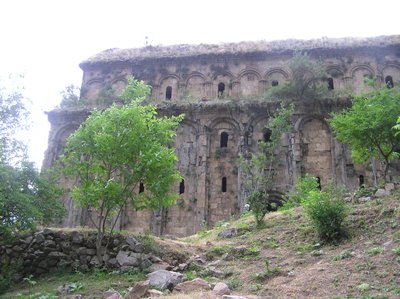
At long last we reached Dort Kilisesi. The church was not completely visible from the road, but sat on a high bluff, which an orchard falling down the hillside to the road. We sat on the ground in the orchard and ate our picnic feast (really, Turkish watermelons are the best in the world). As it was threatening rain, I decided to go on up the hill alone. And perhaps Turan and Belial were tiring of my churches, as they chose to remain in the orchard. Dort Kilisesi sort of sneaks up on you. I was not prepared for the size of the structure. Simple in design, but immense. I entered into the cavernous interior. Dirt has silted up quite a bit on the floor, but the church is still solid, with roof completely intact. Rows of 4-story columns line the interior. The frescoes are fading fast, that, in fact being a major reason I chose to visit here. I took many snapshots, but other than Christ Pantocrator and angels, I was not generally not able to determine who they depicted. Sadly, the old church has also been an obvious and favorite site for teenage graffiti. I lingered for quite a while in the sanctuary, before stepping outside. Of the three churches I had visited in the region--Osk Vank, Barhal and Dort Kilisesi--this was my favorite by far.
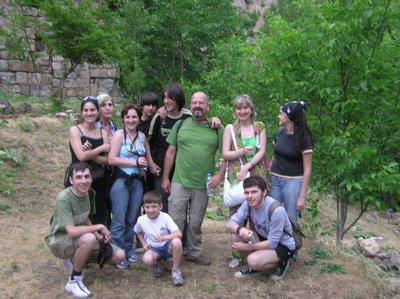
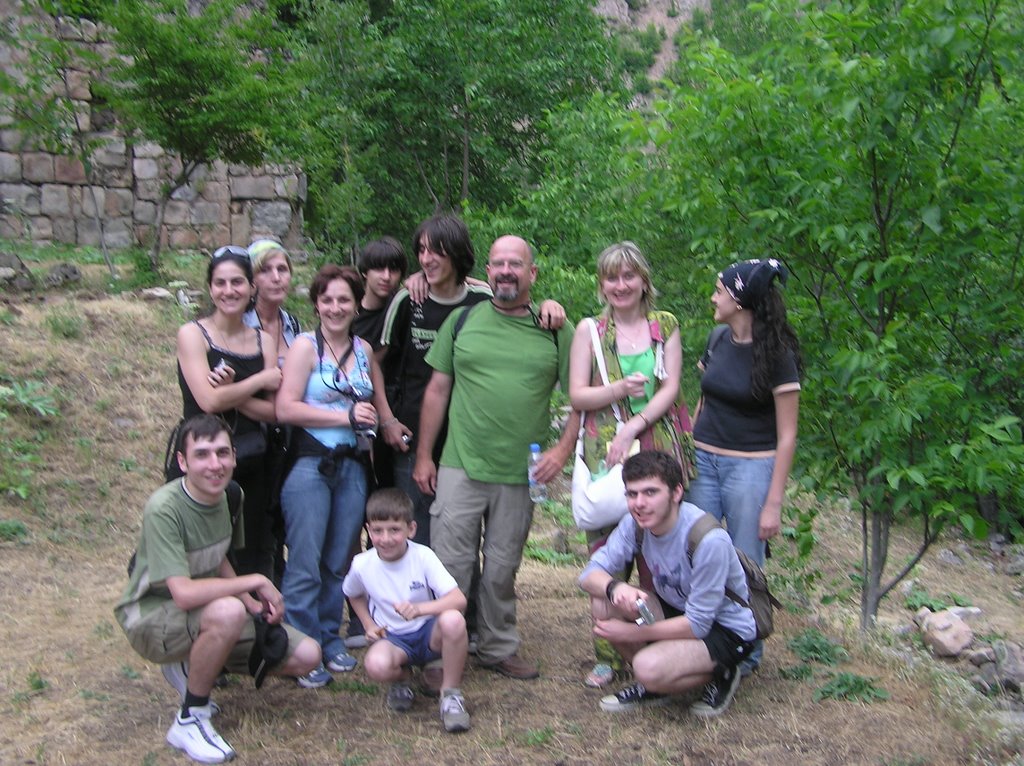
As I stood outside I heard a noise--lots of voices and commotion, in fact, coming from down the hill. I then saw a man approaching the church. I observed him as he slowly crossed himself three times in the unmistakable sweeping movement of the Georgians. My heart lept--the Georgians are here! I approached and tried to make him understand that I too, was Orthodox. I didn't think to show him my cross. Needless to say, we were having trouble communicating--the only word I knew was "madlapt" (sp.), Georgian for "thank you." But we eventually understood each other well enough and shook hands heartedly. The rest of his party had joined us by this time. It seems he was the driver of the minivan we were behind way back in Barhal. The group included 2 female teacher/chaperones and a gaggle of teenagers being taken on a cultural tour of their heritage in what is now Turkey. The young people seemed excited to be there and anxious to see the church and frescoes, once they had finished with their extensive greetings to me. Now I ask you, how many of our teenagers would submit to doing something like this, much less be excited about it? Not many, I fear. We posed for pictures and the one here says it all.

I said goodbye to my Georgian friends and brothers and walked back down the hill, and back into Turkey. I did not realize how much I had missed Georgian society in these 11 days. I do not want to engage in any cheap, simplistic Christian triumphalism. But, this incident brought home to me a great truth. We were only a few miles away (as the crow flies) from Georgia proper. But between there and here lay a deep, cultural chasm: the division between a Christian society and the Muslim world. I am still at something at a loss to express it adequately, but the sense of it is as real as anything I have ever experienced. The strictures of the Muslim world, the separation of men and women, and the very presuppositions from which they order their life may not be so obvious at first, until that is, they are contrasted with these curious, lively, noisy, loving, and sometimes untidy Christians. Thank God for the Georgians.

Wednesday, August 23, 2006

My Akdamar Poll


If you find yourself in far eastern Turkey, in the environs of the breathtakingly beautiful Lake Van, you are probably there to visit Akdamar Island. Such was the draw for me. Akdamar was the locus in this part of "Armenia" from the 900s until about 1918 or so, when the last of the local Christians were killed in the Armenian genocide. At one time, the island housed a royal palace complex and an extensive monastery, in addition to the cathedral church. The church served a comunity of over 140 area churches and 40 monasteries. Today, only the church is left, and it has stood vacant since the end of the First World War.

The church is currently undergoing a government-sponsored restoration, after decades of neglect. Admittedly, this may be cause for concern--the restoration of an ancient Armenian church by the Turkish authorities--but I will give them the benefit of a doubt. Ankara's aggressive PR campaign and overtures to join the EU undoubtedly play a part in this. That, and the dawning realization that there are tourist dollars in these crumbling Christian ruins. Day in, day out, three ferries continuously ply the 2 kilometers between shore and island. Our ferry carried 36 passengers--35 Turks and 1 Texan. I believe that this is a hopeful sign. Turkish nationals are apparently interested in visiting Akdamar and picnicking among the jumble of ancient Armenian tombstones with their huge, ornate crosses. The point is this: there is no way to "Turkify" Akdamar. It is wholly, completely, totally Armenian--and Christian.

My 35 Turkish fellow travelers broke down into 19 men and 16 women. In my journey throughout Turkey, I took to observing the number of women wearing headscarves. They have become common (and an issue) in Turkey only in recent years--tied to political and social conservatism, a "return to traditional values," if you will. I find the wearing of headscarves to be an obviously inexact, but not unreliable, measure of Islamist sentiment.

Lake Van lies in far eastern Turkey, in supposedly one of the most conservative regions of the country. Nevertheless, only 4 of the 16 women wore headscarves. Again, I find this hopeful, and is illustrative of the complex and changing nature of Turkish society.

The Islamist agenda, just as the practice of Islam itself, is somewhat different in Turkey. The Turks are both staunchly Muslim and secular at the same time. This dichotomy precludes making hard-and-fast conclusions about the culture. In fact, the only place I visited where all women wore headscarves was in Yusefeli, deep in the mountains of northeastern Turkey, although I am sure that is also the case in most rural villages, as well. I have been told that for many women, the wearing of the headscarf is more of a political statement than a show of religious fundamentalism. Throughout eastern Turkey, I could draw no firm conclusions--some women wore them, many did not.

There seemed to be no sifting-out between those who did and those who did not. Young women in headscarves--or even dressed "full burkha"--walked arm-in-arm with girls without the scarf who wore western-style blue jeans. My guide told me that each girl made the decision for herself, that there was no pressure one way or the other. I doubt seriously if this is the case in many rural areas, but otherwise I suspect it may be so. What is frowned-on, however, by all parties, is the wearing of short skirts. This is really just not done in Turkey.

I did not notice appreciably more headscarves in eastern Turkey than in Istanbul, as one might expect. In fact, Istanbul is such a cosmopolitan place that it is much like New York in that you are liable to see anything there. For example, the old Greek Phanar district has been largely taken over by poor, fundamentalist Muslims from eastern Turkey. The bearded men are in woolen skullcaps and the women in black burkhas--some with eyes and nose exposed, and some with only the eyes exposed. You might as well be in Kabul. (And believe me, this dress--and what is signifies--is as alarming to most Turks as it is to us). Yet, just across the Golden Horn, along the Istiklal Cadessi, I had to look, and look, and look to spot even one woman in headscarf among the crush of shoppers. As I sat in the sidewalk restaurant, observing, I eventually counted three.

Most of Istanbul falls between these two extremes. Many young Turkish women who opt for the headscarf also wear attractive white close-fitting tunic-style coats. Older women often wear the ubiquitous, shapeless floor-length overcoats endemic to Turkey. They come in two colors: gray and taupe, and they wear them regardless of how hot it is outside. Unfortunately, women who wear these seem cursed to assume their shape. On the other hand, young women in headscarves are often dressed elegantly from head to toe, with special attention to footwear.

I am trying not to obsess on this issue, but merely attempting to gauge the extent and direction of Islamism in the one Muslim country in which I have some limited experience. Blanket assumptions about the Middle and Near East can be ill-informed, and as we are finding out, dangerous. My gut feeling is that Turkey's westward orientation is irreversable; no matter how long it takes, they will eventually join Europe. But they will do so as a decidedly Muslim nation. And Europe, no longer Christian in any real sense, but retaining enough of a veneer of such in their collective memory to be alarmed, is scrambling to confront this dilemma. I am also convinced that if the West ever comes to an accomodation or truce with Islam--and clearly, I am not at all hopeful that such will ever, or should ever occur--it will have to be on the Turkish model.

Thursday, August 17, 2006

All or Nothing

I recommend most anything Theodore Dalrymple writes (and concerning Dalrymples, anthing William or Ian writes as well). He recently reviewed Efraim Karsh's Islamic Imperialism: A History. Dalrymple observes that:

The urge to domination is nearly a constant of human history. The specific (and baleful) contribution of Islam is that, by attributing sovereignty solely to God, and by pretending in a philosophically primitive way that God’s will is knowable independently of human interpretation, and therefore of human interest and desire—in short by allowing nothing to human as against divine nature—it tries to abolish politics. All compromises become mere truces; there is no virtue in compromise in itself. Thus Islam is inherently an unsettling and dangerous factor in world politics, independently of the actual conduct of many Muslims.

There's a lot of truth there. Read the entire essay here.

Monday, August 14, 2006

You're known by the company you keep


This picture may add fuel to the speculation about Prince Charles being a wannabe and/or closet Orthodox. This picture hangs in the reception room at Mar Gabriel Monastery, in the Tur Abdin region of southeastern Turkey. Charles visited Turkey in 2004, Tur Abdin being his only stop outside of Istanbul.

My Akdamar Poll


If you find yourself in far eastern Turkey, in the environs of the breathtakingly beautiful Lake Van, you are probably there to visit Akdamar Island. Such was the draw for me. Akdamar was the locus in this part of "Armenia" from the 900s until about 1918 or so, when the last of the local Christians were killed in the Armenian genocide. At one time, the island housed a royal palace complex and an extensive monastery, in addition to the cathedral church. The church served a comunity of over 140 area churches and 40 monasteries. Today, only the church is left, and it has stood vacant since the end of the First World War.

The church is currently undergoing a government-sponsored restoration, after decades of neglect. Admittedly, this may be cause for concern--the restoration of an ancient Armenian church by the Turkish authorities--but I will give them the benefit of a doubt. Ankara's aggressive PR campaign and overtures to join the EU undoubtedly play a part in this. That, and the dawning realization that there are tourist dollars in these crumbling Christian ruins. Day in, day out, three ferries continuously ply the 2 kilometers between shore and island. Our ferry carried 36 passengers--35 Turks and 1 Texan. I believe that this is a hopeful sign. Turkish nationals are apparently interested in visiting Akdamar and picnicking among the jumble of ancient Armenian tombstones with their huge, ornate crosses. The point is this: there is no way to "Turkify" Akdamar. It is wholly, completely, totally Armenian--and Christian.

My 35 Turkish fellow travelers broke down into 19 men and 16 women. In my journey throughout Turkey, I took to observing the number of women wearing headscarves. They have become common (and an issue) in Turkey only in recent years--tied to political and social conservatism, a "return to traditional values," if you will. I find the wearing of headscarves to be an obviously inexact, but not unreliable, measure of Islamist sentiment.

Lake Van lies in far eastern Turkey, in supposedly one of the most conservative regions of the country. Nevertheless, only 4 of the 16 women wore headscarves. Again, I find this hopeful, and is illustrative of the complex and changing nature of Turkish society.

The Islamist agenda, just as the practice of Islam itself, is somewhat different in Turkey. The Turks are both staunchly Muslim and secular at the same time. This dichotomy precludes making hard-and-fast conclusions about the culture. In fact, the only place I visited where all women wore headscarves was in Yusefeli, deep in the mountains of northeastern Turkey, although I am sure that is also the case in most rural villages, as well. I have been told that for many women, the wearing of the headscarf is more of a political statement than a show of religious fundamentalism. Throughout eastern Turkey, I could draw no firm conclusions--some women wore them, many did not.

There seemed to be no sifting-out between those who did and those who did not. Young women in headscarves--or even dressed "full burkha"--walked arm-in-arm with girls without the scarf who wore western-style blue jeans. My guide told me that each girl made the decision for herself, that there was no pressure one way or the other. I doubt seriously if this is the case in many rural areas, but otherwise I suspect it may be so. What is frowned-on, however, by all parties, is the wearing of short skirts. This is really just not done in Turkey.

I did not notice appreciably more headscarves in eastern Turkey than in Istanbul, as one might expect. In fact, Istanbul is such a cosmopolitan place that it is much like New York in that you are liable to see anything there. For example, the old Greek Phanar district has been largely taken over by poor, fundamentalist Muslims from eastern Turkey. The bearded men are in woolen skullcaps and the women in black burkhas--some with eyes and nose exposed, and some with only the eyes exposed. You might as well be in Kabul. (And believe me, this dress--and what is signifies--is as alarming to most Turks as it is to us). Yet, just across the Golden Horn, along the Istiklal Cadessi, I had to look, and look, and look to spot even one woman in headscarf among the crush of shoppers. As I sat in the sidewalk restaurant, observing, I eventually counted three.

Most of Istanbul falls between these two extremes. Many young Turkish women who opt for the headscarf also wear attractive white close-fitting tunic-style coats. Older women often wear the ubiquitous, shapeless floor-length overcoats endemic to Turkey. They come in two colors: gray and taupe, and they wear them regardless of how hot it is outside. Unfortunately, women who wear these seem cursed to assume their shape. On the other hand, young women in headscarves are often dressed elegantly from head to toe, with special attention to footwear.

I am trying not to obsess on this issue, but merely trying to gauge the extent and direction of Islamism in the one Muslim country in which I have some limited experience. Blanket assumptions about the Middle and Near East can be ill-informed, and as we are finding out, dangerous. My gut feeling is that Turkey's westward orientation is irreversable; no matter how long it takes, they will eventually join Europe. But they will do so as a decidedly Muslim nation. And Europe, no longer Christian in any real sense, but retaining enough of a veneer of such in their collective memory to be alarmed, are scrambling to how to confront this dilemma. I am also convinced that if the West ever comes to an accomodation or truce with Islam--and clearly, I am not at all hopeful that such will ever, or should ever occur--it will have to be on the Turkish model.