I spent the last few days of my journey in Istanbul before heading home on Monday. On Friday, I went out to the Princes Islands. The 4 inhabited islands--Kuniliada, Burgazada, Heybeliada and Buyukada--lie out into the Sea of Marmara, though within sight of the Asiatic side of İstanbul. They have a rich history. Back in the days of the East Roman Empire, the islands were used as a place of exıle (excuse my being pedantic here, but if you called a resident of old Costantinople a "Byzantine" they would not know what you were talking about. They considered themselves to be Romans.) Displaced royalty were dispatched here while the new emperor figured out what to do with them. Theologians out of favor at court also found their way to the islands. Frankly, there are worse things than being sentenced to these beautiful islands.
İn the last half of the 1800s, the islands began taking on a new character. The wealthy Greek and Armenian merchant class of Constantinople built expansive villas on the islands. And what villas they are!
As everyone knows, the Greek and Armenian presence in İstanbul is now little more than a memory. There are a few small cafes and shops clustered around the Ecumenical Patrıarchate (Church of St. George), but that is about all. Walking around the old Greek district--the Phanar--is a real eye-opener. The old Greek mansions and townhouses are now decrepit. An occasional one remains maintained and you wonder if it houses a Greek family behind the locked doors. But as the Greeks were pushed out, the area has been taken over by some of the poorest and most conservative Muslims immigrating from eastern Turkey. Frankly, this area reminds one of pictures of Afghanistan, as most women are in the black burka with only eyes and perhaps nose exposed, and the men with beards and woolen skullcaps. While this is NOT representative of İstanbul, it does describe what has happened to the old Greek district.
But the Christians have held on to the islands. Kuniliada is just a big Armenian social club. Burgazada is mostly Greek. Heybeliada is majority Turkish, but also contains the now-closed Greek Orthodox Theological Seminary (of much controversy) and several monasteries. Buyukada is supposed mostly Jewish, though it is hard to tell (Funny, the island doesn't look Jewish.)
Buyukada is the largest, and farthest away. As the ferry stops in turn at each of the islands, it takes a good hour and a half to reach Buyukada from the Eminonu docks. But İ enjoyed every minute of it. The sight of several pairs of dolphins along the way was a special treat.
An unique aspect of island life is the fact that vehicles are banned. You can walk. You can ride a bicycle. Or you can hire a horse-drawn carriage. These buggies are a big hit with the day-trippers from İstanbul who descend on the islands in droves during the summer. The pungent aroma of horse manure mingles with the fragrance of the lush, flowering shrubs Upon arrival, İ chose the cycling option and rented a bicycle in the Meydan (town square). My goal was the Monastery of St. George.
Buyukada has been rightly called the Turkish Hamptons. The homes are elegant and are usually surrounded by lush tropical landscaping. İ was unfamiliar with most of the flowering shrubs, save the hydrangeas. Whatever they were, they were all in full bloom. The residents were not easily spotted. İ suspect they like to sit on their back terraces which overlook their private beaches. But İ did catch glimpses of older non-Turkish men (whether Greek or Jewish) in sailing caps (think Thurston Howell, III) and henna-haired matrons in their garden chairs giving directions to the gardener, and of handsome young people who perhaps spend a little too much time laying around the pool. İ spotted several churches. Only saw one very small mosque with an aluminum mınaret. İt looked as out of place as you know what.
İ leasurely pedaled my way though these residential areas and on towards the monastery. The Church of St. George is located on the highest hill on the island. A cobbled road leads from the main road up to the summit. İ was already huffing and puffing by the time İ reached the monastery road. This was one steep hill! İ am not sure even Lance Armstrong could have ridden up it (Yeah, he could). Anyway, İ started pushing the bicycle up the hill. Actually, this worked out to my advantage as I was bent over double and used the bicycle seat to rest my head as I trudged along.
At long last, I reached the summit. The church was closed until 2:30, so I settled in and made myself at home on a park bench nearby. I carried a small backpack throughout my travels--ideal for my hat, water, camera, batteries and journal. For many years, I have kept a small journal on me when I travel. I make note of names and places and events, make observations, and draw small maps. I dug around around in the backpack and discovered that the journal was missing! I briefly panicked. Almost a month's worth of writing--gone! But then I remembered what I had written not many days before--about worry and fretting about things that could not be changed. So, I concluded that there were 3 options: 1. The journal had fallen out of my backpack when I was scrambling around in it for my water bottle. I would retrace my steps on the island and find it. 2. The journal had fallen out of my backpack. I would retrace my steps on the island and not find it. In such case, I would reconstruct my journal and this would be a good test of my memory--and a good test of my being able to "walk the walk" about not fretting over transitory things. 3. The journal was on the nightstand in my hotel room and I would find it that night. I took stock of where I was: I was at a monastery on the top of a mountain, with a cool breeze blowing, a view of sailboats bobbing in the harbor below, and I was worried about a damn journal! I took a deep breath, said a prayer and put it out of my mind.
Frankly, I was a little disappointed in the monastery church. There were no priests around (gee, shouldn't they be on hand to provide photo-ops for us tourists???); the church had no gift shop as I had been lead to believe; and no photographs were allowed inside. This may give you real insight into my spirituality that day! I guess I was a little tired and cranky by this time. I have to laugh at myself now, though.
The bicycle ride back into the town was a breeze, being mostly downhill this time. And what luck! There was a ferry right there on the dock preparing to leave. I jumped aboard for the ride back to Istanbul. Perceptive readers will here recognize a marked similarity between this scenario and my "wrong train out of Zurich scenario." The ferry was not going back to where I had come from. Just because a ferry brought me to Buyukada, did not mean that it was the only ferry stopping there. This ferry, I learned, was headed for a dock on the far southern end of Asiatic Istanbul. Well, it's still Istanbul, you say. With 14 million people, this would be similar to aiming for Washington DC and getting off in Baltimore. Some nice Greek tourists consulted a ferry schedule (which apparently everybody but me picked up when they first bought their tickets) and put me back on the ferry to Buyukada. So, once more, with the kindness of strangers, I backtracked and eventually made my way home.
The best part of the day? I saw dolphins.
Oh yeah, and the journal--I never found it. But I did reconstruct the whole thing.
Friday, June 30, 2006


Monday, June 26, 2006
Traveling Stupid
İ like to fancy myself a sophistocated, informed and urbane citizen of the world--at ease in whatever continent İ happen to find myself. An unsettling number of incidents (5, actually) on my current journeying suggests a contrary conclusion. A standard daily prayer of mine is to beseech God to "humble, chastain and dscipline me; to keep me from pride, arrogance and greed." So why am İ still surprised when He does that very thing? İ offer these cautionary tales for your edification and amusement at my expense. Enjoy.
1. WRONG TRAİN OUT OF ZURİCH
İf you fly American Airlines to Eastern Europe or the Middle East, chances are good that you will have a day's layover in Zurich. İf the weather is nice and it is not a Sunday when all the shops are closed this is not such a bad thing at all. A train will whisk you from the airport to the center of the old city where one can stroll around and perhaps even take a dinner cruise on the Zurich Zee. Such was not the case for us on this cold, wet Sunday. Perhaps İ was not on top of my game due to lack of sleep. İ cannot sleep on flights, even with pills. With 45 minutes to an hour sleep under my belt İ was nevertheless ready to tackle Zurich at 8:30 that morning. We stashed our luggage and proceded to the train ticket booth.
İn line in front of us were Mr. and Mrs. American-Evangelical-in-Europe-for-the-first-tıme. Large build, flowery shirt, denim shorts, white sneakers and baseball cap--you get the picture. He hesitatingly asked the agent if she spoke English. (Meanwhile İ was trying to decide whether to just do it in English or whip out a "deux billet a' Zurich, s'il vous plait.") Anyway, she politely nodded yes and he exhaled loudly and exclaimed "Thank the Looorduh" in his best Trinity Broadcasting Network accent, as if to thank God for directing him to the one agent in this heathen land who could accomodate him in God's own English. İ am thinking "Good Lord! Yes she speaks English. And German. And French. And İtalian. And can probably make do in Portuguese or Serbo-Croatian if need be. This is Switzerland, for goodness sake!"
İ note this only because what happened next was undoubtedly pay-back for my arrogance and condescensıon. My son and İ took the flight of stairs down to the train landing. And what luck! There was a train just about to leave. We jumped aboard and settled in for the quick run into Zurich. Except this train was not going to Zurich. İn fact, it was heading in the opposite direction. For the airport train station does not just provide a commuter link into downtown, but rather is a major stop on the extensive Swiss railway system, with trains departing in every direction. Actually, I knew that. So why, like a doofus, did İ just assume this train would take us to Zurich? We rode the train until it stopped at a place called Winterthur. İ suppose İ can add this to my travel tips: When in Winterthur be sure and visit the charming railway station. We sheepishly bought new tickets back to the airport where we eventually boarded the right train. And yes, in the back of my mind, İ knew that the aforementioned couple from the ticket counter--wherever they were--were undoubtedly on the right train!
2. THE TBİLİSİ SULPHUR BATH İNCİDENT
All the Georgian travel guidebooks (actually, İ think there is only one) urge tourists to visit the Tbilisi sulphur baths. İn fact, that was the original reason for the city even being there. A bunch of medieval hedonists started hanging out around the warm mineral springs along the river and before long--Tbilisi! After spending a hot day walking all over the city, a nice long soak sounded like just the ticket.
You go into one of the establishments and pay for a private room. For just a little more money, a "massage man" will come in and work you over. I figure--why not? So İ go into my own private little ante-room and undress and change into the towel thing. İ then go into the main room containing my own private mineral bath and a marble slab to sit or lay on. İ swim around in the pool for a while and İ am beginning to feel very, very relaxed. Then the "massage man" comes in and does his thing. He scrubs me down and then beats on my back and shoulders. İt feels much better than it sounds! Anyway, by the time he was finished working on me, İ was feeling as relaxed as İ have ever felt. İ lay around and swam around a while longer and then tried to get dressed. İt was an effort.
When İ left the baths, fortune continued to shine on me, as there was a taxi waiting right in front (and not a scruffy little Lada but a late model Mercedes). İ jump in and we head off across town to Miskevitch Street. We had gone a little ways and İ began to have a strange uneasiness. Something just did not feel right. İ felt at my waist and there was an empty spot where my money belt was supposed to be. Oh crap! Apparently İ was so very relaxed getting dressed that İ did not even notice that my money belt (containing my passport and 2200 US dollars) had slipped off my belt. İ started gesturing wildly to the taxi driver to "Go Back! Go Back!" Eventually he understood and every second spent stalled in traffic was painful to me. When we reached the sulphur baths, İ jumped out and ran in, startling the little woman manning the front desk. İ went straight back to my room and thankfully they had not yet thought about cleaning up the room for another customer. There was my money belt laying on the floor. İ was so relieved, İ gave the lady a 20.
İ am a big one to preach to others that your passport stays on your body at ALL times when traveling overseas. There is a lesson in here somewhere, but İ am not sure what it is. İ do know that people that do things like this should not be allowed to cross the county line--much less go overseas--without a guardian!
3. ROBBERY BY İSTANBUL TAXİ DRİVER NO. 1
Let me just say upfront that İstanbul taxi drivers are the worst in the world. Their driving stinks, but İ am referring to their thievery. They have no equals. Despite their cheerful demeanor, whenever you get into the back of a İstanbul taxi, you have just hitched a ride with a modern-day Jesse James, but without the social conscıousness. Avoid them at all costs, but especially never, ever get a taxi anywhere near the main plaza in the Sultanhamet District. This İ knew. But like Dad used to say, "Well son, some people live and learn. Some people just live."
Actually, the day did not start out very propitiously. İt was Wednesday, June 15th and we were flying from Tbilisi to İstanbul. Outside of British Airways, all international flights arrive and depart Tbilisi in the wee hours of the morning. They seem fine with this crazy system. Our flight was to leave Tbilisi at 5:00 in the morning. This meant we left our pension at 3:00 in the morning, which of course meant that we did not go to bed that night. We thought that there would be few people on a 5:00 AM flight to İstanbul and we would use that 2 1/2 hours to catch up on our sleep. Such fools! Actually the flight was completely full, a large component consisting of an excited group of Georgian middle schoolers and their chaperones. Any hope of sleep soon faded. Once the plane was in the air, the Georgian schoolchidren being, well, Georgian, were all over the seats and in the aisles, chattering non-stop. The chaperones? Just as bad. Any hope that the little darlings would drift off to sleep was dashed when we realized that they were not running back to the rear of the plane to use the restroom, but rather to get little cups of black coffee. These kids were wired and ready to go! The young boy wearing the hat shaped like a soccer ball in the seat behind me was apparently practicing some athletic stretching exercizes with the back of my seat.
So we arrived in Istanbul somewhat "dazed and confused." Originally, we were to have a short 2-hour layover and then catch a flight directly to Sanliurfa. But after those arrangements were made, our airline went out of business and İ got word right before leaving Georgia that we would now fly Turkish Airways to Urfa. This was fine, except that our flight did not leave until 4:30 that afternoon. That is okay. I know what to do with a day in İstanbul. First stop, Apricot Hotel. The taxi drive from the airport was without incident--22 lira and a 3 lira tip (they never have change). He was happy. İ was happy. My friend Hakan owns the Apricot Hotel and in addition to running a great little establishment, serves up the best breakfast in İstanbul outside of the Pera Palace. We regrouped with a leasurely breakfast on the fifth-floor terrace overlooking the Sea of Marmara, savoring our real, brewed coffee (not that skanky Georgian Nescafe'). Then we strolled up the hill to the plaza between the Blue Mosque and the Haghia Sophia. Although early, the tour buses were already disgorging--and the hawkers were there ready. We waded through these hordes over to the far side and decided on a plan of action. İ wanted to view some of the lesser visited monuments from the Byzantine era. İ charted a sensible path, starting at the Aqueduct of Valens--located maybe a half to 3/4 mile away to the west. İn the interest of time, İ decided to catch a taxi. We were not going to Begolyu or the airport, just down the street a bit. What could go wrong?
İ hailed a cab and took out a map and pointed and said AQUEDUCT. He nodded and seemed to assure me he knew exactly where İ wanted to go. He started off traveling east. Okay, İ thought, he needs to turn around somewhere. But he never did. He kept on east until he came out on John F. Kennedy Blvd. just past the Galata bridge. İ am beginning to be concerned. At least he is heading west now on JFK Blvd. Any moment now İ am sure he will turn back north towards the Aqueduct. İn fact, İ pick out on the map the perfect street for him to do so. We pass that street. İ start trying to let him know that İ know where we are on the map. He is jabbering to me in Turkish--İ think that at one point he tells me there are 27 km. around the old city walls of Constantinople. And İ'm thinking, "yeah, but we don't have to drive them all!" Before long we are actually outside of the Theodosian walls! İ can only assume that our cab ride includes a mini-tour of Thrace. We head north on a major thoroughfare that follows the Theodosian walls. By this time, İ just put my head in my hands and take the Clayton Williams advice (Native Texans will know what İ am talking about. He was a candidate for governor who lost to Ann Richards due to an intemperate remark. İf you don't know, İ'm not about to tell it!) After a while he takes another street east, then one north and finally parks in front of the Aqueduct with a satisfied look on his face. İ give the bandit the 27 lira (18 dollars) and send him on his way to his next victim. Or after this run, maybe he just quit early for the day.
4. DOUBLE ROBBERY BY ISTANBUL TAXİ DRİVER NO. 2
İ am a persıstently optomistic person--even in the face of all evidence to the contrary. I refuse to let these minor annoyances ruin my day in İstanbul. We procede to carry out our plan. We walk west from the aqueduct up to the 4th hill of old Constantinople, dominated today by the Fetih Cami. İ have no particular interest in thıs big old barn of mosque. Frankly, they are all much the same. But it occupies the spot of one of the glories of Byzantium--the Church of the Holy Apostles, and the burial place for generations of emperors of the East Roman Empire. After the Muslim conquest, they tore it down and used the stones from the church to build the current mosque. From there, we walked east towards the 3rd hill and then on past towards the Suleymani mosque, the big daddy of all İstanbul mosques. Along the way, we visited a stunning 12th century church (now Zeyrik mosque), stopped and had tea, tagged the old Church of St. Theodore (now a mosque), saw 2 other Byzantine churches İ recognized from my Byzantine Monuments of İstanbul, looked in on the Suleymani mosque (ho-hum) and stopped for a leasurely smoke on a nargile.
We decided it was time to head back towards the airport. We work our way through the maze of narrow streets in old İstanbul. İ really do not know exactly where we are, but if we just keep walking down the hill we will eventually come out at the Golden Horn. My instincts for direction are better than İ imagine, as we come out at the Spice Bazaar. The SB is a major tourist trap, but at least İ knew exactly where we are. İt is starting to rain and there are a few taxis parked right in front. One man in particular seems very eager to take us to the cleaners (oops, I mean airport). The ride to the airport supposedly costs 34 lira (this being the same ride that cost 22 lira coming from the airport earlier that day). But the scam ıs only beginning. İ hand him some money and he starts saying, "No! No!" and then handed me back the money which is not enough for the ride. I am starting to get a little flustered. İ decide to hand him a 50 and get the change. He hands a 5 back to me and says "No. No. Not 5. 50." İ did not mean to give him a 5, so İ reach in my money belt and give him a 50. He gives me change and İ get free of this man as quickly as İ can. Standing on the curb I suddenly realize what just happened. Taking advantage of foreigner's unfamiliarity with Turkish currency (which all looks pretty much the same), he was taking the bill İ gave him and doing the old switcheroo with a smaller bill, claiming İ gave him the smaller bill. İ know because İ didn't have any 5s. He did it to me twice, and İ am still unsure of just how much he fleeced from me--at least 50 lira and probably much more, in addition to the inflated taxi fare. Also, in my change he gives me an old 250,000 lira note. Last year, Turkey lopped off the last 6 zeros in their currency. So, this was a note that was really no longer in cırculation. But it did have some value. Under the new currency it was worth .25 of a lira, or about 17 cents.
İ refuse to be defeated by this. İ fall back on my old "que sera, sera" attitude and say that if the scoundrel can live with it, İ can certainly live without it. The next day İ was relating the incident to my Turkish friend, Turan. He said they did the same thing to him at the airport. İt is a little comforting to realize that they put the screws to their own people just like they do visıtors. A little, but not much.
5. CELL PHONE SACRİFİCE
İ prided myself on the amount of planning and research İ did for this journey. İ even purchased a "global mobile" phone that would enable me, say, to call my friend Bill from the most remote village in the Caucasus Mountains or to call my nephew with the news of how İ survived a 7 vodka toast at the home of my Sventian hosts. And the phone served me well--what time İ had it.
Once İ was free from the taxi-thief, İ began to worry about our flight connections. The company İ was using to make my eastern Turkey arrangements had booked a flight to Ankara, with a 35 minute lay-over, and then a flight on to Urfa. A 35 mınute lay-over? There is no such thing in America. That just means you miss your connecting flight. So, İ was beginning to fret about that. İ envisioned an unscheduled night's stay in Ankara. The city is not exactly a tourist destination. The only thing to see there is Ataturk' Mauseleum. With his picture in every home, offıce and business and at least one stature in every town and his words inscribed with big white rocks on the sides of mountains, İ didn't feel particularly ınclined to visit his tomb.
And so İ fretted. And then our flight out of İstanbul was delayed 20 minutes. I fretted some more. We finally board and then İ fret all the way to Ankara. The Ankara airport is not as big as you might imagine. Actually, it is about the size of our little airport back home. There is one plane parked in front of the terminal. Hopefully it is our flight to Urfa and maybe, just maybe, we can make it. We make a mad dash through the airport and get to the security check. We know the drill. We unload everything and put them in the little baskets to go throw the scanner. İ walk through and set off the machine. I then remembered that İ had my cell phone in one of the side pockets of my cargo pants. So İ take it out and put it in a separate basket and send it through. (Perceptive readers can see where this is going). İ load everything back into my pockets, heft my backpack up and off we go again. We have to go down some stairs and through a few hallways before we come to another security check. We go through the same drill again. But finally we are at the waiting room for the Urfa flight, and it is still on the ground! İ start doing a check to make sure İ still have my passport, ımportant papers, etc. İ do not find my cell phone, but believe İ had put it in backpack. Anyway. our flight was boarding.
That night, İ realized that İ had not put my cellphone in my backpack. İn fact, İ had left it in the little basket at the first security check in Ankara. İ also remembered that on the last day in Tbilisi İ had added 100 dollars worth of minutes to it. Yikes! Also that night, my Turkish guide explained to me that these flights were what they called "connecting flights." İn other words, the Urfa flight wasn't going anywhere until the passengers from İstanbul disembarked and were processed and on board. İn other words, all of my worry was totally unwarranted.
The incident reminded me of something İ already knew, namely: most of the bad things we worry about never come to pass; and if they do, there was nothing we could have done about it anyway; and the bad things that come along while we are worrying about the other stuff can usually be survived as well. So, a little less fretting and a little more trust seem to be the order of the day. İ believe there is something to that effect in the Gospel of Matthew--something about "birds of the air" and "lillies of the field." İ think İ may need a refresher course.
Trabzon (Trebizond to you Greek hold-outs), Turkey 28 June 2006
1. WRONG TRAİN OUT OF ZURİCH
İf you fly American Airlines to Eastern Europe or the Middle East, chances are good that you will have a day's layover in Zurich. İf the weather is nice and it is not a Sunday when all the shops are closed this is not such a bad thing at all. A train will whisk you from the airport to the center of the old city where one can stroll around and perhaps even take a dinner cruise on the Zurich Zee. Such was not the case for us on this cold, wet Sunday. Perhaps İ was not on top of my game due to lack of sleep. İ cannot sleep on flights, even with pills. With 45 minutes to an hour sleep under my belt İ was nevertheless ready to tackle Zurich at 8:30 that morning. We stashed our luggage and proceded to the train ticket booth.
İn line in front of us were Mr. and Mrs. American-Evangelical-in-Europe-for-the-first-tıme. Large build, flowery shirt, denim shorts, white sneakers and baseball cap--you get the picture. He hesitatingly asked the agent if she spoke English. (Meanwhile İ was trying to decide whether to just do it in English or whip out a "deux billet a' Zurich, s'il vous plait.") Anyway, she politely nodded yes and he exhaled loudly and exclaimed "Thank the Looorduh" in his best Trinity Broadcasting Network accent, as if to thank God for directing him to the one agent in this heathen land who could accomodate him in God's own English. İ am thinking "Good Lord! Yes she speaks English. And German. And French. And İtalian. And can probably make do in Portuguese or Serbo-Croatian if need be. This is Switzerland, for goodness sake!"
İ note this only because what happened next was undoubtedly pay-back for my arrogance and condescensıon. My son and İ took the flight of stairs down to the train landing. And what luck! There was a train just about to leave. We jumped aboard and settled in for the quick run into Zurich. Except this train was not going to Zurich. İn fact, it was heading in the opposite direction. For the airport train station does not just provide a commuter link into downtown, but rather is a major stop on the extensive Swiss railway system, with trains departing in every direction. Actually, I knew that. So why, like a doofus, did İ just assume this train would take us to Zurich? We rode the train until it stopped at a place called Winterthur. İ suppose İ can add this to my travel tips: When in Winterthur be sure and visit the charming railway station. We sheepishly bought new tickets back to the airport where we eventually boarded the right train. And yes, in the back of my mind, İ knew that the aforementioned couple from the ticket counter--wherever they were--were undoubtedly on the right train!
2. THE TBİLİSİ SULPHUR BATH İNCİDENT
All the Georgian travel guidebooks (actually, İ think there is only one) urge tourists to visit the Tbilisi sulphur baths. İn fact, that was the original reason for the city even being there. A bunch of medieval hedonists started hanging out around the warm mineral springs along the river and before long--Tbilisi! After spending a hot day walking all over the city, a nice long soak sounded like just the ticket.
You go into one of the establishments and pay for a private room. For just a little more money, a "massage man" will come in and work you over. I figure--why not? So İ go into my own private little ante-room and undress and change into the towel thing. İ then go into the main room containing my own private mineral bath and a marble slab to sit or lay on. İ swim around in the pool for a while and İ am beginning to feel very, very relaxed. Then the "massage man" comes in and does his thing. He scrubs me down and then beats on my back and shoulders. İt feels much better than it sounds! Anyway, by the time he was finished working on me, İ was feeling as relaxed as İ have ever felt. İ lay around and swam around a while longer and then tried to get dressed. İt was an effort.
When İ left the baths, fortune continued to shine on me, as there was a taxi waiting right in front (and not a scruffy little Lada but a late model Mercedes). İ jump in and we head off across town to Miskevitch Street. We had gone a little ways and İ began to have a strange uneasiness. Something just did not feel right. İ felt at my waist and there was an empty spot where my money belt was supposed to be. Oh crap! Apparently İ was so very relaxed getting dressed that İ did not even notice that my money belt (containing my passport and 2200 US dollars) had slipped off my belt. İ started gesturing wildly to the taxi driver to "Go Back! Go Back!" Eventually he understood and every second spent stalled in traffic was painful to me. When we reached the sulphur baths, İ jumped out and ran in, startling the little woman manning the front desk. İ went straight back to my room and thankfully they had not yet thought about cleaning up the room for another customer. There was my money belt laying on the floor. İ was so relieved, İ gave the lady a 20.
İ am a big one to preach to others that your passport stays on your body at ALL times when traveling overseas. There is a lesson in here somewhere, but İ am not sure what it is. İ do know that people that do things like this should not be allowed to cross the county line--much less go overseas--without a guardian!
3. ROBBERY BY İSTANBUL TAXİ DRİVER NO. 1
Let me just say upfront that İstanbul taxi drivers are the worst in the world. Their driving stinks, but İ am referring to their thievery. They have no equals. Despite their cheerful demeanor, whenever you get into the back of a İstanbul taxi, you have just hitched a ride with a modern-day Jesse James, but without the social conscıousness. Avoid them at all costs, but especially never, ever get a taxi anywhere near the main plaza in the Sultanhamet District. This İ knew. But like Dad used to say, "Well son, some people live and learn. Some people just live."
Actually, the day did not start out very propitiously. İt was Wednesday, June 15th and we were flying from Tbilisi to İstanbul. Outside of British Airways, all international flights arrive and depart Tbilisi in the wee hours of the morning. They seem fine with this crazy system. Our flight was to leave Tbilisi at 5:00 in the morning. This meant we left our pension at 3:00 in the morning, which of course meant that we did not go to bed that night. We thought that there would be few people on a 5:00 AM flight to İstanbul and we would use that 2 1/2 hours to catch up on our sleep. Such fools! Actually the flight was completely full, a large component consisting of an excited group of Georgian middle schoolers and their chaperones. Any hope of sleep soon faded. Once the plane was in the air, the Georgian schoolchidren being, well, Georgian, were all over the seats and in the aisles, chattering non-stop. The chaperones? Just as bad. Any hope that the little darlings would drift off to sleep was dashed when we realized that they were not running back to the rear of the plane to use the restroom, but rather to get little cups of black coffee. These kids were wired and ready to go! The young boy wearing the hat shaped like a soccer ball in the seat behind me was apparently practicing some athletic stretching exercizes with the back of my seat.
So we arrived in Istanbul somewhat "dazed and confused." Originally, we were to have a short 2-hour layover and then catch a flight directly to Sanliurfa. But after those arrangements were made, our airline went out of business and İ got word right before leaving Georgia that we would now fly Turkish Airways to Urfa. This was fine, except that our flight did not leave until 4:30 that afternoon. That is okay. I know what to do with a day in İstanbul. First stop, Apricot Hotel. The taxi drive from the airport was without incident--22 lira and a 3 lira tip (they never have change). He was happy. İ was happy. My friend Hakan owns the Apricot Hotel and in addition to running a great little establishment, serves up the best breakfast in İstanbul outside of the Pera Palace. We regrouped with a leasurely breakfast on the fifth-floor terrace overlooking the Sea of Marmara, savoring our real, brewed coffee (not that skanky Georgian Nescafe'). Then we strolled up the hill to the plaza between the Blue Mosque and the Haghia Sophia. Although early, the tour buses were already disgorging--and the hawkers were there ready. We waded through these hordes over to the far side and decided on a plan of action. İ wanted to view some of the lesser visited monuments from the Byzantine era. İ charted a sensible path, starting at the Aqueduct of Valens--located maybe a half to 3/4 mile away to the west. İn the interest of time, İ decided to catch a taxi. We were not going to Begolyu or the airport, just down the street a bit. What could go wrong?
İ hailed a cab and took out a map and pointed and said AQUEDUCT. He nodded and seemed to assure me he knew exactly where İ wanted to go. He started off traveling east. Okay, İ thought, he needs to turn around somewhere. But he never did. He kept on east until he came out on John F. Kennedy Blvd. just past the Galata bridge. İ am beginning to be concerned. At least he is heading west now on JFK Blvd. Any moment now İ am sure he will turn back north towards the Aqueduct. İn fact, İ pick out on the map the perfect street for him to do so. We pass that street. İ start trying to let him know that İ know where we are on the map. He is jabbering to me in Turkish--İ think that at one point he tells me there are 27 km. around the old city walls of Constantinople. And İ'm thinking, "yeah, but we don't have to drive them all!" Before long we are actually outside of the Theodosian walls! İ can only assume that our cab ride includes a mini-tour of Thrace. We head north on a major thoroughfare that follows the Theodosian walls. By this time, İ just put my head in my hands and take the Clayton Williams advice (Native Texans will know what İ am talking about. He was a candidate for governor who lost to Ann Richards due to an intemperate remark. İf you don't know, İ'm not about to tell it!) After a while he takes another street east, then one north and finally parks in front of the Aqueduct with a satisfied look on his face. İ give the bandit the 27 lira (18 dollars) and send him on his way to his next victim. Or after this run, maybe he just quit early for the day.
4. DOUBLE ROBBERY BY ISTANBUL TAXİ DRİVER NO. 2
İ am a persıstently optomistic person--even in the face of all evidence to the contrary. I refuse to let these minor annoyances ruin my day in İstanbul. We procede to carry out our plan. We walk west from the aqueduct up to the 4th hill of old Constantinople, dominated today by the Fetih Cami. İ have no particular interest in thıs big old barn of mosque. Frankly, they are all much the same. But it occupies the spot of one of the glories of Byzantium--the Church of the Holy Apostles, and the burial place for generations of emperors of the East Roman Empire. After the Muslim conquest, they tore it down and used the stones from the church to build the current mosque. From there, we walked east towards the 3rd hill and then on past towards the Suleymani mosque, the big daddy of all İstanbul mosques. Along the way, we visited a stunning 12th century church (now Zeyrik mosque), stopped and had tea, tagged the old Church of St. Theodore (now a mosque), saw 2 other Byzantine churches İ recognized from my Byzantine Monuments of İstanbul, looked in on the Suleymani mosque (ho-hum) and stopped for a leasurely smoke on a nargile.
We decided it was time to head back towards the airport. We work our way through the maze of narrow streets in old İstanbul. İ really do not know exactly where we are, but if we just keep walking down the hill we will eventually come out at the Golden Horn. My instincts for direction are better than İ imagine, as we come out at the Spice Bazaar. The SB is a major tourist trap, but at least İ knew exactly where we are. İt is starting to rain and there are a few taxis parked right in front. One man in particular seems very eager to take us to the cleaners (oops, I mean airport). The ride to the airport supposedly costs 34 lira (this being the same ride that cost 22 lira coming from the airport earlier that day). But the scam ıs only beginning. İ hand him some money and he starts saying, "No! No!" and then handed me back the money which is not enough for the ride. I am starting to get a little flustered. İ decide to hand him a 50 and get the change. He hands a 5 back to me and says "No. No. Not 5. 50." İ did not mean to give him a 5, so İ reach in my money belt and give him a 50. He gives me change and İ get free of this man as quickly as İ can. Standing on the curb I suddenly realize what just happened. Taking advantage of foreigner's unfamiliarity with Turkish currency (which all looks pretty much the same), he was taking the bill İ gave him and doing the old switcheroo with a smaller bill, claiming İ gave him the smaller bill. İ know because İ didn't have any 5s. He did it to me twice, and İ am still unsure of just how much he fleeced from me--at least 50 lira and probably much more, in addition to the inflated taxi fare. Also, in my change he gives me an old 250,000 lira note. Last year, Turkey lopped off the last 6 zeros in their currency. So, this was a note that was really no longer in cırculation. But it did have some value. Under the new currency it was worth .25 of a lira, or about 17 cents.
İ refuse to be defeated by this. İ fall back on my old "que sera, sera" attitude and say that if the scoundrel can live with it, İ can certainly live without it. The next day İ was relating the incident to my Turkish friend, Turan. He said they did the same thing to him at the airport. İt is a little comforting to realize that they put the screws to their own people just like they do visıtors. A little, but not much.
5. CELL PHONE SACRİFİCE
İ prided myself on the amount of planning and research İ did for this journey. İ even purchased a "global mobile" phone that would enable me, say, to call my friend Bill from the most remote village in the Caucasus Mountains or to call my nephew with the news of how İ survived a 7 vodka toast at the home of my Sventian hosts. And the phone served me well--what time İ had it.
Once İ was free from the taxi-thief, İ began to worry about our flight connections. The company İ was using to make my eastern Turkey arrangements had booked a flight to Ankara, with a 35 minute lay-over, and then a flight on to Urfa. A 35 mınute lay-over? There is no such thing in America. That just means you miss your connecting flight. So, İ was beginning to fret about that. İ envisioned an unscheduled night's stay in Ankara. The city is not exactly a tourist destination. The only thing to see there is Ataturk' Mauseleum. With his picture in every home, offıce and business and at least one stature in every town and his words inscribed with big white rocks on the sides of mountains, İ didn't feel particularly ınclined to visit his tomb.
And so İ fretted. And then our flight out of İstanbul was delayed 20 minutes. I fretted some more. We finally board and then İ fret all the way to Ankara. The Ankara airport is not as big as you might imagine. Actually, it is about the size of our little airport back home. There is one plane parked in front of the terminal. Hopefully it is our flight to Urfa and maybe, just maybe, we can make it. We make a mad dash through the airport and get to the security check. We know the drill. We unload everything and put them in the little baskets to go throw the scanner. İ walk through and set off the machine. I then remembered that İ had my cell phone in one of the side pockets of my cargo pants. So İ take it out and put it in a separate basket and send it through. (Perceptive readers can see where this is going). İ load everything back into my pockets, heft my backpack up and off we go again. We have to go down some stairs and through a few hallways before we come to another security check. We go through the same drill again. But finally we are at the waiting room for the Urfa flight, and it is still on the ground! İ start doing a check to make sure İ still have my passport, ımportant papers, etc. İ do not find my cell phone, but believe İ had put it in backpack. Anyway. our flight was boarding.
That night, İ realized that İ had not put my cellphone in my backpack. İn fact, İ had left it in the little basket at the first security check in Ankara. İ also remembered that on the last day in Tbilisi İ had added 100 dollars worth of minutes to it. Yikes! Also that night, my Turkish guide explained to me that these flights were what they called "connecting flights." İn other words, the Urfa flight wasn't going anywhere until the passengers from İstanbul disembarked and were processed and on board. İn other words, all of my worry was totally unwarranted.
The incident reminded me of something İ already knew, namely: most of the bad things we worry about never come to pass; and if they do, there was nothing we could have done about it anyway; and the bad things that come along while we are worrying about the other stuff can usually be survived as well. So, a little less fretting and a little more trust seem to be the order of the day. İ believe there is something to that effect in the Gospel of Matthew--something about "birds of the air" and "lillies of the field." İ think İ may need a refresher course.
Trabzon (Trebizond to you Greek hold-outs), Turkey 28 June 2006
Friday, June 23, 2006
İ am much relieved
İ am currently in the city of Kars in far northeastern Turkey. The last few days have been a little stressful. My son and İ left Tbilisi at 5 in the morning last Thursday. We flew to İstanbul (where we explored during a 9 hour layover) and then to Ankara (where İ lost my cell phone in the security check gauntlet in a mad dash to catch a flight) and then on to Sanli Urfa Thursday nıght. We spent Friday-Sunday in Mardin and then Monday in Diyarbakir.
By Saturday night my son had developed a worrisome medical conditıon. He thought it better on Sunday but by Monday was no better. On Tuesday he concluded that he was in no condition to travel and refused to seek local medical care and decided he needed to come home. Tuesday and Wednesday night was to find us in Van. This city is about as far as you can get in eastern Turkey without being in İran. İt has an airport with one daily flight to İstanbul.
Here is where İ tell about the hero of this story--my Turkish guide (and new friend) Turan. He got out his laptop and cell phone and started to work. The Wednesday flight from Van to İstanbul was full with 20 stand-bys already. There was a seat on the Thursday flight but no clear availability from İstanbul to Dallas. There was 1 seat remaining on a Swissair flight from İstanbul to Zurich on Wednesday afternoon--if only we could get him to İstanbul. So we reserved that seat which they would hold for us until 12 on Wednesday. İf he could make that one then he could take a Swissair flight to NYC the next day and then connect with American Airlines for a seat İ was holding for him. All of course if he could get on that 11:10 flight out of Van. We arrived at the airport at 8:15 that morning and Turan literally camped-out next to the Turkish Airlines computer. At 11:00 people were still checking in. At 11:05 the guy at the computer nodded at Turan and Turan literally leaped across airport seating over to the ticket booth and thrust my sons passport at the agent. My son got the only stand-by seat thanks to Turans perseverance. Up to 11:05 we had no idea that he would actually get a seat. İ hardly had time to say goodbye to him as he grasped my arm and said "see you on the other side."
İ emailed my contacts back home and made arrangements for him to be picked up. Now there was nothing for me to do but worry. For he actually had no tickets in hand--just some hastily scribbled instructions from me and some flight numbers. Would he make his connection at İstanbul? What would he do on his nights layover in Zurich? Would he make the connection to NYC and then on to Dallas?
İ just heard by email that he is home and is fine--full of stories about the 3 weeks we spent together. İ am sure my wife is fussing over him and fixing his favorite foods. And so the profound sense of relief. As would be expected my most intense periods of prayer have been these last few days. İ appreciate more than words can say those of you who have been praying for our safe return. Please continue!
John
By Saturday night my son had developed a worrisome medical conditıon. He thought it better on Sunday but by Monday was no better. On Tuesday he concluded that he was in no condition to travel and refused to seek local medical care and decided he needed to come home. Tuesday and Wednesday night was to find us in Van. This city is about as far as you can get in eastern Turkey without being in İran. İt has an airport with one daily flight to İstanbul.
Here is where İ tell about the hero of this story--my Turkish guide (and new friend) Turan. He got out his laptop and cell phone and started to work. The Wednesday flight from Van to İstanbul was full with 20 stand-bys already. There was a seat on the Thursday flight but no clear availability from İstanbul to Dallas. There was 1 seat remaining on a Swissair flight from İstanbul to Zurich on Wednesday afternoon--if only we could get him to İstanbul. So we reserved that seat which they would hold for us until 12 on Wednesday. İf he could make that one then he could take a Swissair flight to NYC the next day and then connect with American Airlines for a seat İ was holding for him. All of course if he could get on that 11:10 flight out of Van. We arrived at the airport at 8:15 that morning and Turan literally camped-out next to the Turkish Airlines computer. At 11:00 people were still checking in. At 11:05 the guy at the computer nodded at Turan and Turan literally leaped across airport seating over to the ticket booth and thrust my sons passport at the agent. My son got the only stand-by seat thanks to Turans perseverance. Up to 11:05 we had no idea that he would actually get a seat. İ hardly had time to say goodbye to him as he grasped my arm and said "see you on the other side."
İ emailed my contacts back home and made arrangements for him to be picked up. Now there was nothing for me to do but worry. For he actually had no tickets in hand--just some hastily scribbled instructions from me and some flight numbers. Would he make his connection at İstanbul? What would he do on his nights layover in Zurich? Would he make the connection to NYC and then on to Dallas?
İ just heard by email that he is home and is fine--full of stories about the 3 weeks we spent together. İ am sure my wife is fussing over him and fixing his favorite foods. And so the profound sense of relief. As would be expected my most intense periods of prayer have been these last few days. İ appreciate more than words can say those of you who have been praying for our safe return. Please continue!
John
Monday, June 19, 2006
Just Checking İn
Well so far so good (cannot find commas on Turkish keyboard!) İ am writing this from internet cafe in Diyarbakir Turkey. Visited Church of the Virgin Mary (Syrian Orthodox) today. Dates from 397 AD. Heard part of prayer service in Aramaic which sent shivers up my spine! Will have much to tell upon return.
John
John
Wednesday, May 31, 2006
Sabbatical

For the 3 or 4 (5 tops) of you who check out this blog from time to time, I am just letting you know that I will be away until the 3rd of July. I am taking a month off.
I suspect most of us are good at justifying those things we want to do. I know I am a master at it. My justification for this trip goes something like this: I am 51 years old, I have been at the same job for 29 years, my house is paid for, my son has graduated college and that is paid for, I have been busier at work than ever, and I need a break. How's that? Seriously though, I have been planning and saving for this journey for 2 years. Long-range planning, excellent co-workers and the miracle of frequent-flyer miles makes it all possible.
My itinerary includes 10-11 days in Georgia (see picture above), a day in Armenia, 2 weeks in eastern Turkey and a 4 days in Constantinople. My 23-year old son is my traveling companion. We are both traveling extremely light--a small backpack each.
We will appreciate your prayers for our safety, and upon return will (hopefully) have lots of stories to drone on endlessly about!
John
Wednesday, May 24, 2006
"From Below" Christology
I love magazines and journals. Our home has always been awash in them--home and garden magazines, historical journals (the more obscure the better), travel magazines, current events, literary journals, you name it. In an effort to discipline my spending and to get a handle on the clutter, I have begun to let some drop by the wayside, even to the point of letting my 25+ year National Geographic subscription lapse. It seems NG has become all too issue-oriented. When I open a NG, I want to read about Paraguay and Bakhara and Upper Volta, not "issues."
One journal I continue to receive is the Stone-Campbell Journal. What, you say, is the SCJ? Well, my heritage church is part of what was commonly referred to as the American "Restoration Movement." As our scholars become increasingly uneasy with the implications of "restorationism," they took to calling it the Stone-Campbell Movement, after its two leading figures from the early days (that's early 1800s, in this case!). The SCJ is actually well done, with a number of timely articles and book reviews. Of course, I have moved on, as they say, but I still enjoy reading the journal to keep up with trends in the S-C churches.
Obviously, as an Orthodox Christian, I now read the journal with different sensibilities and insights. And I do not think I am being just knee-jerk critical, as the journal is still of interest to me. Yet, I had a real problem with a lead article (written by the editor, in fact), entitled "The Chalcedon Definition, Pauline Christology and the Postmodern Ehallenge of "From Below" Christology." Huh? I read the article, and then read it again. The best I can make of it is that the professor believes that the promulgations from the Council at Chalcedon are just, well, not spiffy enough for us hip, enlightened postmodern folk, and perhaps need to be replaced with "Pauline" language "from below." Okay. He writes:
...postmodern ways to understand and relate christology, especially as it relates to how Christ's humanity and divinity work are only just beginning.
Only just beginning????? Maybe the postmoderns are "only just beginning," but it seems to me the Church Fathers covered this ground pretty thoroughly some 1600-1800 years ago. Herein lies an inherent problem with the Protestant mindset: ever so often, they feel a need to reinvent the wheel.
He continues:
Many of these hold promise and should not be shackled by Chalcedonian language, much of which is rooted in its own period of history. As important as Chalcedon has been to Christianity, parts of it may no longer be the best representatives of biblical teaching for the coming era.
And where do we find that superior representation of biblical teaching? The SCJ, I suppose. Lord have mercy.
He concludes:
Those of us from the Stone-Campbell heritage have every reason to be in the forefront of these explorations since we have always been reluctant to embrace any "creed but Christ."
The irony here is that this passes for scholarship by some.
I enjoyed the book reviews somewhat better. One S-C contributor reviewed a biography of 20th Century Orthodox theologian Sergius Bulgakov. I found his comments humorous:
Reading this volume transports one into the sometimes mysterious world of the Eastern Church. In contrast to the Lockeian simplicity of Stone-Campbell theology, Bulgakov's Russian Orthodoxy is complex and rambling. It is both speculative and richly philosophical. For spiritual descendants of Barton Stone and Alexander Campbell who celebrate the simplicity of the gospel, reading Bugakov may remind us of the sometimes complex nature of Christian doctrine.
No kidding.
One review commented on a book entitled The Jazz of Preaching. Another reviewed Rubel Shelly's The Jesus Proposal, mercifully dismissing it as an "easy-to-read volume...that will simply be placed on the shelf and forgotten because it cannot be put into practice consistently..." Finally one review tackled D. G. Hart's Deconstructing Evangelicalism:
At the heart of this book, he notes that constructed evangelicalism cannot hold its center and is heading towards "deconstructing." This study should make scholars consider whether their endeavors have favored a movement and its inadequate forms over the church and its tradition. Also, scholars in the Stone-Campbell tradition should take heed as more segments of the Restoration Movement accept this "low-church" Protestantism.
Indeed. I think I'll read Hart's book.
One journal I continue to receive is the Stone-Campbell Journal. What, you say, is the SCJ? Well, my heritage church is part of what was commonly referred to as the American "Restoration Movement." As our scholars become increasingly uneasy with the implications of "restorationism," they took to calling it the Stone-Campbell Movement, after its two leading figures from the early days (that's early 1800s, in this case!). The SCJ is actually well done, with a number of timely articles and book reviews. Of course, I have moved on, as they say, but I still enjoy reading the journal to keep up with trends in the S-C churches.
Obviously, as an Orthodox Christian, I now read the journal with different sensibilities and insights. And I do not think I am being just knee-jerk critical, as the journal is still of interest to me. Yet, I had a real problem with a lead article (written by the editor, in fact), entitled "The Chalcedon Definition, Pauline Christology and the Postmodern Ehallenge of "From Below" Christology." Huh? I read the article, and then read it again. The best I can make of it is that the professor believes that the promulgations from the Council at Chalcedon are just, well, not spiffy enough for us hip, enlightened postmodern folk, and perhaps need to be replaced with "Pauline" language "from below." Okay. He writes:
...postmodern ways to understand and relate christology, especially as it relates to how Christ's humanity and divinity work are only just beginning.
Only just beginning????? Maybe the postmoderns are "only just beginning," but it seems to me the Church Fathers covered this ground pretty thoroughly some 1600-1800 years ago. Herein lies an inherent problem with the Protestant mindset: ever so often, they feel a need to reinvent the wheel.
He continues:
Many of these hold promise and should not be shackled by Chalcedonian language, much of which is rooted in its own period of history. As important as Chalcedon has been to Christianity, parts of it may no longer be the best representatives of biblical teaching for the coming era.
And where do we find that superior representation of biblical teaching? The SCJ, I suppose. Lord have mercy.
He concludes:
Those of us from the Stone-Campbell heritage have every reason to be in the forefront of these explorations since we have always been reluctant to embrace any "creed but Christ."
The irony here is that this passes for scholarship by some.
I enjoyed the book reviews somewhat better. One S-C contributor reviewed a biography of 20th Century Orthodox theologian Sergius Bulgakov. I found his comments humorous:
Reading this volume transports one into the sometimes mysterious world of the Eastern Church. In contrast to the Lockeian simplicity of Stone-Campbell theology, Bulgakov's Russian Orthodoxy is complex and rambling. It is both speculative and richly philosophical. For spiritual descendants of Barton Stone and Alexander Campbell who celebrate the simplicity of the gospel, reading Bugakov may remind us of the sometimes complex nature of Christian doctrine.
No kidding.
One review commented on a book entitled The Jazz of Preaching. Another reviewed Rubel Shelly's The Jesus Proposal, mercifully dismissing it as an "easy-to-read volume...that will simply be placed on the shelf and forgotten because it cannot be put into practice consistently..." Finally one review tackled D. G. Hart's Deconstructing Evangelicalism:
At the heart of this book, he notes that constructed evangelicalism cannot hold its center and is heading towards "deconstructing." This study should make scholars consider whether their endeavors have favored a movement and its inadequate forms over the church and its tradition. Also, scholars in the Stone-Campbell tradition should take heed as more segments of the Restoration Movement accept this "low-church" Protestantism.
Indeed. I think I'll read Hart's book.
Monday, May 22, 2006
I'm still here
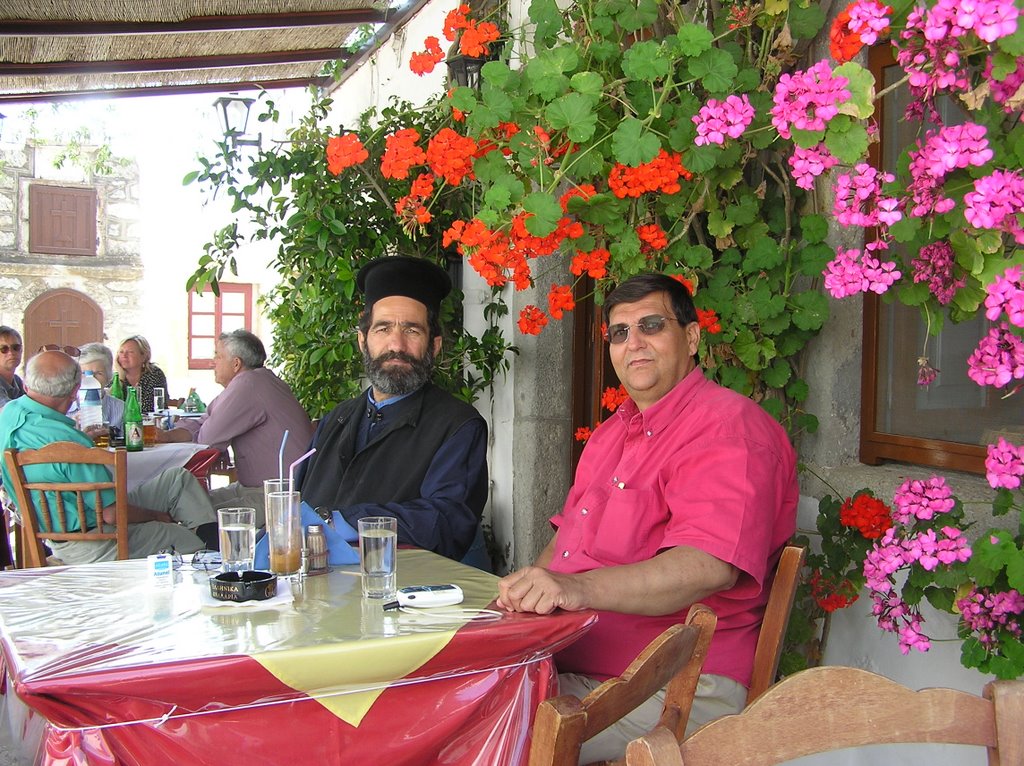
....barely! I've been busier than ever these last few months. I have about a half dozen ideas to blog about, but I have just not had time--that whole job, family and responsibilities thing. But I do hope to post something soon. I am leaving for a "long explore" on 3 June, so it will have to be before then! In the meantime, this is a picture of some Greek friends we made on Patmos--one of my favorite pictures.
Friday, May 05, 2006
A Little Foolishness

I have recently enjoyed re-reading from one of my favorite theologians and perhaps the greatest American writer of the 20th Century: Flannery O’Connor. To the uninitiated, her tales could be dismissed as Southern gothic grotesqueries. But as someone who has always lived in the small-town South, I find her characterizations are never far off mark. On innumerable occasions, my wife and I have found ourselves sitting around the kitchen table, discussing some situation or another, and remarking that it is something straight out of Flannery O’Connor. Her stories are all about the persistent intrusion of grace and redemption into our world, though never in ways that the protagonists would ever imagine.
I have particularly enjoyed reading her 1954 story, “The Displaced Person.” Often called “D.P.s” for short, the term refers to post-WWII European refugees. The story particular resonates in light of the current hubbub over immigration in this country. Mrs. McIntyre is a strong-willed, self sufficient Georgia farm woman. The Shortleys are the white couple who (mis)manage her operation. Several black farm workers live on the place, as well. Their world is turned upside-down when Father Flynn, an aged Irish-Catholic priest, arranges to place a refugee Polish family on the farm. These hard-working “D.P.s” soon engender jealousy and hostility from the insular farm community—exposing the racism, xenophobia, prejudice, selfishness and just plain small-mindedness of their hosts. The story ends tragically, but through suffering O’Connor forces her characters to face their own “displacedness” and to recognize, however reluctantly, the workings of God in their life. One of the clear messages of the story is that we are all “displaced persons.” None of us are in our true country.
I find two of O’Connor’s symbols of especial interest: a peacock and the priest. I believe that the peacock represents the persistent (and unwanted) presence of the Divine on the farm. In fact, the peacock is something of a rebuke to many of the characters, “his attention fixed on something no one else could see.” All try to ignore it, save the priest. Father Flynn was "glowing with pleasure" when he viewed the sublime beauty of the bird—“a vision for them all.” When the peacock spread his feathers, “the priest stood transfixed, his jaw slack,” exclaiming “Christ will come like that!” and later, “the Transfiguration!”
Of course, Mrs. Shortley will have none of that. The story actually begins with “the peacock was following Mrs. Shortley up the road…” Later, with its tail spread before her “she might have been looking at a map of the universe but she didn’t notice it any more than she did the spots of sky that cracked the dull green of the tree.” To Father Flynn’s admiration, Mrs. Shortley responded that it was “nothing but a peachicken.” Mrs. McIntyre was no better, dismissing the glorious bird as just “another mouth to feed.” She admitted that she kept it only out of superstitious fear, but “when the peachicken dies, there won’t be any replacements.”
Father Flynn represents—on an obvious level--the Church, or at least her testimony in the world, the Gospel. The Southern ladies are equally dismissive of this Church and all his talk about Christ. “Mrs. McIntyre’s face assumed a set puritanical expression and she reddened. Christ in the conversation embarrassed her the way sex had her mother.” She rebuked the priest and explained to him that she didn’t find herself “responsible for all the extra people in the world.” As he would talk to her about the doctrines of the church, she would wonder “where she had ever seen such an idiotic old man.” Yet, in the end, alone and paralyzed, only Father Flynn came to visit, talking to her about the “doctrines of the Church.”
Mrs. Shortley had even less use for the priest and “his visits irked her more and more.” She called him foolish—“He don’t look smart…kind of foolish.” She told her husband, Chancey, of the priest and the Poles, that “these people did not have an advanced religion. There was no telling what they believed since none of the foolishness had been reformed out of it.” Declaring that the priest was planning to “plant the Whore of Babylon in the midst of the righteous,” the undeceived Mrs. Shortley observed that “they’re full of crooked ways. They never have advanced or reformed. They got the same religion as a thousand years ago. It could only be the devil responsible for that.” Yet “she had never given much thought to the devil for she felt that religion was essentially for those people who didn’t have the brains to avoid evil without it. For people like herself, for people of gumption, it was a social occasion providing the opportunity to sing; but if she had ever given it much thought, she would have considered the devil the head of it and God the hanger-on.” Mrs. Shortley compared the priest and the Poles unfavorably to her son, H. C., who “was going to Bible school now and when he finished he was going to start him a church. He had a strong sweet voice for hymns and could sell anything.” She knew “that the Lord God Almighty had created the strong people to do what had to be done and she felt that she would be ready when she was called.”
Foolishness. I understand the mind of Mrs. Shortley--the self-sufficient, self-satisfied myth of “strong people,” secure in their own country. This characterizes much of my own upbringing. The priest and all he represents would have been to me and mine, foolishness. Like Mrs. Shortley noted, our religion had had all the foolishness “reformed out of it.” And the beauty. And the mystery. And the glory. And the humility. To the extent that I have had any spiritual growth at all, it is has been away from my own knowledge, my own logic, my own rationality, my own opinion, and towards foolishness. Thank God for foolishness. Even Mrs. Shortley at the last "seemed to contemplate for the first time the tremendous frontiers of her true country." We all do eventually, one way or another.
Friday, April 21, 2006
More from St. Ephraim the Syrian

Last month, I commented on my discovery of A Spiritual Psalter by St. Ephraim the Syrian. This book continues to be a blessing to me, and has really helped me through the Lenten season. The psalter contains 150 prayers and hymns. I started off bookmarking those that were especially meaningful to me, but I was soon bookmarking just about every other page.
Outside of Orthodoxy, I suspect St. Ephraim is a fairly unknown figure, and this is certainly the case within Protestant circles. Without criticizing the Prots (for I was one most of my life), it seemed we often acted as though church history began with the Reformation. My particular religious heritage did make a lot of noise about the "first century church," but there was no place in it for the writings of the 2nd, 3rd, 4th and 5th century saints and martyrs. St. Ephraim, and others such as St. Cyril, St. Athanasius, St. Gregory, St. Basil, St. John of Damascus were unknown to us (and if known, we would have never put the "St." in front of their names). Also, evangelicals have sometimes acted as if they "discovered" the concept of grace. St. Ephraim knew a thing or two about it in the 4th century, it seems.
Having thus exposed the wiles of the enemy, tell him with conviction: I have had enough of you, O devil. And leave the evil one and join yourself to the man-befriending God. Are you wounded? Despair not. Have you fallen? Get up and say bravely: now I have begun. Fall down before your merciful Master and confess your sins.
But before you say anything He will already know what you intend to say. Before you open your lips, He will see what is in your heart. You will not be able to say, "I have sinned," before you see Him stretch forth His hands to receive and embrace you.
Approach with faith and He will cleanse you straightway as He cleansed the leper, lift you from your bed as He lifted the paralytic, and raise your from the dead as He raised Lazarus.
One of my favorite old-time gospel hymns was "Marching to Zion." It still resonates with me and I love the mental picture it conveys. What I now realize is how impoverished that march is without being accompanied by, and encouraged by the likes of St. Ephraim and all the others.
Monday, April 17, 2006
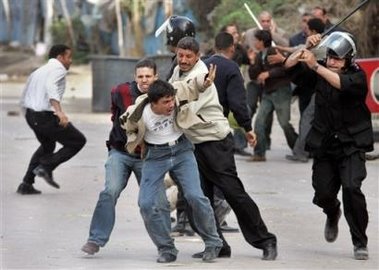
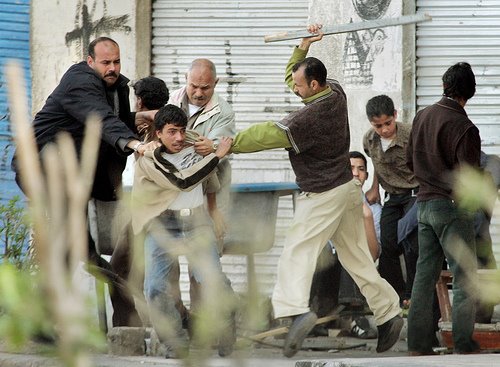
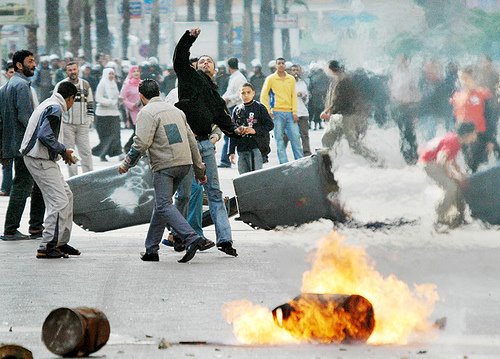
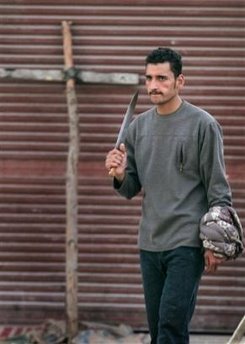
More Bad News

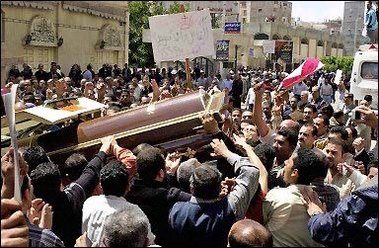
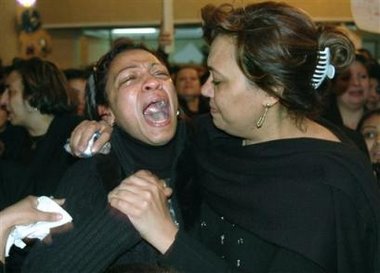
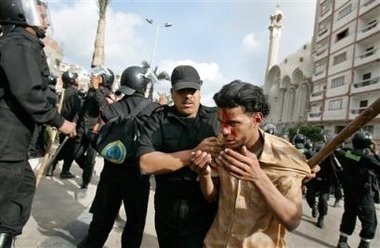
The violence in Egypt seems to be escalating. Typically, it is receiving little press over here. A short AP story did note, however that "this attack was the first in recent memory in which Muslims attacked Christians inside the churches while they were praying" and they quoted from an official in the Orthodox Church in Alexandria, who said "these tensions are the harvest of 30 years of Muslim fundamentalists spreading hate speech from the mosques.” Go to Sand Monkey's blog here for the full story, as usual.
These pictures tell the story.


Friday, April 14, 2006
A Bad Friday in Egypt

It seems that Muslim extremists have attacked Coptic churches in Egypt (again), resulting in 1 death and at least 12 injuries. See story here. Middle East news agencies typically discount the attacks as aberrant behavior, with the attackers characterized as mentally unstable (see here). Yeah, right. For the real story and voices of sanity from Muslim Egypt, check out Big Pharoah here and Sandmonkey here. The comments to Sandmonkey's post are particularly good. Just food for thought as Americans--Catholic and Protestant this Sunday, and we Orthodox next Sunday--toddle off to Easter services at our safe and comfortable churches.
Monday, April 03, 2006

Sunday, April 02, 2006
A Real "War on Christians"

Yesterday, I went on at some length about Tom Delay and his appearance at the "War on Christians" conference in Washington. I noted that what the conferees considered "war"--Hollywood, liberal media, political activism, etc.--was weak tea indeed when compared to the real life war on Christians in many parts of the world. An excerpt from Lawrence F. Kaplan's excellent article carried in today's Dallas Morning News is exactly what I'm talking about.
There are about 800,000 believers remaining in Iraq's ancient Christian community, mainly Chaldean Catholics and Syrian Orthodox. There used to be more; many more. It seems that these Christians are "today's victims of choice." In fact, it is the one thing that the Sunnis, Shiites and Kurds can all agree on--the brutalization of their Christian neighbors. Even though Christians predated Moslems by over 500 years in Iraq, they are nevertheless seen as emissaries of the West. Because of this, they are especially targetted for kidnappings, executions and beheadings. Many of the churches have been bombed, and more and more Christians are worshipping at home, or even in the crypts (how is that for some 1st Century authenticity!) Anyone that can get out is doing so. Most can't. What is the US government doing? Nothing. What are American evangelicals doing? With typical perceptiveness, they are oblivious to the Iraqi's plight and are actually making the situation much worse.
For the entire article, go here. But at least read the following excerpt:
To the lengthy indictment of Christians, their persecutors have also added the charge of proselytizing. Unlike American soldiers, who mean to save Iraqi lives, the American evangelicals who followed on their heels mean to save Iraqi souls. The infusion of pamphlets and missionaries from organizations like the International Mission Board of the Southern Baptist Convention enrages Iraqi Muslims, who, Iraqi Christian leaders claim, increasingly conflate their congregants with "the crusaders" – and, too often, treat them as such.
"The evangelicals have caused such problems for us," says Mr. Kanna. "They make the Sunni and Shia furious."
Even though Iraq's Christians suffer in the name of their American co-religionists, their fate seems not to have made the slightest impression on much of the evangelical establishment. Their Web sites and promotional literature advertise the importance of creating new Christian communities in Iraq while mostly ignoring the obligation to save ancient ones. Nor, with a few exceptions, have mainstream church leaders in the United States broached the subject, either. Dr. Carl Moeller, the president of Open Doors USA, an organization that supports persecuted Christians abroad, pins the blame on Christianity's own sectarian rifts. "The denominations in Iraq aren't recognized by Americans," he explains. "The underlying attitude is, 'They're not us.' "
What have we done?
Saturday, April 01, 2006
The Almost Formerly Important
"When the powers that be are done with you, we mainline liberals will have a rocking chair for you at the retirement home of the formerly religiously important."
Jason Byassee, addressing evangelicals in the March issue of Christianity Today. For more, go here.
Jason Byassee, addressing evangelicals in the March issue of Christianity Today. For more, go here.
An Odor of Mendacity
I have been out of town for the better part of a week, and removed from my usual sources of information (not a bad thing, actually). In getting caught up on the news, I find that our old buddy Rep. Tom Delay is still in the headlines, this time from a speech given at a “War on Christians” conference in Washington. From someone who is still "working out my own salvation," I'm not about to pass judgment on someone else's faith. Yet public piety and cheap religiousity is always suspect, particularly from someone who, in his Texas Legislature days was nicknamed “Hot Tub Tom” by his colleagues (this, in fact, from a colleague).
In reading about the conference, I remembered just who Delay reminded me of. In the 1958 movie adaptation of the Southern gothic stage classic, Cat on a Hot Tin Roof, the actor Jack Carson portrayed Big Daddy Pollitt’s oily, fast-talking and conniving older son, Gooper. Yep, Gooper. Tom Delay is simply Gooper Pollitt writ large on the national scene.
The theme of the Washington conference leaves me uneasy. Delay told the adoring crowd that “the enemies of virtue may be on the march, but they have not won.” Now, there is nothing inherently wrong with that statement—it is indeed, the Christian hope, for in the end, the Enemy will NOT win. But, you know this is not what "Team Delay, with its paladins of public piety" had in mind. In their war, the battle is waged with conservative political activism, PACs, Capitalism as gospel, while railing against Hollywood, the gay-rights crowd, and of course the liberal media and so on. There is, of course, a battle going on, but its true nature is more accurately described in Ephesians 6:12. The conference organizer likened Delay’s deepening ethical and legal problems to Christ’s Passion, concluding that “God always does his best work after a crucifixion.” I kid you not, he actually said that. You can’t make up crap like this.
But I guess the real thing that bothers me is that it cheapens and takes away from the very real, “war on Christians.” We caught a glimpse of that last week in the trial of the Abdul Rahman. The entire Soviet era was very much a “war on Christians” as perhaps millions of Russian martyrs attest. Ever so often, churches (and Christians) are bombed in Pakistan. Christians are arrested in Iran. Just a few years back, the Indonesians were butchering the Catholic East Timorese. The Sudanese government—before their current butchery in Darfur—were killing Christians in the south of that country. My church has a large contingent of Orthodox Christian refugees from Eritrea. The Egyptian Copts are routinely persecuted. The diminishing Arab Christians in the Middle East, after 1400 years of dhimmitude, are now caught in the squeeze between the Muslim and the Jews, as well as suffering the backlash from Western policies in the region. Now these are real, actual “wars on Christians.” But I doubt that this is what Delay was thinking about. Perhaps he should.
This brings me back to Cat on a Hot Tin Roof. My favorite lines include:
BRICK: Have you ever heard the word “mendacity”?
BIG DADDY: Sure. Mendacity is one of them five dollar words that cheap politicians throw back and forth at each other.
BRICK: You know what it means?
BIG DADDY: Don’t it mean lying and liars?
BRICK: Yes, sir, lying and liars.
And then this from the movie:
What's that smell in this room? Didn't you notice it, Brick? Didn't you notice the powerful and obnoxious odor of mendacity in this room?
A powerful and obnoxious odor of mendacity, indeed.
In reading about the conference, I remembered just who Delay reminded me of. In the 1958 movie adaptation of the Southern gothic stage classic, Cat on a Hot Tin Roof, the actor Jack Carson portrayed Big Daddy Pollitt’s oily, fast-talking and conniving older son, Gooper. Yep, Gooper. Tom Delay is simply Gooper Pollitt writ large on the national scene.
The theme of the Washington conference leaves me uneasy. Delay told the adoring crowd that “the enemies of virtue may be on the march, but they have not won.” Now, there is nothing inherently wrong with that statement—it is indeed, the Christian hope, for in the end, the Enemy will NOT win. But, you know this is not what "Team Delay, with its paladins of public piety" had in mind. In their war, the battle is waged with conservative political activism, PACs, Capitalism as gospel, while railing against Hollywood, the gay-rights crowd, and of course the liberal media and so on. There is, of course, a battle going on, but its true nature is more accurately described in Ephesians 6:12. The conference organizer likened Delay’s deepening ethical and legal problems to Christ’s Passion, concluding that “God always does his best work after a crucifixion.” I kid you not, he actually said that. You can’t make up crap like this.
But I guess the real thing that bothers me is that it cheapens and takes away from the very real, “war on Christians.” We caught a glimpse of that last week in the trial of the Abdul Rahman. The entire Soviet era was very much a “war on Christians” as perhaps millions of Russian martyrs attest. Ever so often, churches (and Christians) are bombed in Pakistan. Christians are arrested in Iran. Just a few years back, the Indonesians were butchering the Catholic East Timorese. The Sudanese government—before their current butchery in Darfur—were killing Christians in the south of that country. My church has a large contingent of Orthodox Christian refugees from Eritrea. The Egyptian Copts are routinely persecuted. The diminishing Arab Christians in the Middle East, after 1400 years of dhimmitude, are now caught in the squeeze between the Muslim and the Jews, as well as suffering the backlash from Western policies in the region. Now these are real, actual “wars on Christians.” But I doubt that this is what Delay was thinking about. Perhaps he should.
This brings me back to Cat on a Hot Tin Roof. My favorite lines include:
BRICK: Have you ever heard the word “mendacity”?
BIG DADDY: Sure. Mendacity is one of them five dollar words that cheap politicians throw back and forth at each other.
BRICK: You know what it means?
BIG DADDY: Don’t it mean lying and liars?
BRICK: Yes, sir, lying and liars.
And then this from the movie:
What's that smell in this room? Didn't you notice it, Brick? Didn't you notice the powerful and obnoxious odor of mendacity in this room?
A powerful and obnoxious odor of mendacity, indeed.
Friday, March 24, 2006
The Spiritual Psalter
St. Ephraim the Syrian is a favorite of mine among the Church Fathers. His writings continue to affect me in wonderful ways. I recently purchased a small book entitled A Spiritual Psalter, or Reflections on God, excerpted by Bishop Theophan the Recluse from the works of our Holy Father Ephraim the Syrian. I highly recommend it. I don't know how readily available the book is, but I do know you can purchase it from the St. Isaac the Syrian Skete here. I have copied a couple of examples from the book, below:
#41
Woe is me, to what judgement will I be subject, and of what disgrace am I worthy! My inner self is not like my outward appearance: I talk about how to fee oneself from the passions, but day and night I myself think about disgraceful passions. I conduct discussions about purity, but myself, I indulge in indecent behavior.
Alas! What trials await me? the truth is that I bear the image of righteousness, but lack its capacity. What face shall I who am guilty of such indecency wear when I approach the Lord God Who knows the secrets of my heart? When I stand in prayer, I am afraid gha fire will descend from heaven and burn me up, as it happened in the desert that there came out a fire from the lord that consumed the men who offered strange incense.
What can I expect, I who am weighted down with sucha heavy burden of sins? My heart is consumed with fire, my mind is clouded, righteous thougths have failed in me: like a dog do I ever return to my own vomit.
I have no boldness before Him Who will try my heart and inner workings. I have no clean thoughts, no tears while praying. Although I sigh and fall prostrate on my shame-filled face and beat my chest--this is a dwelling place of passions, a sweatshop of evil thoughts.
Thou knowest, O Lord, my passions hidden in darkness; the sores of my soul are known to Thee. Heal me, O Lord, and I will be healed. If Thou wilt not build the hourse of my soul, I labor in vain trying to build it myself.
It is true that sometimes I prepare myself to do battle with the passions when htey war against me; but the evil wiles of the serpent paralyze the efforts of my sould with sensuality and yield to them. Though no one visibly ties my hands, the invisible passions drag me away like a captive.
O Lord, enlighten the eyes of my heart, that I might rightly recognize the deceit and the malice of the passions. May Thy grace shield me, that I might be able to stand firm and resist, having girded my loins with courage.
Once Thou, O Lord, didst provide safe passage through the impassable sea for Thy people. Thou gavest Thy people who thirsted water out of a hard rock. Thou alone, according to Thy grace, didst save the one who fell in with theives. Have mercy upon me as well, for I have also fallen into the hands of thieves and, like a captive, I am bound by wicked thoughts.
No one is trong enough to heal the passionate temperament of my soul except Thou, O Lord, Who knowest the depths of my soul. Condescend and save me by Thy kindness!
and
#50
Have mercy on me, O God, according to Thy great mercy, and according to the multitude of Thy compassions, blot out my trangression. For if Thou wilt have mercy on me and free me from the pitiful affliction of the passions--if only Thou wilt have mercy on me, then will I willingly obey Thy grace.
If Thou wilt do this according to the greatness of Thy goodness, then wilt Thou deliver me. If Thou wilt pour out upon me Thy goodness, I will be saved.
I am certain that this is possible for Thee. I know that Thou hast forgiver and dost forgive all who turn to Thee with all their strength.
I confess that I have enjoyed the benefits of Thy grace many times already; but each time I have rejected Thy grace and sinned as no other has sinned.
But Thou, Who has resurrected the dead, raise also me who am deadened by sin. Thou Who hast healed the blind, enlighten the clouded eyes of my heart. Thou Who hast delivered Adam from the mouth of the serpent, pull me out of the mire of mine iniquities; for I too belong among Thy sheep, though I have by my own free choice become food for lions.
Sins have made of me a god; but, healed by Thy grace, I will become Thy son. I was thrown out like a corpse, but if Thou so desirest I will be brought to life.
I know that I have sinned consciously, but I have Thy saints to pray for me. I know that I exceed every measure with my sins, but Thy goodness is unsurpassable.
Thou Who hast preferred the publican, prefer also me, who recognize that I have done many more vile deeds than he. Thou, O Lord, hadst mercy on Zacchaeus who was unworthy. Likewise have mercy on me who am also unworthy.
Paul was once a wolf, and chased the sheep of Thy flock; but according to Thy grace he became a pastor who diligently cared for the sheep.
I know that he sinnes in ognorance, and that he was vouchsafed forgiveness of his sins and much grace because of his ignorance. But Thou, O Lord, condemn my sin committed in knowledge, and have mercy on me according to Thine exceedingly abundant grace.
#41
Woe is me, to what judgement will I be subject, and of what disgrace am I worthy! My inner self is not like my outward appearance: I talk about how to fee oneself from the passions, but day and night I myself think about disgraceful passions. I conduct discussions about purity, but myself, I indulge in indecent behavior.
Alas! What trials await me? the truth is that I bear the image of righteousness, but lack its capacity. What face shall I who am guilty of such indecency wear when I approach the Lord God Who knows the secrets of my heart? When I stand in prayer, I am afraid gha fire will descend from heaven and burn me up, as it happened in the desert that there came out a fire from the lord that consumed the men who offered strange incense.
What can I expect, I who am weighted down with sucha heavy burden of sins? My heart is consumed with fire, my mind is clouded, righteous thougths have failed in me: like a dog do I ever return to my own vomit.
I have no boldness before Him Who will try my heart and inner workings. I have no clean thoughts, no tears while praying. Although I sigh and fall prostrate on my shame-filled face and beat my chest--this is a dwelling place of passions, a sweatshop of evil thoughts.
Thou knowest, O Lord, my passions hidden in darkness; the sores of my soul are known to Thee. Heal me, O Lord, and I will be healed. If Thou wilt not build the hourse of my soul, I labor in vain trying to build it myself.
It is true that sometimes I prepare myself to do battle with the passions when htey war against me; but the evil wiles of the serpent paralyze the efforts of my sould with sensuality and yield to them. Though no one visibly ties my hands, the invisible passions drag me away like a captive.
O Lord, enlighten the eyes of my heart, that I might rightly recognize the deceit and the malice of the passions. May Thy grace shield me, that I might be able to stand firm and resist, having girded my loins with courage.
Once Thou, O Lord, didst provide safe passage through the impassable sea for Thy people. Thou gavest Thy people who thirsted water out of a hard rock. Thou alone, according to Thy grace, didst save the one who fell in with theives. Have mercy upon me as well, for I have also fallen into the hands of thieves and, like a captive, I am bound by wicked thoughts.
No one is trong enough to heal the passionate temperament of my soul except Thou, O Lord, Who knowest the depths of my soul. Condescend and save me by Thy kindness!
and
#50
Have mercy on me, O God, according to Thy great mercy, and according to the multitude of Thy compassions, blot out my trangression. For if Thou wilt have mercy on me and free me from the pitiful affliction of the passions--if only Thou wilt have mercy on me, then will I willingly obey Thy grace.
If Thou wilt do this according to the greatness of Thy goodness, then wilt Thou deliver me. If Thou wilt pour out upon me Thy goodness, I will be saved.
I am certain that this is possible for Thee. I know that Thou hast forgiver and dost forgive all who turn to Thee with all their strength.
I confess that I have enjoyed the benefits of Thy grace many times already; but each time I have rejected Thy grace and sinned as no other has sinned.
But Thou, Who has resurrected the dead, raise also me who am deadened by sin. Thou Who hast healed the blind, enlighten the clouded eyes of my heart. Thou Who hast delivered Adam from the mouth of the serpent, pull me out of the mire of mine iniquities; for I too belong among Thy sheep, though I have by my own free choice become food for lions.
Sins have made of me a god; but, healed by Thy grace, I will become Thy son. I was thrown out like a corpse, but if Thou so desirest I will be brought to life.
I know that I have sinned consciously, but I have Thy saints to pray for me. I know that I exceed every measure with my sins, but Thy goodness is unsurpassable.
Thou Who hast preferred the publican, prefer also me, who recognize that I have done many more vile deeds than he. Thou, O Lord, hadst mercy on Zacchaeus who was unworthy. Likewise have mercy on me who am also unworthy.
Paul was once a wolf, and chased the sheep of Thy flock; but according to Thy grace he became a pastor who diligently cared for the sheep.
I know that he sinnes in ognorance, and that he was vouchsafed forgiveness of his sins and much grace because of his ignorance. But Thou, O Lord, condemn my sin committed in knowledge, and have mercy on me according to Thine exceedingly abundant grace.
Thursday, March 23, 2006
A Fool for Christ (continued)
I try to read the New York Times whenever I can. I often differ with their positions, but for better or for worse, they still frame the debate in this country. I can support wholeheartedly, however, their stance in today's editorial about the Afghani on trial for Christianity (see previous post). You'll find no mealy-mouth platitudes, here.
Wednesday, March 22, 2006
A Fool for Christ

Before you get too comfortable with the status of the new Afghani democracy, you might want to read this. It seems Abdul Rahman is on trial, facing a death sentence for the greatest crime one can commit in Afghanistan. That's right, Abdul Rahman is a Christian. He even confessed to his crime: "They want to sentence me to death and I accept it, but I am not a deserter and not an infidel. I am a Christian, which means I believe in the Trinity."
The Afghani government--desperately seeking a way out of this public relations nightmare--has hit upon a solution: declare Rahman insane, as no Muslim in their right mind would convert to Christianity. "We think he could be mad. He is not a normal person. He doesn't talk like a normal person," prosecutor Sarinwal Zamari told The Associated Press. But this isn't anything new--as St. Paul noted, "we are fools for Christ" (1 Cor. 4:10).
The charges would be dropped if only Abdul would renounce Christ. The prosecutor, Abdul Wasi, said he had offered to drop the charges if Mr Rahman converted back to Islam, but he refused. "He would have been forgiven if he changed back. But he said he was a Christian and would always remain one," Mr Wasi said. "We are Muslims and becoming a Christian is against our laws. He must get the death penalty." At least give the prosecutor credit for being honest. There is no way Western apologists can put a smiley face on that kind of statement. Of course, this reminds me of the innumerable accounts of the early martyrs. All they had to do was deny Christ before their Roman accusers and their lives would be spared. Invariably, they refused to do so.
For an always colorful discussion of this and other Middle Eastern outrages and absurdities--but from an Egyptian perspective--check out Sand Monkey here.
For a courageous commentary on this issue, and the plight of Christians in the Middle East in general, from a Jordanian Christian read here.
And say a prayer for Abdul Rahman.
Friday, March 17, 2006
Open at Both Ends

Flannery O'Connor, who always had a way of getting to the heart of things, once observed that "one of the good things about Protestantism is that it always contains the seeds of its own reversal. It is open at both ends--at one end to Catholicism, at the other to unbelief." I have come to agree with O'Connor--that Protestantism is inherently self-destructive. This may seem a strange notion, living as we do in the Land of the Megachurch. But historians, I suppose, take a little longer view of things. Anyway, for a good read on what is going on in Evangelicalism today--and a fine example of the last part of O'Connor's statement--read the review of George Barna's Revolution in Christianity Today here.
I am particularly struck by this disturbing paragraph from the article:
Churching Alone
Still, Revolution's emphasis on personal choice would make a marketer rejoice and an apostle weep. Barna expects to see believers "choosing from a proliferation of options, weaving together a set of favored alternatives into a unique tapestry that constitutes the personal 'church' of the individual." The phrase "personal 'church' of the individual" must be the most mind-spinning phrase ever written about the church of Jesus Christ. Could it be that we evangelical Protestants, who have done more to fragment Christendom than any other group, are now taking that to the logical extreme: a church at the individual level, each person creating a personal "church" experience? At any other point in church history, "personal church" would be nonsensical. In today's America, it's the Next Big Thing.
On the Road—Part 4

Occasional thoughts on my spiritual journey
In my previous installment on this topic, I related my first exposure to the Orthodox faith during a 2003 trip to Bulgaria. Upon return to the US, my life quickly resumed its familiar pattern of work, home, and church. Things rocked along much as they had before--that is, until my encounter with the Church Fathers.
Above all else, you could characterize me, my wife and my son as readers. One cannot sit or lie down anywhere in our home without being within arms reach of a book, magazine or newspaper. Our bedrooms are no different, with books stacked on the floor and nightstands. And that’s the way we like it. About two months after my return, I was sleeping in our son’s bed, as we had overnight company who were using our bedroom. I reached underneath the bed to extract a book to read before going to sleep. What I pulled out was a small volume entitled Early Christian Writings: The Apostolic Fathers. I remember buying the book at a used book store about 15 years earlier, but had never gotten around to reading it. I suppose I was ready for it now.
I chose the section on Ignatius, probably because it consisted of only 7 short letters. As a history major, it is somewhat embarrassing to admit now that I really knew nothing of the man. In the short introduction to the letters, I learned that he was the third bishop of Antioch; had been so from about 69 AD; and penned these letters on his way to martyrdom in Rome in 107 AD.
Yet even this biographical information was challenging to my own particular religious presuppositions--for I was a Protestant of the Restorationist persuasion. Briefly put, we subscribed to the “great apostasy” view of church history. Adherents believe that the church went into a steep doctrinal tailspin soon after the death of the last apostle, John. Although pockets of “New Testament Christians" were supposedly in evidence throughout the ages, things basically continued to deteriorate until the Reformation, which saw a partial recovery.
But while we saw the Reformation as corrective, we viewed it as incomplete, a half-measure, as it sought only to reform, rather than restore the church to its New Testament purity. This view remains distinctly ahistorical, seeing the church as being above history and not being subject to historical forces; that it could be “restored” at any time using the “blueprint” of the New Testament. This restoration had to wait until the early years of the 19th century, however, when American frontier revivalists initiated what we referred to as “the Restoration Movement.” So, after 1700 years or so, it would seem that someone had finally figured out how to interpret the Bible correctly. Now, I say that a little facetiously and I realize that I am painting with a very broad brush here. Many sincere, faithful Christians in Restorationist churches today would scoff at this simplistic view. Indeed, perhaps sensing the inherent fallacies in the argument, most of the churches are downright sheepish about using this terminology anymore. And yet, this view accurately describes how Restorationists see themselves in history and remains the foundational understanding which under girds all these churches and sets the parameters for the way they continue to “do church.”
The Restoration Movement was very much a product of the American frontier, drinking deeply from prevailing concepts of liberty and individualism and being nourished on the tenets of the 18th century Scottish Enlightenment. They were confident that the intelligent, sincere inquirer could open his Bible, and with logic and rationality, deduce what God wanted him to do. They could avoid all the fractious, bickering denominations and become simply “New Testament Christians." From this vantage point, the early leaders gleaned from scripture that the "first century church" was autonomous in its governance, with each local congregation being led by elders, and being served by deacons, with emphasis on the priesthood of all believers. They perceived no organizational structure beyond the local congregation. The historical development of a hierarchy culminating in the papacy (and they had no concept of developments in the East as being anything separate and apart from Catholicism), was nothing more than the fulfillment of the prophetic warnings of Paul. This was our basic view of church history and when we read the pages of the New Testament, this is the church we saw.
This brings me back to Ignatius and his letters. For the church he quite plainly described was not this church. As Paul, the scales literally fell from my eyes. While I often have trouble remembering names, I am pretty good with chronology. The fact that Ignatius wrote these letters in 107 AD is not in dispute. This means, that to a large degree, his life overlapped the ministry of the Apostles. So, even though the date is 107 AD, this is clearly “first century” stuff. Ignatius’ church was one of bishops and clergy and deacons and laity. The unity of the church was his greatest concern as he approached his martyrdom. He admonished the churches at Ephesus, Magnesia, Trallia, Rome, Philadelphia and Smyrna to be united in Christ; to be submissive and obey their bishops, indeed to “be as submissive to the bishop and to one another as Jesus Christ was to His Father, and as the Apostles were to Christ and the Father; so that there may be complete unity, in the flesh as well as in the spirit.” He spoke freely and with warm, collegial affection for the bishops in these other cities.
Now the Restorationist would have a ready answer for this. They would say that this development was indeed the apostasy that Paul had warned about—the whole “wolves in sheep’s clothing” thing; an apostasy from “simple New Testament Christianity" into a hierarchical power structure. But this response is woefully inadequate. For the general view is that this digression evolved slowly over time. Ignatius was a contemporary of the Apostles. The fact that he served as the third bishop of Antioch from 69 AD to 107 AD places him squarely in the Apostolic age. So, the system of bishops, clergy and deacons were solidly in place by the end of the Apostolic era, rather than a digression that occurred after the Apostles. And if this system was heretical, as Restorationists maintained, then where was the outcry? Where were the voices of opposition? There were none. In fact, the “first century church" understood itself the way Ignatius described it. To be sure, there were schismatics, but they were, as Ignatius related, those who “denied that the Eucharist is the self-same body of our Saviour Jesus Christ.”
The bottom line is this: the church of Ignatius’ day--who studied at the feet of the very Apostles of Christ, who were part of the very same culture, who spoke the same language, who lived out their lives in that particular part of the world, who faced martyrdom for their faith-—understood scripture and Apostolic teaching one way. The church of the American frontier—separated by 1700 years and thousands of miles, a product of the western European Protestant Reformation, endued with the tenets of the Scottish Enlightenment and American pioneer individualism, reading English bibles translated from Latin bibles translated from the original Greek—understood scripture another way. Which had more credibility? Put in this light, the answer seems obvious. And yet I often heard it remarked in bible studies that we were much better off than the “First Century Christians," since we had “the word,” meaning of course, scripture and they didn't (Imagine that, having only the Apostles and their teaching!) That statement always bothered me, but only in time did I come to realize the misguided arrogance, and ignorance, behind it.
Frankly, the issue of church governance and authority was not “the” issue with me. But this raised a question in my mind that refused to go away. If we were so decidedly wrong about this, if our reading of scripture here was so fractured by the prism of our Protestant presuppositions, then what else did we have wrong? The question became for me, what do I do with this new insight?
Subscribe to:
Posts (Atom)